Report Shows that Anti-Bullying Programs Actually Cause Bullying

October 10, 2013

make

It’s so easy to read a report that claims that anti-bullying programs actually increases incidents of bullying and throw your hands up in despair. But the truth is, that it isn’t the principle of teaching such skills to our students that is the problem it is the strength of the material and how its core messages are backed up within the school culture.

A major issue for school anti-bullying programs are that they are conducted in the classroom. The classroom in many cases has a stigma and therefore it is hard to find a program that doesn’t feel like more schoolwork. Additionally, many such programs feel preachy, saccharine and completely out of touch with the lives and interests of the student population. Lastly, teaching students to value and respect others is extremely difficult to pull off in an environment where many students feel undervalued and disrespected. How do you get students to respect others when they have trouble respecting themselves?

In other words, it is the range of programs that is to blame, not the principle of teaching children how to treat each other. That’s why I was fortunate in 2011 to discover what I believe to be the most refreshing, innovative and groundbreaking addition to what has become a tired and listless genre. A series of anti-bullying films entitled How to UnMake a Bully is, from my experience, able to speak to school aged children in a way nothing I have come accross ever has. Amongst other important life skills, it focuses on strategies for supporting victims of bullying, helping bullies change, empowering bystanders, reacting to low and high grade bullying scenarios, creating a schoolyard united stance on bullying, respecting others and ones self and adapting to change. My love for these movies and the way in which my students have responded to them have made a world of difference to my students’ lives and actions. So much so, that their fan letters and a subsequent Skype session with the cast and crew led to their participation in one of the upcoming films in this extraordinary series.

Instead of feeling despondent about anti-bullying programs, please watch these films (which I have posted below for your convenience) with your students. It will entertain and move them, whilst also setting a framework for increased communication, awareness and overall empowerment.

Enjoy!
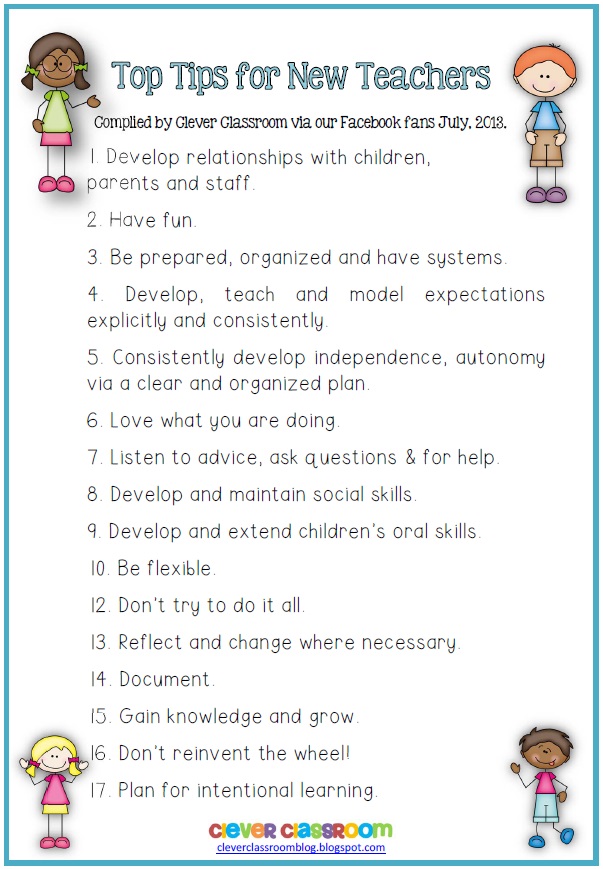
Tips For New Teachers from Experienced Teachers

October 9, 2013


Some brilliant advice courtesy of teachthought.com:


tips

Click on the link to read my post, Do experienced teachers give enough back to the profession?
Click on the link to read, ‘Teachers Trained Very Well to Teach Very Poorly

Click on the link to read my post 25 Characteristics of a Successful Teacher

Click on the link to read my post 10 Important Tips for New Teachers


If You Think Teaching is so Easy You Should Try it for Yourself

October 9, 2013


help


Yes, it’s true, the holidays are good and the hours can be flexible, but teaching is not an easy profession. I adore teaching, but even on a good day I come home absolutely exhausted. And it’s not as if my day stops when I get home. Marking, planning and reporting duties often have me working deep into the night.

The same parents that think teaching is not very hard, openly complain about how tiring their child’s birthday party was to manage. They freely talk about the noise levels, the repeated requests for them to be quiet and the tears when games are lost and feelings are hurt.

Now picture this: You are hosting a birthday party every single day for a year. Now you know what it can be like to teach a class!

I am very lucky. My natural love for teaching energises me and gives me the adrenaline I need to get through the day with my smile intact. But I have experienced enough stress and challenges in my time to completely sympathise with the overwhelming number of teachers experiencing burnout:

More than one in four new teachers are suffering from ”emotional exhaustion” and almost burnt out soon after starting their careers, according to a Monash University study.

The reasons offered include a lack of administrative support, onerous compliance measures and much tougher emotional conditions than they expected to face, particularly in economically depressed areas.

“We could go within five kilometres of this university and find classroom environments where some teachers would be experiencing forms of post-traumatic stress as a result of the sorts of things they deal with on a daily basis – where the social dimension of their work is a big, big ask,” Associate Professor Paul Richardson said. ”People would be shocked.”

He and Associate Professor Helen Watt made their findings from surveys of 612 primary and secondary teachers. They were first surveyed in 2002 as they enrolled in teacher education at universities in Victoria and NSW.

”I would never have thought 27 per cent would be on a path to burnout or worn out already,” Dr Richardson said. Dr Watt described those affected as ”a very dangerous group”.

“They report much greater negativity in their interaction with students,” she said, ”such as using sarcasm, aggression, responding negatively to mistakes. They were there [originally] for reasons such as wanting to enhance social equity, making a contribution to society, or having a personal interest in teaching and working with youth,” she said.

Yet the latest results of the FIT-Choice (Factors Influencing Teaching) project indicate low morale is all too common among this sample.

And the most positively motivated teaching students – those who initially planned to stay in teaching the longest – suffered the greatest drop in confidence and satisfaction once they started working.

In Victoria, new teachers have orientation days, mentoring arrangements and even “buddy” programs to help them feel at home in their first weeks on the job.

“But it would appear most of these measures are ad hoc,” said Andrea Gallant, a senior lecturer and education researcher at Deakin University.

Dr Gallant is tracking the attrition rate among beginning teachers – a statistic made difficult to pin down because teachers often remain registered after leaving the profession. The Education Department puts the attrition rate for teachers under 30 at 3 per cent. “We would estimate the rate of attrition to be probably 50 per cent,” Dr Gallant said. She recently completed a small case study interviewing high-performing teaching graduates who left the profession within a few years, to find out why.

“They were keen to introduce new practices, which were not always widely accepted by peers. They were supported in their first year and isolated in their second year,” Dr Gallant said. ”And often they’re given the toughest classes.”

Meredith Peace, Victorian branch president of the Australian Education Union, said schools were not given enough support to implement structured peer-to-peer programs. “Good mentoring requires time,” she said.

Click on the link to read Teachers are Extremely Vulnerable to False Accusations
Click on the link to read Top 10 Ways of Dealing with Teacher Burnout

A New Way to Get Kids to Brush Their Teeth

October 7, 2013


OK, perhaps this wont catch on:

These unique photos capture the moment a boy has his teeth picked clean by amazing underwater shrimp.

These fascinating creatures spend their lives diving inside the mouths of fish to remove the parasites that lurk there.

Russell Laman imitated the behaviour of the surrounding fish swarm to entice the cleaner shrimp into his mouth whilst snorkelling with his father Tim Laman in Bali, Indonesia.

The 13-year-old queued with the waiting fish and then opened his mouth when the shrimps came near.

The shrimp then incredibly started to clean Russell’s mouth and remove food from between the boys teeth whilst Tim took photographs.

Russell Laman, from Lexington, Massachusetts, said: ‘It felt like tiny little dentists picking away at my teeth and scuttling around my mouth, it tickled a little but not too badly.

‘I had watched fish getting cleaned at cleaning stations before and decided to try it out myself.

‘I thought it would be really cool to experience shrimp in my mouth first hand.

Russell who has been diving with his father for seven years is unfazed by the dangers of holding his mouth open underwater.

He learnt how to get the shrimp out of his mouth when he needs to breathe, by imitating the behaviour of the fish.

Russell said: ‘I observed that the shrimp are always keeping an eye on the mouth of the fish and as soon as it starts to close they shoot out.


teeth1


Click on the link to read Tips to Help Parents Control Their Kids’ TV Habits

Click on the link to read 10 Steps Parents Can Take if their Child is Being Bullied

Click on the link to read School Holidays are Very Hard for Many Parents (Video)

Click on the link to read 20 Reassuring Things Every Parent Should Hear

Click on the link to read 10 Tips for Nurturing Independence Among Children

Click on the link to read Seven Valuable Tips for Raising Your Child’s Self-Esteem

Click on the link to read Top Ten Compliments Your Children Need to Hear

The Call to Stop Kids From Reading Books they Actually Enjoy

October 7, 2013

The Hunger Games

At a time when just getting kids to read a book is the stuff of small miracles, why would anyone want to make books less accessible to children. I am sure The Hunger Games will never go down a classic of literature but I really don’t care. The objective of books is to entertain, inspire and transport its readers to distant places, cultures, traditions and experiences.  If the children of the day find that The Hunger Games achieves this goal then its up to us, the educators, to get in touch with them rather than the other way around.

I am a literature major at University. I studies every period of literature dating back from Chaucer onwards. And guess what? I find many so-called classics to be utterly tedious. My tutor was gobsmacked when I told him that I found Robinson Crusoe boring.

“How can you not like Robinson Crusoe? It is the most printed book behind the bible!”

His argument didn’t wash. I am never going to like a book just because it is deemed a classic or it has had multiple reprints.

And the same goes with Shakespeare. People are aghast when I say that Shakespeare should not be a compulsory fixture in the high school curriculum. How many people that strongly believe in studying Shakespeare in High School have a copy of one of his plays on their bedside table? How many of them are ever likely to read Macbeth or Hamlet for pleasure? When is the last time you ever had a deep urge to reread The Tempest?

We are hypocrites if we subject children to the types of books we are glad we no longer have to read ourselves. If we are ever going to get children to read we must employ the same criteria for reading as we have when we search for a book. Our students must find the subject matter topical, interesting, amusing, dramatic and most of all – ENTERTAINING:

Joanna Trollope says children should be taught literary classics in school because they spend too much time reading fantasy books, such as The Twilight Saga. 

The novelist said fantasy teen fiction, such as the hugely popular Hunger Games series, fails to give children an insight into reality or guidance in moral dilemmas. 

The Rector’s Wife author said youngsters should be encouraged to read the likes of Jane Austen, George Eliot and the Bronte sisters.

However, she admitted her 12-year-old grandson loves The Hunger Games, about a post-apocalyptic nation in which two children are selected to compete to the death in an annual televised battle.

Trollope told The Sunday Times: ‘I feel children are missing out on an enormous amount.

‘The consolation to be found in the classics is absolutely infinite and greater than fantasy novels. Fantasy doesn’t relate to the real world.’

The author, who used to be a teacher, said using popular culture can be a useful tool to lead children towards the classics.

She said she gave her class The Beatles lyrics to study in one English poetry class before giving them Robert Frost to read.

Last year, the three Hunger Games books were in the top 10 bestsellers list with more than 2.1million sold.

Click on the link to read The Classic Children’s Books they Tried to Ban

Click on the link to read How Spelling Mistakes can Turn a Compliment into Something Quite Different.

Click on the link to read Why Spelling is Important at Starbucks

Click on the link to read The Ability to Spell is a Prerequisite for Getting a Tattoo (Photos)

Click on the link to read This is What Happens When You Rely on Spell Check

Click on the link to read Hilarious Menu Items Lost in Translation

Click on the link to read The 15 Most Commonly Misspelled Words in the English Language

Click on the link to read Who Said Grammar Isn’t Important?

The Worst Thing a Teacher Can Ever Say to a Student

October 5, 2013


horns


Forget the fitness to teach evaluation and just cut to the chase. Did the teacher really tell his student the shocking comment below? If so, he must be fired immediately and have his teaching registration torn up:

High school teacher Gordon Bibby has been ordered by the B.C. Teachers Regulation Branch to undergo a fitness-to-teach evaluation after a series of bad moves, including telling one student: “Your mother lies when she tells you she loves you.”

According to the teachers regulation authority, the Merrit, B.C., teacher also made disrespectful comments about a student’s financial situation at home, and ripped up the homework of two Grade 9 students.


Click on the link to read A Teacher Who Beds their Teenage Student Should be Jailed

Click on the link to read My Teacher, the Pedophile

The Call to Have Students Rate Their Teachers is Better than it Sounds

October 4, 2013

test

Students grading their teacher on the quality of their lessons? What will they think of next? Surely that is merely asking for trouble. It puts the teacher in an impossible position where they may feel they have to pander to their students and disregard blatant misbehaviour in order to keep them on side lest they be graded poorly.

Then I actually read the article in its entirety and realised that what is being called for is actually very exciting and empowering for students. Instead of what the article first made us believe, students don’t grade the teacher on each individual lesson, but rather fill out a general questionnaire, giving them the opportunity to give the kind of feedback many feel stifled from giving:

Richard Cairns, Head Master of Brighton College is calling on the Government to make it compulsory for students to play a part in assessing the performance of teachers.

The move would help school leaders deal with under-performance in the classroom, he suggested.

In a speech to the Headmasters and Headmistresses’ Conference (HMC) annual meeting today, Mr Cairns will say that he has introduced such a system at his own school.

Pupils at Brighton College are asked to fill in an online questionnaire about each of their teachers.

The form includes 22 statements or questions such as “my teacher sets clear expectations for my studies and the quality of my work”, “my teacher caters for my learning style and my ability level” and “my teacher is passionate about his subject”.

Students are asked to give a grade for each statement or question ranging from one, which is positive, to five, which is negative. They can also add their own comments.

It is thought to be the first time that students have been asked to help appraise their teachers in this systematic way.

The findings are collected and used as part of a teacher’s appraisal, Mr Cairns says.

He will tell the conference: “It is used as the basis for discussions in appraisal meetings – either to praise good practice, or inform the setting of targets.”

Ahead of today’s meeting, Mr Cairns said: “All good heads know what the ‘word on the street’ is regarding good or bad teachers but we have no objective evidence except those that arise from lesson observations and exam results.”

Lesson observation is a “seriously flawed approach”, Mr Cairns argued, while exams results can say more about the culture of a school than how effective an individual teacher is.

Pupil appraisals are the only objective way of both praising good teachers and being able to have serious conversations with those that are not doing well, he suggested.

Mr Cairns said he is calling on the Government to make such a system compulsory in all schools “in order to help Heads deal quickly with underperforming teachers and also to provide positive, objective feedback for the best teachers which will aid retention and maintain enthusiasm”.

He added: “We have put a lot of money into school inspection and we are very concerned about standards in schools but the key consumers – the pupils – are not consulted. That strikes me as crazy.

“We’ve got to get over this issue that young people might abuse such a system.

“Every good teacher I know trusts the pupils that they teach to act responsibly.”

Mr Cairns said a similar system has been introduced at the London Academy of Excellence – a new state- funded sixth form in east London – which is co-sponsored by Brighton College.

Click on the link to read First Work Out What a Quality Teacher is, Then Evaluate

Click on the link to read 7 Tips for Building a Better School Day

Click on the link to read Tips for Catering for the Visual Learner

Click on the link to read Student Rant Goes Viral

Click on the link to read Could This be the Most Violent High School Test Question Ever?

Click on the link to read Six Valuable Steps to Making Positive Changes in Your Teaching

Who is Going to Do Something About Cyberbullying?

October 3, 2013

fb

Cyberbullying continues to grow, even considering the increased public awareness of the problem. This is simply not good enough.

For too long schools have been avoiding the issue, claiming that what is done outside of their gates is not within their domain – Wrong!

Parents have all too often decided to ignore whether or not their children are of age to use social media and whether they are using these sites responsibly – Wrong!

Bystanders, aware of Facebook hate sites have often decided to stay out of a potential conflict and have either opted to sit on their hands or worse, tacitly encourage the bullying – Wrong!

Facebook claim they are working overtime to ensure that cyberbullies are not rampant on their site – Wrong!

When are the stakeholders and custodians of this problem going to take their collective blindfolds off and start fixing this terrible form of bullying?

More than a million young people are subjected to ‘extreme cyberbullying’ every day, according to the largest ever survey into online abuse.

The report found young people are twice as likely to be bullied on Facebook than any other social network.

Experts say cyberbullying can have a ‘catastrophic’ impact on self-esteem and have called for parents and regulators to recognise the seriousness of the issue.

Liam Hackett, founder of national anti-bullying charity, Ditch The Label, which produced the report, said many people assume cyberbullying is not as hurtful as face-to-face abuse.

But he said it can be even more distressing because it is more public.

The survey of 10,000 13 to 22-year-olds found that levels of cyberbullying were much higher than previously reported.

It found that 70 per cent of youngsters had experienced cyberbullying and one in five said it had been ‘extreme’.

Of those surveyed, almost 40 per cent said they were bullied online frequently.

Mr Hackett said: ‘I think there’s a tendency for older people to think that cyberbullying is a lesser form of bullying because there is this idea you can delete a comment or you can block it and it’s gone.

‘But actually, we have seen that content becomes viral very quickly and when comments are put out on a public platform it can be more distressing for the victim because a lot of people are exposed to this content, so it’s incredibly harmful.’

Facebook, Ask.fm and Twitter were found to be the most likely sources of cyberbullying, and 54 per cent of Facebook users reported cyberbullying on the network, the survey said.

Click on the link to read Engaging in Gossiping Isn’t as Pleasurable as it Seems

Click on the link to read The Explosion of Online Bullying

Click on the link to read The Researchers into Cyberbullying Should Review Their Findings

Click on the link to read The Use of Facebook in Cyberbullying Activity

Click on the link to read A Positive Approach to Tackling Cyberbullying

Rules that Restrict the Teacher and Enslave the Student

October 1, 2013


A heartfelt and extremely well articulated rant against the current rules restricting ESL teachers in the classroom.


Click on the link to read This is What I Think of the No Hugging Rule at Schools

Click on the link to read Political Correctness at School

Click on the link to read What Are We Doing to Our Kids?

Click on the link to read Stop Banning Our Kids From Being Kids

Click on the link to read Banning Home-Made Lunches is a Dreadful Policy

Kids Asked About Social Media: Funny Clip

September 30, 2013


Am I the only one that is glad there are still children around that have no idea what Facebook is?


Click on the link to read 5 Tips to Help Your Children Use Social Networking Safely

Click on the link to read Monitoring Children’s Social Networking Activities Proving too Difficult for Parents

Click on the link to read Parents and Teachers Should Not Be Facebook Friends

Click on the link to read Introducing the App that will Give Parents Nightmares

Click on the link to read Facebook’s Ugly Little Secret

Click on the link to read Who Needs Real Friends When You Have Facebook Friends?