Posts Tagged ‘new teachers’

The Free Resource That Could Change Your Teaching Career

July 12, 2026

If you are a caring teacher who is struggling with classroom management, I want to tell you about something that is completely free and might be the most useful thing you read this year.

It is called the CALM Method guide. And I built it because I spent twenty five years in education watching good teachers leave the profession for a reason that had nothing to do with their ability or their passion.

They left because nobody gave them the right system.

What is the CALM Method guide?

It is a single, practical document that takes you from a struggling classroom to a managed one. Step by step. No jargon. No academic theory that falls apart the moment you walk through the door on Monday morning.

It is built around four strategies I developed over twenty five years of teaching and school leadership, including time as Head of High School. Four strategies designed specifically for caring, relationship-first teachers who were never given a classroom management system that worked with their personality rather than against it.

The four strategies are these.

C. Claim the Start. The first five minutes of every lesson set the emotional temperature for everything that follows. The guide shows you exactly what those five minutes should look like and why getting them right changes everything.

A. Arrive Prepared. Predictability is not the enemy of great teaching. It is the foundation of it. The guide shows you how to create a classroom environment so structured and consistent that even your most difficult students begin to feel safe enough to learn.

L. Leverage Key Relationships. Your genuine care for your students is your greatest asset. The guide shows you how to make that care work for you rather than against you, and how to use your key relationships strategically to shift the culture of your entire class.

M. Mean It Every Time. Consistency is not about being harsh. It is about being the same teacher on Monday as you are on Friday. The guide shows you exactly what that looks like in practice and why the room notices every exception.

Who is this for?

It is for the teacher who lies awake on Sunday night dreading Monday.

It is for the teacher who has been told to just be stricter and knows that is not the answer.

It is for the teacher who got into this profession because they genuinely love young people and cannot understand why that love is not translating into a classroom that works.

It is for the teacher who is thinking about quitting and has not quite made that decision yet.

If any of that sounds like you, this guide was written for you.

Why is it free?

Because I remember what it felt like to be in that classroom without the right system. And I remember what it felt like when things finally started to shift.

I do not want money to be the reason a good teacher does not get the help they need.

The guide is free. It always will be. Download it, use it, share it with every teacher you know who is struggling.

What teachers are saying

Teachers who have downloaded the guide describe it as the first classroom management resource that actually speaks to who they are rather than who they are supposed to become. Practical. Honest. Immediately usable.

Not a list of tips. A system.

Download it now

You have nothing to lose and potentially everything to gain.

The free CALM Method guide is waiting for you at the link below. Download it today and start using it tomorrow morning.

Download the free CALM Method guide here:
https://confidentteachingacademy.com

It is free. It is practical. And it might be the thing that keeps you in the profession long enough to discover the teacher you are capable of becoming.

5 Things That Are Quietly Destroying Your Classroom Management (And What To Do Instead)

July 6, 2026

If you are a caring teacher who is struggling with classroom management, I want to say something before I say anything else.

You are not failing because you do not care enough. You are almost certainly failing because nobody gave you the right system.

After twenty five years in classrooms and school leadership, I have watched the same patterns destroy good teachers over and over again. Not lazy teachers. Not indifferent teachers. Caring, committed, relationship-first teachers who got into this profession for exactly the right reasons and were let down by advice that was never designed for their personality type.

Here are the five things I see most often. And what to do about each one.

1. You are letting things go that should never go unnoticed

Every time you overlook something that should have a consequence, the room reads it as an opening. Not as kindness. Not as flexibility. As an opportunity.

There is a chance.

And once that seed is planted, every student in the room will test whether the chance is still there. Sometimes consciously. Often not. But the testing will happen.

The reason caring teachers let things go is almost always grounded in something that sounds reasonable. The parents are difficult. The student is going through something. It feels cruel to escalate. But the cruel irony is that the act of compassion in that moment, the giving of benefit of the doubt, is the exact thing that makes the room harder to manage tomorrow.

What to do instead. Identify your non-negotiables before the lesson starts. The three or four behaviours that cannot go unaddressed regardless of the circumstances. And deal with them every single time, calmly, consistently, without exception.

2. You believe rapport is enough

Rapport is essential. It is the foundation everything else is built on. But it is not a system.

A student who likes you will behave for one lesson, for one day, sometimes for one week. But the brief is to behave for an entire year, day in and day out. And warmth alone does not hold a room across two hundred lessons.

What to do instead. Use your rapport as the reason students trust your system, not as a substitute for having one. When students understand that your procedures come from a place of genuine care for their learning and their future, they are far more likely to buy into them.

3. You are optimising for the wrong unit

This is the mistake I made for years and it is the hardest one to see when you are inside it.

You are trying to manage one student at a time. Being patient with the difficult one. Giving them more chances. Adjusting your approach for their specific needs. And all of that sounds like good teaching.

But you are not a tutor. You are a classroom teacher. And the patience that would be exactly right for a one on one session becomes a liability in a room of thirty. Because the other twenty nine are watching every decision you make.

What to do instead. Think in terms of the room, not the individual. What does this classroom need to function well for every student, from the easiest to the hardest to reach? That question will often give you a different answer than the one you get when you focus only on the most challenging student in front of you.

4. You are starting your lessons too late

By the time you have settled the room, dealt with the students who came in hot from recess, handled the ones who are still talking, and finally gotten everyone facing forward, five minutes have gone. Sometimes ten.

And those are not neutral minutes. They are minutes where the emotional temperature of the room has been set by whoever was loudest. Not by you.

What to do instead. The first five minutes of every lesson need to be intentional, structured, and calm. Not exciting. Not a hook designed to grab attention. Calm. A quiet, self-directed task waiting for students when they arrive. Something low stakes enough that even your most overwhelmed student can engage with it without feeling threatened.

The first five minutes set the temperature for everything that follows. Get them right and the rest of the lesson becomes significantly more manageable.

5. You are waiting for the system to fix this for you

The most painful truth about classroom management is this. Most of what is making teaching brutal right now you cannot fix by yourself. The pay. The admin culture. The lack of support. The complexity of what students are bringing into your classroom from their home lives.

But there is one part of this that belongs entirely to you. What happens inside your classroom. And when that one variable changes, your relationship to everything else changes with it.

Caring teachers who are struggling tend to wait. For better support. For a different class. For the difficult student to move schools. For something outside themselves to shift.

What to do instead. Start with what you can control. Today. Tomorrow morning. The first five minutes of your next lesson. One non-negotiable held consistently. One relationship invested in strategically. Small changes compounded over weeks become the difference between a classroom that works and one that does not.


If any of this resonates, I have made two videos that go deeper on these ideas.

The first video walks through the full CALM Method, the classroom management framework I developed over twenty five years specifically for caring teachers.
Watch it here: https://youtu.be/C8yOzE3Hn1c

The second video is for teachers who are thinking about quitting. Before you make that decision, watch this.
Watch it here: https://youtu.be/_Oe3eUh7dDE

And if you want the complete CALM Method framework in a single document, you can download the free guide here: https://confidentteachingacademy.com

Thinking About Quitting Teaching Because of Classroom Management? Read This First.

July 6, 2026

In my first year of teaching, a student walked into my classroom and pointed what looked like a real gun at my face and pulled the trigger.

It was a toy. The class laughed. I laughed too. And inside I was shaking.

I reported it to my principal. He looked horrified. And then gave the student an in-house suspension that barely inconvenienced him. The parents were barely notified. The student never apologised.

That day I learned something I wish I had never had to learn. The system would not always protect me. And I had become a soft target.

If you are thinking about quitting teaching right now, I want you to read this before you do anything else.

The hidden cost nobody talks about

Every time a teacher quits, the conversation focuses on what they are leaving behind. The stress. The difficult students. The unsupportive administration. The impossible workload.

Nobody talks about what they are walking away from.

The years of university training. The assignments and exams. The teaching rounds. The student debt. The rejected applications before the first job. The sacrifices made to get to that point.

When a caring teacher quits because of classroom management, they are not just leaving a job. They are writing off everything they invested to get there. And what comes next is not guaranteed to be better paid, more fulfilling, or less draining.

You deserve to find out if this can work before you walk away from it.

The supervision gap

I am currently studying counselling. One of the first things you learn in the counselling profession is that you cannot do this work alone. Every counsellor, no matter how experienced, is required to have a supervisor. Someone they can debrief with, think alongside, and stay grounded with. It is not optional. It is a professional obligation.

Because the counselling profession understands something the teaching profession has not yet acted on.

Without that structure, burnout is not a risk. It is a prediction.

Counsellors sit with one person at a time in a quiet room for fifty minutes.

Teachers stand in front of thirty students carrying trauma and are handed a timetable and told to be resilient.

That gap is not your fault. But it is your reality.

The one thing that belongs to you

Most of what is making teaching brutal right now you cannot fix by yourself. You cannot fix your pay. You cannot fix admin culture. You cannot fix what is happening at home for your most difficult students.

But there is one part of this that belongs to you. What happens inside your classroom. That is the one variable you can change without waiting for anyone else’s permission. And when that one variable changes, your relationship to everything else changes with it.

Mia

I want to tell you about a teacher I will call Mia.

When Mia got her first teaching job she came in during the holidays to set up her classroom. Made it look pristine. Put her own personal spin on things. Her face lit up the day she got the job.

Six months later she was gone. And as far as I know she never went back to the classroom again.

I got some colleagues together. We met after school once a week. A small reflection circle. Just teachers talking honestly about what we were all dealing with, in the hope that she would feel safe enough to do the same.

She came. She talked. We tried to help.

It was already too late. The loneliness had already done its work.

All those years of training. All that potential. All that genuine love for the work. And she never got the chance to discover the teacher she might have become.

Two possible futures

You might be six months from becoming Mia.

Or you might be six months from turning the corner.

And in my experience the difference between those two futures is not talent. It is not passion. It is not how much you care about your students. You have all of those things already.

It is whether somebody gives you the right system before exhaustion and loneliness convince you that you were never meant for this work.

I wish somebody had told me in my first year that struggling with classroom management did not mean I was failing. It meant I needed a system. And that is what I want to give you.

Watch the full video here: https://youtu.be/_Oe3eUh7dDE

And grab the free CALM Method guide at the Confident Teaching Academy website: https://confidentteachingacademy.com

Things Teachers Wish Parents Knew Before the School Year Begins

August 13, 2014

great listA great list courtesy of Lisa Flam:

1. Happy parents make happy teachers.

“Keeping parents happy is definitely the hardest part of the job for teachers,” said Adam Scanlan, who teaches fifth grade at E. W. Luther Elementary School in South Milwaukee, Wisconsin. “We have 25 sets of parents in our classes, many of whom want different outcomes from one another.” The need to please parents, more than anyone else, he says, is “constantly in the back of your mind,” he said. “I think a lot of parents expect perfection from teachers but in reality, we’re humans, too, and we do the best we can.”

2. Give new teachers a chance.

Have you crossed your fingers wishing your child would not get the newbie teacher? Kristina Hambrock was nervous as she made her teaching debut a year ago. She was often still working in her classroom until 9 p.m., hoping to create an environment where parents would be happy to send their children every day. “What I lack in experience, I can make up in the amount of time I can dedicate to your student,” she said, adding that newbies like her bring enthusiasm, motivation and excitement to their jobs. “Trust them, give them the benefit of the doubt,” she urges parents. “As hard as it is, they’re going to work twice as hard to earn your trust and respect.”

3. Embrace new ways of teaching.

The way kids are taught today is different from how it was even several years ago, let alone how different it was when their parents went through school. Teachers wish parents would embrace the changes more. “Our kids don’t bring home folders because they’re all on the computer,” says Laura Kerrigan, who teaches at Bay Lane Middle School in Muskego, Wisconsin. Supporting your child today means reading a classroom blog or checking your child’s Google Drive. “Embrace those avenues of learning,” Kerrigan says. “Sometimes it’s hard for parents to wrap their minds around.” She urges parents to “get comfortable with this changing environment. It’s not going away.

4. It’s okay for kids to fail (especially in middle school). 

Parents don’t want kids to fail, period. But teachers say there is time and place for that: middle school. “This is a safe place to fail because we’re here to support it,” Kerrigan said. “Let’s teach them how to get back up for when they don’t have as many support systems in places like high school and college.” But just as kids need to learn to pick themselves back up, they also need to speak up for themselves more often. Students “should be the ones to ask the questions or tell me they’re stuck, instead of the parent because the parent has already gone through seventh grade.”

5. Testing is not the end-all be-all.

As a former teacher who is starting his first year as a principal, Todd Nesloney wants parents to know that for him, education is about much more than a test score. “Sometimes, with the constant conversation of testing and scores and accountability, parents begin to think that we are just here to get their kid to pass a test.” Yes, the principal of Navasota Intermediate School in Navasota, Texas, does want his students to do well on state tests. But his overall goal is to encourage kids to enjoy learning. “We just want parents to know that we deeply care about their children, and we are trying to prepare them for a crazy world out there, and that’s not all about this testing.”

6. Be a good listener.

It can be hard for parents to hear that their child is having a social or academic problem, but Scanlan urges parents to be willing to listen. “Know that every child and adult, myself as well, needs improvement and not to come in thinking it’s teacher against parents,” he said. “It’s not a battle. It’s trying to work together to help the child succeed.”

7. Your child’s homework is not your responsibility – it’s theirs.

Scanlan heaps on the praise when his students take responsibility for something like forgetting to bring their homework, rather than shifting the blame. He urges parents to stop making excuses for their kids by saying things like homework didn’t get done because of football practice. “You’re not modeling good acceptance of responsibility,” he says. “You’re telling your kid there’s always an excuse for something.” 

8. Stay involved, even when your kids are in high school.

Parents may have dutifully attended every back-to-school night and stayed in close contact with teachers when their kids attended elementary and middle school but find themselves pulling back during high school. Don’t, advises Michael Woods, a special education science teacher at Santaluces Community High School in Lantana, Florida.

High schoolers may tell their parents they don’t need them, but Woods says, “That couldn’t be further from the truth.

“Everything in high school is credit-driven, test-driven,” Woods says. “It’s a lot of pressure, and they need a team — the parents and teachers.” He urges parents to meet the teachers and get in touch before progress report or report card time. “I celebrate when a parent calls me or emails me,” says Woods, who is starting his 22nd year as a teacher.

9. Teachers get sick, too.

No parent is happy to hear that a child’s teacher was out — again. But teachers need to be operating at “110 percent,” Hambrock says, and don’t take sick days lightly. “It’s way more work to get a sub and plan for the sub because you want your kids to be taken care of,” she says. “When we get sick, we’re really sick.”

10.  Shhhh  don’t let kids hear negative talk.

When you’re dishing about school, make sure your kids are out of earshot. “Your child’s opinion is affected by yours,” Weidmann says. “So please make sure that if you discuss any negative feelings toward classmates or teachers, that your child is not listening. We can always tell when it’s coming from the parents.”


Click on the link to read The Worst Parent in the World May be an Australian

Click on the link to read 10-Year-Old’s Marriage Advice to His Teacher

Click on the link to read The Science of Parenting

Click on the link to read Why the Call to Fine Parents for Not Reading to Their Children is Utter Stupidity

Click on the link to read Children are Precious!

Click on the link to read Is it Ever OK to Lie to Your Kids?

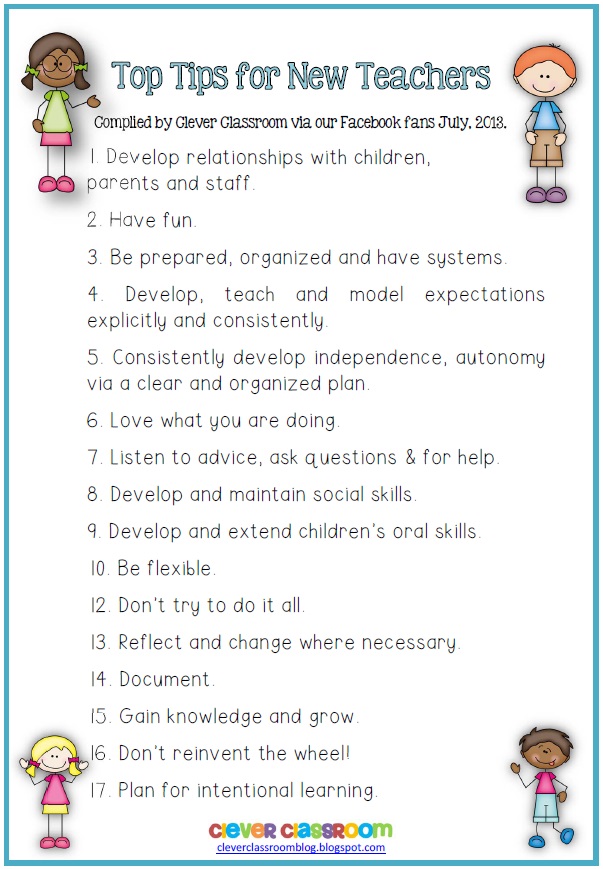
Tips For New Teachers from Experienced Teachers

October 9, 2013


Some brilliant advice courtesy of teachthought.com:


tips

Click on the link to read my post, Do experienced teachers give enough back to the profession?
Click on the link to read, ‘Teachers Trained Very Well to Teach Very Poorly

Click on the link to read my post 25 Characteristics of a Successful Teacher

Click on the link to read my post 10 Important Tips for New Teachers