Top 10 Most Unusual School Bans

November 4, 2013


Schools should be working on making the school going experience more manageable not more stifling. Below are the top 10 most usual school bans courtesy of ozteacher.com.au:


  1. Hugging This rule has been rolled out all over the country with school authorities suggesting it was introduced to protect children who may be hurt by the physical contact. The rule has been highly criticised by parents who say it is excessive.
  2. Handstands and cartwheels One Sydney school has banned handstands and cartwheels in the playground because it is too dangerous as the school doesn’t have enough ‘soft surfaces’.
  3. Red ink One Queensland school has banned its teachers from marking in red ink in case it upsets the children. It is suggested they use a ‘calming’ green ink instead. Traditionalists have condemned the ban as ‘absolutely barmy’, ‘politically correct’ and ‘trendy’.
  4. Having a best friend In the UK, teachers have banned school kids from having best pals so they don’t get upset by fall-outs. Instead, the primary pupils are being encouraged to play in large groups.
  5. Santa One Gold coast school sent a letter home to parents outlining the Kris Kringle tradition would now be referred to as ‘Secret Friends’ not ‘Secret Santa’. Education Queensland defended the ban, saying the teacher acted in a sensitive and respectful manner and in the best interests of all students, in line with their inclusive policy.
  6. Bikes Parents are “outraged” after an eco-friendly school in the UK banned pupils from cycling to school because of health and safety. Parents argue given childhood obesity is on the rise, promoting healthy eating and exercise is a must.
  7. Bake sales Several schools in Massachusetts placed a ban on school bake sales because it promoted unhealthy eating habits, but the decision was later overturned – meaning cupcakes, brownies and other biscuits will be spared the chopping block.
  8. Winning A few schools have decided to forgo the term ‘win’ in exchange for ‘doing your best’ and ‘completing.’
  9. Party invitations, unless the whole class is invited. This rule is becoming increasingly common in schools, and is enforced to avoid bullying and children feeling left out.
  10. Sunscreen One school in Washington State banned sunscreen on a student field day because it has so many additives and chemicals in it, it can cause allergic reactions. ABC News reports that because sunscreen is considered a medication in all 50 states with the exception of California, children are not allowed to bring it to school or apply it to themselves.

I must say I don’t have a problem with number 9, but I have a major problem with most of the rest.


Click on the link to read Rules that Restrict the Teacher and Enslave the Student

Click on the link to read This is What I Think of the No Hugging Rule at Schools

Click on the link to read Political Correctness at School

Click on the link to read What Are We Doing to Our Kids?

Click on the link to read Stop Banning Our Kids From Being Kids

Click on the link to read Banning Home-Made Lunches is a Dreadful Policy


12,000 Students a Year Change Schools Due to Bullying

November 4, 2013


bullies

Changing schools used to be a rarity when we were students. Nowadays it seems it has become not only extremely common, but in many cases a survival technique:

Thousands of parents are taking their children out of schools because of severe bullying, a Mail on Sunday investigation has found.

More than 2,000 parents who applied to transfer their children to new schools in just 28 local authority areas in the last school year gave bullying as the reason. The figures would rise to 12,000 if extrapolated across the UK.

The findings have dismayed school heads and campaigners. Charities blame 40 per cent of suicides among 11 to 14-year-olds on bullying.

The new figures were compiled from freedom of information requests to 150 local authorities for a breakdown of the reasons parents gave on ‘in year application forms’ for wanting to move their child during the school year.

While most councils said they did  not keep this information, 28 revealed that 2,300 parents said they were changing schools because of bullying.

North East Lincolnshire said 173 applications out of 2,217 cited bullying, while in Essex it was 444 out  of 12,695 and in Nottingham 131 out  of 3,424.

If this were replicated across the country, about 12,000 parents applied to move their children for that reason during the past school year.


Schools must work on bully proofing their environment as quickly as possible. Instead of waiting for the problem to arise they must offer an environment that acts as a disincentive for negative behaviours. They must offer alternatives to bullying by teaching good communication skills, anger management methods, problem solving tips and ensuring that its teachers are eager to help their students sort through problems that may arise.

The following series of films is sure to help achieve these goals.

Proof that the Goodness of Our Youth Cannot be Underestimated (Video)

November 2, 2013


kayla

What an incredible gesture. A far cry from the selfish, spoiled, competitive animals our kids are children are often portrayed as:


Click on the link to read Teaching Kids to be Competitive Often Leads to Needless Pain

Click on the link to read Two High School Athletes Brawl During Race (Video)

Click on the link to read Tips for Teaching Your Children How to Lose

Click on the link to read Preparing Students for the Real World

Click on the link to read Is Competition in the Classroom a Good Thing?

Woman Plans to Give ‘Fat Notes’ Instead of Candy to Trick or Treaters

October 31, 2013


fat

When will people start realising that the kids of today have had enough of the food associated guilt trips? I have never seen a child motivated to change their eating habits on the back of a public shaming, and I probably never will:

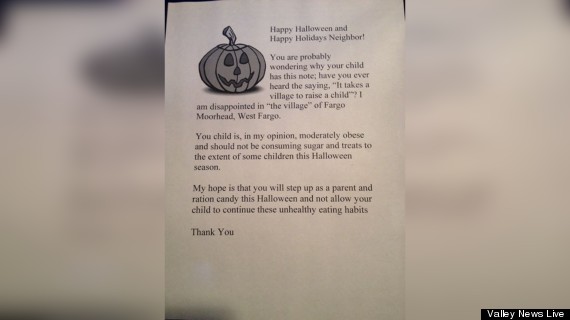
Children in a North Dakota neighborhood may be slated to get an awful surprise this Halloween: A local woman is reportedly planning to hand out “fat letters,” instead of candy, to kids she thinks are “moderately obese.”

Valley News Live reported a local Fargo woman called into Y-94 radio recently and revealed her plan to take on childhood obesity by handing out letters targeting trick-or-treaters whom she considers obese.

“I just want to send a message to the parents of kids that are really overweight,” she told the station. “I think it’s just really irresponsible of parents to send them out looking for free candy just ’cause all the other kids are doing it.”

Valley News Live obtained a copy of the letter, in which the woman, who is only identified as Cheryl, writes, in part:

You [sic] child is, in my opinion, moderately obese and should not be consuming sugar and treats to the extent of some children this Halloween season. My hope is that you will step up as a parent and ration candy this Halloween and not allow your child to continue these unhealthy eating habits.


Click on the link to read The Unique Challenges that Body Image Represents for Females

Click on the link to read An 8-Year-Old’s Take on Body Image

Click on the link to read A Father’s Advice to His Daughter About Beauty

Click on the link to read The Call to Stop Telling Your Children they are Beautiful

Click on the link to read School Official’s Solution to Harassed Teen: Get a Breast Reduction

Click on the link to read Our Young Children Shouldn’t Even Know What a Diet Is?

You Can’t Foster Tolerance With Racist Teachers

October 30, 2013


racist

Facebook has obviously provided teachers with with the ability to connect with students and colleagues in a way they have never before. It has also exposed some teachers as being completely unfit for their chosen profession.

Case in point:

A High school teacher in the United States has sparked a racism row after ranting about black children on Facebook.

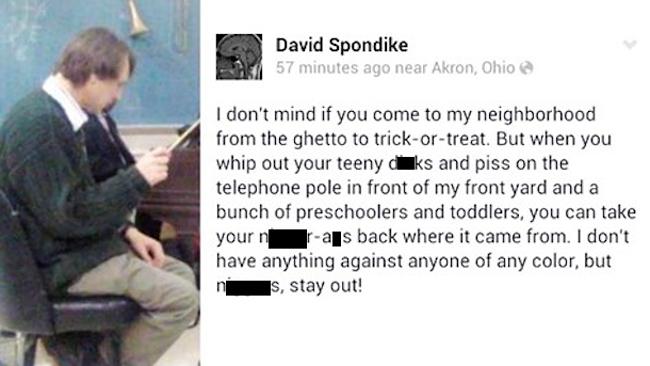
David Spondike, a 51-year-old teacher at Firestone High School in the state of Ohio, logged onto the social networking site and unleashed a diatribe against kids from the “ghetto” who had caused trouble trick-or-treating outside his house, Akron News Now reported.

The post was soon deleted, but someone sent screenshots to several local news outlets. Mr Spondike was apparently upset about one of the kids exposing himself and urinating in front of his home.

“I don’t mind if you come to my neighbourhood from the ghetto to trick-or-treat,” Mr Spondike said.

“But when you whip our your teeny d***s and piss on the telephone pole in front of my yard and a bunch of preschoolers and toddlers, you can take your n****r-a** back where it came from. I don’t have anything against anyone of any colour, but n*****s, stay out!” he said.

There are many things wrong with this post, not least of which is the inconsistency of saying you have nothing against people of any colour in the same sentence as a demeaning racial slur.

Facing an almighty backlash, Mr Spondike removed the post and said he was sorry “to those who are sincerely offended”.

However, in a series of additional posts, he didn’t apologise for using the N-word. Mr Spondike said he hears “that n****r word more than 25 times a day in a public school, where it is used thousands of times every day by black people”.

“Racism is racism and to allow one race to use a word and not another IS racist. What I said was absolutely NOT racist by any stretch of the imagination,” Mr Spondike said.

“When I try to get the teenagers in my school to stop using the word n****r, I only get laughed at.”

Mr Spondike will reportedly remain on leave while his school district investigates the incident.

The district released a statement regarding the online spat, condemning the conduct of its teacher.

“His comments were unprofessional and unbecoming a teacher,” said Superintendent David W James. “Regardless of whether he was on his own time and own account doing this, he is a teacher, and his actions influence children. This is serious.”

According to Mr Spondike’s personnel file, his record was already less than spotless. In 2007 he was accused of choking a student, though the claim was never substantiated, and in 2000 he was reprimanded for throwing a chair across his classroom.

Having said that, Mr Spondike also received “glowing evaluations” for his teaching.


A very poor defense by Mr. Spondike and an equally poor response by the Superintendent. A teacher should not be judged on their teaching skills alone, but also by their ability to act as a role model.  Mr. Spondike claims he is not a racist. He hasn’t quite convinced me yet.


Click on the link to read The Teacher that Defended Hitler and Child Abuse and Advocated Porn

Click on the link to read The Worst Thing a Teacher Can Ever Say to a Student

Click on the link to read A Teacher Who Beds their Teenage Student Should be Jailed

Click on the link to read My Teacher, the Pedophile

Click on the link to read Teacher Strip Searches Students in a Bid to Catch them Cheating

Click on the link to read Students Asked to Submit an Assignment Arguing that ‘Jews are Evil’

Click on the link to read School Instructs Students on How to Become Prostitutes


The Teacher that Defended Hitler and Child Abuse and Advocated Porn

October 29, 2013


fired


If these allegations are true this teacher deserves his reputation to be completely destroyed:

A teacher has been struck off for after telling pupils that ‘Hitler wasn’t all bad – he killed the Jews, the gays and the disabled’.

David McNally also told a third-year Religious Education class at Kilwinning Academy, Ayrshire, in November last year that he would ‘rather have been a prison warden or a child abuser’, the General Teaching Council (GTC) said.

The supply teacher was found to be unfit to teach at a GTC hearing today.

The comments were brought to light when pupils complained to their parents, who contacted the school.

Mr McNally did not attend the hearing but accepted he had made the remarks in his written submission to the hearing.

He said that he was having a ‘particularly bad day’ and had made the comments in a ‘general sense’.

The GTC panel rejected his suggestion.

The Hitler comments were said to a class in which he also asked pupils: ‘Did you have sex at the weekend?’

The GTC panel heard that he told a third-year class: ‘I love my mobile phone because I can sit and watch porn on it.’

He was also reported to have said: ‘I have a part-time job at a children’s home – they have taught me how to whip a child with a wet towel without leaving a mark.’


Click on the link to read The Worst Thing a Teacher Can Ever Say to a Student

Click on the link to read A Teacher Who Beds their Teenage Student Should be Jailed

Click on the link to read My Teacher, the Pedophile

Click on the link to read Teacher Strip Searches Students in a Bid to Catch them Cheating

Click on the link to read Students Asked to Submit an Assignment Arguing that ‘Jews are Evil’

Click on the link to read School Instructs Students on How to Become Prostitutes

Click on the link to read Some Teachers Just Desperately Want to get Fired

The Moment a 9-Year-Old Became a Star (Video)

October 28, 2013


I don’t like talent shows and I find the constant judge and host reaction shots manipulative and distracting, but who can criticise this monumental performance by 9-year-old Amira Willighagen, singing Puccini for the judges of Holland’s Got Talent?


Click on the link to read Tips for Teaching Gifted Students

Click on the link to read School Calls Police to Stop A-Grade Student From Studying

Click on the link to read Schools are Failing Gifted Students


Jeremy Forrest Dumped by Schoolgirl: Anyone Surprised?

October 27, 2013


cuffs

This is the ultimate morality tale for any teacher stupid enough to go down the unprofessional and highly unethical path of starting a relationship with a student:


The schoolgirl who ran away with married teacher Jeremy Forrest last year when she was just 15-years-old has dumped him for a boyfriend her own age, it has been reported.

The girl, now 16, sparked an international hunt last year when she fled to France with 31-year-old Jeremy Forrest.

Forrest was arrested by French police when he turned up for a job at a bar owned by a British woman who had recognised him from television appeals and was jailed for five-and-a-half years.

The girl, who cannot be named for legal reasons, had vowed to wait for him ‘for ever’ for him and also said she wanted to have his baby.

She had been in regular contact with his parents and had reportedly made several attempts to contact him in prison.

But Social workers stepped in and banned him from having any contact with him until she is at least 18.

According to a report in the Sunday Mirror, the girl now has a new boyfriend who is a sixth-form student her own age.

She reportedly phoned Forrest’s parents in tears to explain and his father Jim broke the news to his son in prison yesterday.

A family source told the Sunday Mirror: ‘Jeremy is naturally devastated. He’s really upset, but at the same time he’s a realist.

‘He half expected this to happen while he was in prison, I think.’

She is now said to be back living with her mother.

The pair had fallen out over her relationship with Forrest but they have now made peace.

The schoolgirl first kissed Forrest in his classroom when she was 14. He took her virginity one week after her 15th birthday in the marital home while his wife was away.

They fled to Bordeaux when their affair was uncovered by her mother after someone reported seeing text messages on her phone.

Police had failed to find the messages when they examined the phone the day before the girl and Jeremy fled.

She claimed that the pair were only caught because she had been jealous of a ‘flirty barmaid’ who lured him to an interview with offers of work.

In front of his weeping teenage girlfriend, Forrest was arrested and returned to the UK to stand trial.

At Forrest’s trial, the court heard that the schoolgirl turned to her teacher during a tumultuous period in her life. She was upset over the break-up of her parents’ marriage. Both had gone on to meet new partners.

Her mother was pregnant with a new baby by her fiance, and her father had fallen in love and was busy planning a wedding.

Jeremy Forrest was all ears, but crucially failed to stop her growing infatuation in its tracks.

He posted tortured blogs about the moral dilemma he was facing, exchanged explicit photos with the girl via mobile phone and told bare-faced lies when warned over his behaviour by suspicious colleagues.

He even had the cheek to complain to the girl’s mother about the rumours threatening his reputation.

The former maths teacher is currently incarcerated in Ashfield Prison, near Bristol, one of five controversial new jails designed to house only sex offenders.

Built to cope with the dramatic increase in the number of people being convicted of sexual abuse, they have faced a barrage of criticism, with many people fearing that keeping abusers together could reinforce their behaviour.

Please click on the links to read two related posts on the same story:

The Inspirational Moment a Brave Student Overcomes His Stammer (Video)

October 26, 2013

Wow! What a brilliant clip this is!

Using techniques from the film A King’s Speech a teacher is able to help student Musharaf Asghar overcome his stutter and speak for the first time in front of his peers.  To watch supportive staff and students reduced to tears at the overwhelming power of his courage and achievement has touched me enormously.

Please forward this clip to others to shed some light on the positive role teachers and schools can play and what a fantastic thing it is to encourage risk taking as well as fostering a kind and compassionate student community.

Click on the link to read There Should Be No Children Left on the Outer

Click on the link to read Teachers Addicted to Referring Their Students to Specialists

10 Essential Facts About Cyberbullying for Parents

October 24, 2013

bully

Courtesy of Caroline Knorr:

Q. What is cyberbullying?

A. Cyberbullying is using digital communications (like the Internet and cell phones) to make another person feel angry, sad or scared, usually again and again.

Many experts agree that intent and context are important, too. If the behavior was intentional, that’s clearly cyberbullying and there should be consequences. But if a kid inadvertently hurts another kid, then he or she may just need to learn better online behavior.

Either way, if your kid feels bad as a result of someone else’s online actions, then they may have been targeted and you should take it seriously. Kids’ conversations can be rowdy and rude. But if they’re not deliberately (and repeatedly) designed to inflict cruelty, and no one feels wronged, then chalk it up to juvenile antics. But keep an eye on it.
Q. How is cyberbullying different from bullying?

A. All bullying is extremely hurtful to the target and can make kids feel uncomfortable, embarrassed, helpless, sad and angry. But cyberbullying is a particular form of bullying that often spreads faster and further to more people and can occur at any time of day or night.

Online messages can be more confusing or scarier than in-person communication because there are no face-to-face cues to help you understand people’s intentions. Helping kids recognize bullying will help them learn to better deal with it.

  • Kids may use more hurtful and extreme language online than offline. It’s not uncommon for cyberbullies to say things like “I wish you would die,” “You’re ugly,” and “Everybody hates you.” If a kid said these things out loud in public, a teacher, a parent or even another kid would probably overhear and intervene.
  • Cyberbullying can happen anytime, whereas regular bullying generally stops when kids go home. Your kid could get a text, an email or see a post — or posts — on Facebook at any moment.
  • Cyberbullying can be very public. Posts can spread rapidly to a large, invisible audience because of the nature of how information travels online.
  • Cyberbullies sometimes act anonymously, whereas, with traditional bullying, it’s often clear who the bully is. Anonymity is a cloak that bullies hide behind. Not only does it encourage the bully to be more brazen, it makes him or her hard to trace.
  • In-person bullying can cause both physical and emotional harm. Cyberbullying causes “only” emotional harm (though it can lead to physical bullying, as well).

Q. What are some examples of cyberbullying?

A. Usually, cyberbullying is characterized by repeated cruelty. Whether this was a thoughtless, one-time prank or a more deliberate act of cruelty, it sounds as if your kid was humiliated over and over as every kid saw the picture. That’s what matters most. Hopefully, the kids’ parents were notified and your kid recovered.

Here are some other examples of behavior that could cross the line into cyberbullying:

  • Sending a mean email or IM to someone
  • Posting mean things about someone on a website
  • Making fun of someone in an online chat
  • Doing mean things to someone’s character in an online world
  • Creating a hostile environment in an online world or game
  • Impersonating someone online — including creating a fake online profile
  • Repeatedly texting someone to the point of harassment
  • Directly threatening or intimidating someone online or in a text
  • Starting rumors or spreading gossip online
  • Stealing someone’s password and logging into someone else’s account
  • Taking a photo or video and sharing it without the subject’s consent, knowing it might be embarrassing

Q. How do you have the conversation with another parent about their kid’s bullying?

A. If your kid is bullied by someone he or she knows, you should probably talk it over — face-to-face — with the kid’s parents. These steps can help you achieve a cooperative conflict resolution that will get everyone working together.

  • Schedule a meeting. While your impulse may be to confront the kid’s parents immediately, it’s better to set a time to meet and discuss the situation in a civilized manner.
  • Explain that you’re there for your kid. Say that your kid reported the incident and you wanted to follow up. That takes the heat off of the parents and allows you both to discuss your kids’ actions.
  • State your goal. Yes, you’re angry and hurt, but your goal should go beyond blaming. You want to end the bullying and have your kids stop engaging in destructive behavior.
  • Let the other parent talk. Hear them out; they may have information that you don’t know.
  • Bring the evidence. Show printouts or the devices on which the bullying occurred.
  • Work together. As much as possible, try to enlist the other parent so you can work as a united front.
  • Talk about next steps.Create a plan for how to proceed as well as a check-in schedule so you can see how things are progressing. Depending on whether things calm down or escalate, you may need to bring in a neutral party — a teacher, counselor, even a community leader — to deal with the problem and help you all move forward.

Read the rest of this entry »