Posts Tagged ‘Parenting’

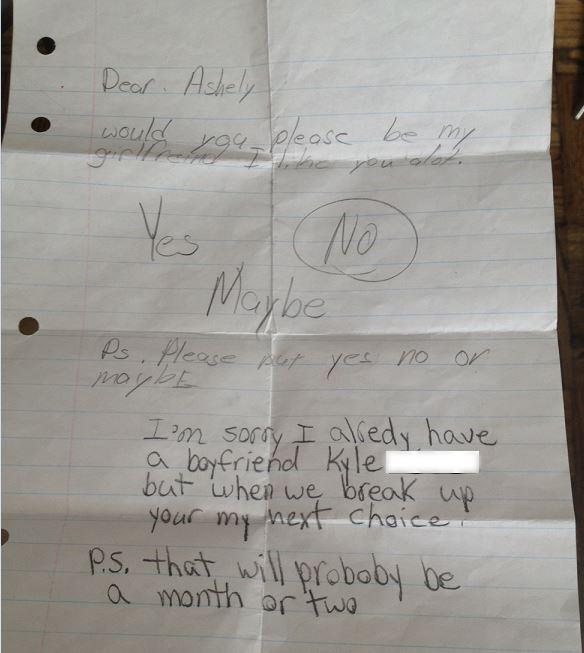
Young Love Elementary School Style

November 6, 2013

Below is a very cute note capturing the innocence of Elementary school.

note

Click on the link to read What Age Should Children Start School At?

Click on the link to read Fun Facts about Children

Click on the link to read Teaching Children to be Honest Yet Respectful

Click on the link to read The Children of Today Show a Lack of Respect For Authority

Click on the link to read Is There Anything Better than an Inspirational Child? (Video)

Proof that the Goodness of Our Youth Cannot be Underestimated (Video)

November 2, 2013


kayla

What an incredible gesture. A far cry from the selfish, spoiled, competitive animals our kids are children are often portrayed as:


Click on the link to read Teaching Kids to be Competitive Often Leads to Needless Pain

Click on the link to read Two High School Athletes Brawl During Race (Video)

Click on the link to read Tips for Teaching Your Children How to Lose

Click on the link to read Preparing Students for the Real World

Click on the link to read Is Competition in the Classroom a Good Thing?

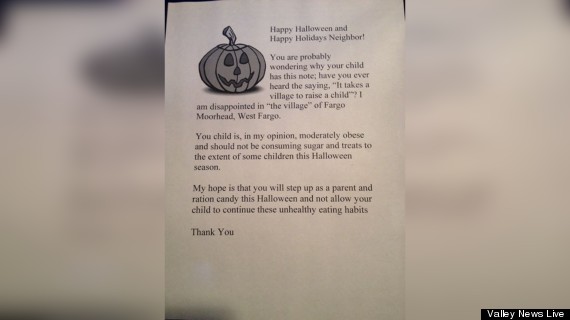
Woman Plans to Give ‘Fat Notes’ Instead of Candy to Trick or Treaters

October 31, 2013


fat

When will people start realising that the kids of today have had enough of the food associated guilt trips? I have never seen a child motivated to change their eating habits on the back of a public shaming, and I probably never will:

Children in a North Dakota neighborhood may be slated to get an awful surprise this Halloween: A local woman is reportedly planning to hand out “fat letters,” instead of candy, to kids she thinks are “moderately obese.”

Valley News Live reported a local Fargo woman called into Y-94 radio recently and revealed her plan to take on childhood obesity by handing out letters targeting trick-or-treaters whom she considers obese.

“I just want to send a message to the parents of kids that are really overweight,” she told the station. “I think it’s just really irresponsible of parents to send them out looking for free candy just ’cause all the other kids are doing it.”

Valley News Live obtained a copy of the letter, in which the woman, who is only identified as Cheryl, writes, in part:

You [sic] child is, in my opinion, moderately obese and should not be consuming sugar and treats to the extent of some children this Halloween season. My hope is that you will step up as a parent and ration candy this Halloween and not allow your child to continue these unhealthy eating habits.


Click on the link to read The Unique Challenges that Body Image Represents for Females

Click on the link to read An 8-Year-Old’s Take on Body Image

Click on the link to read A Father’s Advice to His Daughter About Beauty

Click on the link to read The Call to Stop Telling Your Children they are Beautiful

Click on the link to read School Official’s Solution to Harassed Teen: Get a Breast Reduction

Click on the link to read Our Young Children Shouldn’t Even Know What a Diet Is?

10 Essential Facts About Cyberbullying for Parents

October 24, 2013

bully

Courtesy of Caroline Knorr:

Q. What is cyberbullying?

A. Cyberbullying is using digital communications (like the Internet and cell phones) to make another person feel angry, sad or scared, usually again and again.

Many experts agree that intent and context are important, too. If the behavior was intentional, that’s clearly cyberbullying and there should be consequences. But if a kid inadvertently hurts another kid, then he or she may just need to learn better online behavior.

Either way, if your kid feels bad as a result of someone else’s online actions, then they may have been targeted and you should take it seriously. Kids’ conversations can be rowdy and rude. But if they’re not deliberately (and repeatedly) designed to inflict cruelty, and no one feels wronged, then chalk it up to juvenile antics. But keep an eye on it.
Q. How is cyberbullying different from bullying?

A. All bullying is extremely hurtful to the target and can make kids feel uncomfortable, embarrassed, helpless, sad and angry. But cyberbullying is a particular form of bullying that often spreads faster and further to more people and can occur at any time of day or night.

Online messages can be more confusing or scarier than in-person communication because there are no face-to-face cues to help you understand people’s intentions. Helping kids recognize bullying will help them learn to better deal with it.

  • Kids may use more hurtful and extreme language online than offline. It’s not uncommon for cyberbullies to say things like “I wish you would die,” “You’re ugly,” and “Everybody hates you.” If a kid said these things out loud in public, a teacher, a parent or even another kid would probably overhear and intervene.
  • Cyberbullying can happen anytime, whereas regular bullying generally stops when kids go home. Your kid could get a text, an email or see a post — or posts — on Facebook at any moment.
  • Cyberbullying can be very public. Posts can spread rapidly to a large, invisible audience because of the nature of how information travels online.
  • Cyberbullies sometimes act anonymously, whereas, with traditional bullying, it’s often clear who the bully is. Anonymity is a cloak that bullies hide behind. Not only does it encourage the bully to be more brazen, it makes him or her hard to trace.
  • In-person bullying can cause both physical and emotional harm. Cyberbullying causes “only” emotional harm (though it can lead to physical bullying, as well).

Q. What are some examples of cyberbullying?

A. Usually, cyberbullying is characterized by repeated cruelty. Whether this was a thoughtless, one-time prank or a more deliberate act of cruelty, it sounds as if your kid was humiliated over and over as every kid saw the picture. That’s what matters most. Hopefully, the kids’ parents were notified and your kid recovered.

Here are some other examples of behavior that could cross the line into cyberbullying:

  • Sending a mean email or IM to someone
  • Posting mean things about someone on a website
  • Making fun of someone in an online chat
  • Doing mean things to someone’s character in an online world
  • Creating a hostile environment in an online world or game
  • Impersonating someone online — including creating a fake online profile
  • Repeatedly texting someone to the point of harassment
  • Directly threatening or intimidating someone online or in a text
  • Starting rumors or spreading gossip online
  • Stealing someone’s password and logging into someone else’s account
  • Taking a photo or video and sharing it without the subject’s consent, knowing it might be embarrassing

Q. How do you have the conversation with another parent about their kid’s bullying?

A. If your kid is bullied by someone he or she knows, you should probably talk it over — face-to-face — with the kid’s parents. These steps can help you achieve a cooperative conflict resolution that will get everyone working together.

  • Schedule a meeting. While your impulse may be to confront the kid’s parents immediately, it’s better to set a time to meet and discuss the situation in a civilized manner.
  • Explain that you’re there for your kid. Say that your kid reported the incident and you wanted to follow up. That takes the heat off of the parents and allows you both to discuss your kids’ actions.
  • State your goal. Yes, you’re angry and hurt, but your goal should go beyond blaming. You want to end the bullying and have your kids stop engaging in destructive behavior.
  • Let the other parent talk. Hear them out; they may have information that you don’t know.
  • Bring the evidence. Show printouts or the devices on which the bullying occurred.
  • Work together. As much as possible, try to enlist the other parent so you can work as a united front.
  • Talk about next steps.Create a plan for how to proceed as well as a check-in schedule so you can see how things are progressing. Depending on whether things calm down or escalate, you may need to bring in a neutral party — a teacher, counselor, even a community leader — to deal with the problem and help you all move forward.

(more…)

A Father’s Priceless Reaction to his Son’s Report Card (Video)

October 22, 2013


Is there anything more powerful than a proud parent? Watch how much this positive math result means to this father.


Click on the link to read A New Way to Get Kids to Brush Their Teeth

Click on the link to read Tips to Help Parents Control Their Kids’ TV Habits

Click on the link to read 10 Steps Parents Can Take if their Child is Being Bullied

Click on the link to read School Holidays are Very Hard for Many Parents (Video)

Click on the link to read 20 Reassuring Things Every Parent Should Hear

Click on the link to read 10 Tips for Nurturing Independence Among Children

Click on the link to read Seven Valuable Tips for Raising Your Child’s Self-Esteem


The Normalisation of Cyber Bullying

October 21, 2013


scalp

Cyberbullying has become a normal practice and it’s all our fault. Parents, teachers and school administrators have completely dropped the ball on this one. Cyberbullying is a significant issue and it requires all its stakeholders to assume responsibility and work together. We must focus on this issue before it gets even worse:

More than half of children and young people in England accept cyber-bullying as a part of everyday life, a new survey has found.

But parents and teachers say they do not feel they are equipped to deal with the growing problem of internet abuse.

Campaigners warned that cyber bullying had become ‘an everyday problem for today’s children’ and demanded better education to tackle the phenomenon.

More than half of children polled – 55 per cent – said cyber-bullying had become a part of life for children and young people, while 60.5 per cent of parents also said it had.

Keeping their children safe online is a major worry for parents, with 49 per cent complaining that the amount of access their child has to the internet leaves them struggling to monitor their behaviour online.

And 51 per cent say this makes them scared for the safety of their child.

However, the poll suggests that many families would struggle to respond if their child did fall victim to internet abuse.

Some 40 per cent of parents said they would not know how to respond if their child fell victim to cyber-bullies or how to set up filters on computers, tablets and mobile phones that could protect their children.

There were growing calls for online safety to be taught in more schools, with 69 per cent of teachers and 40 per cent of young people calling for it to be included in the national curriculum.

Nearly half of teachers – 43 per cent – admitted their school did not currently teach anything about cyber-bullying and online safety and 44 per cent admitted they did not know how to respond to cyber-bullying.

Almost a third – 32.1 per cent – of young people said that teaching schools, parents and children about internet safety would be the biggest step that can be taken to tackle cyber-bullying, yet just a fifth of children felt they were taught enough about it at school.

The major new survey, commissioned by the Anti-Bullying Alliance, underlines the struggle many families face trying to protect their children on the internet.

Click on the link to read The Explosion of Online Bullying

Click on the link to read The Researchers into Cyberbullying Should Review Their Findings

Click on the link to read A Positive Approach to Tackling Cyberbullying

The Pressure on Girls to Engage in Sexting is Unacceptable

October 17, 2013

sexting

On this very blog I have been castigated by readers for calling sexting a very serious and problematic pastime.  Some of my readers have insisted that sexting is just an innocent activity synonymous with a teenager’s tendency to be flirtatious and experiment with new ways of expressing their sexuality.

I couldn’t disagree more.

Like many other forms of controlling behaviour, it is often designed to pressure impressionable teens (mainly girls) to conform in a way that may lead them to serious humiliation in the short and long terms. Whilst sexting can be consensual, the research shows that is often done due to great pressure and with great reluctance:

Six out of 10 teenagers say they have been asked for sexual images or videos, an NSPCC/ChildLine survey seen by the BBC’s Newsnight programme suggests.

Of those questioned, 40% said they had created a sexual image or video, and about a quarter said they had sent one to someone else by text.

The NSPCC’s head, Peter Wanless, said “sexting” was getting much more common.

“These results show that sexting is increasingly a feature of adolescent relationships,” he told Newsnight.

“It is almost becoming the norm that a young person in a relationship should share an explicit image of themselves,” he said.

For the survey, NSPCC and ChildLine spoke to 450 teenagers from across the country.

Of those who had sent an image or video to someone else by text, 58% said the image had been sent to a boyfriend or girlfriend, but a third said they had sent it to someone they knew online but had never met.

About 15% said they had sent the material to a stranger.

Jonathan Baggaley National Crime Agency, Ceop command

Of those who said they had sent a photo to someone, 20% said it had then been shared with other people, while 28% said they did not know if their picture had been shared with anyone else.

More than half (53%) of those questioned said they had received a sexual photo or video, a third of whom had received it from a stranger.


Click on the link to read 30 Per Cent of Teens Have Sent Naked Images of Themselves Online: Report

Click on the link to read Sexting Reaches our Primary Schools


Teaching Kids the Art of Public Speaking

October 16, 2013


shell

Courtesy of everydaylife.globalpost.com:


Step 1Brainstorm topic ideas. Your child will feel more confident making a speech if he is passionate about, or at least familiar with, the subject matter. Topics might include a favorite hobby, memories of a family vacation or a persuasive speech on why your child thinks he needs a bigger allowance.

Step 2Create a preliminary outline. Instruct your child to write down everything he knows about his chosen topic. For instance, your child might write down instructional details or tips and personal feelings about his favorite hobby.

Step 3Research online or at the local library. Fill in what your child knows with facts. For instance, if he is giving a speech about soccer, he might research the history of the sport. If he is describing a family vacation, he might look for information about the geography and culture of the vacation site.

Step 4Help your child organize the material into an introduction, body and conclusion. The introduction should be short, but catchy. Include a joke or anecdote to catch the audience’s attention. The body of the speech should include two to five main points accompanied by supporting facts. Your child may wish to include short stories in the body to weave a narrative. The conclusion is a brief summary of the speech. Help your child find an applicable quote or anecdote to wrap up the subject matter.

Step 5Encourage your child to write short notes on cards to help him if he gets lost during his speech. Don’t allow him to write the entire speech on cards, though, or he’ll be tempted to read and avoid eye contact.

Step 6Assemble an audience of friends and family so that your child can practice his speech in a non-threatening environment. Encourage your child to speak slowly and engage his audience with eye contact. If he is fidgety, it may help him to hold onto a podium or table.

Step 7Address your child’s concerns before he gives his speech to a formal audience. Remind him that it is okay to feel nervous or scared. He doesn’t have to give the speech perfectly. Encourage him to relax and simply tell his story.


Click on the link to read The Call to Stop Kids From Reading Books they Actually Enjoy

Click on the link to read The Classic Children’s Books they Tried to Ban

Click on the link to read How Spelling Mistakes can Turn a Compliment into Something Quite Different.

Click on the link to read Why Spelling is Important at Starbucks

Click on the link to read The Ability to Spell is a Prerequisite for Getting a Tattoo (Photos)

Click on the link to read This is What Happens When You Rely on Spell Check

Click on the link to read Hilarious Menu Items Lost in Translation

Click on the link to read The 15 Most Commonly Misspelled Words in the English Language

A New Way to Get Kids to Brush Their Teeth

October 7, 2013


OK, perhaps this wont catch on:

These unique photos capture the moment a boy has his teeth picked clean by amazing underwater shrimp.

These fascinating creatures spend their lives diving inside the mouths of fish to remove the parasites that lurk there.

Russell Laman imitated the behaviour of the surrounding fish swarm to entice the cleaner shrimp into his mouth whilst snorkelling with his father Tim Laman in Bali, Indonesia.

The 13-year-old queued with the waiting fish and then opened his mouth when the shrimps came near.

The shrimp then incredibly started to clean Russell’s mouth and remove food from between the boys teeth whilst Tim took photographs.

Russell Laman, from Lexington, Massachusetts, said: ‘It felt like tiny little dentists picking away at my teeth and scuttling around my mouth, it tickled a little but not too badly.

‘I had watched fish getting cleaned at cleaning stations before and decided to try it out myself.

‘I thought it would be really cool to experience shrimp in my mouth first hand.

Russell who has been diving with his father for seven years is unfazed by the dangers of holding his mouth open underwater.

He learnt how to get the shrimp out of his mouth when he needs to breathe, by imitating the behaviour of the fish.

Russell said: ‘I observed that the shrimp are always keeping an eye on the mouth of the fish and as soon as it starts to close they shoot out.


teeth1


Click on the link to read Tips to Help Parents Control Their Kids’ TV Habits

Click on the link to read 10 Steps Parents Can Take if their Child is Being Bullied

Click on the link to read School Holidays are Very Hard for Many Parents (Video)

Click on the link to read 20 Reassuring Things Every Parent Should Hear

Click on the link to read 10 Tips for Nurturing Independence Among Children

Click on the link to read Seven Valuable Tips for Raising Your Child’s Self-Esteem

Click on the link to read Top Ten Compliments Your Children Need to Hear

The Call to Stop Kids From Reading Books they Actually Enjoy

October 7, 2013

The Hunger Games

At a time when just getting kids to read a book is the stuff of small miracles, why would anyone want to make books less accessible to children. I am sure The Hunger Games will never go down a classic of literature but I really don’t care. The objective of books is to entertain, inspire and transport its readers to distant places, cultures, traditions and experiences.  If the children of the day find that The Hunger Games achieves this goal then its up to us, the educators, to get in touch with them rather than the other way around.

I am a literature major at University. I studies every period of literature dating back from Chaucer onwards. And guess what? I find many so-called classics to be utterly tedious. My tutor was gobsmacked when I told him that I found Robinson Crusoe boring.

“How can you not like Robinson Crusoe? It is the most printed book behind the bible!”

His argument didn’t wash. I am never going to like a book just because it is deemed a classic or it has had multiple reprints.

And the same goes with Shakespeare. People are aghast when I say that Shakespeare should not be a compulsory fixture in the high school curriculum. How many people that strongly believe in studying Shakespeare in High School have a copy of one of his plays on their bedside table? How many of them are ever likely to read Macbeth or Hamlet for pleasure? When is the last time you ever had a deep urge to reread The Tempest?

We are hypocrites if we subject children to the types of books we are glad we no longer have to read ourselves. If we are ever going to get children to read we must employ the same criteria for reading as we have when we search for a book. Our students must find the subject matter topical, interesting, amusing, dramatic and most of all – ENTERTAINING:

Joanna Trollope says children should be taught literary classics in school because they spend too much time reading fantasy books, such as The Twilight Saga. 

The novelist said fantasy teen fiction, such as the hugely popular Hunger Games series, fails to give children an insight into reality or guidance in moral dilemmas. 

The Rector’s Wife author said youngsters should be encouraged to read the likes of Jane Austen, George Eliot and the Bronte sisters.

However, she admitted her 12-year-old grandson loves The Hunger Games, about a post-apocalyptic nation in which two children are selected to compete to the death in an annual televised battle.

Trollope told The Sunday Times: ‘I feel children are missing out on an enormous amount.

‘The consolation to be found in the classics is absolutely infinite and greater than fantasy novels. Fantasy doesn’t relate to the real world.’

The author, who used to be a teacher, said using popular culture can be a useful tool to lead children towards the classics.

She said she gave her class The Beatles lyrics to study in one English poetry class before giving them Robert Frost to read.

Last year, the three Hunger Games books were in the top 10 bestsellers list with more than 2.1million sold.

Click on the link to read The Classic Children’s Books they Tried to Ban

Click on the link to read How Spelling Mistakes can Turn a Compliment into Something Quite Different.

Click on the link to read Why Spelling is Important at Starbucks

Click on the link to read The Ability to Spell is a Prerequisite for Getting a Tattoo (Photos)

Click on the link to read This is What Happens When You Rely on Spell Check

Click on the link to read Hilarious Menu Items Lost in Translation

Click on the link to read The 15 Most Commonly Misspelled Words in the English Language

Click on the link to read Who Said Grammar Isn’t Important?