Posts Tagged ‘Parenting’

9 Truths About Children and Dinnertime

April 25, 2014


dinner

As a stay-at-home father I can fully appreciate this brilliantly realised list by Beau Coffron:


1. You learn to eat one-handed.
When you have a baby, you should get a Ph.D. in doing things one-handed. You find out you didn’t really need that other hand anyway. Serving the food with one hand? Easy. Pouring drinks? Simple. Cutting steak? C’mon, give me something difficult. With a little practice, parents can become magicians with that one hand. In between having babies you don’t lose this skill, either; it just goes into hibernation and comes out again when it’s needed.

2. You wish someone would invent seat belts for the dining room table.
How has someone not thought of this already? We can put a man on the moon but we can’t figure out a way to strap a 6-year-old to their dinner chair? Kids act like you make them sit on nails when they are at the dinner table. Partly it’s just the 45 times they need to go to the bathroom, but the other times seem to be an involuntary reaction to vegetables, little brothers or both.

3. Finding a Kids Eat Free place is like winning the lottery.
Before kids, I didn’t think “Kids Eat Free” coupons were worth the paper they were printed on. Now, I wouldn’t trade them for getting “Let It Go” banned in the United States (although it’s tempting). The beauty of eating at restaurants that give out these coupons is that not only do kids eat free, but you also don’t have to clean up the mess on the floor! This benefit alone automatically triples what the coupon is worth.

4. Chicken nuggets are a food group.
You try to make balanced meals, but honestly, many parents always keep frozen nuggets in their freezer for backup. Nuggets are like the first aid kit of the kitchen. Dinner goes wrong. You have nuggets. Kid’s friends stop by unexpectedly? Nuggets to the rescue. Nothing like breaded chicken… um, pork… uh, turkey? It doesn’t really matter what that meat is — if this is the first time your child has eaten more than two bites at a meal in three days, you are not complaining.

5. Dogs are basically vacuum cleaners.
Remember when your dog used to be your prized possession? You would go dog treat shopping, and buy it that special collar. Now the dog is 10 pounds overweight because of the mounds of food the kids feed him. After your children are done with dinner, there might be a whole meal in scraps under that table. Dogs are now more than man’s best friend; they are every parent’s best cleaning appliance.

6. Who needs napkins when you have sleeves?
No matter how many times you tell kids not to, or how many stacks of napkins you pile in front of their plates, a sleeve always gets used. OK, maybe not at every meal, but every single time you serve fried chicken or spaghetti. When drinking water or eating Saltines, kids will use every napkin in the house to clean themselves up instead.

7. Dirty dishes seem to multiply like rabbits.
Parents, how many times have you looked around after the meal and wondered where all those extra dishes came from? Some of them you don’t even recognize as yours. Since when did mac and cheese require you to use 22 plates, 17 bowls and 8 spatulas? You don’t know how, it just happens. Like how LEGO bricks transform into deadly weapons that attack parents’ bare feet at night, it’s unexplainable.

8. It’s against the law for a parent to have a “hot” meal.
Remember that scene from the movie A Christmas Story when Ralphie states that his mother hadn’t had a hot meal for herself in 15 years? Before you were a parent, you laughed at how far-fetched that line was. You’re not laughing now, are you? Between getting all the kids second helpings, extra ketchup and rags for spills — and cutting up their meat — your hot meal never stood a chance.

9. Dinner with your kids can be your favorite time of the day.
Even after all of this craziness that we call mealtime, it can still be one of my favorite times of the day. Why? I get to sit down with my family and listen to them talk about their favorite moments and their biggest challenges. This is family time. In our busy culture, we don’t get enough of it, and you can’t buy an experience like a good family meal. Meals like these are memories that last a lifetime in our family, and I wouldn’t trade them for all the quiet, clean, hot meals in the world.


Click on the link to read The Most Original Way to Pull Out Your Child’s Tooth Out (Video)

Click on the link to read Father Carries His Disabled Son 9 Miles to School Every Day

Click on the link to read Never Take the Dream out of the Child

Click on the link to read The Snow Day Song that Has Gone Viral (Video)

Click on the link to read Is Tiger Mom a Racist?

Click on the link to read 44 Things Parents Say to their Kids to Get them to Eat
Teaching Young Children the 3Rs Could be Damaging: Psychologist

April 24, 2014


reading

Teaching young children the 3Rs may not be the only skills a teacher or parent should be imparting to their young students, but it is hardly damaging. A considerate, patient and skilled person can teach all kind of skills without causing the distress alarmist psychologists make us believe occurs:


Cambridge University lecturer David Whitebread said it was important for parents to play with their children, as these youngsters were more likely to enjoy solving problems, and better equipped to cope with failure.

Former primary school teacher Mr Whitebread also claimed the government was overly concerned with getting children to learn the 3Rs at an ever decreasing age, and said younger children were better off learning to cook alongside their parents.

Mr Whitebread, a developmental cognitive psychologist, said that although learning to read was an important skill, teaching reading, writing and arithmatic to toddlers was a waste of government money and the child’s time.

Mr Whitebread said that learning to read at to young an age could even be damaging for a child.

‘Instead the parent can share something they love, such as making cakes, or tinkering with engines, the key is partly sharing the enthusiasm but mainly the conversations you have with the child while doing it.’


Click on the link to read 7 Ways To Teach Kids Self-Awareness

Click on the link to read Kids Explain the Meaning of Happiness

Click on the link to read 5 Reasons Why It’s Healthy to Encourage Children to Play

Click on the link to read Allowing Children to Stand Out From the Pack

Click on the link to read Hilarious Examples of Kids Telling It As It Is

Brilliant New Advertisement on Schoolyard Bullying

April 17, 2014


An absolute masterpiece!


Click on the link to read The Bystander Experiment (Video)

Click on the link to read Tips for Managing Workplace Bullying

Click on the link to read 12,000 Students a Year Change Schools Due to Bullying

Click on the link to read The Devastating Effects of Bullying (Video)

Click on the link to read Sickening Video of Girl Being Bullied for Having Ginger Hair

Click on the link to read Our Young Children Shouldn’t Even Know What a Diet Is?


7 Ways To Teach Kids Self-Awareness

April 8, 2014

helmet

Courtesy of Sherrie Campbell, PhD:


1. Be a good role model.
In order to parent self-awareness, you have to have it yourself. This means that you demonstrate through your own behaviors that you can calm your anxieties and frustrations and not act out in a negative way. If you start to act out, demonstrate that you can call a time-out on yourself and get centered again.

2. Accept and recognize your child’s feelings.
Emotions are emotions. They are temporary energies meant to pass through. If we accept and acknowledge what our children are feeling, the emotions pass through much more quickly and with more understanding. Taking this time to sit with their feelings helps them to not act emotions out in a negative way. Accept the feelings from their viewpoint, and then, if possible, spin them in a positive light.

3. When in doubt, empathize.
Your empathy teaches children their emotional life is not threatening, abnormal or scary. Their emotions are not shameful or defective. They are human and manageable. In this way, you teach your children they are not alone. This helps them see that even the less-than-perfect parts of themselves are acceptable, which helps them to accept themselves and others more wholly.

4. Do not encourage the avoidance of emotions.
Emotions may be uncomfortable, but never minimize them to your children or tell your kids to “move on.” Refrain from telling them what they are feeling is wrong. They may not be ready to move on, and it is important for children to learn to navigate the uncomfortable. This is how they learn and grow. We must teach them that whatever they avoid will return in the form of a similar and harder lesson, so they may as well do their learning now.

5. Encourage communication.
Repressing feelings doesn’t work. Repressed sadness turns into depression; repressed anger turns into rage; repressed envy turns into jealousy; repressed love turns into possession; and repressed fear turns into anxiety/panic. When we reject or ignore our children’s emotions, this causes them to repress, which leads to more severe and chronic emotional problems all throughout life. Let them express freely.

6. Time, attention and listening.
Actively listen to your children. You do not have to agree with what they say or feel, but to argue against it doesn’t allow them to hear or know who they are as unique people. Accept their feelings, repeat them back to them for understanding, and listen. Show that you care and can see their point of view.

7. Teach problem solving.
Most of the time, when children experience that their emotions are understood and accepted, the emotions lose their charge and begin to dissipate. This leaves an opening for problem solving. Sometimes, kids can do this themselves. Ask them how they want or think they should handle the situation which is upsetting them. This helps them to hear themselves out, and to learn to make good decisions from within. Sometimes, they need your help to brainstorm, but resist the urge to handle the problem for them; that gives them the message that you don’t have confidence in their ability to handle the problem on their own.


Click on the link to read Kids Explain the Meaning of Happiness

Click on the link to read 5 Reasons Why It’s Healthy to Encourage Children to Play

Click on the link to read Allowing Children to Stand Out From the Pack

Click on the link to read Hilarious Examples of Kids Telling It As It Is

Click on the link to read Kids Can Operate an iPad but Can’t Tie their Shoelaces

The Most Original Way to Pull Out Your Child’s Tooth Out (Video)

March 27, 2014


Far more original the the string tied around the door handle method we grew up fearing.


Click on the link to read Father Carries His Disabled Son 9 Miles to School Every Day

Click on the link to read Never Take the Dream out of the Child

Click on the link to read The Snow Day Song that Has Gone Viral (Video)

Click on the link to read Is Tiger Mom a Racist?

Click on the link to read 44 Things Parents Say to their Kids to Get them to Eat

Father Carries His Disabled Son 9 Miles to School Every Day

March 16, 2014


dad


What an inspirational father!

Let’s all agree to extend an early Happy Father’s Day to this Chinese dad who will do just about anything to give his son with disabilities every opportunity in the world.

Yu Xukang, 40, a single dad from the Sichuan Province in China, walks 9 miles every day with his son, Xiao Qiang, strapped to his back so that the boy can get an education. The 12-year-old has a disorder that has caused his arms and legs to become twisted and his back to be hunched over, and there is no public transportation available to take him to class, Central European News (CEN) told The Huffington Post in an email.

To support himself and his young son, Yu works as a farmer, according to China Daily. Since last September, Yu has woken up every day at 5 a.m., prepared a lunch for his son and then secured Xiao Qiang — who is about 3 feet tall — in a basket that he attaches to his own back.

The pair makes the 4.5-mile trek to school across the rugged terrain, then Yu walks back home so that he can work. The devoted dad then returns to pick his boy up from school and carries him all the way home –- an 18-mile round trip, according to CEN.

The single dad estimates that he’s walked about 1,600 miles since he started taking his son to school.

“I know that my son is physically disabled but there is nothing wrong with his mind,” he told CEN. “However, I couldn’t find any school here with the facilities to accept him and was constantly rejected.”

Once Xiao Qiang was accepted to the Fengxi Primary School, Yu vowed to do everything in his power to make sure his son would get there every day.

His dream is for Xiao Qiang to one day go to college.

After word of the father and son’s daily journey got out, authorities decided to step in to help the two. They agreed to provide a small room near the school for them, according to CEN.

Xiao Qiang has already climbed to the top of his class.

“I know that he will achieve great things,” his father told CEN.


Click on the link to read Never Take the Dream out of the Child

Click on the link to read The Snow Day Song that Has Gone Viral (Video)

Click on the link to read Is Tiger Mom a Racist?

Click on the link to read 44 Things Parents Say to their Kids to Get them to Eat

Click on the link to read Should Teachers be Able to Tell People they Are Bad Parents?

In My Opionion Pedophiles are the Same as Murderers

March 13, 2014

cowan

Whilst it was a relief to see the evil killer of poor young Daniel Morcombe receive his guilty verdict, it came with a most horrifying revelation.

Only after a trial verdict is delivered can the criminal record of the accused be released to the public. It turns out that Daniel’s killer, Brett Peter Cowan, has a past:

Daniel Morcombe’s killer Brett Peter Cowan was finally found guilty when the longest-running police investigation in Queensland’s history came to a dramatic end on Thursday.

Fairfax Media can now reveal Daniel was not Cowan’s first victim.

Ten years before taking Daniel from a Sunshine Coast bus stop, Cowan lured a six-year-old boy into the bush in the Northern Territory.

Cowan viciously raped the little boy on a rusted car wreck, leaving him with severe head injuries, a collapsed and punctured lung, a deep cut at the base of his scrotum, a bloodied nose and scratch marks over his torso.

The boy was found wandering naked, dazed and distressed near a petrol station on the Stuart Highway and taken to the Royal Darwin Hospital where he was placed in intensive care.

Cowan, then aged 24, initially denied having any involvement in the attack, but confessed when questioned a second time by police.

He told police he needed help and requested to be imprisoned in the Moreton Correctional Centre in Queensland, where he could participate in a sexual offenders treatment program.

Cowan was already a repeat offender by this stage. In September 1989, Cowan took a seven-year-old boy into a public toilet in Brisbane, where he digitally and orally raped the child.

Cowan was sentenced to seven years’ jail for his assault on the boy in the Northern Territory, but his non-parole period was set at no more than three years and a half years.

How can they let a man who has raped and nearly killed a child out of prison within 4 years? Why is there such a gulf between the sentences of child sex offenders and murderers? To me they are highly comparable.
In my opinion a child sex offender should receive a similar sentence to a murderer, and should they ever re-offend upon release, they should never see light of day again.

Governments Should Ban Schools From Imposing Toilet Rules

March 10, 2014


toilet roll

I have vehemently opposed school toilet rules for some time, arguing that it is unfair and unhealthy to impose such a rule. The evidence seems to back up my claim:

Some primary school children are at risk of developing kidney and bowel problems because they have difficulty getting permission from their teacher to go to the toilet.

And others say they are avoiding the school toilets because of where they are located and worries about sanitation and security.

Almost 1,000 school-aged children attending eight Irish primary schools in the east coast were surveyed and 545 children responded.

While, overall, children had a positive perception of their school toilets, and used them if they needed to, around 57pc said they experienced difficulties going to the toilet.

The findings emerged in a survey of pupils by Maeve Smyth, a public health nurse with the Health Service Executive (HSE) in Wicklow. She was prompted to investigate the issue after school-aged children attending her bedwetting clinic said they found difficulties following their care plans while at school.

“These children described how they were reluctant to use the school toilets and permission was often denied,” she told the nursing and midwifery conference at the Royal College of Surgeons.

“Significantly, 57pc of the children had difficulties getting permission from the teacher to use the toilet when they needed to.

“And 34pc of children also intentionally avoided using them. These findings were significantly related to age, location, sanitation and security.”

She added: “Prolonged postponing increases the risk of, or exacerbates the problem of, urinary and bowel disorders.”

A spokesman for the Irish National Teachers Organisation (INTO) said the finding that 34pc of children intentionally avoided using school toilets should be further investigated by the schools concerned.

He said: “Regrettably, sanitation was an issue in some schools due to government neglect of school buildings. While progress has been made in many schools in recent years, there is still a backlog of schools awaiting funding.

“A school board has a duty to ensure that the overall hygiene of a school is of an acceptable standard. But where it is identified that it is of a less than acceptable standard, then the board should be funded by the Department of Education to urgently redress the situation.”

He added: “In general, the union advises against children being forced to line up to go to the toilet at specific times.

“Where possible, children should be facilitated to go to the toilet when the need arises. However, this is not always possible where toilets are external to the classroom.”


Click on the link to read Even Prisoners Don’t Have to Beg for Toilet Paper

Click on the link to read School Makes Children Pay to Use the Toilet

Click on the link to read School Toilet Trial is a Terrible Idea

Click on the link to read Schools Putting Spy Cameras in Toilets and Change Rooms

Click on the link to read A Toilet Break is a Right Not a Privilege

Click on the link to read Even Prisoners Get to Use the Toilet

The Destructive Impact of the “Fashion Police” Brigade

March 9, 2014

Now more than ever, our children feel the strain of living up to the judgmental and often unrealistic expectations of the “fashion police” crowd. Every classroom and every school seems to have them. Magazines thrive on it. Office water cooler discussions is dominated by it.

And like society’s skewed and misguided view of success, the definition for a “body beautiful”shuts so many out of contention from birth. Is this right? Is this fair?

It isn’t. But at the same time, by giving oxygen to shows such as Fashion Police, we are giving permission for the message to harm our children. We can’t make life better for our kids if they feel we are buying into the very lie we wish to protect them from. They wont feel better about themselves if we continue to buy the magazines and watch the disgusting elitist rubbish.

Take this appalling example of how low these shows can go. Imagine poking fun at a woman pregnant with twins?

Click on the link to read The Plus Sized Barbie Debate Misses the Point

Click on the link to read Study Claims that Being Attractive can give you Better Grades

Click on the link to read The Unique Challenges that Body Image Represents for Females

Click on the link to read An 8-Year-Old’s Take on Body Image

Click on the link to read A Father’s Advice to His Daughter About Beauty

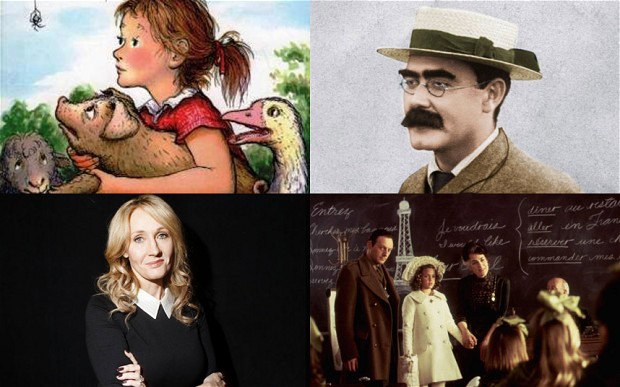
The Telegraph’s Best Children’s Book of All Time

March 6, 2014


books

Some absolute classics among this very well compiled list:

Watership Down

Richard Adams (1972)

The full-scale novel about rabbits finding their promised land has the magic of prophecy, idyllic Hampshire locations and the structure of the Aeneid. Adams enjoys parading his scholarship, and this is a lively introduction to brainy books.

The Hobbit

J R R Tolkien (1937)

Here we meet the characters who will make The Lord of the Rings happen, and on a pre-Peter Jackson scale. If anything, Gollum is even more chilling here, because we see him through the eyes of a hobbit – seldom the calmest of travellers.

The Lion, the Witch and the Wardrobe

C S Lewis (1950)

Welcome to the magical land of Narnia, where the White Witch reigns over a snow-girt land peopled by fawns, talking beavers and people eager to put their trust in four kids from Finchley. The Christian allusions come later, but for now this is pure narrative magic.

Charlotte’s Web

E B White (1952)

The New Yorker writer cherished for his elegance of style gives us an altruistic spider with exquisite manners, and a pig to make her proud. There are intimations of mortality, but a plot of fame and legacy thumbs its nose at the inevitable.

The Little Prince

Antoine de Saint-Exupéry (1943)

The Little Prince falls to Earth to meet the author, who has crashed his plane. His quizzical, wise stories of other planets (most of which are inhabited by solitary monomaniacs) lead to the daftest of all – our own.

Pippi Longstocking

Astrid Lindgren (1945)

It’s quite something to live as an orphan with just a horse and a monkey for companions. The heroine has a chutzpah that makes her sound at her most adult when she’s flouting adult conventions, especially at teatime.

Emil and the Detectives

Erich Kästner (1929)

When Emil is robbed of his mother’s hard-earned savings (that were never likely to stretch far), he has help from a scratch squad of child detectives from Berlin. However much this sounds like the best child’s game ever, the real world is seldom far away.

James and the Giant Peach

Roald Dahl (1961)

One of Dahl’s earliest, best, and most fully developed tales. There is no attempt to make the giant insects or articulate clouds seem natural: this is a world of wonder, more marvellous than Wonka’s, even.

Winnie the Pooh

A A Milne (1926)

Characters begin days by visiting one another, and end up shifting houses, learning to fly or surviving floods.

A Little Princess

Frances Hodgson Burnett (1905)

Sara has a privileged background but is now living as a Cinderella figure; and she plays at being a princess. But her response shows that being a princess is less a social ranking than a state of mind.

The Just So Stories

Rudyard Kipling (1902)

How did the leopard get his spots? How was the alphabet made? Why are elephant’s trunks so long? Kipling is the model of the patient parent in the face of constant questions. And who cares about evolution? This is much more fun.

A Journey to the Centre of the Earth

Jules Verne (1864)

Verne uses all the tricks that make Anthony Horowitz so successful – the action-packed chapters that end at just the right time and the sense of deepening mystery – but also a knack for convincing us that there really might be creatures down there.

The Wind in the Willows

Kenneth Grahame (1908)

The idyllic, stylised account of life on the river, with anxious glimpses beyond it, is a masterclass in character-driven comedy – alongside the arriviste Toad is the petit bourgeois Mole, and Rat, the gentleman of leisure.

The Doll People

Ann M Martin and Laura Godwin (2000)

The dolls in your dolls’ house might look inanimate to you, but you clearly have no idea of what they get up to at night. They’re casing the joint, tracking lost relatives and dodging that cruel fate – PDS (Permanent Doll State).

The Child that Books Built

Francis Spufford (2002)

Although this book isn’t written for children, the more reflective might enjoy it as a guide on how to grow into reading; and it’s a wonderfully eloquent take on how growing up happens unexpectedly.

THE BEST OF THE REST

(more…)