
Posts Tagged ‘Child Development’

Young Love Elementary School Style

November 6, 2013

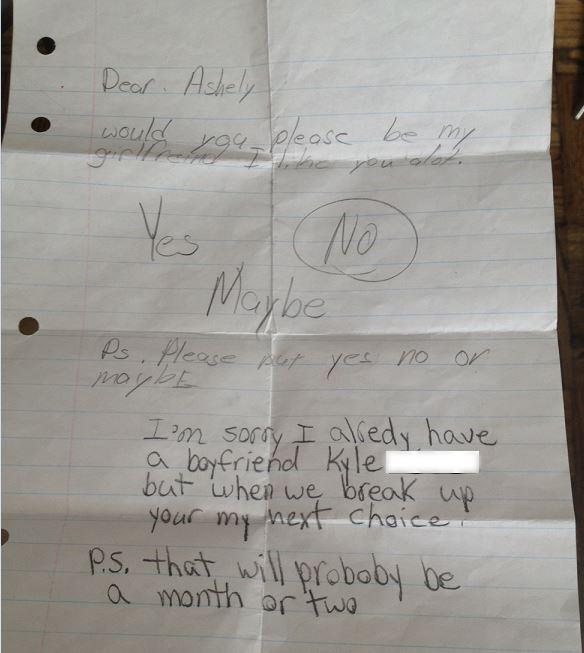
Below is a very cute note capturing the innocence of Elementary school.

note

Click on the link to read What Age Should Children Start School At?

Click on the link to read Fun Facts about Children

Click on the link to read Teaching Children to be Honest Yet Respectful

Click on the link to read The Children of Today Show a Lack of Respect For Authority

Click on the link to read Is There Anything Better than an Inspirational Child? (Video)

What Age Should Children Start School At?

September 12, 2013


bell


Prolonging the commencement of school by 2 years is a nonsense. There is nothing wrong with the current system when it comes to the school age requirement. However, there is a great deal wrong with the system when it comes to helping support children through the transition and developing an environment which is just as determined to boost a child’s sense of self as it is their grade average. Better they work on reinvigorating the current system instead of changing it radically:

Children should not start primary school until they are six or seven-years-old, according to a coalition of education experts who warn of the damaging pressure to perform in class at a young age.

A letter written by 130 teachers, academics and authors said the UK should follow the Scandinavian model and put off formal lessons for two years.

Under the UK’s current system, children start full-time schooling at the age of four or five.

Experts say this is causing ‘profound damage’ in a generation which is not encouraged to learn through play.

But the call was last night dismissed by as ‘misguided’ by a spokesman for the Education Secretary Michael Gove.

Children in the UK are obliged by law to be in school aged five, which the lobby group said is creating a ‘too much, too soon’ culture.

The warning singled out recent government proposals which mean five year olds could be formally tested from the beginning of their schooling.

Under the current system, children are first assessed at the age of seven. But under Deputy Prime Minister Nick Clegg’s proposals, a ‘baseline’ test could be introduced in the first year of primary school.

The group of experts warned that monitoring a pupil’s progress from such a young age promotes stress and fear around learning.


Click on the link to read Fun Facts about Children

Click on the link to read Teaching Children to be Honest Yet Respectful

Click on the link to read The Children of Today Show a Lack of Respect For Authority

Click on the link to read Is There Anything Better than an Inspirational Child? (Video)

The Harmful Effects of Yelling at Students

September 8, 2013

yell


I have yelled before and will probably yell again at some point. Not only is it detrimental to my voice but it is utterly useless in changing behaviour and asserting control”

Sticks and stones indeed break bones — but words can cause real harm to kids, too, a new study says. And bullies in the school yard aren’t the only ones to blame.

“Harsh verbal discipline” on the part of a parent increases a child’s risk for depression and aggressive behavior, and is “not uncommon,” according to the research, which was published online earlier this week in Child Development. The disciplinary techniques in question include yelling, cursing and humiliation — defined as “calling the child dumb, lazy, or something similar.”

The study even suggests that verbal reprimands can have the same impact on children as physical punishment: “the negative effects of verbal discipline within the two-year period of [the] study were comparable to the effects shown over the same period of time in other studies that focused on physical discipline,” a press release from the University of Pittsburgh, where the study’s lead author is an assistant professor, explains.

The study followed 976 Pennsylvania 13- and 14-year-olds and their parents for the 7th and 8th grade years, and found that the depression or poor behavior increased in the children who were exposed to harsh verbal discipline. Instead of serving to remedy the issue, verbal discipline tactics seemed to provoke the unwanted behavior.

“Adolescence is a very sensitive period when [kids] are trying to develop their self-identities,” study leader Ming-Te Wang told the Wall Street Journal. “When you yell, it hurts their self image. It makes them feel they are not capable, that they are worthless and are useless.”

Wang added to NPR that the study was “a reminder to [parents] that we need to stay calm,” going on to recommend “two-way interventions for parents and kids.”

Neil Bernstein, author of How to Keep Your Teenager Out of Trouble and What to Do if You Can’t, agreed with the study’s implications, he told USA TODAY, arguing: “Extremes of parenting don’t work. The put-down parent is no more effective than the laissez-faire parent who is totally chill and sets no limits on their children’s behavior.”

The study’s authors explored more than the effects of harshness alone; they also measured whether “parental warmth,” or the degree of love, emotional support and affection between parents and adolescents, counteracted the effects of verbal discipline — and concluded it does not.

“Even lapsing only occasionally into the use of harsh verbal discipline can still be harmful,” Wang said in the study’s press release. “Even if you are supportive of your child, if you fly off the handle it’s still bad.”

“Harsh verbal discipline deserves greater attention in both research and practice,” the researchers conclude in the study’s Discussion. “The majority of research conducted on harsh discipline has focused on physical discipline in early childhood. However, given that parents tend to resort to verbal discipline as their children mature (Sheehan & Watson, 2008), it is important that researchers and parents are aware that harsh verbal discipline is ineffective at reducing conduct problems and, in fact, leads to increased adolescent conduct problems and depressive symptoms.”


Click on the link to read First Prize for a Primary School Raffle: A Rifle

Click on the link to read Another Reason why Television is Unealthy for Children

Click on the link to read The Spoiled Twins with their £70k First Birthday Party (Photos)

Click on the link to read 5 Tips to Help Children Cope With Stress

Click on the link to read Seven Valuable Tips for Raising Your Child’s Self-Esteem

Click on the link to read Top Ten Compliments Your Children Need to Hear

Click on the link to read Tips For Parents of Kids Who “Hate School”
 

Who Needs the Right Answer When You Can Think Like a Child

July 11, 2013


The clip above demonstrates more than just cuteness. It captures children who are not yet interested in wealth, answer with creativity and insight and are not afraid of being wrong. You ask those same questions to teenagers and you will possibly find cynicism and insecurity on show.

Cuteness has a short shelf life but confidence is of eternal significance. We must help our young maintain their confidence and creativity long after their ‘cute’ period is behind them.

Click on the link to read Teaching Perfectionists
Click on the link to read Teaching Children to be Honest Yet Respectful
Click on the link to read The Children of Today Show a Lack of Respect For Authority
Click on the link to read Our Real Heroes are Not Celebrities or Athletes

Instead of Teaching a Baby to Read, Teach it to Smile

December 13, 2012

read

What is the rush? So your child reads when he/she is developmentally ready instead of when they’re a baby? So what?

Reading is not the greatest gift you can give a young baby. Love, optimism, hope and friendship are much more important to a baby’s development that the ability to read:

John Wilkey was just four days old when his mother Dana set about teaching him how to read. The fact that newborns can’t focus on anything more than a few inches away — let alone understand words in any form — did not deter her.

Dana, 39, an events organiser who lives in Chelsea, West London, is so passionate in her view that it’s never too early to make your child brilliant, she used to run through a set of ten flashcards with her son twice a day. ‘I would show John words like “milk”, give him my breast, and then show him the baby sign language for milk,’ she says. ‘I did it morning and evening.’

Baby sign language, for those not familiar with modern  parenting, is something ‘Tiger parents’ like Dana are well versed in. It works on the theory that children want to communicate long before they develop speech and can be taught little hand signals to communicate their needs and thoughts.

When he was nine months, Dana says John — her only child — was pointing and using basic baby sign language to show he could recognise up to 20 words and phrases, including ‘I love you’, ‘nose’, ‘ear’ and ‘arms-up’.

From there, Dana says his vocabulary grew at break-neck speed. A video of John at 20 months shows him sitting in his high-chair using a chubby finger to trace underneath the words ‘eyes’, ‘clap’ and ‘book’ from left to right.

Dana, who lived in the U.S. with John’s father before they separated, now lives with her fiance, Philip, in an £3.5 million London townhouse, once owned by a well-known footballer.

She is now one of a growing number of mothers convinced that getting children reading before they are potty-trained will help them get ahead in later life.

Great Collection of Critical Thinking Videos

December 12, 2012

crit

Courtesy of educatorstechnology.com:


1- Critical Thinking Part 1:  A Valuable Argument

2- Critical Thinking Part 2 : Broken Logic

3- Critical Thinking Part 3 : The Man who was Made of Straw


4- Critical Thinking Part 4 : Getting Personal


5- Critical Thinking Part 5 : The Gambler’s Fallacy


6- Critical Thinking Part 6 : A Precautionary Tale


Click on the link to read Kid’s Cute Note to the Tooth Fairy

Click on the link to read ‘Love’ as Defined by a 5-Year Old

Click on the link to read The Innocence of Youth

Click on the link to read Letting Kids Take Risks is Healthy for Them

Click on the link to read Study Reveals Children Aren’t Selfish After All


The Innocence of Youth

October 22, 2012

A 7-year old girl writes a precious note that captures the innocence and simplicity of youth. It is just such a privilege to be working with young people. Their view of the world is refreshingly positive and uncomplicated and their tone lacks the sarcasm that adults often project.


Click on the link to read Kid’s Cute Note to the Tooth Fairy

Click on the link to read ‘Love’ as Defined by a 5-Year Old

Letting Kids Take Risks is Healthy for Them

September 30, 2012


In the age of over regulation and OH&S interference it’s important to be reminded that taking risks can be beneficial for children:

ALLOWING children to take risks increases their resilience and helps them make judgments.

The current “cotton wool” culture means many kids are not getting the chance to fully explore their world and learn essential life skills.

“Too many kids are playing it too safe, [creating] a marshmallow generation,” says child psychologist Dr Michael Carr-Gregg.

“If you restrict children from playing outside, you send a message that the world is a much more terrifying place than it is and you run the risk of making kids risk-averse,” he says.

“They will spend more time on the computer and being sedentary. Children ought to be taking risks and it is not the end of the world if a child has an accident.”

The need for kids to learn to take calculated risks in safe environments has been a fervent topic of discussion in the media following recent reports that a Sydney inner-suburban primary school had banned kids from doing cartwheels and handstands.

“Schools are scared parents would sue if children were injured,” Carr-Gregg says. “This play-paralysis means children no longer experience adventure.”

Click on the link to read ‘Love’ as Defined by a 5-Year Old

What our System Does to Children Without Attention Spans

August 7, 2012

Why is it alright for children to be tone deaf  at music or fail at sport but it’s not acceptable for children to struggle to maintain concentration?

Why do educators believe that if you easily lose concentration you have a disability that must be fixed. Remember, these are the same teachers whose minds wander during professional development sessions and who stare into space during staff meetings. Yet, when their students gaze out the windows while they’re teaching a maths skill – it’s time to get the child assessed!

Talk about hypocrisy!

Teachers are obsessed with fixing the attention spans of children. They call for hearing tests, speech analysis, psychological examinations, occupational therapy sessions, language disorder checks and if you are really unlucky start the ADHD ball rolling.

Do they ever consider that children are not all meant to have endless attention spans? Just like every child can’t draw a landscape, every child cannot sustain a 20 minute mat session. What is it with mat sessions anyway? When is the last time a teacher tried to sit on a floor without so much as back rest to lean on for an extended period of time? It’s unbelievably uncomfortable! Yet you get teachers complaining all the time about children not sitting still or failing to pay attention. Try paying attention when your back feels like it was just hit by a rolling pin!

And have teachers ever contemplated that it might be their dry and boring style of teaching and their failure to properly communicate to children that has their class zoning off completely? Worksheet dense, talky, stagnant lessons result in inattentive students – guaranteed!

So a recent study shows that children with better concentration spans have a better academic success rate. In my view this study tells us more about the way we teach than the virtues of concentration:

Toddlers who are better at concentrating, taking directions and persisting with a game even after hitting difficulties have a 50 per cent greater chance of getting a degree when older, a two-decade long experiment found.

The study tracked 430 kids from pre-school to 21-years-old, monitoring academic and social development, behavioural skills and behaviour at home and in the classroom.

Parents were asked to watch how long the children would play with one particular toy while at home, while teachers were instructed to give the class a task and then monitor which toddlers gave up and which ones kept persevering until they had completed it.

Results of the study by Oregon State University were published in the online journal Early Childhood Research Quarterly.

The children most likely to go through further education were those who, at an early age, persisted in tasks and paid attention in pre-school sessions, said researchers.

Perhaps if classroom conditions changed we wouldn’t have to worry so much about the student without the super-human concentration endurance.

Click on the link to read Kids Don’t Need Gold Stars

Click on the link to read Experts Push for Kids to Start Driving at 12

Click on the link to read Kids as Young as 3 are Getting Tutors

Evidence that Daydreaming Helps Children Perform Better in Tests

July 3, 2012

I love this research. I am a proud daydreamer – always has been, always will be.

Daydreaming has the capacity to drive teachers insane. In my day it lead to bad reports and vicious lectures. Nowadays it often leads to recommendations for an ADHD diagnosis and the resultant daily dosages of Ritalin.

Well, throw those blasted tablets in the rubbish bin. Daydreaming is here to stay:

Daydreaming could help children concentrate – and even perform better in tests, researchers claim.

The children also feel less anxious and more motivated to perform, according to a review of studies on the value of time to reflect.

Education should focus more on giving children time to think, claim researchers at the University of Southern California.

Research indicates that when children are given the time and skills necessary for reflecting, they often become more motivated, less anxious, perform better on tests, and plan more effectively for the future.

It is also important in helping us make sense of the world at large … and contributes to moral thinking and well being.