Child Given a Bill for Missing His Friend’s Birthday Party

January 20, 2015

party


Remember when a child’s birthday party was a simple and innocent affair?


Two mothers became embroiled in a bitter Facebook battle over an invoice handed to one of their sons for missing the other’s birthday party.

Tanya Walsh and her partner Derek Nash were appalled when their son Alex, five, arrived home from school with a £15.95 bill for missing his classmate Charlie Lawrence’s big day at a local ski centre.

After refusing to pay, Alex’s parents were threatened that they would be taken to court. 

Since then Miss Walsh and Charlie’s mother Julie Lawrence have become entangled in a war of words. 

‘I messaged Julie on Facebook to say sorry and let’s resolve this amicably. And she said: “The amicable way I believe is for you to pay me the money. And let that be a lesson learnt,’  Miss Walsh, 30, said. 

 
‘The next thing I heard she was taking us to small claims court. My partner went to see her and it ended in an argument. She shouted down the street: “Don’t mess with me”.

‘Every time I spoke to her previously she was always very polite,’ Miss Walsh added. 

All of this is very shocking.’ 

‘Julie could have tried to contact us before issuing the bill. If she had spoken to us we would have considered paying it.

I could totally understand her point. It is not about the money for us and we did not mean to let them down. It is the way she has gone about it.’

But Mrs Lawrence said in a statement: ‘All details were on the party invite. They had every detail needed to contact me.‘ 

Alex’s father however said he had no means of contacting the woman, resorting to trying to find her at the children’s school gates to apologise. 

‘My partner looked out for [Mrs Lawrence] to apologise for Alex not showing up to the party, but didn’t see her.

‘But on January 15 she looked in Alex’s school bag and found a brown envelope. It was an invoice for £15.95 for a child’s party no-show fee.’

Click on the link to read Tip for Getting Your Kids to Open Up About Their School Day

Click on the link to read Study: Smartphones are a Bigger Concern than TV

Click on the link to read What Kids Really Wanted for Christmas (Video)

Click on the link to read Young Girl Pens Angry Letter to Tooth Fairy

Click on the link to read Gift Ideas for Children that Are Not Toys

Teacher Encourages Students to Plot Her Death

January 19, 2015

Patricia Lorenzen


I am a big advocate for finding new and engaging ways of teaching the same skills. Having said that, I don’t think I would go this far:


If students were going to die of boredom in an English class it wasn’t going to happen on Patricia Lorenzen’s watch.

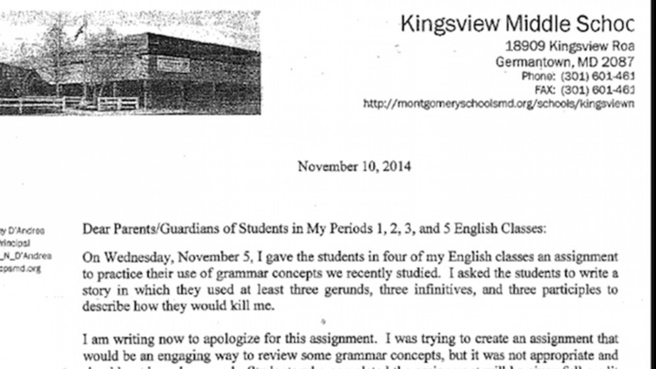
Last November, the Maryland English teacher decided to set an unorthodox assignment asking her students to describe how they would kill her.

The story had to include at least three gerunds, three infinitives and three participles and was an attempt by Ms Lorenzen to engage students while teaching them grammar.

However, parents were not so keen on the idea and many voiced concern over the content of assignment.

It was only after she received some complaints the Ms Lorenzen realised not all the content of the stories would be PG-rated.

Ms Lorenzen ended up writing a letter to parents apologizing for setting the task.

“I was trying to create an assignment that would be an engaging way to review some grammar concepts, but it was not appropriate and should not have happened,” she wrote.

The school’s principal told The Washington Post that this is the first time the school has received complaints about Ms Lorenzen.


Click on the link to read The Questions that Great Teachers Ask Every Day

Click on the link to read Learning as an Experience

Click on the link to read I Love it When Teachers are Excited to Come to Work

Click on the link to read Every Science Teacher’s Worst Nightmare (Video)

Try Sitting Still as Much as the Average Student Has To

January 19, 2015

chair

If you want to improve the behaviour of the classroom you could do worse than treat your students the same way as you wish to be treated. Just like I find sitting on the mat utterly uncomfortable I try to minimise the amount of time they are on the mat. Just like I can’t sit still for too long before feeling under duress, so too I allow my students to experience active lessons that mixes learning with some movement.

The truth of the matter is that kids are bound to their seats or the mat for way too long. It is unhealthy and bad for the brain. Don’t take my word for it. Read this wonderful piece by pediatric occupational therapist Angela Hanscom:


Except for brief periods of getting up and switching classrooms, I’ve been sitting for the past 90 excruciating minutes. I look down at my leg and notice it is bouncing. Great, I think to myself, now I’m fidgeting! I’m doing anything I can to pay attention – even contorting my body into awkward positions to keep from daydreaming. It is useless, I checked out about forty-five minutes ago. I’m no longer registering anything the teacher is saying. I look around the room to see how the children a few decades younger than me are doing.

I’m immersed in a local middle-school classroom environment. I quickly realize I’m not the only one having a hard time paying attention. About 50 percent of the children are fidgeting and most of the remaining children are either slouched in the most unnatural positions imaginable or slumped over their desks. A child suddenly gets up to sharpen their pencil. A few minutes later, another child raises their hand and asks to go to the bathroom. In fact, at least three children have asked to go to the bathroom in the past twenty minutes. I’m mentally exhausted and the day has just begun. I was planning on observing the whole day. I just can’t do it. I decide to leave right after lunch.

There is no way I could tolerate six hours of sitting even just one day, never mind every day – day after day. How on Earth do these children tolerate sitting this long? Well, the short answer is they don’t. Their bodies aren’t designed for extended periods of sitting. In fact, none of our bodies are made to stay sedentary for lengths of time. This lack of movement and unrelenting sitting routine, are wreaking havoc on their bodies and minds. Bodies start to succumb to these unnatural positions and sedentary lifestyle through atrophy of the muscles, tightness of ligaments (where there shouldn’t be tightness), and underdeveloped sensory systems – setting them up for weak bodies, poor posturing, and inefficient sensory processing of the world around them.

If most of the classroom is fidgeting and struggling to even hold their bodies upright, in desperation to stay engaged – this is a really good indicator that they need to move more. In fact, it doesn’t matter how great of a teacher you are. If children have to learn by staying in their seats most of the day, their brains will naturally tune out after a while – wasting the time of everyone.

Are these teachers clueless to the benefits of movement? No. Most teachers know that movement is important. And many would report that they are downright and overwhelmingly frustrated by their inability to let children move more throughout the day. “We are expected to cram more and more information down their throats,” gripes one middle school teacher. “It is insane! We can no longer teach according to what we feel is developmentally appropriate.” Another teacher explains, “due to the high-stakes testing, even project-based learning opportunities are no longer feasible. Too many regulations, not enough time.”

They go on to explain that recess has been lost due to lack of space and time as well as fear that children will get injured. “Too many children were getting hurt,” says a teacher. “Parents were calling and complaining about scrapped knees and elbows – the rest was history.” Even their brief break from instruction during snack time is no longer a reality. These few minutes of freedom are now replaced with a “working snack” in order to pack in a quick vocabulary lesson. Physical education is held only every sixth day, so technically this isn’t even a weekly affair.

The children line up for lunchtime. “Come watch this,” a teacher yells over to me. The children line up in pairs and are told to be quiet. Once everyone is quiet, two teachers (one in front of the line and one in back) escort the children down to the cafeteria. The thought of prison inmates quickly comes to mind, as I watch the children walk silently, side by side down the corridors of the school hallway. I’m told they are to remain quiet and seated throughout the lunch period. “I feel so bad for them,” exclaims the teacher. “They are so ready for down time during lunch, but are still required to sit and be silent!”

Many parents are also becoming increasingly unsatisfied with the lack of recess and movement their children are getting in middle school. One mother states, “Middle school kids in particular are just coming out of the elementary school environment, consisting of multiple breaks throughout the day. These kids are still young, and depending on the district, could be just 10-years-old going into middle school. They are experiencing a great change already in the transition alone. A break during the day is what they need to re-group.”

This same parent contacted the district’s school board members who ultimately make many of the decisions regarding school policies. She also met with the principal and deans and created an online petition consisting of a strong parent community advocating for more movement in school. The results? A brief five to ten-minute walk outdoors after lunch, which the teachers explain is really half a lap around the building and back indoors they go. “It may not be recess–but it’s a good start,” this mother states. “However, I still believe it’s necessary to make it school policy that all kids get a longer break.”

I ask the teachers what kids do when they get home from school. “About 60 percent of them are over-scheduled. The other 40 percent have no one home, so they do what they want – which often relates to playing video games,” a teacher complains. “I’d say we have only a handful of children that go home and find time to play.” Both teachers try to keep homework meaningful and under an hour, knowing kids need time to release after a long day of school.

Even middle-school children need opportunities to play. This past summer, a teacher at one of our TimberNook camps brought along his 12-year-old daughter, Sarah as a “co-counselor.” Sarah was excited about being a counselor alongside a college student for their small group of five children. In the past, she had simply been a camper. However, as soon as the group set out into the deep woods, dispersed, and started to play,  she quickly switched roles. She instantly forgot about her new status and jumped wholeheartedly into the pretend world, alongside the younger children. What took place next, was quite remarkable.

Sarah climbed high onto a fallen log that ascended to the very top of their newly designed teepee, donned with fresh ferns to camouflage their rustic “living quarters.” She wore a brightly colored feathered mask on top of her forehead. “Listen,” she said to the group of children gathered around her. “We need to get ready for the opposing team’s attack.” She took the time to look each of the children in the eye. “You,” she said to one of the bigger kids in the group. “You are now appointed as top commander.” “Julie,” she said to a girl that is known to be one of the fastest runners in the group. “You are going to be our top spy.” She proceeded to roles for each of the children to play.

Her age, strength, and intelligence made her their natural chosen leader and the children respected her decisions. She played just as hard as the other children. She forgot about her new role as co-counselor for the rest of the week, except to occasionally lead a group song or chant during morning meeting. The fun of being a camper and free play trumped all responsibility. She was still a child. She was not ready to give up her right to free play. Who could blame her?

Why do we assume that children don’t need time to move or play once they reach sixth grade, or even fifth grade? They are only children! In fact, I would argue that we all could benefit from opportunities to play, even up through adulthood. Everyone needs downtime. Time to move our bodies. Time to get creative and escape the rigors of reality.

What can we do for our middle-school children? I asked Jessica Lahey, a middle school teacher, contributing writer at The Atlantic, and author of the upcoming book, “The Gift of Failure: How the Best Parents Learn to Let Go So Their Children Can Succeed,” to give her opinion on the matter.

“Teachers are often afraid that if they let children move, it will be hard to get them to settle back down again. This shouldn’t stop us from providing them with the necessary movement children need in order to learn. Middle-school children can always benefit from recess! Also, when I taught for Crossroads Academy, we had some great nature trails behind our school through the woods. I would often take my whole English class for walks. I’d give them a topic to ponder and then we’d walk for ten minutes to think about the question. We’d huddle and discuss the topic. Then, I’d throw out another question and we’d start to walk again.”

Jessica explains that this is also true for schools in urban regions. Children can walk to museums or local parks to explore and learn. They can bring along their writing journals and assess the world and culture around them. Learning doesn’t have to be done in a chair. Jessica goes on to tell me that one time, she had her middle-school children practice public speaking by taking turns standing on a small bridge over a rumbling brook. They had to learn to project their voice over the babbling brook in order to be heard by the rest of class. “It was a good practical lesson and there is something about nature that grounds the child, taking away the anxiety that typically comes with public-speaking,” Jessica reports.

All people in decision-making positions for school policies should be required to sit through at least one school day and experience first-hand what is required of children today. Then they will have a better idea of what is appropriate and what isn’t. Then they will start to think about what their decisions mean for real children in real schools. Maybe then, they will begin to value children’s need to move, need to play, and the need to be respected as the human beings that they are.

Middle school-age children need to move – just like everyone else!


Judge Gives Excuses for Teacher Who Had Sex With His Student

January 15, 2015

kerner

I don’t care if the teacher initiated, was groomed, it happened accidentally or it was planned, when a teacher has sex with his student he must be imprisoned for long enough to deter others from going down the same road:


Child protection campaigners have reacted angrily after a judge declined to jail a teacher who had a sexual affair with a teenage pupil, on the basis that he had been “groomed” by his victim.

Stuart Kerner, 44, a married religious studies teacher, was given a suspended 18-month jail term after being convicted of an illicit relationship with the 16-year-old student during which the pair had sex at his school in south-east London and at his home.

Judge Joanna Greenberg QC said she was allowing Kerner, a vice principal at Bexleyheath Academy, to walk free after finding his victim had been “stalking” him. Sitting at the Inner London Crown Court, Mrs Justice Greenberg described the teenage victim as “intelligent and manipulative”, adding: “Her friends described her, accurately in my view, as stalking you.

“If grooming is the right word to use, it was she who groomed you [and] you gave in to temptation.”

The  remarks by the 63-year-old judge, who has sat on the bench for almost 20 years and last year became a circuit judge – one rank below a place in the High Court – were criticised as “astonishing” by child abuse workers.

Campaigners accused Judge Greenberg of seeking to transfer blame on to the victim when teachers have a legal and professional responsibility to reject any sexual advances from pupils. Jon Brown, lead for tackling sexual abuse with the NSPCC, said: “Despite the alleged pressure that he was under from the girl in question, it’s still a fact that Stuart Kerner grossly abused his position of trust.


Click on the link to read The Horrible Case of Abuse that a School Laughed Off as a “Joke”

Click on the link to read Should we Continue to Give Out Teacher of the Year Awards?

Click on the link to read The Things Some Teachers Think They Can Get Away With

Click on the link to read I Would Like to Write “Fired” on This Teacher’s Forehead

Click on the link to read Hugging Students Should be a Crime Not an Excuse

School Freaks Out Its Parents for No Logical Reason

January 14, 2015

w.f. burns

What on earth was the Principal thinking? Firstly, this dumb idea encourages children to fight gunmen with baked beans cans instead of running for cover, and secondly, it encourages parents to panic about a scenario that is both remote and strictly hypothetical.


A US high school has asked parents to arm their children with cans of food as part of its response plan against gun-armed intruders.

School officials from W.F. Burns Middle School in Valley, Alabama, wrote a letter to students’ parents, asking them to buy their children “an 8 oz canned food item (corn, beans, peas etc.) to use in case an intruder enters the classroom”.

“We hope the canned food items will never be used or needed, but it is best to be prepared.”

The strategy was inspired by the ALICE Training Institute, a company founded by a former police officer and a former primary school principal.

The institute follows the mantra of: Alert, Lockdown, Inform, Counter and Evacuate, and the cans of food are only a small — but still important — part of the whole procedure, school officials wrote.

“We realise at first this may seem odd; however, it is a practice that would catch an intruder off-guard,” the letter read.

“The canned food item could stun the intruder or even knock him out until the police arrive. The canned food item will give the students a sense of empowerment to protect themselves and will make them feel secure in case an intruder enters the classroom.”

Since the letter was sent out, it has been shared thousands of times, with some questioning its effectiveness.

But Chambers County School Superintendent Kelli Moore Hodge told CNN via email that the point of the training “is to be able to get kids evacuated and not be sitting ducks hiding under desks”.

Since the year 2000, the US has suffered through more than 100 school shootings, including the horrific 2012 Sandy Hook massacre, which claimed the lives of 27 people, 18 of them children.


Click on the link to read Nine-Year-Old Writes a Stunning Letter to Teacher After He Reveals He is Gay

Click on the link to read What’s in a Name?

Click on the link to read 10 Ways to Move Forward in Teaching as Well as Life in General

Click on the link to read 5 Ways the System Could Better Recognise Teachers

Click on the link to read Teachers, Lay Down Your Guns

List of Body Positive Books for Kids

January 13, 2015

body positive

A great list courtesy of thehuffingtonpost.com


  • Flora and the Flamingo and its sequel, Flora and the Penguin, age 4+. These charming, wordless picture books feature a spunky yet graceful little girl. Flora has a pear-shaped body, yet does a ballet pas de deux with a flamingo in the first book and figure skates with a penguin in the second. So many images in books, movies, magazines and ads feature young girls with slim bodies; it’s nice to see an image of a girl with a round tummy who’s athletic, graceful and creative.
  • Brontorina, by James Howe and illustrated by Randy Cecil, age 4+. When a brontosaurus shows up at ballet class, some of the students insist, “You are too big!” But the open-minded ballet teacher decides the problem is that her studio is too small — and moves the class outdoors. It’s a lighthearted lesson about not letting your size or shape prevent you from following your dream.
  • Freckleface Strawberry, age 5+. The main character feels self-conscious about her freckles, especially when other kids make comments and give her a nickname she doesn’t like. The final message isn’t that her freckles are beautiful, but that maybe they don’t matter. More important, people are happier when they accept who they are and what they look like.
  • Firebird, by Misty Copeland, age 5+. A young girl who wants to be a dancer almost gives up before ballet great Misty Copeland inspires and mentors her to reach her full potential in this exuberant picture book that emphasizes hard work and self-discovery.
  • Ivy + Bean, age 6+. Two “opposite” 7-year-old girls become best friends in the first of a wonderful 10-volume series. Bean is a rough-and-tumble tomboy who wears pants and a T-shirt and gets dirty; Ivy wears dresses, thinks a lot and is always reading books. They appreciate each other’s qualities, and the kids in their neighborhood appreciate them for their uniqueness and imagination.
  • Confessions of a So-Called Middle Child and its sequel, Watch Out Hollywood!: More Confessions of a So-Called Middle Child, age 8+. In the first book, Charlie shows she’s comfortable with her out-of-shape body (while trying to make healthy food choices) and confident in her bold sense of style. In the sequel, when she tries out for a TV show, kids tease her about her body, but the TV people admire her for being comfortable with her shape. It’s a refreshing, positive-body-image message to find in a book about middle school.
  • Harry Potter series, age 8+. Hermione is part of the triangle of main characters, and she’s smarter and does better in school than Harry and Ron. Her looks are never a focus, even when the kids become teens, go to dances and start to have crushes. It’s always about who she is as a person and her outstanding abilities.
  • Randi Rhodes Ninja Detective: The Case of the Time-Capsule Bandit, by Octavia Spencer, age 8+. Randi moves to a new town and becomes best friends with two boys who also are outsiders; one is bullied for being hearing impaired but is as passionate about martial arts as Randi is, and the other is lanky, into music and super smart. Together the diverse pals — Randi’s white, and her friends are Latino and African-American — solve a mystery using brains and the occasional Bruce Lee move.
  • Blubber, age 9+. An overweight girl is teased mercilessly by some classmates, and no one stands up for her in this brutally honest look at (pre-Internet-era) bullying among fifth graders. The novel doesn’t spell out moral lessons but teaches kids by portraying repugnant behavior and showing the value of true friendship and courage under peer pressure.
  • Diary of a Wimpy Kid: The Ugly Truth, age 9+. Middle schooler Greg Heffley goes through puberty in this series installment and suffers the indignity of teeth-fixing head gear. He deals with it all through humor and utter cluelessness, as always. He may not become more accepting of himself, but kids reading about his travails understand that everyone goes through this stage and that you can have a good laugh at the embarrassing stuff instead of being quietly embarrassed.
  • Grace, Gold, and Glory: My Leap of Faith, by Gabby Douglas and Michelle Burford, age 10+. This moving memoir shows the Olympic gymnast’s dedication in the face of homelessness, bullying and having a coach tell her she should get a nose job. Gabby stays focused, works hard and accepts herself as she is, even as she strives for greatness.
  • The Girl of Fire and Thorns, age 12+. A plump princess is chosen by God (in a fictional religion) for a special unknown task. She begins the book as intelligent but insecure and afraid and ends it confident and powerful.​ Rising to challenges and having faith in yourself are big lessons here — as is the message that any size girl can be a respected and capable leader.​
  • InReal Life, age 12+. An exciting graphic novel about a teen girl gamer who learns about harsh working conditions in other parts of the world. She’s smart, competent, and compassionate, both in real life and as her online avatar.


Click on the link to read Sometimes You Need to Expect Rudeness

Click on the link to read Do We Learn Enough From Children?

Click on the link to read Kids as Young as 7 Diagnosed with Anorexia

Click on the link to read The Destructive Impact of the “Fashion Police” Brigade

Click on the link to read The Plus Sized Barbie Debate Misses the Point

The Plot by Fourth Grade Students to Kill Their Classroom Teacher

January 12, 2015

hand

I hope this doesn’t get dismissed as a kids’ fantasy. I really worry about my fellow colleagues. Teaching should be a far safer profession than it currently is:


THREE nine-year-old students have been caught plotting to kill their teacher with hand sanitiser.

The plot was foiled when concerned parents and a school board member became aware of the plan reported WGRZ.

Word initially got out when the students told their classmates about their evil plot.

The students said they were going to cover the classroom with hand sanitiser after they found out their female teacher was highly allergic to antibacterial products.

In a report provided by the Genesee County Sheriff’s Department, they said “the suspects made comments to other students that they were going to kill [the teacher] by putting antibacterial products around the classroom”.

When youth officers interviewed the suspected students with their parents and school officials present one student stated that her teacher “yells at us and that the class has problems with her.”

In the end police handed the matter back over to the school to deal with.

“When we realised they never followed through with it and they told us they had no intention of following through, we said there was not much we can do,” Genesee County Sheriff Chief Investigator Jerome E. Brewster told The Buffalo News.


Click on the link to read We Are Not Doing Nearly Enough to Protect Teachers

Click on the link to read Teacher Forced to Defend Moving a Child to the Front of the Class

Click on the link to read 10 Tips for Teachers on how to Improve Their Work/Life Balance

Click on the link to read News Flash: Teachers Make Mistakes!

We Are Not Doing Nearly Enough to Protect Teachers

January 11, 2015


How on earth are we going to attract the best teachers to a profession that is so appallingly bad at protecting the health and safety of its own? Teaching, especially in the upper years, can be an extremely daunting and scary proposition. I don’t care what his excuse is, this student needs to be made an example of:

A high school freshman has been caught on video allegedly punching his substitute teacher and putting him in a headlock, because he said he couldn’t go to the bathroom.

The vicious attack on part-time faculty member and football coach Ron Santavicca at Gorton High School in Yonkers, New York, was recorded on a cell phone by another student in the hallway.

The 16-year-old boy, who has not been named, is seen hitting the teacher and swearing as he grabs his head. 

Witnesses described how the teacher told the student he could not leave after asking if he could use the restroom – prompting him to react violently. 

Senior Rocio Vidao told CBS New York: ‘The teacher was, like, telling him, “Don’t leave,” and then the kid came out of the classroom, and the teacher went after him, and that’s when the kid attacked the teacher.

‘It’s not supposed to be like that, you know. When a teacher says no, it’s supposed to be a no.’ 

Police were called in to investigate the incident, but the student has not been arrested or charged.

Yonkers School District have however suspended him for five days and have arranged a superintendent’s board meeting, according to NBC New York

Click on the link to read Teacher Forced to Defend Moving a Child to the Front of the Class

Click on the link to read 10 Tips for Teachers on how to Improve Their Work/Life Balance

Click on the link to read News Flash: Teachers Make Mistakes!

Click on the link to read Is There a More Undervalued Career than Teaching?

Click on the link to read Tribute to the Fallen Teachers


The Horrible Case of Abuse that a School Laughed Off as a “Joke”

January 10, 2015

santa hat

How is this a joke? If proven the teacher should be investigated criminally and those that defended it should be forced to resign:

A teacher ordered two seven-year-old boys to strip to their underwear at a Danish school before threatening to cut off their penises with a pair of scissors.

The pupils were made to take their clothes off after forgetting to bring Santa hats to a Christmas party at Strandmølle School in Assens, western Funen.

It has been reported that the youngsters were also told to climb into bin bags in front of the whole school.

The school admitted that the action was inappropriate adding that even though it had not been funny, it had only been meant as a joke.

But the parents were not satisfied with the response and complained to a child protection group, which urged them to report it to the police.

The school’s deputy chairman of the board, Thomas Hald, said: ‘It is correct that it happened and that this type of humour is something that we on the board naturally do not condone.’ 

He said the fact that the teacher apologised was enough and regarded the matter as closed. 

Would Mr. Hald find it as funny if his child was involved? Would he settle for an apology?

Click on the link to read Should we Continue to Give Out Teacher of the Year Awards?

Click on the link to read The Things Some Teachers Think They Can Get Away With

Click on the link to read I Would Like to Write “Fired” on This Teacher’s Forehead

Click on the link to read Hugging Students Should be a Crime Not an Excuse

Click on the link to read PE Teacher Caught on Camera (Video)

Tip for Getting Your Kids to Open Up About Their School Day

January 8, 2015

first day

Personally, I try to make the child’s’ school experience pleasurable enough to make them anxious to share their day with their parents. But for the parents who find it hard to get anything substantive from their children in this area, here are some tips courtesy of via parenttoolkit.com:


1. Wait at least a half an hour

Kids are generally drained and strained the moment they walk in door. So wait at least 30 minutes to start talking about school. Give your child a chance to decompress and have a snack, take off the backpack, and just breathe.

2. Don’t turn questions into a third degree

What would make you want to open up and tell her all those details? The same rules apply to kids. Big kid turn offs: pushing, prodding, demanding, coaxing, lecturing and threatening.

3. Look interested

Think of how your best friend asks you about your day. Use her example. Make sure you are relaxed and appear genuinely interested when you speak to your child.

4. Ask questions that require more than yes or no

“Do you have homework?” “Did you give your speech?” are questions that make your kid only have to answer with a yes or no response. So pose questions that require your child to respond with more than just yes, no, nope, sure, nothing, fine.

5. Don’t use the same questions

A big kid turn off is hearing your same old predictable: “How was your day?” query. So be creative. Churn up those questions so your kid knows you are interested!

6. Stop and listen

The nanosecond your child utters ANYTHING related to school, stop  and give your full presence. Catch any little nugget of information and make it seem as though it’s a gold mine. Kids open up more when they think you’re interesting.

7. Stretch conversation with “invitation openers”

If and when your child shares a detail try using the “stretching method.” Don’t push or prod but instead use these type of comments: “Really?” “Uh-huh?” “I don’t believe it!” “Wow!” They’re not threatening and invite a talker to open up.

8. Repeat “talk” portions

Try repeating bits of your child’s conversation: Child: “I played on the swing.” You: “You played on the swing.” The trick is to repeat the tidbit in a matter-of-fact but interested way to get your child to open up and add more.

9. Make your house kid-friendly

Many parents swear they find out more about school from their kids’ friends than from their own child. So invite your child’s friends over. Keep the fridge stocked with food. Set up a basketball court (or whatever you need to keep those kids at your house). And then be friendly (but not intrusive) to the friend. You may find that not only do the friends open up more, but your child will tag onto the friend’s conversation.

10. Get on the school website

Find out what’s going on in your kid’s school world: read the teacher newsletters, click onto the school calendar, read the school activities schedule and menu. You can then ask specific questions about your kid’s day.


Click on the link to read Study: Smartphones are a Bigger Concern than TV

Click on the link to read What Kids Really Wanted for Christmas (Video)

Click on the link to read Young Girl Pens Angry Letter to Tooth Fairy

Click on the link to read Gift Ideas for Children that Are Not Toys

Click on the link to read When Parents Get Busted!