What Principal Would Ever Approve of this Kind of Bullying?

November 16, 2012

What happened to the all-inclusive school that caters for all personality types and individual learning needs?

Some Declo, Idaho parents are furious over what they call principal-approved teacher bullying.

Summer Larsen’s students at Declo Elementary School needed to meet a reading goal of 10 points, KMVT reports. Those who failed to attain that goal could choose one of two punishments: have their faces drawn on by fellow classmates or miss recess.

Nearly half the class underperformed. Three chose to skip recess, while six opted to have their faces drawn on by peers — artistic choices included names, mustaches and goatees.

One parent tells KMVT that the teacher’s decision teaches students that bullying is OK.

“Not only was my son punished with bullying but the other students were rewarded [for] bullying,” the parent said. “If you ask any 10-year-old or fourth grade student, ‘I get my face colored on or I don’t get to go to recess,’ they’re going to pick get my face colored on, they did not understand what was going to happen to them later.”

The school principal knew about the drawings, KBOI reports. And while superintendent  says the students had a say in the decision, parents’ concerns are being taken “seriously” and an investigation is underway.

This incident may seem light-hearted to some, but don’t get sucked in by it. What this does it tell students who already feel stupid that they should be made to look stupid too. These kids are not stupid at all. No student should be judged by the way they read, speak or add. They should be judged by their character and attitude. Give me a child that tries and is respectful over one that read fluently but treats others poorly any day.

Click on the link to read The Rise of Teacher Approved Bullying (Video)

Click on the link to read Bullies Should Not Be Treated Like Students With Incorrect Uniform

Click on the link to read Social Media: A Playground for Bullies

Click on the link to read Charity Pays for Teen’s Plastic Surgery to Help Stop Bullying

School Official Allegedly told a Teacher to Train her Breasts to not Make Milk at Work

November 15, 2012

Some school officials have a love affair with the word “no”. Any time they are asked a question by a teacher the answer is a predictable – “No”.

In the rush to satisfy politicians, donors, board members and parents, looking after teachers and responding to their wants and needs takes a backseat to all other stakeholders.

Teaching is supposed to be a flexible, family friendly career. But it isn’t in the hands of officials and their favourite two letter answer.

One former teacher allegedly found out that the word “no” is not nearly as bad as advice on what she should do with her breasts!

A former California school teacher accuses school officials in a lawsuit of failing to accommodate her breastfeeding schedule.

The Monterey Herald reports that Sarah Ann Lewis Boyle has sued the Carmelo School, where she worked, and the Carmel Unified School District, alleging discrimination and wrongful termination.

The lawsuit was filed on Oct. 30.

Boyle says before returning to work, she told a manager at the school that she would need about 15 minutes every day between 9 a.m. and 11 a.m. to pump her breasts.

Boyle claims the manager told her to train her breast not to make milk then, and the district made no accommodations to allow her to feed her newborn. According to Boyle, she later received a negative evaluation and was urged to resign.

District spokesman Paul Behan said the district does not comment on litigation.

I am glad you don’t comment on litigation. I also hope for your sake your schools don’t comment on breasts and breastfeeding either.


Click on the link to read Who is Going to Stand Up For Bullied Teachers?

Click on the link to read 12 Tips for Managing Time in the Classroom

Click on the link to read If Teachers Were Paid More I Wouldn’t Have Become One

Click on the link to read Different Professions, Same Experiences

Click on the link to read Our Pay Isn’t the Problem


Teaching Children about the Solar Eclipse

November 14, 2012


Some great links for teachers and parents courtesy of exploratorium.edu:

NASA Eclipse Home Page
Includes detailed technical information on eclipses past and future.

Mr. Eclipse
An excellent resource for eclipse information, including primers for novices and plenty of eclipse photography.

Eclipse-Chaser/Bob Yen’s WAY OUT Photography
An extensive photo archive of solar eclipses.

Eclipse Chaser
A substantial solar eclipse Web site, including guides to planning a successful eclipse expedition, eclipse photography tips, an “Eclipse Chaser’s Journal,” and a photo gallery.

Total Eclipses of the Sun.
Reminisences of many eclipses, with lots of additional information and links.

Eclipse in a Different Light
Eclipse stories from Mongolia, Turkey, West Africa, and Egypt are told by a professional storyteller in a series of videos. Transcripts of the videos are also provided.

The Eclipse in History
This article from the European Space Agency briefly discusses eclipse legends as well as historical events.

Stanford Solar Center Eclipse Site
An excellent educational resource with classroom activities. Covers general eclipse topics.

kidseclipse.com
A special eclipse site which may be of particular interest to pupils and teachers.

From Core to Corona: Layers of the Sun and The Solar Wind
A pair of sites with lots of intriguing pictures and diagrams explaining fusion and the energy processes in, and relating to, the sun. Greatfor middle- to high-school kids, or the most eager elementary students.

Stanford Solar Center
This site presents a collection of fun educational activities based on Solar Oscillations Investigation (SOI)and Solar and Heliospheric Observatory (SOHO) data.

Astronomy in Motion: The Sun
A brief story of the sun as a star, plus fun solar activities; best for elementary school use.

Tracking a Solar Storm
How do we know when the next solar storm will affect Earth? Learn the answer to this question and more.

SOHO: The Solar and Heliospheric Observatory
This site for the spacecraft observatory SOHO features live data, mission information, a photo gallery, and classroom resources. One of the instruments aboard SOHO is the LASCO, which blocks the light from the solar disk—creating an artificial eclipse—in order to see the sun’s corona.

Space Weather Prediction Center
This site provides real-time monitoring and forecasting of solar and geophysical events, including current space weather, solar images, and auroral activity.

Helioseismology Tours
Pages from the Stanford SOLAR Center pointing to educational resources relating to helioseismology.

Solar Data Analysis Center
Massive resource from the NASA Goddard Space Flight Center. Includes current solar images and latest events.

Click on the link to read 10 Art Related Games for the Classroom

Click on the link to read 5 Rules for Rewarding Students

Click on the link to read Tips for Engaging the Struggling Learner

Click on the link to read the Phonics debate.

A Parent that Means Well Doesn’t Always Do Well

November 13, 2012

Some children get a kick out of watching their parents get irate with school administrators and teachers. They sit back and gladly let their parents fight on their behalf.

Whilst it is important for parents to seek explanations from their child’s school when something comes up, such support is best exemplified with a calm and stable approach. It never works to the child’s benefit when the parent gets too flustered or seeks revenge:

Steven Werner is protesting a Michigan principal’s decision to educate his daughter on porn, calling it an act of bullying and demanding a written apology.

The 10th grade girl went to school on halloween wearing a pink and black female pirate costume the other week, but was called to the Utica High School principal’s office for an outfit that resembled a porn star, Werner tells WJBK. The costume features a short black dress and knee-high black stockings with pink bows.

Werner says that Principal Janet Jones proceeded to tell the teen that she looked like a porn star in the outfit. When the girl asked what a porn star was, “she elaborated to [the girl] what a porn star was and what they do for a living,” Werner said.

“She did say that all men watch porn and it’s a fact of life and I should get real,” he told WJBK. “My daughter was pretty shocked that her principal would explain to her what a porn star is and what a porn star does and about the pornography industry, and I thought it was wrong.”

While the teen wasn’t sent home for her costume, she was told to hide the bows on her stockings, WDIV reports.

The principal should have just come clean and said, ‘Hey, I made a mistake.‘” Werner told WDIV. “I checked the costume, and it looked appropriate. She wasn’t planning on going into porn, and the school doesn’t teach it, and they should keep it out of school.”

In protest, Werner is driving around town in a trailer that says “Mrs. Jones taught my daughter about porn. ‘All men watch porn.'” He says the move is an effort to raise awareness of community happenings, telling WJBK that Jones’ move “is a form of bullying.”

I’m going to take some educated guesses on this report, so please don’t confuse my theories for the facts.

I believe that the child does know what porn is and wasn’t shocked by the comment of Mrs. Jones. Whilst the comment, if said, was humiliating and not appropriate, I can see how schools prefer some basic modesty from their students. That being said, it seems Mrs. Jones could have handled it better.

Mrs. Jones, if this report is in fact accurate, didn’t bully the young girl. The only one in this story that was involved in bullying behaviour was the father, whose response was undignified and completely over-the-top.

Supporting your children is completely understandable, but a character assassination against the child’s principal is counter productive and immature.

Click on the link to read Hilarious Parenting Checklist

Click on the link to read Father Posts Daughter’s Controversial Worksheet

Click on the link to read Dad’s Letter to 13-Year Old Son after Discovering he had been Downloading from Porn Sites

Click on the link to read Mother Shaves Numbers Into Quadruplets Heads So People Can Tell Them Apart

Click on the link to read A Joke at the Expense of Your Own Child

Why I Changed My Mind About Homework

November 12, 2012


When I started my teaching journey I was dead against homework. I didn’t see the value of prescribing work at the end of a long school day. I preferred to let my students take on after-school activities like sports and dance and hoped that the extra time could be used to help with chores and spending quality time with the family. I also felt that homework was a common cause of friction in a family. Homework tends to be the subject of arguments between parents and their children. By avoiding homework, I had hoped that I could play my part in reducing tensions between my students and their parents.

And then I changed my mind.

It wasn’t a complete 180 degree turn. I have observed the myriad of arguments against homework, and as hypocritical as it sounds, I agree with nearly all of them.

Yet, I couldn’t help but change my position.

Two reasons triggered my change of heart:

1. I had noticed that children nowadays are involved with fewer after-school activities than ever before. In fact, many believe that children are less active now than they have ever been. Students seem to spend most of their after-school time glued to a screen. Many even eat dinner in front of a screen. From iPads to iPhones, laptops to television sets, children aren’t using their home time as effectively as I’d hoped. Of course some are, but most clearly aren’t. If my 10-15 minutes of homework a day is enough to break up a child’s daily screen time regimen, I can’t see that as a bad thing.

2. As much as I get a kick out of the classroom breakthroughs, there is nothing more satisfying than watching a child succeed on their own. Too much of the emphasis in teaching involves spoonfeeding the curriculum. The teacher is always there, always supporting , always guiding. Some children capatalise on this arrangement and defer every challenge back to the teacher. This is not altogether a bad thing. The child does progress that way. They do learn skills from the extra time with their classroom teacher. But what they don’t seem to learn is self sufficiency. They don’t learn how to do things on their own, think for themselves. Achievement is the greatest ingredient in developing a positive self-esteem. True achievement occurs when one works through a problem without any immediate help.

The trick then is too ensure that the child doesn’t run to their parents for assistance. That would defeat the whole entire purpose of homework. That’s why I administer homework with the following underlying principles:

  1. Homework should be revision.  It should not introduce a new concept or skill.  It should simply be a vehicle for students to demonstrate how well they understood what was covered in class that week.  If the child is bringing home work that was not introduced in class, I advise you to see the teacher.
  2. Most teachers give a few days to complete the homework.  I strongly urge my students to use night one to read over the homework and circle any question that they don’t understand.  Then, instead of approaching their parents, come see me the next day with anything that may have caused confusion.  Of course, I am not restricting the parents from helping their kids, I am merely offering my help as the first option.  In my opinion, parents have already spent most of their youth completing homework, they have paid their debt to education and should now be allowed to enjoy a homework-free life.
  3. When the student approaches the teacher early on about difficulties in the homework, they are showing a great deal of responsibility and assertiveness.  This isn’t lost on me.  So if the students maintain this sort of dialogue with me, extensions are likely to be given should they struggle to meet the deadline.
  4. My advice to parents when assisting their children through a homework task is patience and perspective.  Offer your services by all means, but ensure that their children are the ones that end up having ownership of their own work.  Kids are not proud of their parents homework, they are proud of their own achievements.  Whilst instilling independence and confidence in children may sometimes feel like an overwhelming proposition, the payoff is huge.  I would rather my students hand in a piece of homework that they took ownership of that was full of mistakes than a brilliant piece ultimately done by mum or dad.

It’s not that I disagree with the opponents of homework (in fact I agree with most of what they say), I just think that homework isn’t the evil some make it out to be.

Click on the link to read Leave Parents Alone When it Comes to Homework

Click on the link to read Parents Urged to do the Job of a Teacher

Click on the link to read This is What You Get for Doing Your Homework

Click on the link to read Experts Call For Homework to Be Abolished

Click on the link to read The Case in Favour of Homework


November 11, 2012

A funny post by a teacher quite sick of the same old questions.

Father Posts Daughter’s Controversial Worksheet

November 11, 2012


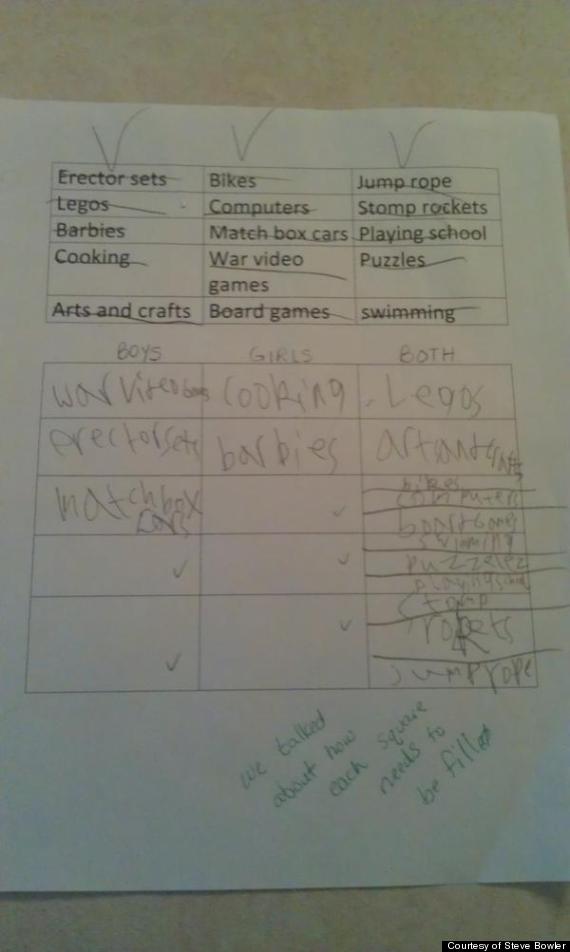
I don’t have a particular issue with this worksheet. I honestly believe that differences exist between genders and understanding these differences can help you as a teacher or parent. My problem is with the teacher’s corrections. This young girl was entitled to respond the way they she did. It was an open-ended task that clearly had no right or wrong answer. By insisting that she fill out the table in a certain way, the teacher is in fact undermining the very nature of the task.

The girl’s father was far less generous about the objective of this activity than I was:

A little girl’s school assignment has generated impassioned debate online after her father, blogger Steve Bowler, sparked outrage by posting the third-grader’s worksheet, which dealt with gender stereotypes.

Dad, who designs and blogs about video games (@gameism on Twitter), pointed out his daughter’s unsuccessful attempt to separate items into three categories: boys, girls and both. On Saturday, he posted her completed worksheet and tweeted: “Proud my 8yo girl failed this worksheet. Wish she had failed it even ‘worse.’ #GenderBias”

Based on the image alone, Bowler tweeted that it looked like his daughter’s class was asked to sort activities and products like “Barbies” and “Erector sets” into gender columns. She crowded all the answers into a column labeled “Both,” and the teacher wrote at the bottom, “We talked about how each square needs to be filled in.”

“My wife brought [the worksheet] to my attention Friday night when we were looking through her schoolwork folder,” Bowler told HuffPost via email, adding that his daughter hadn’t complained about the assignment herself.

Click on the link to read Hilarious Parenting Checklist

Click on the link to read 7 Rules for Raising Kids: Economist

Click on the link to read Dad’s Letter to 13-Year Old Son after Discovering he had been Downloading from Porn Sites

Click on the link to read Mother Shaves Numbers Into Quadruplets Heads So People Can Tell Them Apart

Click on the link to read A Joke at the Expense of Your Own Child

YouTube Video Shows Teacher Being Bullied by Students

November 9, 2012

A video like the one I have posted above can be both a blessing and a curse.

It’s a curse, obviously, because it comes at the expense of a poor, seemingly innocent substitute teacher who was clearly harassed by some of her students. It is quite upsetting that an ever increasing number of students are treating their teachers with the greatest of disdain.

But it’s a blessing too if responded to in a diligent and thorough manner. The wrong way to respond is simply to punish the students involved and leave it at that. The right way to handle such a situation is to realise that such behaviour almost always prevails in an environment that tolerates it. Extreme incidents like this one are almost never one-of-a-kind. I am willing to bet that there have been multiple incidents like this one at this very school that have gone unreported. This footage can make school administrators aware of the likelihood of a bullying culture that can be dealt with by incorporating a number of whole school measures.

Ultimately, a student doesn’t tend to pick on a substitute teacher unless the school culture and his/her classmates tacitly tolerate it. Singular punishments ignores the overriding cultural issues which may be present.

Click on the link to read The Rise of Teacher Approved Bullying (Video)

Click on the link to read Bullies Should Not Be Treated Like Students With Incorrect Uniform

Click on the link to read Social Media: A Playground for Bullies

Click on the link to read Charity Pays for Teen’s Plastic Surgery to Help Stop Bullying

The Psychological Impact of Divorce on Children

November 8, 2012

Many in society figure that since divorce is very common nowadays that the effects on children are far reduced. This is not the case. A child can be in a classroom full of children from broken homes. It doesn’t make their personal pain any less tangible:

Family breakdown is as devastating for today’s children as it was when divorce was a source of social disgrace, a state-backed report warned yesterday. 

Even though divorce is no longer considered ‘shameful’ – as it was until the 1970s – the children of broken families continue to suffer destructive effects throughout their lives, the report said.

The paper, produced by a team of senior academics, found that the damage caused to a child by divorce continues to blight his or her life as far as old age.

It said parental separation in childhood was ‘consistently associated with psychological distress in adulthood during people’s early 30s’.

The report added: ‘This seems to be true even across different generations, which suggests that as divorce and separation have become more common, their impact on mental health has not reduced.’

It comes a week after figures were published showing that almost half of all children have now seen their parents break up by the time they are 15.

The report said that good health depends on lifestyle conditions that it termed ‘social medicines’. Key among these is a stable family background.

The findings undermine the claims of politicians, lawyers and activists who have argued for years that divorce causes no harm to children if parents part amicably and without conflict.

‘Family life has undergone dramatic changes over recent decades,’ the report, produced by a team led by Professor Mel Bartley, said.

‘Families no longer have to have two parents, they can contain children from different parents, and parents no longer have to be of different genders.’

But it warned: ‘More freedom also means less certainty, and this has led to concerns about the impact of family stability on the health and well-being of both children and adults.

‘Family living arrangements are related to children’s physical health.

Click on the link to read Research Suggests That There’s no Such Thing as a Good Divorce
Click on the link to read The Role of Teacher in Helping Students Deal With Divorce
Click on the link to read Don’t Dismiss the Effect of Divorce on a Child
Click on the link to read Teaching Union Wants Porn on the National Curriculum

Helping Kids Cope in the Aftermath of Sandy

November 6, 2012

Courtesy of cnn.com:

1. Children need to be with their family and to feel safe.

Physical reassurance is a great comfort for children. You can give your child a sense of security by physically holding and reassuring them. Use simple sentences, such as, “We are all safe now” or “I will take care of you.”

If your family is in a shelter or somewhere other than home, it’s important to remain together so children feel safe and secure. Displaced children will require more physical comforting and reassurance.

2. Children regain a sense of control by talking about the disaster.

Refrain from telling your child the disaster is “nothing to be afraid of.” Instead, listen to their worries and acknowledge their feelings.

You may gently express your own concerns: “I was worried too when the lights went out” — but follow up with comforting words, such as: “But I was glad we had a flashlight.” Children need to know that their parents understand and share their worries, but it’s best to wrap up the conversation in a positive way.

Katrina, Joplin survivors offer advice to Sandy victims

3. It’s important to talk to children honestly.

At the same time, too much information can be scary and confusing to young children.

Since parents and caregivers often have their own feelings to deal with, this can be a delicate issue. Parents must distinguish between their own and their children’s feelings. It is essential that children are not burdened with the full extent of their parents’ or caregivers’ worries. Share worries in an age-appropriate way.

4. Remain as calm as possible; maintain routines as much as you can.

Adult conversations about the disaster should be reserved for after children have gone to bed or out of their earshot.

Observe usual meal and bedtime rituals, even if there is no light or water. Routines can help provide a sense of security.

If children’s schools and daycare centers are open, keep their routine. Do not keep children at home, but expect them to be more clingy and suffer from more separation anxiety.

5. Expect regressive behavior.

Children may begin sucking their thumbs, wetting the bed, and they may become afraid of being left alone. In general, regressive behaviors will go away in the days, weeks and months following the disaster.

If children’s fears or anxious behaviors persist or if children suffer from delayed reactions, parents should seek professional counseling.


Click on the link to read Explaining Hurricane Sandy To Kids

Click here to read ‘Helping Our Children Make Sense of Natural Disasters’.