Posts Tagged ‘Teacher’

Tips for Teaching an Overcrowded Classroom

July 30, 2014

crowd

Courtsey of Rebecca Alber from the fabulous website edutopia.org:

Tip #1: Don’t Give up on Collaborative Grouping

Students need opportunities to check in with each other around their learning, ask questions, guide each other and reflect together. And this is even more crucial with a large class. If a tight classroom space won’t allow for quick triads or quad grouping, use “elbow partners” — two students in close proximity. Do this often. As we know, with large class sizes, quiet students tend to get even less airtime. With less one-on-one time with small groups and individual students, teachers need to keep that large number of kids talking and being listened to!

Tip #2: Accept that Things Take Longer

Know that a learning objective that maybe took 20 minutes with that smaller class in the past, might take twice as long with this larger group. You might also be lamenting over the days when you could whip around the room and spend a few quality moments with each student or group. Or when you could offer immediate and thorough support. Unfortunately, if you did that now with 35 in the room, you’d find yourself out of time before coming close to accomplishing the daily learning objective.

One remedy, especially when it comes to checking for understanding? Strategies like thumbs up/thumbs down, or having students hold 1 to 3 fingers on their chest to let you know how well they understand (3 is, “I’ve got it!) Other quicky formative assessments, such as sentence starters, can help beat that Time Thief in the room. You can also use exit slips to see if they “got it,” asking one strategic question about the day’s learning.

Tip #3: Find New Ways to Know Students

Unfortunately, the larger the class size, the more the relationships with students suffer. Consider creating surveys once or twice a week where students can answer questions on a likert scale and also ask questions of you. Invite students to write you a letter about their learning, their accomplishments, challenges, and interests.

You can also rotate your focus every few days to 5-6 different students. That way, no one will slip through the cracks. Often with large class sizes, the squeaky wheels, so to speak, are the one’s that receive much of the teacher’s time. Make sure you check in regularly with your “proficient” students, and continue to create differentiated assignments for those gifted kids in the room.

Tip #4: Be Okay with Loud and Letting Go

Start saying this mantra immediately, “just because it’s loud doesn’t mean they aren’t learning, just because it’s loud…” Somewhere along road, we began to attribute silence to deep thought and high-level learning. It’s more often just a sign of kids being compliant. So go ahead, take those 37 kids and put them in groups! Give them a challenging task and some supplies. Let it be loud! Roam from group to group and if your door suddenly swings open to visitors from the district… Let them get an eye full of engaged, enthusiastic learners!

As for the letting go, if you are still passing out papers, collecting supplies, stamping homework all on your own — stop. Assign students “jobs” immediately. By giving up these managerial tasks, you will have more time free to check in with a child who has been absent a lot, add a step to an assignment for that advanced student, crack a joke with the quiet, moody teen who avoids others, or pose a strategic inquiry question to the whole class.


Click on the link to read The Most Over-Crowded Classroom in the World (Photo)

Click on the link to read Meet the School Consisting of Only 1 Teacher and 1 Student

Click on the link to read Classroom Free Schools

Click on the link to read Teaching 150 Students in the One Classroom!

Click on the link to read What is the Perfect Class Size?

When Teachers Prank Their Students (Video)

July 28, 2014


I just love it when teachers go to the trouble to make their students laugh. Laughter in the classroom, when it isn’t at someone’s expense, adds so much to the environment.

Take the above April Fools Day prank this teacher organised.


Click on the link to read 18 Tips For Getting the Best Out of Your Students

Click on the link to read Michael Michalko’s 7 Principles of Creative Thinking

Click on the link to read Why Many Teachers Don’t Bother Making Their Lessons Interesting

Click on the link to read Why is it Always the Kids’ Fault?

Click on the link to read Student Shot by Teacher Protests His Sacking

Click on the link to read Science Not For the Faint Hearted (Video)

18 Tips For Getting the Best Out of Your Students

July 17, 2014

Courtesy of teachthought.com:


reach


Click on the link to read Michael Michalko’s 7 Principles of Creative Thinking

Click on the link to read Why Many Teachers Don’t Bother Making Their Lessons Interesting

Click on the link to read Why is it Always the Kids’ Fault?

Click on the link to read Student Shot by Teacher Protests His Sacking

Click on the link to read Science Not For the Faint Hearted (Video)

Click on the link to read 7 Tips for Building a Better School Day

Teacher Threatens to Give Away TV Show Spoilers if Class Misbehaves

March 23, 2014

game of thrones

Well here is a novel way of getting rowdy students to quieten down:

A maths teacher apparently decided to up the ante by threatening to reveal Game of Thrones spoilers to his misbehaving students.

One day while teaching in a noisy classroom, the educator asked who watched Game of Thrones, to which the majority raised their hands.

‘Well, I’ve read all the books,’ he told them. ‘If there is too much noise, I will write the name of the dead on the board. They are enough to fill the whole year and I can even describe how they die,’ reports nieuwsblad.be.

Those troublemakers who took it as an empty threat soon found themselves living to regret it when the teacher proceeded to write the names of those killed off in the third series on the board.

Unsurprisingly, the class got back pretty sharpish to working on long division and the like in silence after that.

Click on the link to read Teacher Called Cops Because Students Planned to Sabotage Class Photograph

Click on the link to read Teachers are Better with a Sense of Humour (Photo)

Click on the link to read Would You Want Your Teacher Chair Replaced by a Yoga Ball?

Click on the link to read Worst Examples of Teacher Discipline

Click on the link to read Why Students Misbehave

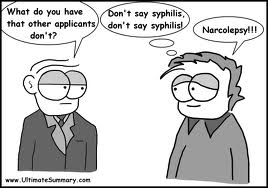
The Most Common Questions Teachers Are Asked at Job Interviews

January 29, 2014

job interview

I stumbled on a brilliant article in the Guardian where Head Teachers share the questions they regularly ask at job interviews and the rationale behind their questions.

I hope this article comes in handy next time you interview for a new teaching position:

If I walked into your classroom during an outstanding lesson, what would I see and hear?

“I’d like to hear about: animated discussions, students clearly making progress as evidenced in oral and written contributions. High quality visual displays of students’ work showing progress. High levels of engagement. Behaviour that supports learning.”

Helen Anthony, head teacher, Fortismere school

“After hearing a candidate’s response I try to get them to talk about their experiences in the classroom. I try to get a sense of the impact that they have had on pupils’ achievement.”

Tim Browse, head teacher, Hillcrest primary school

• Why do we teach x in schools?

“This question really throws people. If it is maths or English they sometimes look back at you as if you are mad. They assume it is obvious – a very dangerous assumption – and then completely fail to justify the subject’s existence.

“Whatever the subject, I expect to hear things like: to improve skills and independent learning; to encourage team work; to gain a qualification; for enjoyment (very important, rarely mentioned); to enhance other subjects; to develop literacy, numeracy and ICT skills; to improve career prospects; self discipline; memory development; to encourage life-long learning in that subject. The list goes on…”

John Kendall, head teacher, Risca community comprehensive school

• Can you tell me about a successful behaviour management strategy you have used in the past that helped engage a pupil or group of pupils?

“This allows candidates to give a theoretical answer – one that anyone who swotted up could give you – balanced with a personal reflection that shows how effective they are.”

Tim Browse, head teacher, Hillcrest primary school

• If you overheard some colleagues talking about you, what would they say?

“This is one of my favourite questions (it’s based on a question my National Professional Qualification for Headship (NPQH) coach used to ask me) because it gets candidates to think about their contribution to the school organisation and their team spirit. If I’m interviewing for a senior leader I would follow this up with: what would you want them to say about you in three years time? This way I can get a sense of where they want to develop as leaders.”

Tim Browse, head teacher, Hillcrest primary school

• Why do you want to work in special education?

“We’re looking to see that the person genuinely recognises that we’re in the business of education as opposed to simply caring for the children (surprisingly, some applicants don’t really see it that way).”

Sean O’Sullivan, head teacher, Frank Wise school

• Why do you want to work in this school?

“We want to see clear indications that candidates have done background work about our school and can talk about why the way we work appeals to them. We’d always want candidates to have visited the school so they should be able to flesh this out with specific examples of what they thought based on their visit.”

Sean O’Sullivan, head teacher, Frank Wise school

• A question that is specific to the candidate’s letter of application

“A candidate may have made a grand statement in their letter, but not gone into details about ‘how’ or the impact it had.”

Tim Browse, head teacher, Hillcrest primary school

• What are the key qualities and skills that students look for in teachers?

“Liking young people. Fairness. Consistency. Sense of humour. Passion for their subject. Good at explaining new concepts/ideas. Able to make the topic or subject relevant. Able to make everyone feel comfortable and confident about contributing.”

Helen Anthony, head teacher, Fortismere school

• Evaluate your lesson

“Teaching a one-off lesson in an unfamiliar school with students you have never met before is a difficult task, but a useful one for candidates and those making the appointment. The evaluation of the lesson by the candidate is crucial. I need to see someone who can be self-critical but who also recognises when things go well. Someone who makes suggestions as to how the lesson may have gone better, what they would do differently with hindsight. I like to hear them talk of the individual student’s progress in the lesson, and how they would follow it up. Remembering pupils’ names is always impressive. I’d rather see an ambitious lesson that goes a bit awry than a safe boring one.”

John Kendall, head teacher, Risca community comprehensive school

• If we decided not to appoint you, what would we be missing out on?

“This is great as it enables candidates to sell themselves and really tell us what they are about.”

Brett Dye, head teacher, Parc Eglos school

Click on the link to read The Profession You Choose When You Don’t Want to Get Fired

Click on the link to read The School They Dub the “Worst Primary School in the World”

Click on the link to read Education New Year’s Resolutions 2014

Click on the link to read Eight Fundamentals that Every Student Deserves

Click on the link to read 21 Reasons to Become a Teacher

How Many Teachers Does it Take to Change a Light Bulb? (Part 1)

January 28, 2014

bulb

Courtesy of educationrethink.com:

Principal: I’ll get back to you on that.

Superintendent: There’s a lightbulb out? I’ll ask the Board of Education if we have any money for them.

Board of Education: The schools have enough lightbulbs. They don’t need any more.

State Department of Education: Teachers will fulfill measurable lightbulb-changing objectives based on a pre-assessment and post-assessment.

PD Coordinator: I need to develop a Lightbulb Theory Training with clip art lightbulbs and Comic Sans font. Can anyone tell me what Marzano said about lightbulbs?

Standardized Test: A) 2 B) 3 C) 3.14 D) Pineapple

Federal Government: “We see you have been changing lightbulbs but we don’t think you have been changing enough of them fast enough. All lightbulbs must be changed at a 100% rate each year or you will lose money for lightbulbs.”

Taxpayers: Why are our tax dollars being spent on things like lightbulbs?

Teach for America: The lightbulbs are going out, because the engineers are lazy slobs. Let’s replace them with someone who went through a month-long training course on engineering.

Parent: Why didn’t you call me two weeks ago to tell me the lightbulb was going to go out?

Union: This isn’t in the contract. It’s the custodian’s job.

Movie Tagline: Some lightbulbs, they said, would never be changed. She inspired them so they could be.

RT @participantname: We should think beyond the lightbulbs and inspire the light to light the bulb itself.

Education Conference Attendee: I just was so INSPIRED by that wonk’s keynote about changing lightbulbs!

Techie Reformy Post: Eventually lightbulbs will replace teachers. Kids can find the light. You don’t have to do it for them.

Student: [says nothing and doesn’t notice lightbulb is out because he/she is texting]

#stuvoice: Why is the teacher the one changing lightbulbs? Every kid should have their own lightbulb.

Maker Movement: Kids will make lightbulbs if you get out of the way and leave them alone.

Unschooler: We don’t need lightbulbs. That’s a part of factory/industrial mindset. Kids should be playing out in the sun all day.

Homeschooler: Even though the lightbulbs are exactly the same, the ones in my home are better than the ones at school.

#edchat: How do we change professional development so that teachers start changing lightbulbs instead of complaining that the bulbs are dead?

#edtech: Check out these 95 coolest, super-amazing, LED lightbulbs that will revolutionize classroom space.

2,000 retweet Twitter post: You have to think outside the bulb. #lightchat #bulbchat

TED Talk: Everything you thought you knew about light bulbs is wrong and I’m here to tell you why.

Tumblr Teacher Post: Here’s a .gif of a flashing lightbulb and a quote by Dewey about enlightening minds. Hope this helps.

This American Life: I’m not sure how many it takes, but I think we could learn something from a counterintuitive human interest story on lightbulbs. I’ll narrate it in a near-whisper.

Time Magazine: Why Teachers Are the Real Reason for Busted Lightbulbs and How Michelle Rhee Will Fix It

Internet Magazine: How An Amazing Way a 3rd World Teacher Changes Lightbulbs and Occasionally Refurbishes Lightbulbs from the Dump

Politician: Why do Finland’s lightbulbs work so much better than ours? I’ll ignore the evidence and assume that their bulbs and their entire electric grid must be decentralized.

Teacher: Actually, I did it 35 minutes ago.

Click on the link to read How Many Teachers Does it Take to Change a Light Bulb? (Part 2)

Teacher Accused of Stealing Food from her Students

December 3, 2013

OK, I admit it.  On one or two occasions I have asked for and received a potato chip from my students’ lunch.

But there is no way I would ever deprive my students of their packed lunch:


A Waikato kindy teacher was caught stealing food from children’s lunchboxes before either eating it, hiding it or putting it in her pocket.

The case is one of more than a dozen of serious misconduct at Waikato education providers in the past five years.

The 16 cases include sexual relations between teachers and students, sexual violation, possessing child pornography, and convictions for drugs and threatening to kill.

It is the first time that disciplinary decisions specific to Waikato teachers can been revealed as, until now, the Teachers Council has kept all location and identifying details secret.

The council initially refused to provide the information and it has taken more than five months for the Times to obtain it via the Official Information Act.

Teacher Gift Ideas

December 1, 2013


apple

Personally I appreciate any kind gesture, but I would have to say that the parents who bought gifts for my kids were on to a winner. Not only was I deeply grateful for their thoughtful gift but I was a real hit back home.

Below is a list of gift ideas courtesy of teacher Kathy Mathews:


1. Gift cards – I personally adored Starbucks gift cards. I would get a bunch of 5.00 cards and transfer them all to my Paul McCartney Starbucks card. I would stop for a treat every on my way to work and be wide awake all the way to Valentine’s day. Target was my second most common gift card and I loved those also. Both are great choices.

2. A written note or card – I saved every single one of these that I got and they are still upstairs in a bin in my sewing room. You really don’t need to spend any money, heartfelt thanks from your child is a fabulous gift.

3. A glowing email to the boss – Every once in a while a parent would email my principal or superintendent and cc me in. One parent even wrote the newspaper! It was terrific, I can’t tell you how much I loved it. Let’s just say most parents who email or call the teacher or the principal are not doing it to praise.

4. A small item for the teacher’s hobby – I had a student whose Mom got me a small quilting iron for getting in corners. I was blown away! This is a tricky one to copy as you have to know the teacher’s hobby.

5. An item which matches the teacher’s passions – I love U of I and the Cubs. I had students give me pennants or cute signs. I put them on the walls of my classroom and when I retired I decorated all the walls of my garage and I smile every time I pull the car in.

6. School supplies – We had a very small budget for supplies and all the rest came from our personal money. (Or what we could “borrow” from our husband’s office.) I once had a parent give me a gift bag of post it notes. I was in 7th heaven!

7. Small item related to the subject matter – I taught Spanish and French. I had students bring me back small items like Eiffel Towers or Mexican vanilla from trips to the country. I love those! (I also got margarita glasses from a parent once back when things were a little less regimented in schools. I actually liked them but I wouldn’t recommend an alcohol related gift.)

8. Ornaments – I know there are teachers groaning out there but I liked teacher ornaments and I still have some I received on my tree.

9. Bags – Teachers are all bag ladies. I once had a parent give me a Lands End canvas bag with my name embroidered on it. I still have it and will have it forever. All cute bags are welcome.

10. Books – I have gotten lovely art or travel books about Spain, France and Mexico. They are still on my book shelves.

I do want to add there are gifts I would avoid. Teachers have allergies and restrictions. I would  NOT recommend the following.

No food – No pets – No fancy smelling soaps and lotions – Please, no small decorative items – Mugs are cute, they are. But how many can you use? And I feel compelled to add no cash or booze.


Click on the link to read The Importance of a Second Chance

Click on the link to read I Also Had a Student Hold a Toy Gun to my Face

Click on the link to read Who is Going to Stand Up For Bullied Teachers?

Click on the link to read 12 Tips for Managing Time in the Classroom

Click on the link to read If Teachers Were Paid More I Wouldn’t Have Become One

Click on the link to read Different Professions, Same Experiences

Why Isn’t There Tougher Penalties for Teachers who Abuse their Students?

November 27, 2013


mad

Every day whilst looking for topical news stories in education I am forced to sift through the myriad of articles relating to teachers who have sexually groomed and assaulted their students. To say this is a heinous crime is a gross understatement.

But how are we as a society supposed to adequately safeguard our precious children when many of these convicted criminals are spared any jail time at all!

Take this case for example:

A St. Charles County teacher accused of molesting students four different times will not spend time in prison.

Joseph Maddock, 34, is out on the streets, free to walk, but he is now a registered sex offender, has lost his teaching license and will be monitored for the next five years. Also, the victim’s mother is okay with all of this.

Prosecutors say Joseph Maddock has a pattern of “grooming” young boys that he teaches, not fully sexually abusing them, but getting too close to them and touching them.

Maddock has taught in 11 different schools mostly in the St. Louis area, but most recently at Andrews Academy and Dynamic Pathways both of Lake St. Louis.

Prosecutors say the “grooming” has happened four times, once in Florida, twice in the St. Louis area, but most recently in St. Charles County, where he has been charged and convicted of the sexual act. On Monday, he was sentenced to five years probation and no jail time.

“He needs to be in jail because children are very susceptible to grown ups and what they think is right and wrong and this was definitely wrong,” said Brian Voss, a St. Charles resident.

“I hate to say it, but it sounds fair to me because nothing really happened,” said Patti Bussgude, another resident.

St. Charles County assistant prosecutor Jillian Anderson says they had to make a decision.

“Perhaps we do not file it at all because we don’t have the full commission of sexual abuse or perhaps we decide that the community is best served by intervening early and doing something,” said Anderson.

She says no, this sentence is not as severe as it would be if the assault had been worse. If Maddock had fully sexually assaulted the child, jail time would have most likely been given. For this prosecuting attorney’s office, doing nothing is not an option.

“We certainly don’t want to be in a position and are not going to be in a position in our office where we wait, we sit back and we don’t file charges until this defendant or any other defendant actually fully commits the crime of sexual abuse,” said Anderson.


Monitored for the next five years? Come on! After four separate offenses? He should be monitored to his dying breath!


Click on the link to read Teacher Allegedly Published the Grades of her Students by Writing on their Foreheads

Click on the link to read You Can’t Foster Tolerance With Racist Teachers

Click on the link to read The Teacher that Defended Hitler and Child Abuse and Advocated Porn

Click on the link to read The Worst Thing a Teacher Can Ever Say to a Student

Click on the link to read A Teacher Who Beds their Teenage Student Should be Jailed

Click on the link to read My Teacher, the Pedophile

Click on the link to read Teacher Strip Searches Students in a Bid to Catch them Cheating

50 Things You DON’T Have to do to Maintain Classroom Management

September 15, 2013


manage

Courtesy of the brilliant site smartclassroommanagement.com:


1. You don’t have to lecture, yell, or scold.

2. You don’t have to micromanage.

3. You don’t have to ignore misbehavior.

4. You don’t have to be unlikable.

5. You don’t have to tolerate call-outs and interruptions.

6. You don’t have to use bribery.

7. You don’t have to walk on eggshells around difficult students.

8. You don’t have to give false praise.

9. You don’t have to send students to the office.

10. You don’t have to implore your students to pay attention.

11. You don’t have to say things you don’t truly believe.

12. You don’t have to be humorless, stern, or overly serious.

13. You don’t have to repeat yourself over and over again.

14. You don’t have to work on building community.

15. You don’t have to beg or coax or convince your students into behaving.

16. You don’t have to waste time and attention on difficult students.

17. You don’t have to do more or say more to have better control.

18. You don’t have to show anger or lose your cool.

19. You don’t have to lower your behavior standards.

20. You don’t have to talk so much, so often, or so loud.

21. You don’t have to have an antagonistic or demanding relationship with difficult students.

22. You don’t have to shush your students or ask repeatedly for quiet.

23. You don’t have to give frequent reminders and exhortations.

24. You don’t have to show hurt or disappointment to get your message across.

25. You don’t have to guide, direct, or handhold your students through every moment of the day.

26. You don’t have to be thought of as a “mean” teacher.

27. You don’t have to use threats or intimidation to get students to behave.

28. You don’t have to have friction or resentment between you and any of your students.

29. You don’t have to use behavior contracts to turn around difficult students.

30. You don’t have to give over-the-top or gratuitous praise.

31. You don’t have to plead with your students to follow your directions.

32. You don’t have to use different strategies for different students.

33. You don’t have to tolerate a noisy, chaotic, or unruly classroom.

34. You don’t have to talk over your students or move on until you’re ready.

35. You don’t have to accept being disrespected, cursed at, or ignored.

36. You don’t have use complicated classroom management methods.

37. You don’t have to be fearful of holding your students strictly accountable.

38. You don’t have to hold time-consuming community circles or hashing-out sessions.

39. You don’t have to be negative or critical to motivate your students.

40. You don’t have to cover up your personality or hold back from having fun.

41. You don’t have to tolerate arguing and talking back.

42. You don’t have to ask two or three times or more for your students’ attention.

43. You don’t have to offer praise for expected behavior.

44. You don’t have to rely on parents, the principal, or anyone else to turn around difficult students.

45. You don’t have to be overbearing or suffocating to have excellent control.

46. You don’t have to give incessant talking-tos to difficult and disrespectful students.

47. You don’t have to ask students why they misbehaved or force assurances from them.

48. You don’t have to have a boring, no-fun classroom to keep a lid on whole-class misbehavior.

49. You don’t have to be tense, tired, and sick of dealing with misbehavior.

50. You never, ever have to be at the mercy of your students.


Click on the link to read Ten Tips to Minimise Classroom Distractions

Click on the link to read 6 Methods For Getting Kids to Cooperate

Click on the link to read 10 Important Steps to Stop Yelling at Kids

Click on the link to read Classroom Management is Getting Harder

Click on the link to read The Dog Eat Dog Style of Education

Click on the link to read Problem Kids, Suspensions and Revolving Doors