Posts Tagged ‘Parenting’

Don’t Look for Rolemodels from Our Sporting Stars

March 4, 2013

athl

Tiger Woods, Lance Armstrong and Oscar Pistorius are just some examples of sporting stars with immense talent who were looked up to by impressionable children only to be exposed as dubious role models.

Whilst it is quite natural for our children to seek out celebrities and athletes as role models, and some in fact live up to that label, it is important that children see that looks, strength, charisma and humour are subservient to empathy, kindness, integrity and respect. These latter characteristics are often found not by footballers or lead singers but my ordinary individuals within the community.

Recently I was alerted to the video I have attached below. It features a soccer goalkeeper fainting on the field out of heat exhaustion. Do the opposing players come to his aid and help him? Not at all! Watch what happens next:

Click on the link to read Our Real Heroes are Not Celebrities or Athletes

Click on the link to read Girl Writes Cute Note to the Queen

Click on the link to read Instead of Teaching a Baby to Read, Teach it to Smile

Click on the link to read The 15 Most Commonly Misspelled Words in the English Language

Click on the link to read Who Said Grammar Isn’t Important?

Click on the link to read Why Spelling is Important

The Benefits of Reading to Your Kids

March 4, 2013

read

If you aren’t already reading to your kids, I highly recommend that you do:

MELBOURNE researchers have proven what parents have intuitively known all along – the more often you read to your children from an early age, the greater the positive effect on their reading and thinking skills.

The Melbourne Institute of Applied Economic and Social Research has not only proven a causal effect between the frequency of reading to a child and his or her development, but have also for the first time measured the benefits.

Children four to five years old who are read to three to five times a week have the same reading ability as children six months older (who are read to only twice or less a week).

Reading to children six to seven days a week puts them almost a year ahead of those who are not being read to. It was also found that reading to small children has a positive effect on the development of numeracy skills.

”It does appear to be the case that children who are read to more often keep doing better as they age than other children,” said Professor Guyonne Kalb, director of the institute’s Labour Economics and Social Policy Program, and co-author of the study.


Click on the link to read Why Spelling is Important at Starbucks

Click on the link to read The Ability to Spell is a Prerequisite for Getting a Tattoo (Photos)

Click on the link to read This is What Happens When You Rely on Spell Check

Click on the link to read Hilarious Menu Items Lost in Translation

Click on the link to read The 15 Most Commonly Misspelled Words in the English Language

Click on the link to read Who Said Grammar Isn’t Important?


If Only All Special Needs Students Were Treated this Way

February 27, 2013

What a fitting and miraculous end to an absolutely amazing story. I hope this gets played in classrooms all over the world:

A special needs student from a Texas high school scored a basket in the final game of the season after a player from the opposing team gave up the ball.

Mitchell Marcus, a teenage student at Coronado High School in El Paso, Texas, is the team manager for the Coronado Thunderbirds and an avid basketball fan. During the last game of the season on Feb. 12, Marcus, who has a “developmental disability,” was given the chance to play, according to Fox local affiliate KFOX 14 in El Paso. With 90 seconds left, Coach Peter Morales put Marcus into the game.

Mitchell’s a great shot,” his mother Amy told KFOX. “He took his first shot and missed. It hit the rim. You just hear the whole crowd sighing. It went out of bounds and Franklin got it. We all knew that he wasn’t going to have his chance.”

Then, Jonathon Montanez, a senior at Franklin High School and a member of the opposing team, down by 10 points, tossed Marcus the ball. “Since we were down and there was only 13 seconds left, might as well give Mitchell his last shot,” Montanez told KFOX.

Marcus finally scored, and the crowd went wild.

A video of the game and Marcus’ basket went viral after being uploaded online.

CBS News correspondent Steve Hartnan knew he wanted to tell Marcus’s story. “It’s America at its best,” he told the El Paso Times. “When I grew up, kids like Mitchell got picked on, and to see how far we have come along is touching. I get emotional thinking about it.”

NBC Southwest station KTSM first reported on Marcus’ story the day after the game, calling it “the play of the year.”

“I was so happy then,” Marcus said about his shot. “It made my night.”

Over the past three years, Marcus has helped the Thunderbirds earn a No. 1 ranking in the city of El Paso.

Coach Morales spoke with ESPN’s El Paso radio station, KROD, about Marcus’s amazing experience.

“This kid is very very loyal to your program,” Morales told ESPN radio. “He’s dedicated. We’ve had kids that come to this program and play with us and this kid has been more loyal than some of those kids to us because he wants to be here.”

Click on the link to read I am a Proud Defender of the Mixed-Ability Classroom

Click on the link to read The Difficulties of Parenting a Special Needs Child

Click on the link to read Schools Have to Wake Up to Confidence Issues Amongst Students

Click on the link to read Would You Notice if Your Child Was a Bully?

Click on the link to read Labelling Children is Extremely Harmful

Click on the link to read The Insanity of Modern Educational Thinking

Parody of Oscar Nominated Movies Featuring a Cast of Adorable Kids

February 25, 2013


Click on the link to read Hilarious Parenting Checklist

Click on the link to read 7 Rules for Raising Kids: Economist

Click on the link to read Dad’s Letter to 13-Year Old Son after Discovering he had been Downloading from Porn Sites

Click on the link to read Mother Shaves Numbers Into Quadruplets Heads So People Can Tell Them Apart

Click on the link to read A Joke at the Expense of Your Own Child

Horrible Video of Young Girls Forced to Fight Goes Viral

February 24, 2013

These poor children deserve much, much better than this.

Click on the link to read A Case of Parenting at It’s Worst

Click on the link to read The Most Popular Lies that Parents Tell their Children

Click on the link to read Dad’s Letter to 13-Year Old Son after Discovering he had been Downloading from Porn Sites

Click on the link to read A Parent that Means Well Doesn’t Always Do Well

Click on the link to read A Joke at the Expense of Your Own Child

Do You Vet Who Your Children Play With?

February 21, 2013

kids

I think it’s entirely appropriate to try to have your children playing with friends that will be a good influence on them. What might not be so appropriate is judging children based on jewelery, gadgets, lateness to school and grades.

Katie Hopkins has taken things way too far and let her controlling and apparent judgmental instincts get the better of her good intentions.

What troubles me greatly with her flawed system is that she has confused ‘under performing’ kids with’ bad influences’. This mistake is extremely offensive to good-natured, highly respectable and courteous children from loving homes who are discriminated by her due to their Maths average. Similarly, it might have been best for the families of her children’s classmates, that they were left in the dark about her scheme:

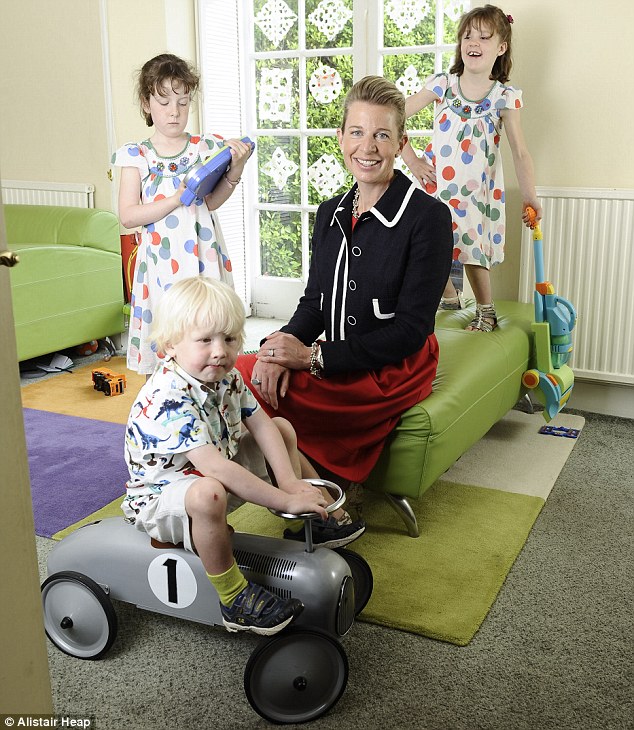
Call me controlling, call me ruthlessly aggressive. But I’m convinced one of the best things I can do for my children – India, eight, Poppy, seven, and Max, four – is to choose their friends for them.

I target children that I think will be a good influence and curtail friendships with children I think will drag them down.

I know I’m not alone, either. If they’re honest, I think most caring mothers do exactly the same.

They’re just too embarrassed to admit it.

So I wasn’t a bit surprised to learn last week that a study confirms exactly what I  have always believed. Academic success is infectious. Pupils ‘catch’ cleverness from their friends.

I have absolutely no intention of letting my two precious daughters get dragged down into the quagmire of underperforming children. So I work hard at targeting the right sort of friends for them.

From the moment they started school, I have kept an ear out for little snippets of information about their classmates. I know who is falling behind and who is clearly not interested in their work or study.

My state primary school doesn’t stream children academically but you don’t need to be a genius to work out who is clever and who, most definitely, is not. For example, hearing that a child has finished their home learning book (we used to call it homework) and asked for another is music to my ears. It means the parents are investing time and trouble in their child’s education.

When one of my girls came home last week and announced that a classmate had filled up her star sheet for good behaviour, I made a mental note of the child’s name for future reference.

She is clearly the type of child who is eager to learn, ambitious and wants to work hard in order to be rewarded with success. And that is the type of child I want my daughters to play with and to learn from.

This brings me back to a problem I’ve had regarding the influx of parenting advice and parenting themed self-help books. The industry has been hijacked by do-gooders who wish to spend less time showcasing their strategies and more time criticising other parenting methods. Take this excerpt from the same article for example:
If his parents can’t be bothered to get him into class on time, they clearly don’t care about the  education of their child – and, worse still, are hindering the learning of others. My girls are as frustrated with this continual tardiness as I am. Is it beyond the wit of a parent to get their child to school on time?

When I hear my daughters talking about children who have all the latest gadgets – whether it’s an iPhone or iPad – I’m instantly on my guard because they definitely won’t have time to devote to homework. As a result, I will discourage any friendship.

At the risk of sounding snobbish, I also favour children who have good old-fashioned Victorian names such as George, Henry and Victoria. And, if a child has a name with a Latin or Greek derivation such as Ariadne or Helena, all the better. It indicates the parents are well educated.

And then there is this …

I am convinced that my tactics are paying off. Recently I asked India which children she liked to play with.

‘The children who come to school on time and wear proper school uniforms are the nicest and the most fun,’ she told me. ‘If children don’t put any effort in, I don’t want to play with them.’

My younger daughter, Poppy, is attracted by the wild side and I have no doubt that, left to her own devices, she would choose friends who would be a bad influence on her.

When she was four she asked if she could have her ears pierced like a (male) classmate. I, of course, said no. I cannot understand why the parent of this child would think it was acceptable.

Recently she asked for a Nintendo after she played on one during a class trip. The boy sitting on the coach next to her had sneaked it into his bag.

‘But you know that children aren’t supposed to bring in electronic games equipment,’ I said. ‘So what on earth were you doing sitting next to him when you knew he was doing the wrong thing?’ That hammered my message home.

Primary Children Caught Playing ‘The Raping Game’

February 17, 2013

stan

When we used to play it, we called it ‘tag’:

Primary school children have been banned from playing a new break time game they called ‘the raping game’.

The playground activity had been named after a violent video game which depicts violent sexual assaults on a mother and two daughters.

More than a dozen boys, some as young as nine, were caught playing the ‘the raping game’ at Stanford Junior School in Brighton, East Sussex.

The school confirmed it had been taking place and headteacher Gina Hutchins said she had spoken to children about the vile name. It has now been called ‘the survival game’ following the head’s intervention.

Mrs Hutchins said: ‘As soon as we found out that this inappropriate word was being used, we spoke to the children concerned and they now no longer use it.’

The game has been played mainly by boys in Year 5 at the school for the past two to three weeks.

It involves one person being ‘on’ who has to catch others until only one is left uncaught and that person is the winner.

About 13 boys, aged nine and ten, played the game in the school playground but have since changed the title.

One concerned parent said: ‘I was horrified that my son had learnt that word.

‘He is only nine. Thankfully he did not know what it meant but it was that horrible thought he might use it elsewhere.

‘Most people assume children learn these words at home.’

The parent added she did not blame the school saying it is almost impossible to stop children bringing words into the playground.

They commended the headteacher for her swift actions in taking decisive action and stamping out the use of the word.

It is unsure what video game led to the naming of the game, but several on the market contain scenes of rape.

One game called Rapelay sees the main character try to rape a mother and two daughters.

Love According to Children

February 14, 2013


Happy Valentines Day!


Click on the link to read The ‘Meanest Mother’ Isn’t Mean at All (Photo)

Click on the link to read The Most Popular Lies that Parents Tell their Children

Click on the link to read The Innocence of Youth

Click on the link to read Kid’s Cute Note to the Tooth Fairy

Click on the link to read A Joke at the Expense of Your Own Child

Principal Trying to Educate Parents Against Using Slang

February 6, 2013

slang

A truly brave yet worthwhile initiative:

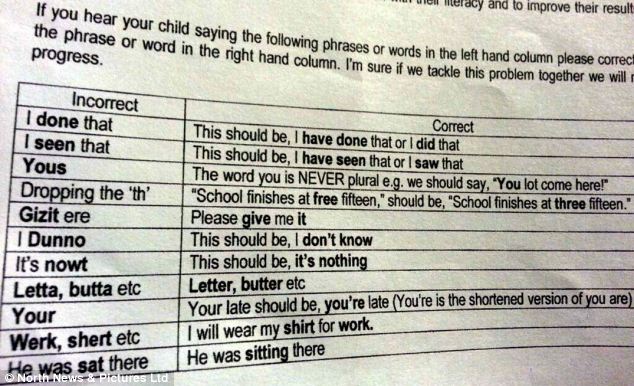
Parents have been sent letters from a school urging them to stop their children using phrases such as ‘it’s nowt’ and ‘gizit ere’.

Sacred Heart Primary School, a Roman Catholic Voluntary Aided school, warned against ‘problem’ phrases and criticised children using pronunciations, such as ‘free’ and ‘butta’ instead of ‘three’ and ‘butter’.

The letter spells out 11 ‘incorrect’ phrases. ‘I done that’ and ‘I seen that’ were blacklisted, and parents were reminded that ‘yous’ should not be permitted because ‘you is never a plural’.

Carol Walker, Sacred Heart’s headteacher, defended the letter, saying: ‘We would like to equip our children to go into the world of work and not be disadvantaged. 

‘We need the children to know there is a difference between dialect, accent and standard English.

‘The literacy framework asks children to write in standard English.

‘I am not asking the children to change their dialect or accent but I don’t want them to enter the world of work without knowing about standard English.’

Parents seemed broadly in favour of the language initiative, though they were taken aback to receive the letter.
Cheryl Fortune, 35, a school escort for Middlesbrough Council and parent at Sacred Heart, said: ‘When I saw it I was a bit shocked. I thought my kids are only eight and five, so it is a bit extreme.‘If I am honest though my eldest son said “yeah” last night and my youngest said “it’s yes”, so he corrected him. I can understand why the school has done it, to encourage people to speak properly.’

Carol Walker, the headteacher at Sacred Heart, who is focusing on her pupils’ competitiveness in the workplace

Another parent, engineer Chris Allinson, 31, hadn’t seen the letter but thought it was a good idea.

He said: ‘I try to correct my daughter Jasmine’s speech if she says things wrongly. I want her to get the best start in life.’

Sacred Heart is not the only school where accent is an issue.

Essex school children at the Cherry Tree Primary School in Basildon are being offered elocution lessons after teachers complained that the accent was affecting their grammar and spelling. 

Children as Young as 5 are Self Harming

February 5, 2013

Concept of a young injured girl being a victim of child abuse

We have a huge self-esteem crisis facing our young and unless we stop picking on how they express their emotions rather than the feelings that brought them on we are going to see more self-harm and greater incidents of depression, anxiety, obesity and suicide:

Children as young as five are harming themselves, in a worrying epidemic that is sweeping the country, ChildLine has warned.

The charity says that it is no longer just teenagers who are self harming, but they are also receiving calls from five-year-olds.

The charity says that it has also seen a surge in the number of girls aged 10 to 14 self-harming and recorded a 30 per cent rise in boys who are deliberately hurting themselves.

Chris Leaman of charity Young-Minds, told The Daily Mirror that in some parts of the UK the number of young people self-harming had reached ‘almost epidemic’ proportions.

Research has suggested that self-harm is most common among 15 to 19-year-olds, and those suffering from anxiety and depression, according to the NHS.


Click on the link to read Schools Putting Spy Cameras in Toilets and Change Rooms

Click on the link to read Is There No Better Way to Teach Fitness to Kids than Pole Dancing?

Click on the link to read The Courts are Pathetic in Punishing Paedophiles

Click on the link to read Shops Should Stop Selling “Sexy” Clothes for Children

Click on the link to read The Toy that Stopped a Child Porn Ring