What kind of policy prevents young children from applying sun block? How on earth can schools proclaim to be looking after the welfare of their students when they would rather see them burn in the sun than let them apply lotion?
Two young girls had to go to the hospital with severe sunburns after a Washington state school forbid the sisters from applying sunscreen during an outdoor field day.
Jesse Michener said she was horrified when her two daughters, Violet, 11, and Zoe, 9, came home from school Tuesday sporting “hurts-to-look-at” burns after spending five hours outdoors with no protection, according to a post on the mom’s blog.
Michener said she didn’t rub sunscreen on her kids because it was raining when they left for school. She argued that even if she did apply the much-needed block, the school wouldn’t have let the girls reapply to maintain protection due to a “deeply flawed” school policy.
Children in all states except for California are not allowed to apply or bring the product to school, ABC News reports, partially because it is considered a medication.
Sunblock – a medication? So let me get this straight. The same school system that is going berserk when it comes to recommending children be prescribed ADHD drugs such as dexamphetamine and methylphenidate, prevent children from applying sun protection on the grounds that it’s a medication?
If I taught under such twisted logic I would risk my job over this issue. I would seek parental information regarding allergies and written permission from them to allow their children to put on sun block. No doctors certificate, no consultation with policy makers and hopefully, no sun cancers on innocent children raised under a stupid, incoherent and irrational system.
More horrible news that will taint our wonderful profession:
A Southern California high school teacher has been arrested on suspicion of directing students to assault another student in a classroom hazing incident.
Fontana police said Sunday that 27-year-old Emmanuel De La Rosa, along with four other students, were arrested on Saturday.
Police alleged that De La Rosa facilitated some students to carry out the hazing to curb behavioral problems in the classroom at AB Miller High School. Police declined to describe the nature of the hazing, citing the ongoing investigation. At least one student suffered minor injuries.
The Riverside Press-Enterprise reports (http://bit.ly/Ocffl5) that an 18-year-old student arrested in the case faces charges of assault, child cruelty and attempted sodomy.
De La Rosa was booked for investigation of child endangerment.
I have traditionally been against the installation of cameras in classrooms. My view was that such an initiative would show disrespect for the teacher and make them feel insecure and constantly scrutinised. I also felt that it would weaken the teacher’s authority.
But with the proliferation of secret cell phone videos that have made its way to YouTube, I wonder if it’s in the best interest of teachers and students alike to have cameras installed in the classroom. This will stop children from filming their teachers without their knowledge, it will pick up incidents where students are bullying their teacher and it will prevent predators from abusing children:
In the wake of school abuse scandals like the one involving Miramonte Elementary School in Los Angeles, some people think equipping classrooms with camera could protect children from predators.
Surveillance cameras are nothing new. They are in convenience stores and government buildings and even in bus stations.
But they aren’t in classrooms.
Mal Weisberg, the owner of a company that sells surveillance equipment, said this should change.
“These parents deserve to know what their kids are up to,” said Weisburg, whose company, Privacy Connection, has been selling such cameras for a quarter century.
The problem with being a credible hulk is no matter how credible the story, he’s still a hulk.
Such is the hard truth for an obese Ottawa dad deemed too fat to keep his kids.
We’ll call him Dad because he can’t be named or identified.
Dad, 38, claims there’s no adequate oversight of Children’s Aid judgements in this province.
His two sons – age 5 and 6 – have been put up for adoption. He’s not been granted custody because – among other things – he’s 360 lbs and has been as much as 525 lbs.
It appears the judge used Dad’s obesity as a major reason as to why he can’t have custody of his kids. That’s created a lot of chatter and created a debate about whether obese people make good parents.
The judge may have some good reasons for not allowing this man to be with his children but his obesity should not be a factor.
People don’t have patience any more. Everything needs to be immediate and instantaneous. I heard someone on the radio last night complain about the 5 seconds of advertising they had to sit through before they could access their YouTube clip.
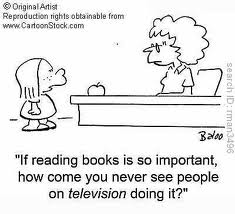
More than four-in-10 teachers said children failed to read for pleasure at the age of 11, it emerged.
The study – by the publisher Pearson – found that many schools fear children have short attention spans and prefer to spend time online rather than reading a novel.
Teachers also said that books were not seen as “cool” by pupils and raised fears that parents are failing to do enough to promote a love of reading in the home.
Frank Cottrell Boyce, the author, said: “It’s worrying to think that so many young children are not being inspired to pick up a good book and get lost in a story.
“According to Unesco, the biggest single indicator of whether a child is going to thrive at school and in work is whether or not they read for pleasure.”
The poll questioned around 400 secondary school English teachers.
Two-thirds of those questioned said that reading was not seen as “cool” by pupils, according to the study.
Three-quarters said that children’s attention spans were shorter than ever before, while 94 per cent claimed that pupils preferred to be using the internet rather than reading.
It is my belief that a crucial part of my job is to promote the joys of reading. I take pride in selecting books for my class that will appeal and entertain. I also have a Book Club. This allows my students to see that reading is not necessarily a personal experience but it can be a shared experienced too.
It has been labelled “heartbreaking” and one of the most effective anti-smoking advertisements ever.
The new public service announcement from Thailand shows two small children approaching adults who are smoking and asking them for a light.
Not one of the adults shown in the ad gives the children what they ask for.
Instead the adults — who have no idea they are being set up — begin giving the children earnest lectures on why smoking is so bad for them.
“If you smoke you die faster,” one man tells a little boy.
“Don’t you want to live and play?”
“When you smoke you suffer from lung cancer, emphysema and strokes,” another says.
The children then reveal their trump card, a brochure they hand the adults which reads: “You worry about me. But why not about yourself?”
The video, produced by the agency Ogilvy Thailand on behalf of the Thai Health Promotion Foundation, was uploaded to YouTube a week ago and has since gone viral, attracting more than 350,000 views.
The foundation has reported a 40 percent increase in the number of calls it has received about how to stop smoking.
A BRITISH high school called police to remove a star pupil who refused to stop studying and leave the library.
Jamie Gagliardi, 18, was ejected from Ifield Community College in southern England, after refusing to leave the library, the Crawley News reported.
The school accused Mr Gagliardi, who is predicted to be an A-grade student, of being “obsessed” with after-school tuition and said that it called the police because the pupil was causing a “nuisance.”
Mr Gagliardi, who was forced to call his mother to pick him up, said, “I have been punished for wanting to do well. I am a hard-working and dedicated student, and this could have such an impact on my future.”
The student went to the library despite being banned from the premises for the day as a punishment for interrupting the school principal during a meeting – to request extra revision sessions.
Marilyn Evans, the school’s director of administration, said, “He became vociferous and irritated that he couldn’t have after-school revision.”
She described Mr Gagliardi as a “top student” who should do well in his exams, but said he had been “causing a nuisance and a disturbance on the premises,” adding, “He is obsessed with doing after-school revision.”
A police spokeswoman confirmed that officers were called to the school to remove a “disruptive” pupil who was refusing to leave the premises, but said that Mr Gagliardi will not face any charges.
This case sends the wrong message for the school’s other students. Most schools would take that form of “disruptive student” over the ones they currently have.
Technology addiction is one of the most prevalent, yet socially acceptable addictions. It envelopes both children and adults and can ruin marriages, cost jobs and effect sleep.
1. Do you feel preoccupied with the Internet (think about previous online activity or anticipate next online session)? 2. Do you feel the need to use the Internet with increasing amounts of time in order to achieve satisfaction? 3. Have you repeatedly made unsuccessful efforts to control, cut back, or stop Internet use? 4. Do you feel restless, moody, depressed, or irritable when attempting to cut down or stop Internet use? 5. Do you stay online longer than originally intended? 6. Have you jeopardized or risked the loss of significant relationship, job, educational or career opportunity because of the Internet? 7. Have you lied to family members, therapist, or others to conceal the extent of involvement with the Internet? 8. Do you use the Internet as a way of escaping from problems or of relieving a dysphoric mood (e.g., feelings of helplessness, guilt, anxiety, depression)?
Other Symptoms Include:
• Failed attempts to control behavior • Heightened sense of euphoria while involved in computer and Internet activities • Neglecting friends and family • Neglecting sleep to stay online • Being dishonest with others • Feeling guilty, ashamed, anxious, or depressed as a result of online behavior • Physical changes such as weight gain or loss, backaches, headaches, carpal tunnel syndrome • Withdrawing from other pleasurable activities
Big Bird, Elmo and Oscar the Grouch could be returning to cinemas after studio 20th Century Fox bought the film rights to the show from production company Sesame Workshop.
A new film would be the third big-screen outing in the 43-year history of the iconic US TV series, whose previous guests have included Johnny Cash, David Beckham and Michelle Obama.
The announcement comes off the back of a successful film featuring Jim Henson’s other troupe of puppets, the Muppets, which took over £100 million at the box office earlier this year, and picked up an Academy Award for best song.
It is also reported that Fox have secured Sesame Street writer Joey Mazzarino to pen the script, as well as Shawn Levy, director of Night at the Museum and Reel Steel, to produce.
The movie will be the first from Sesame Street, which was originally launched as an educative tool by the US government, since the 1999 film The Adventures of Elmo in Grouchland. That came 14 years after 1985’s Follow That Bird, starring Chevy Chase.
As of 2008, the show, which is shown in some form across 140 countries, was estimated to have been watched by over 77 million children during its run of 4,300 episodes. The Cookie Monster and friends can boast a collective 8 Grammies, and 118 Emmys between them.
Television, long seen as a negative influence on children has managed to turn the tide thanks to the recent spate of reality programming:
What do reality television shows The Block, MasterChef and Australia’s Got Talent have in common?
Your child.
According to a TV Tonight report, in 2011, those three shows were the most popular with children under 15.
It seems that feel-good family oriented sitcoms, popular with tweens and teens of the past generation have given way to talent quest shows and experts say that this is not necessarily a bad thing.
Competency based programs showcase hard work and discipline, while graphically depicting the euphoria of success and and the bitter disappointment of failure. In contrast, popular family sitcoms of the 80s and 90s like The Cosby Show or Full House featured safe, insular worlds, in which a happy ending was assured.
Laura Kiln, internationally recognised parenting expert and owner of Laura’s Place, a practice where she offers counselling to families, cautiously endorses reality TV saying some shows expose children to a wide spectrum of issues and offer useful advice without sugar-coating difficult matters.
Kiln notes that a show like The Biggest Loser can help children develop empathy by observing the severe impact of weight problems on contestants’ lives, especially in cases where the children’s own families have no experience of obesity.








 Topical Teaching
