Posts Tagged ‘Teachers’

18 Tips For Getting the Best Out of Your Students

July 17, 2014

Courtesy of teachthought.com:


reach


Click on the link to read Michael Michalko’s 7 Principles of Creative Thinking

Click on the link to read Why Many Teachers Don’t Bother Making Their Lessons Interesting

Click on the link to read Why is it Always the Kids’ Fault?

Click on the link to read Student Shot by Teacher Protests His Sacking

Click on the link to read Science Not For the Faint Hearted (Video)

Click on the link to read 7 Tips for Building a Better School Day

Why Principals Overlook Young Teachers

June 11, 2014


train

I can say with great certainty that the standard of teacher training in this country is lamentable. In my view it is the single biggest factor when it comes to our slipping academic standards. Teachers coming from years of university training are just not ready for the rigors of teaching.

It isn’t surprising that Principals have noticed this. That is why new teachers often find it extremely difficult to get their first job. They are constantly overlooked, regardless of their grades, passion, determination and communication skills. They aren’t overlooked for who they are, but rather where they have come from.

But where the Principals get it all wrong is that they place the blame on the quality of the teachers graduating rather than the quality of the training program. This is a cheap shot and is extremely unfair to the exuberant and idealistic teacher graduates served so poorly by training courses steeped in the theoretical and starved of the practical:


TEACHERS should face one-year internships before they get jobs, to stop underperformers permanently entering classrooms, principals will tell the Federal Government.

Australian Secondary Principals Association executive director Rob Nairn said school heads wanted to see a better selection process for teacher education and year-long internships — longer than current teacher practical places — could be a way of doing it.

“At the moment, we have some teachers who are underperforming,” he said.

“We have got to get better at selecting teachers for teacher training.

“We then have to get better at supporting those teachers and developing those teachers so that every teacher is a good teacher.”

Mr Nairn said the principals association would be suggesting the changes to the Federal Government’s Teacher Education Ministerial Advisory Group.


Click on the link to read my post The Bizarre Call to Train Teachers Specifically for Left-Handed Students

Click on the link to read my post Why Professional Development for Teachers is Often Useless

Click on the link to read my post Finally, a Step Forward in Education

Click on the link to read my post Tips For New Teachers from Experienced Teachers

Click on the link to read my post, Do experienced teachers give enough back to the profession?


Michael Michalko’s 7 Principles of Creative Thinking

May 28, 2014


creative

Courtesy of edutopia.org:


1. You Are Creative

Artists are not special, but each of us is a special kind of artist who enters the world as a creative and spontaneous thinker. While creative people believe they are creative, those who don’t hold that belief are not. After acquiring beliefs about their identity, creative people become interested in expressing themselves, so they learn thinking habits and techniques that creative geniuses have used throughout history.

2. Creative Thinking is Work

You must show passion and the determination to immerse yourself in the process of developing new and different ideas. The next step is patience and perseverance. All creative geniuses work with intensity and produce an incredible number of ideas — most of which are bad. In fact, more bad poems were written by major poets than by minor poets. Thomas Edison generated 3,000 different lighting system ideas before he evaluated them for practicality and profitability.

3. You Must Go Through the Motions

When producing ideas, you replenish neurotransmitters linked to genes that are being turned on and off in response to challenges. Going through the motions of generating new ideas increases the number of contacts between neurons, and thereby energizes the brain. Every hour spent activating your mind by generating ideas increases creativity. By painting a picture every day, you would become an artist — perhaps not Van Gogh, but more of an artist than someone who has never tried.

4. Your Brain is Not a Computer

Your brain is a dynamic system that evolves patterns of activity, rather than simply processing them like a computer. The brain thrives on creative energy that results from experiences, real or fictional. The brain cannot tell the difference between an “actual” experience and one that is imagined vividly and in detail. Both are energizing. This principle helped Walt Disney bring his fantasies to life and also enabled Albert Einstein to engage in thought experiments that led to revolutionary ideas about space and time. For example, Einstein imagined falling in love and then meeting the woman he fell in love with two weeks later. This led to his theory of acausality.

5. There is No Right Answer

Aristotle believed that things were either “A” or “not A.” To him the sky was blue or not blue — never both. Such dualistic thinking is limiting. After all, the sky is a billion different shades of blue. We used to think that a beam of light existed only as a wave until physicists discovered that light can be either a wave or a particle, depending on the viewpoint of the observer. The only certainty in life is uncertainty. Therefore when trying to produce new ideas, do not evaluate them as they occur. Nothing kills creativity faster than self-censorship during idea generation. All ideas are possibilities — generate as many as you can before identifying which ones have more merit. The world is not black or white. It is gray.

6. There is No Such Thing as Failure

Trying something without succeeding is not failing. It’s producing a result. What you do with the result — that is, what you’ve learned — is the important thing. Whenever your efforts have produced something that doesn’t work, ask the following:

  • What have I learned about what doesn’t work?
  • Can this explain something that I didn’t set out to explain?
  • What have I discovered that I didn’t set out to discover?

People who “never” make mistakes have never tried anything new. Noting that Thomas Edison had “failed” to successfully create a filament for the light bulb after 10,000 attempts, an assistant asked why the inventor didn’t give up. Edison didn’t accept what the assistant meant by failure. “I have discovered ten thousand things that don’t work,” he explained.

7. You Don’t See Things as They Are –
You See Them as You Are

All experiences are neutral and without inherent meaning until your interpretations give them meaning. Priests see evidence of God everywhere, while atheists see the absence of God everywhere. Back when nobody in the world owned a personal computer, IBM’s market research experts speculated that there were no more than six people on earth who needed a PC. While IBM saw no market potential for PCs, two college dropouts named Bill Gates and Steve Jobs viewed the same data as IBM and perceived massive opportunity. You construct reality by how you choose to interpret your experiences.


Click on the link to read Why Many Teachers Don’t Bother Making Their Lessons Interesting

Click on the link to read Why is it Always the Kids’ Fault?

Click on the link to read Student Shot by Teacher Protests His Sacking

Click on the link to read Science Not For the Faint Hearted (Video)

Click on the link to read 7 Tips for Building a Better School Day

Click on the link to read Student Rant Goes Viral


9 Characteristics of a Great Teacher According to Parents

May 12, 2014


teacher quality


This list of of characteristics that great teachers possess prove that parents are extremely perceptive when it comes to assessing teacher quality.


1. They teach self-confidence.

“My daughter has gone from being shy and lacking self-confidence to being brave enough to teach a math class to her peers. She is shining and thriving and is excited about school every morning.” — Christine Sulek-Popov

2. They’ve got it covered.

“I know that my children are well looked after at school and I don’t have to worry because you will let me know if there is a problem.” — Erin Marsee Irby

3. They make kids feel special.

“My child feels like he belongs!” — Sherri Kellock

4. They know every child is different.

“You don’t compare his skill set to the other [kids in his class]. He is an individual and he’s treated as such.” — Athena Albin

5. Their commitment is unparalleled.

“My kids’ teachers are amazing. All 3 of them. They’ve brought my son out of his shell, they’re teaching my daughter how to be a leader, and they spend countless hours outside of the school time working on homework, fundraising, organizing class outings, and continuing to upgrade their skills all so they can be even better teachers than they already are.” — Jane Brewer

6. They have parents’ backs.

“My daughter had so many opportunities to see how valuable helping her peers can be, and you’re helping reinforce my lessons to her that there is joy in service.” — Debbie Vigh

7. They’re fair.

“My son is accepted for who he is. And you make the playing field even for everyone!” — Gayle Stroud

8. They’re always raising the bar.

“My daughter has grown in ways I never could have imagined. I’ve seen her flourish in areas I struggle in.” — Shaunna Glaspey

9. They generally rock.

“My son loves going to school everyday. You make him feel safe, loved, and included. It may be hard for you to see (since he is so shy) but he loves spending his day in your care.” — Jennifer O’Donnell Snell


Click on the link to read 9 Secrets for Raising Happy Children

Click on the link to read Brilliant Prank Photos Show Parenting at its Worst

Click on the link to read Little Girl’s Delightful “Brake Up” Note

Click on the link to read 9 Truths About Children and Dinnertime

Click on the link to read The Most Original Way to Pull Out Your Child’s Tooth Out (Video)

Click on the link to read Father Carries His Disabled Son 9 Miles to School Every Day

Student Writes Nasty Letter to Teacher and Teacher Corrects it!

April 10, 2014


correct

Never mess with an English teacher!


Click on the link to read The Telegraph’s Best Children’s Book of All Time

Click on the link to read The New York Public Library’s 100 Most Requested Children’s Books

Click on the link to read Stunning Photographs of the Most Beautiful Libraries in the World

Click on the link to read The Call to Stop Kids From Reading Books they Actually Enjoy

Click on the link to read The Classic Children’s Books they Tried to Ban

Click on the link to read How Spelling Mistakes can Turn a Compliment into Something Quite Different.

Click on the link to read Why Spelling is Important at Starbucks

Should Teachers Allow Students Call Them by Their Christian Name?

March 11, 2014


sean

I don’t want my students to call me Michael because I believe it is important to remind them that I am their teacher and not their friend. This is important, because if you want your advise to be respected, I think it helps to have a more formal title.

Still, I think it is over the top to suspend a child for 5 days for referring to you by your name outside of school. Sure it was rude, but it amazes me how badly punishments fit the crime nowadays:

A boy has been suspended from classes for five days after he called a teacher by his Christian name outside of school hours.

Sean Roberts, 14, has been banned from Wellington Academy in the mornings and in the afternoons he must attend the school’s ‘department for naughty kids’.

The school in Tidworth, Wiltshire, is sponsored by Wellington College and its executive head is political historian Dr Anthony Seldon. Yesterday, Sean’s mother Julie Roberts, 42, demanded her son be allowed back in class ‘as the punishment is over the top’.

She claimed the Academy was ‘making an example’ of her son.

Hairdresser Mrs Roberts – who has already lost 106 pounds in wages staying at home to look after him – said she was only told about the punishment in an evening phone call from the teacher Head of Department Barry Seymour

‘This happened in the village where we live – it was outside of school. My son was walking home and my son shouted out to him Hi Barry. Barry followed him and challenged him at school the next day and my son said he did it.

‘Then I had a phone call telling me my son was not allowed in school for five days but I have had nothing in writing and no official meeting. The night he called the punishment was due to start the next day.

‘The teacher involved said to me your son shouted my name in a way that made me feel small and undermined. I said to him because I know this guy ‘come on Barry he is a 14 year old kid – you should not be intimidated by a 14 year old. Is that all he said and he said yes.

‘I would have thought if they were sanctioning something so serious then I would have been called in for a meeting and laid out on the table what was going to happen – a structured plan. But I have had nothing – just a phone call from the teacher involved. I have had nothing in writing.


Click on the link to read Let’s See if you Can Work Out Why This Teacher was Suspended

Click on the link to read Why Healthy Eating Laws in Schools Don’t Work

Click on the link to read You Can’t Have Your Lunch and Eat it Too

Click on the link to read How Many Teachers Does it Take to Change a Lightbulb? (Part 1)

Click on the link to read Girl Faces Expulsion for Being a Victim of Bullying

Why Healthy Eating Laws in Schools Don’t Work

February 10, 2014


health

The late great Dale Carnegie wrote:

There is only one way under high heaven to get anybody to do anything … Yes, just one way. And that is by making the other person want to do it.

It’s a shame that policy makers and school administrators don’t seem to have read any of Carnegie’s work because had they absorbed the quote above, perhaps they may have come up with something better to offer students.

People think that school represents the perfect place to undo parenting errors. They think that by bringing in a new school rule or program, that children will be set for life. Some of the rules and regulations in a school near you include:

– Anti-bullying programs

– Sex Ed programs

– Junk Food policies

– Playground no hugging rules

– Toilet rules

– Drug programs

– Anti-gambling programs.


And it goes on and on ….


Is this really a bad thing? What’s wrong with scrapping junk food from school?

Of course nothing is wrong with instilling healthy eating habits, teaching children about what constitutes bullying and how important it is to avoid drugs.  But to be successful you’re going to need more than a worthy cause.

The problem with schools taking on these issues is that schools already have a stigma for most children. Whether we like to admit it or not, most kids hate school and they hate what they are taught at school. So whether it’s a math or science lesson or its a discussion about the dangers or excess sugar consumption, the chances of breaking through are difficult. It requires a positive and creative approach.

And let’s face it, the programs eluded to above often look and feel like schoolwork. They often consist of worksheets and paired activities and feature mini-quizzes. Why do the people who put together these programs think that if they put an animal mascot on the front of the pack and crossword on page five that kids will warm to the content? No child has ever been fooled by such a gimmick.

And inflexible rules are worse. Sure, it’s not ideal for kids to be eating chips or popcorn at school, but taking away their treats is yet another way of reinforcing the stigma that schools are overbearing, ruthless and prison like. I just read that Brussels want to ban yogurts and cheese from school lunches. If I was a school kid in Brussels I would want to go home and douse myself in cheese just out of spite!

It is such a breath of fresh air when a great anti-bullying initiative or healthy eating idea surfaces. One that captures the students’ imagination and encourages rather than bans, nurtures rather than smothers.

If you want children to listen they must want to listen. Don’t shove draconian rules and anti-bullying packs down their throats. Give them something that doesn’t look or feel like school work.


Click on the link to read You Can’t Have Your Lunch and Eat it Too

Click on the link to read How Many Teachers Does it Take to Change a Lightbulb? (Part 1)

Click on the link to read Girl Faces Expulsion for Being a Victim of Bullying

Click on the link to read Cancer Sufferer Claims she was Banned from Daughter’s School Because of her “Smell”

Click on the link to read Top 10 Most Unusual School Bans

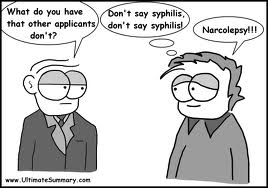
The Most Common Questions Teachers Are Asked at Job Interviews

January 29, 2014

job interview

I stumbled on a brilliant article in the Guardian where Head Teachers share the questions they regularly ask at job interviews and the rationale behind their questions.

I hope this article comes in handy next time you interview for a new teaching position:

If I walked into your classroom during an outstanding lesson, what would I see and hear?

“I’d like to hear about: animated discussions, students clearly making progress as evidenced in oral and written contributions. High quality visual displays of students’ work showing progress. High levels of engagement. Behaviour that supports learning.”

Helen Anthony, head teacher, Fortismere school

“After hearing a candidate’s response I try to get them to talk about their experiences in the classroom. I try to get a sense of the impact that they have had on pupils’ achievement.”

Tim Browse, head teacher, Hillcrest primary school

• Why do we teach x in schools?

“This question really throws people. If it is maths or English they sometimes look back at you as if you are mad. They assume it is obvious – a very dangerous assumption – and then completely fail to justify the subject’s existence.

“Whatever the subject, I expect to hear things like: to improve skills and independent learning; to encourage team work; to gain a qualification; for enjoyment (very important, rarely mentioned); to enhance other subjects; to develop literacy, numeracy and ICT skills; to improve career prospects; self discipline; memory development; to encourage life-long learning in that subject. The list goes on…”

John Kendall, head teacher, Risca community comprehensive school

• Can you tell me about a successful behaviour management strategy you have used in the past that helped engage a pupil or group of pupils?

“This allows candidates to give a theoretical answer – one that anyone who swotted up could give you – balanced with a personal reflection that shows how effective they are.”

Tim Browse, head teacher, Hillcrest primary school

• If you overheard some colleagues talking about you, what would they say?

“This is one of my favourite questions (it’s based on a question my National Professional Qualification for Headship (NPQH) coach used to ask me) because it gets candidates to think about their contribution to the school organisation and their team spirit. If I’m interviewing for a senior leader I would follow this up with: what would you want them to say about you in three years time? This way I can get a sense of where they want to develop as leaders.”

Tim Browse, head teacher, Hillcrest primary school

• Why do you want to work in special education?

“We’re looking to see that the person genuinely recognises that we’re in the business of education as opposed to simply caring for the children (surprisingly, some applicants don’t really see it that way).”

Sean O’Sullivan, head teacher, Frank Wise school

• Why do you want to work in this school?

“We want to see clear indications that candidates have done background work about our school and can talk about why the way we work appeals to them. We’d always want candidates to have visited the school so they should be able to flesh this out with specific examples of what they thought based on their visit.”

Sean O’Sullivan, head teacher, Frank Wise school

• A question that is specific to the candidate’s letter of application

“A candidate may have made a grand statement in their letter, but not gone into details about ‘how’ or the impact it had.”

Tim Browse, head teacher, Hillcrest primary school

• What are the key qualities and skills that students look for in teachers?

“Liking young people. Fairness. Consistency. Sense of humour. Passion for their subject. Good at explaining new concepts/ideas. Able to make the topic or subject relevant. Able to make everyone feel comfortable and confident about contributing.”

Helen Anthony, head teacher, Fortismere school

• Evaluate your lesson

“Teaching a one-off lesson in an unfamiliar school with students you have never met before is a difficult task, but a useful one for candidates and those making the appointment. The evaluation of the lesson by the candidate is crucial. I need to see someone who can be self-critical but who also recognises when things go well. Someone who makes suggestions as to how the lesson may have gone better, what they would do differently with hindsight. I like to hear them talk of the individual student’s progress in the lesson, and how they would follow it up. Remembering pupils’ names is always impressive. I’d rather see an ambitious lesson that goes a bit awry than a safe boring one.”

John Kendall, head teacher, Risca community comprehensive school

• If we decided not to appoint you, what would we be missing out on?

“This is great as it enables candidates to sell themselves and really tell us what they are about.”

Brett Dye, head teacher, Parc Eglos school

Click on the link to read The Profession You Choose When You Don’t Want to Get Fired

Click on the link to read The School They Dub the “Worst Primary School in the World”

Click on the link to read Education New Year’s Resolutions 2014

Click on the link to read Eight Fundamentals that Every Student Deserves

Click on the link to read 21 Reasons to Become a Teacher

How Many Teachers Does it Take to Change a Light Bulb? (Part 1)

January 28, 2014

bulb

Courtesy of educationrethink.com:

Principal: I’ll get back to you on that.

Superintendent: There’s a lightbulb out? I’ll ask the Board of Education if we have any money for them.

Board of Education: The schools have enough lightbulbs. They don’t need any more.

State Department of Education: Teachers will fulfill measurable lightbulb-changing objectives based on a pre-assessment and post-assessment.

PD Coordinator: I need to develop a Lightbulb Theory Training with clip art lightbulbs and Comic Sans font. Can anyone tell me what Marzano said about lightbulbs?

Standardized Test: A) 2 B) 3 C) 3.14 D) Pineapple

Federal Government: “We see you have been changing lightbulbs but we don’t think you have been changing enough of them fast enough. All lightbulbs must be changed at a 100% rate each year or you will lose money for lightbulbs.”

Taxpayers: Why are our tax dollars being spent on things like lightbulbs?

Teach for America: The lightbulbs are going out, because the engineers are lazy slobs. Let’s replace them with someone who went through a month-long training course on engineering.

Parent: Why didn’t you call me two weeks ago to tell me the lightbulb was going to go out?

Union: This isn’t in the contract. It’s the custodian’s job.

Movie Tagline: Some lightbulbs, they said, would never be changed. She inspired them so they could be.

RT @participantname: We should think beyond the lightbulbs and inspire the light to light the bulb itself.

Education Conference Attendee: I just was so INSPIRED by that wonk’s keynote about changing lightbulbs!

Techie Reformy Post: Eventually lightbulbs will replace teachers. Kids can find the light. You don’t have to do it for them.

Student: [says nothing and doesn’t notice lightbulb is out because he/she is texting]

#stuvoice: Why is the teacher the one changing lightbulbs? Every kid should have their own lightbulb.

Maker Movement: Kids will make lightbulbs if you get out of the way and leave them alone.

Unschooler: We don’t need lightbulbs. That’s a part of factory/industrial mindset. Kids should be playing out in the sun all day.

Homeschooler: Even though the lightbulbs are exactly the same, the ones in my home are better than the ones at school.

#edchat: How do we change professional development so that teachers start changing lightbulbs instead of complaining that the bulbs are dead?

#edtech: Check out these 95 coolest, super-amazing, LED lightbulbs that will revolutionize classroom space.

2,000 retweet Twitter post: You have to think outside the bulb. #lightchat #bulbchat

TED Talk: Everything you thought you knew about light bulbs is wrong and I’m here to tell you why.

Tumblr Teacher Post: Here’s a .gif of a flashing lightbulb and a quote by Dewey about enlightening minds. Hope this helps.

This American Life: I’m not sure how many it takes, but I think we could learn something from a counterintuitive human interest story on lightbulbs. I’ll narrate it in a near-whisper.

Time Magazine: Why Teachers Are the Real Reason for Busted Lightbulbs and How Michelle Rhee Will Fix It

Internet Magazine: How An Amazing Way a 3rd World Teacher Changes Lightbulbs and Occasionally Refurbishes Lightbulbs from the Dump

Politician: Why do Finland’s lightbulbs work so much better than ours? I’ll ignore the evidence and assume that their bulbs and their entire electric grid must be decentralized.

Teacher: Actually, I did it 35 minutes ago.

Click on the link to read How Many Teachers Does it Take to Change a Light Bulb? (Part 2)

Should Teachers be Videotaped?

December 30, 2013


chalk


When I was a kid I always wanted to be on the big screen, but now I’m not so sure.

Sure, private screenings with a colleague could net me one of those rather large buttered popcorn bags and a Big Gulp, but I’m not sure the rest of the process would be all that much fun.

The latest call to videotape teachers at work so that their approach and style can be scrutinised by a mentor or peer may not be as effective as it sounds. Sure, I would learn a great deal from watching my lessons back on tape and perhaps my examiner may come up with useful insights, but more realistically it would lead to tension.

If teaching was all about one style fits all then this idea is a winner, but it isn’t. The way I teach would not necessarily impress teachers who have a very different style and vice versa. At the end of the day, I am more interested in developing ways to improve student outcomes than following the herd. This process would involve trying to get teachers to teach in a singular style rather than their own natural style.

But having said that, I believe that classrooms should be videotaped.

Not for the cinematic pressure of being dissected by a peer, but for the legal protection of both teacher and student. By using CCTV cameras, there will be less cases of false teacher accusations and teachers who have committed serious breaches of their duty of care will be caught and dealt with more expediently.

But what about reflecting on your teaching? What about being assessed?

I am assessed all the time. Formally, informally, through questions without notice, bi-annual Principal/teacher conferences, surveys that are filled out by parents and students alike and who can forget about the fallout from standardised testing results.

Still, if you recreate the Gold Class cinema experience, I may join you for at least a few minutes in the screening room.  Let’s hope my production isn’t a comedy, or worse, a horror!


Click on the link to read Guess What Percentage of Teachers Considered Quitting this Year

Click on the link to read The Classroom Shouldn’t be a War Zone for Our Teachers

Click on the link to read Remember When Teachers Were Shown Respect? (Video)

Click on the link to read If You Think Teaching is so Easy You Should Try it for Yourself

Click on the link to read Teachers are Extremely Vulnerable to False Accusations