Posts Tagged ‘Education’

The Education Version of “Moneyball”

December 23, 2011

The continued debate between private and public school funding tires me out. I am a big believer of a well-funded (i.e. wisely funded) public school sector as well as a thriving private school sector. There is no reason why parents can’t be given choice and why supporting private schools must come at the expense of quality public education.

This is where the “Moneyball” analogy fits in.

Moneyball is the true story of Oakland A’s GM Billy Beane. Oakland is severly restricted due to the lowest salary constraints in baseball. Winning means beating teams with much better infrastructure and player payment capacities. Billy is presented with the unenviable task of finding a winning team with the miniscule budget offered. Together with a Harvard economics major, a system is devised that uses statistical data to analyse and value players they pick for the team.

Public schools need to take the same approach. Just like the big baseball teams of the time, plenty of money is spent on public schools, but much of it is wasted money. I look at education in a very traditional way. Whilst it is ideal to have the best sporting fields, technologies and building designs, none of these ingredients has been proven to be essential for teaching and learning the curriculum. The school across the road may be able to give each child their own i-Pad, but that shouldn’t explain a marked difference in maths, science or english results. A teacher should be able to deliver on the curriculum with or without such devices.

Whilst many get worked up when Governments subsidise private schools, there is a good reason why they do it.

1. It takes billions off the budget bottom line. This saves Governments money, resulting in reduced taxes and smaller class sizes in public schools.

2. It allows private schools to lower their fees. This is crucial for parents who are by no means wealthy, but are prepared to scrimp and save (and sometimes take on multiple jobs and a second mortgage) to get their children into private schools. These people should be commended. They work long hours, weekends, give up overseas travel and big screen TV’s, just to give their kids the best education possible. Government subsidies allow that to happen.

In Australia, the Government gives $13,000 to every public school per student. Private schools get $5,000. Factor in to the equation that many private schools are not elite schools with truck loads of money and resources (I work in such a private school, where I earn considerably less than a public school teacher), and you realise that the subsidy shouldn’t detract from a thriving public education system.

By constantly drawing attention to private schools, we risk bringing the private school system down to the public level. What we should be doing instead is trying to get the public school system improved to the level where it gives its private school equivalent a run for its money. That way, you have a private school that sets the bar for top quality education and a public school system that is structured to be able to go toe-to-toe with them based on prudent spending, good decision-making and a workforce of supported and fairly paid teachers.

Time To Shut Down Teacher Bullying Websites

December 22, 2011


I commend head teacher Andre Sohatski for not only standing up for himself and his reputation, but also for representing the downtrodden teachers and students victimised by scandalous bullying websites proliferating across the web.

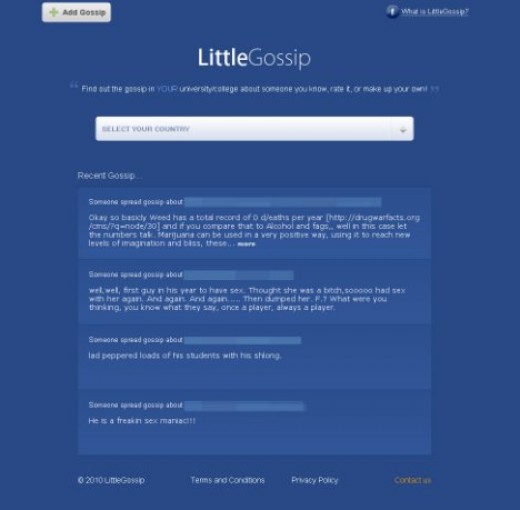
Web sites like RateMyTeacher.com allow students to post salacious accusations and damaging insults. These sites, together with sites that allow students to slander other students such as Little Gossip  have been allowed to remain unhindered under the guise of freedom of speech.

Until now …

Andre Sohatski, headteacher of Priory School in Dorking, Surrey, took action after being told by his pupils that children were being targeted on the website Little Gossip with homophobic, racist and sexist abuse.

The site contains abusive and explicit messages written by schoolchildren that can be rated “true” or “false” by their peers. It allows them to name their “targets” but the user remains anonymous.

Mr Sohatski called for the site to be shut down and said it could cause “really big problems,” for children.

“I think it’s irresponsible. It is a form of internet bullying. Any kind of comment posted anonymously about somebody is basically unfair and sometimes cruel,” he said.

Police said they would investigate the US-based website, which has previously faced heavy criticism, and said the consequences of online bullying were “worrying”.

I am a big believer in the freedom of speech. I can accept that people have the right to vent about any professional within certain boundaries. When a student slanders another student or a teacher with homophobic, racist, sexist or defamatory insults it is fair to say those boundaries have been well and truly crossed.

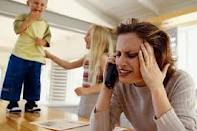
Parents’ Stress Damaging the Development of Their Children

December 22, 2011

Author David Code goes beyond warning parents about the effect their stress has on the lives of his children. He even blames their stress for “damaging their development and altering their DNA, because of crushing worry and anxiety.”

“Stress is highly contagious,” says David Code, an Episcopal minister and author of Kids Pick Up on Everything: How Parental Stress is Toxic to Kids. “Parental stress can weaken the development of a child’s brain or immune system, increasing the risk of allergies, obesity, or mental disorders.”

So calm down and socialize more. Resolve to start the new year with peace on hearth – it’s not only good for your health but your children’s physical and mental health too.

If you really want to make your kids happier, forgo the Xbox or iPad and invite friends over. The greatest gift you can give your children is your own, healthy relationships with other adults, Code says.

“That Xbox or iPad will placate the kids for a while, but soon they’ll demand even more. Far better to take the kids over to your friend’s house – you and your friend can relax with a drink while both sets of kids entertain each other. That means better social skills for your children, and lower stress levels for you as you ‘scratch that primal itch’ to bond, which reduces your stress,” he adds.

According to Code, research shows children can catch their parents’ stress just like they catch a virus. “Children are like little sponges, soaking up the free-floating stress in today’s anxious households until their developing nervous systems hit overload, at which point they act out, or develop symptoms of mental or physical illness.”

The mind-body connection strongly factors into almost every child’s behaviour –the parent’s mind affects their child’s body “through a kind of emotional pipeline,” Code says. The more stress a kid picks up from the parent, the more ill health – even if the parent is unaware of his or her own anxiety.

Personally I think Code goes over the top with the prognostications of DNA damage but I agree with his main contention. There is no doubt that stress from parents has effects on their offspring.

Code offers the following advice:

Steps to raise healthier kids, according to author David Code:

• Set up a no-screens-after-5 p.m. night: Turn off all screens, big and small and socialize.

• Socialize more with other parents while your kids play together. “If I could wave my magic wand and reduce the stress of today’s parents, I would give them a glass of wine, a friend, and an Italian village square to go socialize in every evening.”

• Bring on the potluck: Once a week dine with friends. “Since you have to make dinner anyway, a weekly potluck doesn’t suck that much time away from your current schedule.”

• Exercise with your spouse. Build muscle and your marriage too. “It’s easier to discuss tough topics and get emotional when you’re side by side on the treadmill or jogging down the street. It’s easier to be emotional in motion.” Even a short evening stroll together is great marital maintenance.

• Take a vacation every three months for a complete change of pace and a healthier family.

• Practice the daily vacation – lunch hour. “Instead of building stress over eight hours, you’ll start over again after lunch and not get so wound up by quitting time.”

• Establish the one-minute instant intimacy builder with your spouse. “When you both get home from work, while changing or preparing dinner, share your highlight and ‘lowlight’ of the day. Try to focus on one moment in time,” he says, adding that sharing one specific lowlight each day builds bonds because we won’t feel so alone in our suffering.

Let’s Teach 4-Year Olds How To Drive

December 20, 2011

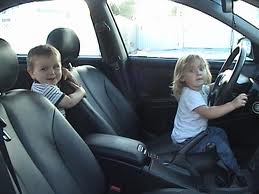
Before you disagree with my proposal let me explain the rationale. At some point people need to know how to drive. We all want capable drivers on our roads, so what better time to teach them the intricacies of driving than when they are young.

Right?

Of course not.

Not only are 4-year olds too young to drive but they are also too young to learn other important life skills such as cyber safety. Why the Government expects kinder teachers to educate their young pupils on proper use of internet and the dangers of purchasing goods online beats me.

KINDERGARTENS will be urged to teach cyber safety to four-year-olds amid fears they could fall prey to online predators and bullies.

The Gillard Government will write to state education heads to encourage the take-up of cyber safety programs that teach children not to be mean online and keep their private information to themselves.

It comes amid revelations Victorian primary school children are “sexting” their friends and posting hate messages about their teachers on social networking sites.

A parliamentary committee report earlier this year recommended the Government consider the feasibility of helping deliver programs in preschools and kindergartens.

The Government yesterday accepted the recommendation in principle, but was waiting for a paper on cyber issues to be released in mid-2012 to give a detailed answer.

 In the meantime, it will encourage use of Australian Communication and Media Authority programs, including Cybersmart for Young Kids.

It features a bottlenose dolphin called Hector Protector and his friends teaching young children to keep “special information” private and tell mum or dad if they see anything scary or upsetting online.

It also encourages children to share passwords with their parents and to “be nice” to others.

And parents can download a “safety button” that children can click on to cover up anything upsetting they see online with a friendly picture.

Cyber safety expert Susan McLean said flexible, compulsory education should begin as soon as children switched on a computer, from kindergarten onwards.

“I’ve seen cyber bullying in grade 2. I’ve seen kids buying things on the internet at age seven after their parents have told them not to. That’s commonplace.”

Teaching kids skills too early is like not teaching them at all. I can’t see the value of making young children endure a program that will surely be too advanced for them and doesn’t relate to their present day lives.

Whats next? Teaching four-year olds how to work an electric drill?

How Badly Do Teachers Need Twitter and Facebook?

December 19, 2011

The very worst teachers usually spoil it for the rest of us. A prime example is social media. Social media is designed to aid communication and make interacting much easier. However, it can also be exploited and abused. Never a day passes where there isn’t a story about a teacher that acted innapropriately by saying or doing something on a social media site. These teachers have single handedly prevented other teachers from using these sites to help support their students.

My colleagues and I recieved an email from my boss a few moths ago, warning us not to have any communication with or about our students on Facebook. This is not an issue for me because I don’t have a Facebook page (I have a Twitter account but my students are unaware that I do). But the trend is clear. Schools don’t want their teachers in a position that could cause negative attention to their establishment.

My position on this is unclear. I am slighly leaning towards backing the school, as I am not fully aware of the benefits of Facebook for teachers and students. Whilst I can clearly see the disadvantages of such interactions, I don’t really understand how such a ban would effect the quality of teaching.

Clearly, there are teachers that swear by it:

Faced with scandals and complaints involving teachers who misuse social media, school districts across the country are imposing strict new guidelines that ban private conversations between teachers and their students on cellphones and online platforms like Facebook and Twitter.

The policies come as educators deal with a wide range of new problems. Some teachers have set poor examples by posting lurid comments or photographs involving sex or alcohol on social media sites. Some have had inappropriate contact with students that blur the teacher-student boundary. In extreme cases, teachers and coaches have been jailed on sexual abuse and assault charges after having relationships with students that, law enforcement officials say, began with electronic communication.

But the stricter guidelines are meeting resistance from some teachers because of the increasing importance of technology as a teaching tool and of using social media to engage with students. In Missouri, the state teachers union, citing free speech, persuaded a judge that a new law imposing a statewide ban on electronic communication between teachers and students was unconstitutional. Lawmakers revamped the bill this fall, dropping the ban but directing school boards to develop their own social media policies by March 1.

School administrators acknowledge that the vast majority of teachers use social media appropriately. But they also say they are increasingly finding compelling reasons to limit teacher-student contact. School boards in California, Florida, Georgia, Illinois, Maryland, Michigan, Missouri, New Jersey, Ohio, Pennsylvania, Texas and Virginia have updated or are revising their social media policies this fall.

To those that have used social media with their students – is it really worth the risk?

Top 10 Best Children’s Books of 2011

December 18, 2011

Liz Rosenberg of the Boston Globe recently released her Top 10 children’s books of 2011.


“Little Owl’s Night’’ by Divya Srinivasan (Viking, ages 3-7)

This is the most visually and verbally gorgeous picture book of the year. Owl loves the beautiful night and hearing about mysterious daybreak when “[d]ewdrops sparkle on leaves and grass like tiny stars come down . . . the sky brightens from black to blue, blue to red, red to gold.’’ Simple, dazzling – and simply dazzling.

“E-mergency!’’ by Tom Lichtenheld and Ezra Fields-Meyer (Chronicle, ages 5 and up)

What happens when the letter “E’’ has an accident and slides out of the language? Sheer madness, enhanced by Lichtenheld and Fields-Meyers’s unceasingly witty, manic visual, and verbal jokes. “O’’ does most of the hard work; the reading is easy for children and their adults.

“Wonderstruck’’ by Brian Selznick (Scholastic, ages 9 and up)

A worthy follow-up to his Caldecott Medal-winning “The Invention of Hugo Cabret,’’ here Selznick creates a fast-paced illustrated novel full of mystery, pathos, beauty, and, yes, wonder. Whatever book you miss this year, do not miss this one. The twists and turns of plot are breathtaking, Selznick’s use of graphics nothing less than stunning.

“Jim Henson: The Guy Who Played With Puppets’’ by Kathleen Krull, illustrated by Lou Fancher and Steve Johnson (Random House, ages 4-10)

This tribute to the creator of the now iconic Muppets is among the year’s best children’s picture book biographies, alongside my next pick.

“The Watcher: Jane Goodall’s Life with the Chimps’’ by Jeanette Winter (Schwartz and Wade, ages 4 and up)

Both the Henson book and this one about anthropologist Jane Goodall celebrate the eccentricity and passion that drove these two very different characters to become pioneers in their fields.

“The Flint Heart’’ by Kathleen and John Patterson, illustrated by John Rocco (Candlewick, ages 7 and up)

Almost nothing is tougher to do well than a classic middle-grade fantasy novel. The Pattersons have created an inventive confection full of literary allusions, eccentric heroes and heroines, wild adventures, and oddities worthy of a new Alice. Not for the timid, but for adventure lovers with a sense of humor. Great read-aloud.

“The Romeo and Juliet Code’’ by Phoebe Stone (Arthur A. Levine, ages 9 and up)

Phoebe Stone introduced us all to the most irresistible 11-year-old British children’s hero since the inimitable Harry Potter. Felicity “Fliss’’ Bathburn Budwig is no wizard, but an ordinary, touching, witty girl who ferrets out the secrets of her family’s past and present. The prose simply sings.

“Okay for Now’’ by Gary D. Schmidt (Clarion, ages 10 and up.)

“Okay for Now’’ manages to juggle themes of family, bullying, abandonment, greed, art, friendship, and – believe it or not – John James Audubon, all in one remarkable novel. Gripping, hilarious, realistic, the perfect book both for avid and reluctant readers, “Okay for Now’’ should win some major prizes.

“The Barefoot Books World Atlas’’ by Nick Crane, illustrated by David Dean (Barefoot, ages 8 and up)

This atlas does more than simply provide a vivid and up-to-date view of the world -though it does that, too. It shows cultures and connections between countries, bringing a truly global perspective to children in eye-popping color. An altogether invaluable resource.

“What We Keep is not Always What Will Stay’’ by Amanda Cockrell (Flux, ages 12 and up)

When the stone statue of St. Felix comes to life, 15-year-old Angie wonders about more than miracles. Add Jesse to the mix, a troubled Afghanistan veteran with post-traumatic stress disorder. Cockrell balances on the knife’s edge between comedy and tragedy. The depth and darkness of her themes makes an absorbing read for older young adults.


Teachers Advised to Discuss the “Positive Side of Sex” With Their Under-Aged Students!

December 18, 2011

I’m sick of groups filling us up with propaganda to justify their cause. Whether it’s breastfeeding, natural birth or the education equivalent – sex-ed, hardly a day goes by without a study released pointing to the same old conclusions. Whilst these causes all have merit, there comes a time when one gets sick of being lectured to via an endless cycle of propaganda.

There is some validity behind the push to enforce sex ed on classrooms around the world. Like any other area, knowledge about safe sex in particular, makes a great deal of sense. But having witnessed various programs in action, I can’t help but think that sex-ed is extremely overrated.

The idea, as a recent study claims, that children in the absence of sex-ed turn to porn is ludicrous:

Australian researchers Maree Crabbe and David Corlett said children were turning to adult films because schools were not handling the positive aspects of sex.

The researchers presented their findings at a conference at London University’s Institute of Education.

“Discussion of sex and intimacy is too often avoided in schools,” they said.

“Porn has become a cultural mediator in how young people are understanding and experience sex. Porn is our most prominent sex educator.”

Diane Abbott, Labour’s Shadow Health Minister, said: “The rising numbers of girls having under-age sex is alarming. It is not a cost-free phenomenon.

“It poses public health policy challenges and social challenges. The underlying cause must be the ‘pornification’ of British culture and the increasing sexualisation of preadolescent girls.

“Too many young girls are absorbing from the popular culture around them that they only have value as sex objects. Inevitably they act this notion out.

“Government needs to respond to spiralling under-age sex, not with pointless schemes to teach abstinence, but with better PSHE teaching in schools for both girls and boys.”

I find the conclusions of this study extremely difficult to believe for the following reasons:

1. It seems to be inferring that if provided with a sex-ed course children wouldn’t turn to porn. Yeah right!

2. That mandatory PSHE classes would radically minimise the number of under-age sex and boys would come to show more respect to girls having taken the course.

“Up until my sex-ed course, I was treating women like objects, but since my classes, I am a changed person.” Yeah right!

3. I have sat through these classes and an inordinate amount of time is spent on the differences between the male and female anatomy. Whilst this is obviously of some value, most porn stars themselves don’t know the difference between a vulva, clitoris or vagina (even the female porn stars!).

4. Is it really the teachers job to “handle the positive aspects of sex?” If so, I quit! I’ve got more important things to do than promote sex to under-age children. This assertion is downright irresponsible. Can you imagine the outcry if kids came home telling their parents that they want to lose their virginity because their teacher told them that sex is a wonderful thing?”

5. Parents, follow my advice on this one. Your child’s sex education is primarily YOUR responsibility.

I refuse to promote sex in my classroom! I would sooner quit my profession than get involved in such downright immoral and undignified behaviour! If you are worried about girls being treated poorly and kids engaging in under-age sex, don’t point at a lack of sex-ed classes or blame the proliferation of porn. Instead remind parents to do the job they were entrusted with when they decided to bring life into this world.

Let’s cut the propaganda and get back to what we signed up to do – let’s teach the curriculum!

Five Signs it is the End of the School Year

December 16, 2011

Teachers find the last weeks of a school year absolutely exhausting. Many of us crawl towards the finishing line amazed that the deadlines have been reached and the seemingly insurmountable boxes have somehow been ticked.

Now that I am both a teacher and a parent of a school aged child, I can see that the end of year poses challenges for parents too.

That’s why I loved this piece by Nancy Davis Kho, whose article about the five telltale signs that the end of the school year has been reached (from a parents perspective) is very insightful and humorous:

1.) You’re Broke. Between the gift for the classroom teacher, the teacher’s aides, the piano teacher, the math tutor, the babysitter graduating high school who wasn’t much for cleanup but at least she could walk home, and the niece graduating college after the five year plan, you are clean out of $20 dollar bills. (Apologies if you are more of $100 dollar bill gifter, I didn’t mean to insult you. Can I please be your babysitter?) It gets so bad that you could almost use a second job. But you can’t do that, because…


2.) Your Productive Workday Has Been Shot to Hell. You have to be up at school to see the end-of-year talent show, of course, and your child would never forgive you for missing out on the end-of-year class picnic. Then the school districts get in on the act, fulfilling some budgetary or union contract obligation by cutting a bunch of June school days in half. Your to-do list becomes an archive, saved in its non-checked-off state for future generations to admire. It’s enough to make you run for comfort to the cookie jar which is full because…

3.) You Have Baker’s Elbow. Brownies for the ballet recital, pound cake for the Little League team party, chocolate chip cookies for the celebration of a completed Social Studies group project; you’re churning them out like your middle name is Poppin’ Fresh. You would like to buy stock in King Arthur Flour and Betty Crocker, but can’t get out of the kitchen long enough to log onto E*trade. And if you’re going anywhere past the stove it’s going to be to the laundry room because….

4.) The Lunch Bags Look Like They’ve Been Beaten. Bruised, torn, bearing tiny flecks of unidentifiable foreign substances that may or may not be mold, the insulated lunchboxes that started off the year in bright primary colors have been reduced, through constant improvised use as seats, soccer balls, and weapons, to an indistinguishable grayish brown.  You weigh running them through the washer one last time. But would it be the cycle that finally separates the strap from the rest of the bag? That would probably make you cry, because…

5.) You Burst Out Crying At Inopportune Times. It’s the inevitable result of being handed concrete evidence, in the form of a graduation certificate or a class council election, that Your Children Are Growing Up. The ultimate example was when the Kindergarten teacher rewrote Eric Carle’s “A Very Hungry Caterpillar” to describe all the knowledge that our children had hungrily gobbled up throughout the year. Then she had them hold up wobbly, colorful pictures they’d drawn of butterflies and said, “And now you are beautiful butterflies who will fly off to First Grade!” Twenty-three moms, 15 dads, and one kindergarten teacher hit the deck sobbing, delaying the children’s American Sign Language performance of “Somewhere Over the Rainbow” until we’d (temporarily) recovered our composure.

Teacher Writes “Stupid” on Student’s Forehead

December 16, 2011

There is no doubt that teachers have a responsibility to maintain their calm and not give in to difficult and challenging students. Whilst this is harder than it sounds, teachers cannot afford to vent at their students.

When people ask me what are some of the most important skills required to be a good teacher, I always mention patience. To me, patience is an essential skill for every teacher. But patience doesn’t come straight away. It often requires years of practise and hard work.

That is why I think it is important to note that the teacher that wrote the word “stupid” on the child’s forehead was in his first year. Yes, he wrong to do what he did. Yes, he deserves to be sacked. But I hope he is not lost to teaching permanently just because of what he did.

A Tennessee teacher’s first year on the job could be his last. He could lose his job for something he did in the classroom.

It’s a simple school supply, but when a teacher, Alex Boles, used a permanent marker to write the word “stupid” on a student’s forehead, the director of Overton County Schools took immediate action.

“One word can break a child I mean I’ve got three children and I wouldn’t want it done to mine,” said Matt Eldridge, Director of Schools.

It happened last week at Allons Elementary. The K-8 school only has a few hundred students just outside Livingston, Tennessee.

One student had a question, and Boles responded and wrote the word on the student’s forehead in front of his classmates.

“The teacher said I was trying to joke with him and of course I’ve tried to talk to him and told him that’s not the way you joke with anyone,” said Eldridge.

Until last week, Boles taught math at Allons Elementary. He was new to the job, he just started this fall, and what many consider his lapse in judgment could cost him in the long haul.

“It’s kind of one of those mistakes that’s hard to correct,” said Eldridge.

The district will allow the teacher due process, but the director said he will insist that Boles lose his job. A big price to pay for a single significant mistake.

I still hold out hope that Mr. Boles has potential to be a very good teacher. It would be great if he was given the support to learn from his mistakes and is given a second chance in another school.  I also hope he apologises profusely to the child involved, as well as the child’s parents.

The System Fails Slow Starting Students

December 15, 2011

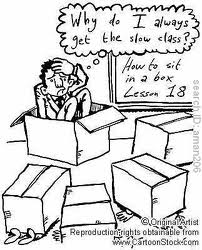
As a child who started slow and only came into my own after school, I have always been determined to help slow starting students find their feet as quickly as possible. It is my belief that the classroom teachers can turn the fortunes of a slow starting student around.

This belief however, is not supported by the data:

Three-quarters of children in England who make a slow start in the “Three Rs” at primary school fail to catch up by the time they leave, data shows.

And more than a third (39%) of pupils who make a bright start are no longer reaching advanced levels when they leave.

The government’s school league tables data also shows 9% of primary schools do not meet its floor standards.

Overall 74% of pupils met the required levels in English and maths.

Some of those kids that are allowed to fall through the cracks are victims of poor teaching. Often the slow start comes about because the learning style of the student differs to the way the information is conveyed by the teacher.

I think it’s a major cop-out to let the slow starters continue on their merry way without giving them the intervention they so desperately need.