Posts Tagged ‘Children’

11 Valuable Digital Media Tips for Students

September 5, 2014

kidsCourtesy of Justin Boyle at teachthought.com:


1. Use Privacy Settings

Let’s talk Facebook, shall we? Chances are pretty good that your students can be counted among the 1.3 billion monthly active users of the social media giant, and there’s practically no other website that contains such a breadth and depth of personal information.

Encouraging students to put all of their social media accounts, including Facebook, on a short leash might be the most important step toward helping them manage their digital footprint. Look into Facebook’s proprietary privacy tips or get the works from Lifehacker.com with it’s “Always Up-to-Date Guide to Managing Your Facebook Privacy,” then inform students about the steps they can take. Better yet, just pass the links along.

Complete privacy on Twitter is simple — you just choose to protect your tweets under “security and privacy” on the account settings page — but encouraging students to do so might do more harm than good. Some teachers have gotten great results using Twitter in education, and a class full of students with protected tweets might interfere with that.

2. Keep A List Of Accounts

Then delete the ones you no longer use. That myspace page you signed up for? Don’t just forget about it–find it and delete it.

3. Don’t Overshare 

Perhaps the best tip for helping students maintain privacy on Twitter is one that can be applied across the whole spectrum of social networking tools: Don’t overshare. As much of an alien concept as it may be to students these days, the only sure-fire way to avoid digital footprint trouble is for them to keep quiet about anything they wouldn’t want to share with everyone in town.

This includes usernames, aliases, passwords, last names, full-names-as-usernames, pictures, addresses, and other important information.

4. Use A Password Keeper

This is more of a security thing, but the worst kind of footprint is the one you didn’t make that contains all of your sensitive information. It’s too much work to remember 50 different passwords, and every site has their own unique rules. Until someone solves this problem, the best solution is likely a password keeper

5. Google Yourself

You may be surprised what you find.

6. Monitor Linking Accounts

When you link your facebook or twitter account to that new site (whatever site that might be), you may not realize–or care at the moment–what you’re giving it access to. It’s usually safest to use a secondary email address to sign-up for new sites rather than granting this kind of access.

7. Use A Secondary Email

Whether you’re communicating with someone new, or signing up for a new social media platform, it can be useful to have a secondary email address.

8. You Don’t Need 12 Email Addresses

That said, you don’t need 12. Keep it manageable.

9. Sending Is Like Publishing–Forever

Every time you send a message, post, or picture, you’re publishing it the same way CNN does a news story. And the internet never forgets.

10. Understand That Searches Are Social

There’s another side to your digital footprint, too — it’s not always information that you choose to make public. Remember: Privacy controls or no privacy controls, Facebook still records and uses every scrap of information it gets to better determine its users’ marketing demographics.

Google pulls the same trick with search and browsing habits. If a student is logged into their Google account, the service tracks every keyword they search, every Web page they visit and every time they visit Youtube.

There are ways, however, to control the bits of deep data that we leave strewn around. First of all, even though Google is practically an official synonym for “Web search,” it isn’t actually the only game in town. Less profit-motivated search engines like DuckDuckGo.com and Ixquick.com may take a little getting used to, but they do make explicit policy of protecting users’ browsing privacy.

11. Use Digital Tools To Manage Your Footprint

A host of browser extensions and app add-ons can also limit the surreptitious capture of personal information. Disconnect (Disconnect.me), DoNotTrackMe (Abine.com) and Ghostery (Ghostery.com) are examples of cross-platform extensions that block tracking cookies and give users control over site scripts.


Click on the link to read The 10 Best Educational Apps for Children

Click on the link to read The Must Have iPad Apps for the Classroom

Click on the link to read Using Videogames in the Classroom

Click on the link to read Five Great Technology Tools for the English classroom

Click on the link to read 5 Great Spelling Apps for Tablets and Smartphones

Click on the link to read Are Educators Being Conned by the i-Pad?

Up to 1 in 10 US Students Have an Inappropriate Relationship With Their Teacher

August 16, 2014

andrea connersSurely there aren’t as many student/teacher relationships as suggested in this article. If it is anywhere near as bad as that, it is a terrible indictment on our profession:


Critics suggest that as many as one in 10 U.S. public school students — or about 4.5 million children — are involved in some kind of inappropriate teacher-student relationship.

But it’s not easy to identify — accusations involve everything from physical contact to inappropriate comments or looks — and can have a crippling effect not only on those involved but on the student body and their parents and educators.

“It’s devastating to the rest of our students,” said Dan Unger, president of the Northwest Local School District Board of Education. Two of the three teachers from his district have already been convicted and this year imprisoned. The third case is pending.

“When (the other students) think about the accomplishments of the class of 2014, they’ll think about that. This is what they will remember,” Unger said.

It’s become easier in a digital world where smart phones can dominate conversation, for teachers and students to communicate. That’s good when it’s used to discuss school work. But sometimes it can turn criminal.

“The biggest reason this occurs now is social media,” Abbott said.

A text, Facebook post, Instagram or Snapchat message can give teachers and students greater access to each other than ever before. All three of the Northwest Local School educators relied heavily on Snapchat, Facebook and text messages to communicate with the victimized students.

“It seems to be when the conversation goes private like that, the teacher says and does outrageous and outlandish things they’d never say in person,” Abbott said.

Those private contacts allow predatory educators to exploit students, enhancing the control teachers have over their students. Students want to be liked by or get attention from the educator.


Click on the link to read Facebook Exposes Yet Another Bad Teacher

Click on the link to read Why I Won’t Be Celebrating Facebook’s 10th Anniversary

Click on the link to read If You Ever Wondered How Some Kids Become Bullies …

Click on the link to read The Researchers into Cyberbullying Should Review Their Findings

Click on the link to read The Use of Facebook in Cyberbullying Activity

Click on the link to read A Positive Approach to Tackling Cyberbullying

I Love it When Children Think for Themselves

July 24, 2014

I love it how this 7-year-old doesn’t let his high principles get muddied just because he is a child talking to a persuasive adult:


https://www.youtube.com/watch?v=Mt4BAICkDGI


Click on the link to read 10-Year-Old’s Marriage Advice to His Teacher

Click on the link to read The Science of Parenting

Click on the link to read Why the Call to Fine Parents for Not Reading to Their Children is Utter Stupidity

Click on the link to read Children are Precious!

Click on the link to read Is it Ever OK to Lie to Your Kids?

Click on the link to read 9 Characteristics of a Great Teacher According to Parents

The Science of Parenting

July 19, 2014

Courtesy of


  • 2
  • 3
  • 4
  • 5
  • 6
  • 7
  • 8
  • 9
  • 10
  • 11
  • 12
  • 13
  • 14
  • 15
  • 16
  • 17


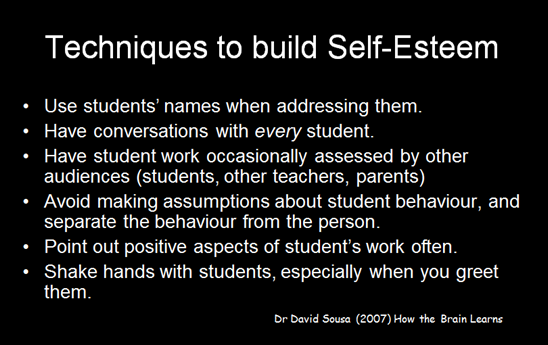
Sousa’s Techniques to Build Self-Esteem

July 15, 2014

Courtesy of

self

I agree with nearly all these tips, especially the first one which is absolutely crucial from my experience. However, I do not advise teachers to shake their students’ hands. It is not appropriate and I would recommend teachers should desist from doing it.


Click on the link to read Why I Believe Classrooms Should Be Fitted With Video Cameras

Click on the link to read Are We Doing Enough to Make Our Children Happy?

Click on the link to read Why Getting Our Kids to Toughen Up is a Flawed Theory
Click on the link to read  Stop Pretending and Start Acting!

Click on the link to read  Some Principals Seem to Be Ignorant About Bullying

Click on the link to read Teaching Kids to be Competitive Often Leads to Needless Pain

Apparently Cool Kids Really Do Finish Last

July 8, 2014

popular

I know this is supposed to vindicate all the so-called “uncool” kids (a group to which I had a gold membership), but I don’t rejoice at any groups lack of success:


A recently-published study from the University of Virginia has confirmed what your mum told you all along – cool kids are not all that they’re cracked up to be. Much like the numerous tragedies that befell The Harbor School’s former Social Chair Marissa Cooper, popular kids are far more likely to experience difficulty with relationships and drugs than their more socially awkward peers.

The ABC report that, in a far-reaching study, academics from the university followed 184 adolescents, tracking their development from the ages of 13 to 23, and found that those who were perceived as “cool” and “popular” by their younger peers struggled in various key areas by the time they reached adulthood.

For instance, that dreamy bad boy who used to pash off with various girls behind the basketball courts, inscribe his name on stuff in permanent market and treat himself to five-finger discounts from City Beach is probably not looking so good through a more sober, grown-up lens.

By the time they hit the age of 23, many of those who were one perceived as “cool” found it difficult to form new friendships and romantic relationships, and had a 45% higher rate of issues relating to alcohol and marijuana use. The kinds of behaviors that make one popular as an early adolescent will get one shunned as a fully-grown adult.

There are various other reasons why cool kids struggle. For one, popular kids thrive within the rigid social structures of school, but once they’ve left that behind, they find it harder to adapt to less structured world of adulthood. For another, popular kids may be driven by the insecurity of needing to stay popular, which can breed various anxieties and insecurities.

Perhaps the most obvious one is that the unpopular kids, who spend most of high school banding together while trying to avoid getting the shit kicked out of them, develop better coping mechanisms and closer friendship bonds, equipping them to deal with the world outside of school far more effectively.

Keep in mind, however, that this study was written by academics, who are the least cool of the least cool, and somewhere in the Behavioral Sciences Department of the University of Virginia, a professor may be rubbing his or her hands together with glee at how nicely this plan to smear the popular kids is coming together.


Click on the link to read Is there Any Better Feeling than Graduating? (Video)

Click on the link to read Stunning Homeless Experiment Revealed (Video)

Click on the link to read Teachers Need to Have High Expectations for all of Their Students

Click on the link to read The Most Common Questions Teachers Are Asked at Job Interviews

Click on the link to read The Profession You Choose When You Don’t Want to Get Fired

Click on the link to read The School They Dub the “Worst Primary School in the World”


Forget About Homework

July 7, 2014


You want to set your children up for life?

Well, forget about fighting over homework, investing in tutors and purchasing standardised testing practice manuals.

Sing with your children. Play with them on the mat. Open up the Lego box. Talk about life. Celebrate their skills.

Work is important as is a formal education and all that comes with it.

But is there anything better than quality time?

And don’t tell me maths homework is quality time.


Click on the link to read Why the Call to Fine Parents for Not Reading to Their Children is Utter Stupidity

Click on the link to read Children are Precious!

Click on the link to read Is it Ever OK to Lie to Your Kids?

Click on the link to read 9 Characteristics of a Great Teacher According to Parents

Click on the link to read 9 Secrets for Raising Happy Children

Click on the link to read Brilliant Prank Photos Show Parenting at its Worst


Children’s Hilariously Inappropriate Spelling Mistakes

July 2, 2014


Courtesy of boredpanda.com via @MrMattHeinrich:


My Whole Family

Image credits: imgur.com

Best Cook

Image credits: white-orchid

Math

Image credits: odalaigh

Virginia

Image credits: draftermath

Horse

Image credits: laughingninja.com


My Goat Is In A Pen

Image credits: imgur.com

Tights

Image credits: rbrown34

Shirt

Image credits: Amanda Da Bast


Happy Birthday Kurt


Account

Image credits: buzzfeed.com


Abraham Lincoln

Image credits: imgur.com


Click on the link to read How Spelling Mistakes can Turn a Compliment into Something Quite Different.

Click on the link to read Why Spelling is Important at Starbucks

Click on the link to read The Ability to Spell is a Prerequisite for Getting a Tattoo (Photos)

Click on the link to read This is What Happens When You Rely on Spell Check

Click on the link to read Hilarious Menu Items Lost in Translation

Click on the link to read The 15 Most Commonly Misspelled Words in the English Language

Click on the link to read Who Said Grammar Isn’t Important?

Click on the link to read Why Spelling is Important


24 Books to Get Your Children Reading

June 19, 2014


reading and children

Courtesy of Huffington Post blogger Devon Corneal:


  • Ninja Red Riding Hood by Corey Rosen Schwartz
    First it was the Three Little Pigs, now Red Riding Hood is studying martial arts! Thank goodness, because how else can she be expected to fend off the Big Bad Wolf? If you liked The Three Ninja Pigs, you’re going to love this new take on an old classic. Get ready — KIYA!
  • Counting has never been so much fun. Detailed pen and ink illustrations splashed with color will keep young readers engaged as they try to spot the adventurous dragon.
  • Troll Swap by Leigh Hodgkinson
    Tabitha Lumpit is loud and messy and doesn’t fit in with her very neat and polite human family. Timothy Limpet is quiet and tidy and doesn’t think he belongs with his scary, mucky troll family. So they do what any two kids would do — they swap places. While it’s fun at first, Tabitha and Timothy soon discover what we all know: there’s no place like home.
  • Little Pear Tree by Jenny Bowers
    Sometimes I recommend books just because they’re beautiful and visually interesting and feel good in my hands. This is one of those times. Little Pear Tree is a gorgeous, eye-catching explosion of color that invites little hands to explore the seasons with an array of images and words tucked behind cleverly designed flaps. Young readers will enjoy searching for the next hidden gem and grown-ups will want to do it right along with them.


  • It’s good to know things about our presidents. Important things. Like whether or not a particular president got himself stuck in a bathtub. These are the sort of facts I wonder about when I’m sitting by the pool drinking lemonade. Maybe you do, too.

(more…)

Children of Seperated Couples Should Not Stay Overnight With Father: Parenting Expert

June 15, 2014

Penelope Leach at her home in Hampstead for Helen Wethers interview

As a stay-at-home father I am calling out so-called “parenting expert” for what I believe is blatant sexism:


A parenting expert has incurred the wrath of fathers’ groups by claiming that children of estranged couples should not stay overnight with them.

Psychologist Penelope Leach has said that generally children of separated couples aged four and under should not be parted from their mother to have a sleepover with their father. 

Ms Leach, whose book Your Baby & Child: From Birth to Age Five was a bestseller in 1977, said attempts to share children was putting parents notions of ‘rights’  and notion of what is ‘fair’ above what is best for the child.

In her new book, Family Breakdown, she writes that there is evidence that separating children from their mothers reduces brain development, and can create unhealthy ‘attachment issues’.

‘Overnight stays with fathers from as early an age as possible is crucial if children are to form strong attachments with both of their parents.

Ian Maxwell, of the charity Families Need Fathers, added; ‘The bond between fathers and children is just as important.’

Ms Leach also criticises the legal profession in the book, writing: ‘when people say that it’s ‘only fair’ for a father and mother to share their five-year-old daughter on alternate weeks, they mean it is fair to the adults – who see her as a possession and her presence as their right – not that it is fair to the child.’

She has since defended her statements, insisting that ‘being a father is not a reward for good behaviour’.


Click on the link to read The Myth Concerning Children and Divorce

Click on the link to read The Psychological Impact of Divorce on Children