Kids are spending way too much time in front of a screen. In my day the warnings about the dangers of television were very prevalent. Now the smartphone and gaming console seem to have overtaken it on the parental danger list:
Having a smartphone in a child’s bedroom translates to less sleep, more fatigue, and later bedtimes, according to a new study. Researchers at UC Berkeley found that kids who slept in the same room as a cellphone, smartphone or iPod touch — what they call “small screens” — got almost 21 minutes fewer sleep than those who didn’t. They also went to bed, on average, 37 minutes later than those without phones in their rooms. (Those who slept in the same room as a TV, meanwhile, got only 18 minutes fewer sleep; the TVs were also associated with a 31-minute delay in bedtime.)
In the study of more than 2,000 fourth and seventh graders, published Monday, 54 percent said they slept near a smartphone. “Small screens are especially concerning because they are a portal to social media, videos and other distractions, and they emit notifications that can disrupt sleep,” Dr. Jennifer Falbe, a postdoctoral research fellow at UC Berkely and the lead author of the study, tells Yahoo Parenting. “Parents should keep screen media out of bedrooms, limit screen time, and set a curfew of an hour before bedtime.”
Falbe says her recommendations are based on the overall literature that excessive screen media can be harmful to children’s health. The American Academy of Pediatrics recommends that kids spend no more than one to two hours a day on recreational screen time, which Falbe says is a good rule of thumb.
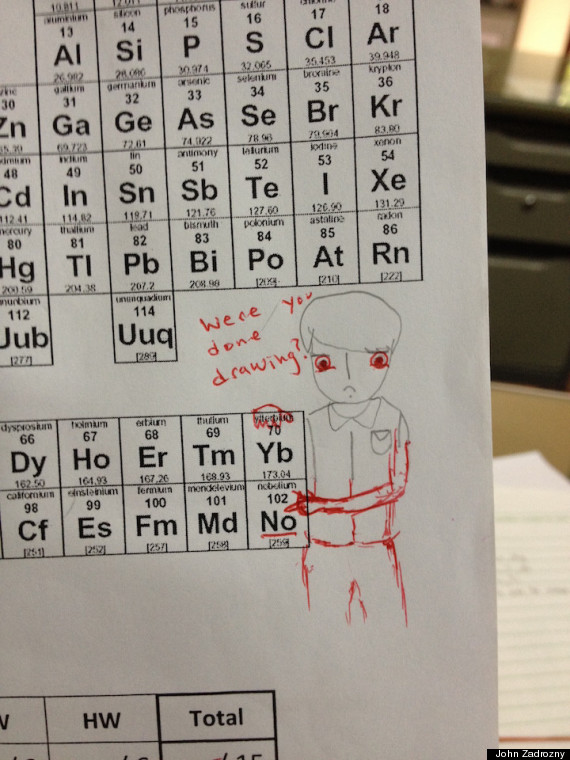
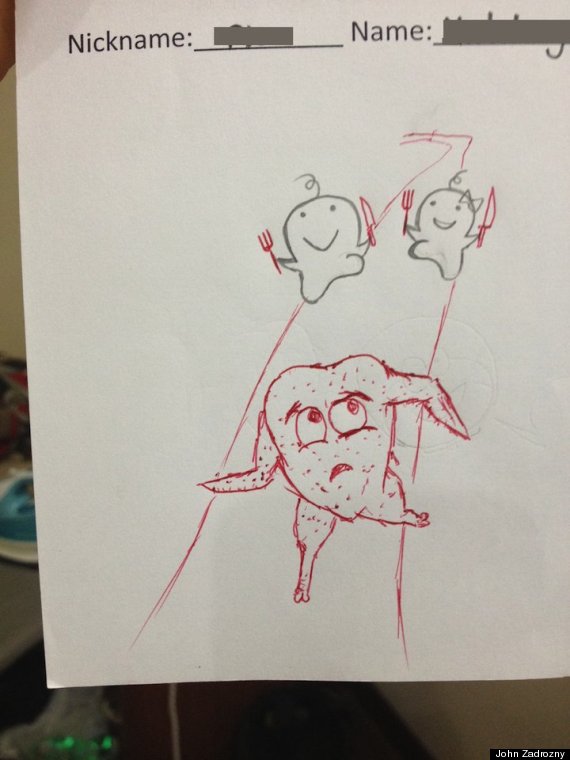
He will probably encourage his students to doodle even more but I just adore a teacher with a sense of humor. Watch how he improves on his students’ doodles:
The strength of the parent-teacher relationship is absolutely pivotal to achieving in the classroom. Below are some insightful tips by teacher Toby Sorge:
* Think of what the end goal is. Teachers can tell when the focus is on a specific grade or assessment, whether the communication is by email, phone call or in person. Giving authentic feedback and grading assessments is not an easy task, but remember that the grade that was earned is now in the past.
* Work with the teacher to create a plan. This plan should focus on student engagement and growth. This may take time, so it’s important to trust the process. Maintain open lines of communication, so if you have questions about your role, you can ask and have them answered.
* Trust is one of the core values when it comes to fostering a successful relationship. Trust that the teacher knows what’s best for each student and how to get there.
* Trusting the process of learning is also important. True learning and deep engagement do not happen with one quiz, test or writing assignment. They take time.
* Make sure you work with teachers and not against them. Instead of coming in with an agenda, work on creating a plan with the teacher. The plan should focus on the development, practice and reinforcement of skills.
* Offer suggestions but also take advice. Discussing with teachers ways for students to succeed will help everyone fully understand children and what their capabilities are.
As some of you might be aware, I have been out of teaching for two long but enormously satisfying years. I have been taking on the privilege of being a stay-at-home dad to my baby son and his older sister whilst my wife continues on her quest to becoming an obstetrician. This has included taking over all aspects of home and child rearing whilst my wife completed her rural rotation and endless night shifts. Although I was already a “hands on” father, two years making my children the sole focus of my life has proved extremely rewarding and quite useful as I prepare to go back to recommence teaching at the end of the month.
I have always loved my job and even though I’ve had a great time being a stay-at-home father, returning to the classroom has me bursting with excitement. I know there will be cobwebs to negotiate and things have changed in the last 2 years (since when did everyone have to have an iPad?), but I have an urge to come back as a better teacher than the one I was when I took leave.
These are some of my initiatives in the lead up to day 1 and throughout the calender year:
1. If they Wont Buy it For Me, I’ll Get it Myself – Every teacher buys stuff for their classroom. You just can’t avoid it. But, there are times after proposing a valuable resource and you get turned down by your school that you give up the idea altogether. There is no way my school would invest in hand held whiteboards for each student. I love them and will find so many great uses for them along the way. I can’t really afford a class set, but that’s not going to stop me this year.
2. Lose Weight – Two years of sandwiches has taken its toll. I’ve got 5 kilos to lose in a month. I’m not sure that’s possible, but it can’t hurt to try. Many people think that teaching is not a physical job. Boy are they wrong! To be at my best, I must be able to withstand the stress, exertion and sleep deprivation that this job demands. For me, it means I can’t get away with starting off the school year looking like the Duff blimp.
3. No More Worksheets! – I don’t like worksheets and have made an effort to avoid them at all costs, but the lazy voice in my head sometimes prevails. It also doesn’t help that the teacher resources handed to you at the beginning of the year features nothing but worksheet laden books. Where are the dice, playing cards, tokens and imitation money? I don’t want to subject my students to worksheets unless I simply have no choice.
4. No Yelling – I never yell at individuals and my students will tell their parents that I never yell at all. I wish they were right. I have on more than enough occasions yelled at the class as a whole for reasons such as disrespect towards each other or for treating a substitute or specialist teacher in an unbecoming manner. I have to try to get my messages across without screaming at them.
5. Develop My Students as People, Not Simply as Learners – Up until now I have approached teaching with 2 main objectives. Firstly to increase the self esteem of each individual by instilling a sense of cohesion in the group and empowering every individual. And secondly, to foster a love of learning by making my lessons engaging and relevant to the learner. This year I want to add a third plank. I want to help prepare my students for the real world by helping them to develop “real world” skills such as working within a budget, developing a stronger work ethic and having better organisation skills. I think I’ve dropped the ball a bit in that area and I sincerely wish to improve.
I’m sure that along the way I will have more to add to the list, but it’s a good start. Now to get those pounds off. Oh well, quinoa can’t be that bad, can it?
Of course I am not in favor of persecuting teachers even further by subjecting them to standardized testing, but you can’t help but shake your head at the lack of skills some of us possess:
Many would-be high school teachers reportedly have worse spelling skills than their prospective students, raising concerns within the education union.
The union is seeking to have entry standards on new teachers raised after a study revealed many teachers had trouble with spelling and had a limited vocabulary, News Corp has reported.
In a study of more than 200 teaching undergraduates, none were able to spell a list of 20 words correctly, with some not getting even one word right.
Among the more frequently misspelled words were “acquaintance” and “parallel”.
The university students also had trouble with word definitions.
Some believed “sanguine” was a type of pasta, while others defined “draconian” as having something to do with dragons.
Australian Education Union president Angelo Gavrielatos said it was evidence standards for new teachers needed to be raised.
The federal government will soon release a report in how to improve teaching standards.
This story isn’t just about a teacher supposedly falling from grace but yet another example of an award that isn’t as useful as it may seem:
A former Teacher of the Year in Jackson County is facing discipline after being drunk and passed out at school.
Lori Lassmann and the staff of Florida’s Education Practices Commission have worked out a settlement in which Lassmann does not admit any wrongdoing, but she also is not contesting the allegations made against her.
If the EPC accepts the settlement at its meeting next week, Lassmann’s teaching certificate would be suspended for two years, and she would be on probation for two years.
She must also undergo substance abuse counseling and testing.
On October 29, 2013, Lassman was apparently intoxicated in front of her first grade students at Golson Elementary.
When she failed to pick up her students at their physical education class, other teachers went to check on her.
They allegedly found her passed out in a chair, and it took vigorous shaking to wake her up.
Lassmann refused to take a sobriety test, and left the school. She resigned three days later.
1. Your child needs to be aware of others’ inner experiences.
It needs to become second nature to him to think about others and their feelings almost as quickly as he thinks of his own. Many parents validate one child’s perspective, but fail to discuss their own feelings or feelings of another child. Just validating your own child’s feelings does not teach him that there are other people in the world whose feelings matter.
Example of validating your child:
“I see you felt really angry right there when John took your ball.”
“I see you felt really angry right there when John took your ball. He looked angry too. I think he thought you were going to play with him, but then you ended up playing alone.”
2. Discuss your own emotions too.
It does children no good to view a parent as having no weaknesses or vulnerable emotions. If they can empathize with you, they will remember this and it will facilitate self-compassion when they are an adult behaving as you do. Here’s an example of that:
“I’m sorry you got upset when Mommy didn’t play with you. Mommy was feeling anxious because she had a lot of cleaning to do before our friends come over. I will play with you now.”
3. Discuss both siblings’ or friends’ emotions after any conflict, validating and empathizing with both sides. Do not only validate the child whose actions you agree with more.
Example: “You were mad that your sister grabbed your doll, and she was feeling sad that you weren’t paying attention to her. That’s probably why she grabbed it.” You’re not condoning any behavior, but just giving a value-free description of the emotions underlying each child’s actions.
4. Make sure to speak for those who cannot speak, such as pets or babies.
“Why is baby crying? I wonder if he is hungry or tired? What do you think?” And a zero tolerance policy for meanness to those smaller and weaker than yourself. Horton Hears A Who! by Dr. Seuss is a good book to serve as a springboard for a discussion about why it is important to look out for those smaller than yourself.
5. When you interact with others outside the home, discuss their feelings later together.
“I wonder what Grandma was thinking when she waved bye bye to you. I think she was happy she visited with you, but also a little sad you had to go. What do you think?”
You can also do this with characters in books and on TV.
6. Aim for consistency around the issue of meanness and teasing.
Any name-calling or making fun of others should be nipped in the bud right away. Bad names and mean words are unacceptable, even from the smallest child. Don’t laugh or roll your eyes when your 3-year-old calls Daddy a poopy head. This just shows her that bad names are okay and even funny. Instead, say something like, “It hurts Daddy’s feelings when you call him a bad name. That is not nice and it’s not okay.”
You and your partner or any other caregiver should get on the same page about “teasing.” Often, one parent thinks that gentle teasing is okay, and a more sensitive parent or child then ends up getting hurt a lot because the less sensitive family members are “just” teasing them multiple times a day. This is especially a salient issue with Highly Sensitive Children. I recommend that this is discussed openly in a family, e.g. “Mary thinks that you calling her sillyhead isn’t funny, so please don’t say that to her. Joe thinks it’s funny so we can say it to him. Whenever someone says they don’t think teasing is funny, it means we should stop right away.”
7. When children see others who are different from them, e.g. with special needs or birth defects, it is important to discuss that everyone has feelings and wants friends.
Don’t be content with just telling your kids not to talk meanly or make fun of these children. You should go up and say hello and introduce yourselves. Read this wonderful article by a mom of a little boy with a craniofacial disorder for more on this.
8. When you are mean, apologize.
Don’t just feel ashamed and then try to silently make it up to your child or partner later. Own your mean behavior. This is extremely important because you’re modeling taking responsibility for your mean behavior. Children learn from what they see you do much more than from what you tell them to you.
Example: “I’m sorry I grabbed your arm roughly when you pulled the stuff off the shelf in the grocery store. I did it because I was mad. But no matter what I was feeling, grabbing you wasn’t okay.”
If I can add to the list I would recommend having your child watch the entire How to UnMake a Bully series. I was fortunate enough to have some involvement in the installment above.
I have attached an article listing 15 life skills that teachers apparently don’t teach. I certainly cover most of these and I would be surprised if many teachers do as well:
1. Basic financial management
I’m not talking about stocks and portfolios (but, okay, those too), I just mean the very simple, very necessary art of budgeting and making household finance decisions. This is one area that kids could use some expert guidance, considering most parents weren’t taught properly themselves.
2. Understanding credit and student loans
A class on interest rates alone would have saved me from a few mega financial blunders.
3. Relationship counseling
We take classes and a test before getting a driver’s license. We take lord knows how many exams before getting into college. We’re even offered a variety of parenting/birthing/breastfeeding classes before having a baby. And yet I could walk into a courthouse with a simple registration and some makeshift rings and call it a marriage. How can something so complicated and important — something that affects everything from our money to our health to our happiness — have next-to-no training or instructions?
This is another thing that should be learned at home in theory, except many kids have really crappy relationship role models because their parents had crappy role models because THERE’S NO EDUCATION ON MAINTAINING RELATIONSHIPS.
4. Personal communication skills
Children are being born into a world of silent communication (texting, emailing, messengering, etc.), and so their personal communication skills — how to engage and connect with other people — might need a boost. Considering our ability to effectively communicate will affect every single aspect of life, it’s astounding how little attention it’s given in school.
5. The power of negotiation
Unless we had the insight to join a debate team, we probably never learned the art of negotiation — something all adults will need at some point, whether negotiating with a boss, a bank, or a spouse.
6. Emotional awareness/intelligence
We learn plenty about our physical health, but what about our emotional and mental health? What about our inner worlds? Could there be any topic more relevant to students and young adults than understanding and managing their stress, anxiety, and emotions? If mindfulness and emotional awareness was as essential to the public school curriculum as Common Core math strategies, we just might raise a healthier generation of humans.
7. Digital etiquette
‘Tis the time to teach selfie regulation, Internet kindness, and social oversharing. Our kids are inheriting a digital world, and so they’ll need to know how to exist in it.
8. Coding
You know what? Take the cursive out of my kid’s curriculum, whatever. I’d much rather him learn modern skills like coding, computer science, and search engine techniques. If we want our kids to have solid life skills, they’ll need to understand their digital environment. THIS is their life.
According to LifeHack, “Not knowing how to program will soon become synonymous to being illiterate … If you don’t know how to program, you’re merely consuming the whole world around you, which is programmed.” Yet 9 out of 10 schools aren’t teaching coding classes, and computer science doesn’t count toward high school graduation requirements in 25 out of 50 states.
9. Focus
Scientists are now realizing that the newest crop of humans have an unprecedented ability to multitask, probably due to neuroplasticity (our brains ability to adapt and change to the environment). New York magazine reported that kids can “[conduct] 34 conversations simultaneously across six different media, or pay attention to switching between attentional targets in a way that’s been considered impossible.”
But with the give comes the take, and studies show that these kids have less of an attention span than ever before. Perhaps the best thing we can teach these kids is to single-task, and to really listen and focus, rather than succumb to every distraction like a dog in a field of squirrels.
Students are chronically rewarded for succeeding and punished for failing — but what kind of lesson does that send? Some of our most important lessons in life come from the biggest failures.
12. Time management
Learning how to stay organized, on task, and productive is something that virtually every human, in every career, will need.
13. The basics of cooking
No student should be allowed to graduate college without mastering at least one dish beyond microwavable dinners and instant oatmeal.
14. Household repairs and maintenance
I’ve been alive for almost 30 years now, and I have no idea how to fix a leaky pipe or why my car makes that rattling sound.
15. Survival skills/basic first aid
Our kids can take a test and memorize facts, but would they know how to find water if they were stranded? Can they fish? Stop a bleed? Perform CPR? Correctly lift heavy objects? Follow a map sans GPS? I understand that these are skills learned over a lifetime, but shouldn’t we have at least one class on the basics of human survival?







 is a good book to serve as a springboard for a discussion about why it is important to look out for those smaller than yourself.


 Topical Teaching