Posts Tagged ‘Teachers’

Guess What Percentage of Teachers Considered Quitting this Year

December 22, 2013

gove

What percentage of British teachers considered quitting their job this year?

10%?

Not even close!

25%?

Keep on going.

35%?

You’re not even trying.

How about 45?

Keep going.

50%?

Correct! According to the Teaching union NASUWT, almost half the teachers in England were considering giving their jobs away. Whilst I don’t take union figures as gospel, the survey results point to two very severe problems.

  • Teachers are not happy. Increased Government funding and standardized testing are not going to sufficiently impact student performance when the most important piece in the puzzle, the teacher, are not committed to seeing the year out. A teacher that isn’t happy is more than an impediment to learning – it is a fatal blow.
  • The latest trend in education policy is to put more pressure on teachers. Paperwork has become ridiculously onerous, constant changes to curriculum have left teachers in a tailspin, the deterioration of classroom behaviour has left many teachers suffering undue stress and assessments by government, school administration, peers, parents and even students have made teaching one of the most critiqued professions around.

My experience with teachers is that they join the profession largely from a desire to make a difference. The fact that so many enter the job with idealism and passion that becomes eroded so quickly is cause for great alarm.

From all the ideas and methodologies surfacing in education there seems to be one crucial policy area that continues to be avoided:

What policies can we put in place to support teachers rather than judge them, to assist them rather than to overwhelm and suffocate them?

If public policy doesn’t show concern for teachers, it stands to reason that many teachers wont get the job done.

Click on the link to read The Classroom Shouldn’t be a War Zone for Our Teachers

Click on the link to read Remember When Teachers Were Shown Respect? (Video)

Click on the link to read If You Think Teaching is so Easy You Should Try it for Yourself

Click on the link to read Teachers are Extremely Vulnerable to False Accusations
Click on the link to read Top 10 Ways of Dealing with Teacher Burnout

Click on the link to read Tips For Teachers for Managing Stress

Top 5 Musicians that Were Once Teachers

October 23, 2013

kiss


I’d love to give you the top 5 teachers who were once musicians, but this will have to do:


KISS frontman Gene Simmons (aka The Demon) was actually a 6th Grade teacher at a Manhattan public school for six months before quitting the classroom for the stage. He’s since said that he realised he went into teaching because he wanted people to notice him – but he preferred the idea of performing in front of thousands of fans rather than a few dozen kids.

If you remember 80s hit Don’t Stand So Close to Me, you might also recall seeing Sting dressed as a school teacher in the film clip (www.youtube.com/watch?v=KNIZofPB8ZM). The man who shot to fame with The Police worked as a teacher in a primary school in North East England for two years. He admits he wasn’t very good at it, because he only taught things he was interested in … poetry and soccer.

Prep teacher Art Garfunkel (of legendary duo Simon & Garfunkel) is a talented mathematician. After going to teachers’ college, he was still working in the classroom in Connecticut just after Bridge Over Troubled Water (www.youtube.com/watch?v=C-PNun-Pfb4) became a massive hit.

“If it makes you happy, it can’t be that bad,” according to Sheryl Crow. Well, teaching was the career that made the Missouri singer-songwriter happy before a string of hits earned her millions. Crow started out as an elementary school music teacher – working in the classroom by day and singing in bands on evenings and weekends.

Our last musician on the list is sweatband-wearing Dire Straits frontman Mark Knopfler. His mother was a teacher and, before he formed the band and hit the big time, a young Knopfler taught English in a UK college and visited schools in the countryside several times a week teaching kids guitar skills.

OK, just because it’s you, here’s a bonus five celebs who have also worked in the classroom …

Mr T (best known for playing BA Baracus in The A-Team and his appearance in Rocky III) was a public school gym teacher in the US. We pity the fool who dared to mess around in his class.

John Hamm (Don Draper in drama series Mad Men) was an 8th Grade drama teacher before finding fame on the small screen.

Australia’s own Hugh Jackman is known for sticking to a tough fitness regime to prepare for roles like Wolverine. What you might not know is he also worked as a PE teacher in the UK in the late 80s.

Finally, two best-selling authors: The master of horror, Stephen King (think The Shining, Misery) used to be an English teacher, and Dan Brown (best known for the mega-hit The Da Vinci Code) was also an English and Spanish teacher.


Click on the link to read Principal Rewards Students for Reaching Reading Goals

Click on the link to read Proof that Teachers Care

Click on the link to read The Short Video You MUST Watch!

Click on the link to read Is There a Greater Tragedy than a School Tragedy?

Click on the link to read School Shooting Showcases the Heroic Nature of Brilliant Teachers

Click on the link to read Meet the Armless Math Teacher


50 Things You DON’T Have to do to Maintain Classroom Management

September 15, 2013


manage

Courtesy of the brilliant site smartclassroommanagement.com:


1. You don’t have to lecture, yell, or scold.

2. You don’t have to micromanage.

3. You don’t have to ignore misbehavior.

4. You don’t have to be unlikable.

5. You don’t have to tolerate call-outs and interruptions.

6. You don’t have to use bribery.

7. You don’t have to walk on eggshells around difficult students.

8. You don’t have to give false praise.

9. You don’t have to send students to the office.

10. You don’t have to implore your students to pay attention.

11. You don’t have to say things you don’t truly believe.

12. You don’t have to be humorless, stern, or overly serious.

13. You don’t have to repeat yourself over and over again.

14. You don’t have to work on building community.

15. You don’t have to beg or coax or convince your students into behaving.

16. You don’t have to waste time and attention on difficult students.

17. You don’t have to do more or say more to have better control.

18. You don’t have to show anger or lose your cool.

19. You don’t have to lower your behavior standards.

20. You don’t have to talk so much, so often, or so loud.

21. You don’t have to have an antagonistic or demanding relationship with difficult students.

22. You don’t have to shush your students or ask repeatedly for quiet.

23. You don’t have to give frequent reminders and exhortations.

24. You don’t have to show hurt or disappointment to get your message across.

25. You don’t have to guide, direct, or handhold your students through every moment of the day.

26. You don’t have to be thought of as a “mean” teacher.

27. You don’t have to use threats or intimidation to get students to behave.

28. You don’t have to have friction or resentment between you and any of your students.

29. You don’t have to use behavior contracts to turn around difficult students.

30. You don’t have to give over-the-top or gratuitous praise.

31. You don’t have to plead with your students to follow your directions.

32. You don’t have to use different strategies for different students.

33. You don’t have to tolerate a noisy, chaotic, or unruly classroom.

34. You don’t have to talk over your students or move on until you’re ready.

35. You don’t have to accept being disrespected, cursed at, or ignored.

36. You don’t have use complicated classroom management methods.

37. You don’t have to be fearful of holding your students strictly accountable.

38. You don’t have to hold time-consuming community circles or hashing-out sessions.

39. You don’t have to be negative or critical to motivate your students.

40. You don’t have to cover up your personality or hold back from having fun.

41. You don’t have to tolerate arguing and talking back.

42. You don’t have to ask two or three times or more for your students’ attention.

43. You don’t have to offer praise for expected behavior.

44. You don’t have to rely on parents, the principal, or anyone else to turn around difficult students.

45. You don’t have to be overbearing or suffocating to have excellent control.

46. You don’t have to give incessant talking-tos to difficult and disrespectful students.

47. You don’t have to ask students why they misbehaved or force assurances from them.

48. You don’t have to have a boring, no-fun classroom to keep a lid on whole-class misbehavior.

49. You don’t have to be tense, tired, and sick of dealing with misbehavior.

50. You never, ever have to be at the mercy of your students.


Click on the link to read Ten Tips to Minimise Classroom Distractions

Click on the link to read 6 Methods For Getting Kids to Cooperate

Click on the link to read 10 Important Steps to Stop Yelling at Kids

Click on the link to read Classroom Management is Getting Harder

Click on the link to read The Dog Eat Dog Style of Education

Click on the link to read Problem Kids, Suspensions and Revolving Doors

5 Ways to Identify a Great Teacher

September 4, 2013


great


Courtesy of Deborah Chang

1. Great teachers are not superheroes; they are everyday heroes.
Teachers should not be expected to work miracles in miserable conditions. They are everyday heroes who want to be working sustainably and joyfully every day. Robert Hawke, a principal-in-residence at Achievement First, puts it eloquently when he says, “Teachers are also mothers, and husbands, and people who need to go grocery shopping and would occasionally like to spend some time volunteering at church or — gasp — reading. Yes, we should expect that they do their jobs the best they can and yes, this job requires much more than eight hours per day, but they won’t be able to continue doing these things beyond a couple of years if we also expect them to put their outside-of-their-job lives completely on hold.”

2. Great teachers are not saviors; they are inspirers.
Children are strong, magnificent human beings who are not waiting to be rescued, they are bursting to grow. Children also come from families and communities with strengths, culture, and knowledge that great teachers affirm, learn from, and celebrate. Great teachers do not swoop into children’s lives thinking that they have all the answers. Instead, great teachers inspire children to draw on their own strengths, interests, and communities to accomplish great things.

3. Great teachers are not magicians; they are practitioners.
The work great teachers accomplish — whether it is teaching a first grader how to read, conducting a middle school orchestra in a masterful rendition of a challenging piece, or helping a high school senior land his first internship — is the very opposite of illusion. What great teachers do to accomplish that work should be on display, deconstructed, and shared to improve everyone’s practice. Books like The Skillful Teacher and online networks like Classroom 2.0 are a more accurate depiction of the skills great teachers work to hone over years than movies like Stand and Deliver, which, while enjoyable, show very little in the way of good instruction.

4. Great teachers are not interchangeable; they are individuals.
Teachers have strengths and weaknesses, preferences and interests. A teacher who thrives in one particular situation might not thrive in another. Teachers are most successful and happy when they work in the subject, school, context, and communities that best fit them. Questions we need to ask when we talk about teachers include:

    • What kinds of schools do teachers work in? What are the schools’ systems for planning, instruction, and discipline?


    • What kind of professional relationships are supported by their schools? How are teachers expected to interact with administrators and with one another?


    • What are the cultural and economic backgrounds of their students and their students’ families?


  • What are the teacher’s responsibilities? Review their actual task lists and calendars to see just how different specific schedules and those specific tasks are across schools, subjects, grades, and districts.

5. Great teachers are not lone rangers, they are team builders.
Behind every great teacher, is a great mentor, and behind every great teacher who loves teaching, is a great team. Great teachers are a product of other great teachers who have built them up. They are hard to find in schools with dysfunctional adult cultures because when the adult culture is bad, teachers leave. And, while good teachers do amazing things in their own classrooms, great teachers extend their influence by partnering with the people most important to their students lives, whether they are siblings, parents, grandparents, coaches, or other teachers. Great teachers do not work alone.

Bottom line, it’s dangerous and destructive to talk about great teachers like they are superheroes, saviors, magicians, interchangeable, or lone rangers. Narratives like these prevent us from dealing adequately with real issues, such as the need to make teaching more sustainable, financially and psychologically, and the challenge of evaluating teachers amidst a great variety of different contexts. Practice recognizing and counteracting these narratives when you come across them, the teacher in your life will thank you for it.


Click on the link to read Principal Rewards Students for Reaching Reading Goals

Click on the link to read Proof that Teachers Care

Click on the link to read The Short Video You MUST Watch!

Click on the link to read Is There a Greater Tragedy than a School Tragedy?

Click on the link to read School Shooting Showcases the Heroic Nature of Brilliant Teachers

Click on the link to read Meet the Armless Math Teacher


The Top 10 Mistakes Teachers Make

August 20, 2013

mistake


Courtesy of Richard M. Felder:


Mistake #10. When you ask a question in class, immediately call for volunteers.

You know what happens when you do that. Most of the students avoid eye contact, and either you get a response from one of the two or three who always volunteer or you answer your own question. Few students even bother to think about the question, since they know that eventually someone else will provide the answer. We have a suggestion for a better way to handle questioning, but it’s the same one we’ll have for Mistake #9 so let’s hold off on it for a moment.

Mistake #9. Call on students cold.

You stop in mid-lecture and point your finger abruptly: “Joe, what’s the next step?” Some students are comfortable under that kind of pressure, but many could have trouble thinking of their own name. If you frequently call on students without giving them time to think (“cold-calling”), the ones who are intimidated by it won’t be following your lecture as much as praying that you don’t land on them. Even worse, as soon as you call on someone, the others breathe a sigh of relief and stop thinking. A better approach to questioning in class is active learning.1 Ask the question and give the students a short time to come up with an answer, working either individually or in small groups. Stop them when the time is up and call on a few to report what they came up with. Then, if you haven’t gotten the complete response you’re looking for, call for volunteers. The students will have time to think about the question, and-unlike what happens when you always jump directly to volunteers (Mistake #10), most will try to come up with a response because they don’t want to look bad if you call on them. With active learning you’ll also avoid the intimidation of cold-calling (Mistake #9) and you’ll get more and better answers to your questions. Most importantly, real learning will take place in class, something that doesn’t happen much in traditional lectures.2

Mistake #8. Turn classes into PowerPoint shows.

It has become common for instructors to put their lecture notes into PowerPoint and to spend their class time mainly droning through the slides. Classes like that are generally a waste of time for everyone.3 If the students don’t have paper copies of the slides, there’s no way they can keep up. If they have the copies, they can read the slides faster than the instructor can lecture through them, the classes are exercises in boredom, the students have little incentive to show up, and many don’t. Turning classes into extended slide shows is a specific example of:

Mistake #7. Fail to provide variety in instruction.

Nonstop lecturing produces very little learning,2 but if good instructors never lectured they could not motivate students by occasionally sharing their experience and wisdom. Pure PowerPoint shows are ineffective, but so are lectures with no visual content-schematics, diagrams, animations, photos, video clips, etc.-for which PowerPoint is ideal. Individual student assignments alone would not teach students the critical skills of teamwork, leadership, and conflict management they will need to succeed as professionals, but team assignments alone would not promote the equally important trait of independent learning. Effective instruction mixes things up: boardwork, multimedia, storytelling, discussion, activities, individual assignments, and group work (being careful to avoid Mistake #6). The more variety you build in, the more effective the class is likely to be.

(more…)

Fun Facts about Children

August 15, 2013


cat

Courtesy of 10-facts-about.com:

Fact 1:
The average age children begin to use a microwave is seven.

Fact 2:
A 3-year old Boy’s voice is louder than 200 adults in a crowded restaurant.

Fact 3:
Fathers tend to determine the height of their child, mothers their weight.

Fact 4:
On average, a 4-year-old child asks 437 questions a day.

Fact 5:
Watching television can act as a natural painkiller for children.

Fact 6:
In ancient Greece, children of wealthy families were dipped in olive oil at birth to keep them hairless throughout their lives.

Fact 7:
The great pharaoh Ramses II who fathered over 160 children.

Fact 8:
Children’s kneecaps only start to turn bony at 3 years of age, until that they are made of cartilage.

Fact 9:
Both boys and girls in 1600s England and New England wore dresses until they were about seven years old.

Fact 10:
Children under the age of six are at the greatest risk for crushing or burning injuries of the hand.

Click on the link to read Teaching Perfectionists

Tips For Teachers for Managing Stress
July 8, 2013


stress


Stress has become an unavoidable part of a teacher’s life. The demands on a teacher are growing every year and the conditions are far harder than ever before. Psychologist Marc Smith gives some useful tips to teachers for managing stress:

Despite much discussion concerning the nature of workplace stress, our jobs are getting more and not less stressful. While stress certainly isn’t unique to the teaching profession, working in schools does throw up a number of situations that are unique to education while the current climate of uncertainty and criticism further undermines the professionalism and confidence of many hard working teachers. Ofsted inspections, changes to pay and conditions and new appraisal systems all add to the feeling that we are far from in control. Identifying those things that we can control and those that we cannot could help to prevent daily hassles from becoming major problems; but we can’t do it on our own.

Stress is a natural biological response and back in the day when wild animals roamed freely and early humans spent much of their time hunting and gathering the body’s response to stress was vital for our survival. Stress allows our biological system to prepare itself to do something – either attack (fight) or run away (flight). Acute stress represents that immediate panic which drives the fight or flight response but if this stress continues we begin to suffer from a more chronic condition, this can not only impact on us psychologically but can also lower our immune system, making us more vulnerable to physical illness.

Psychologically, the stress we feel is often based on our individual perception of a situation and this is why some people appear to suffer more than others. American psychologist Julian Rotter describes this as our ‘locus of control’ or the extent to which an individual feels that they have control over a situation. Locus of control can be internal, in that we believe we have control over our lives, or external, where we believe that the environment controls events. Realistically most of us fall between these two dimensions but we may favour a particular one. Unfortunately, our locus of control is very difficult to change because it probably developed through a combination of genetics and early socialisation.

(more…)

Teachers Addicted to Referring Their Students to Specialists

June 13, 2013

As a social experiment, wouldn’t it be wonderful if teachers decided not to refer their students for 12 months to an occupational therapist or speech pathologist? Wouldn’t it be interesting if they had to provide for the child and adjust their teaching to cater for the special needs of these children instead of relying on specialists to do that for them.

Just wait a minute! Aren’t teachers catering for children of special needs already?

Of course some are, but many aren’t. Here are some questions I have compiled for you to determine whether or not your child’s teacher is relying too heavily on a specialist:

1. Is there evidence that your child’s teacher is in regular contact with the specialist?

2. Is their evidence that your child’s teacher follows the recommendations based on the child’s assessment evaluation?

3. Does your child’s teacher blame a lack of progress solely on your child’s learning difficulty?

4. If you have ceased sending your child to a specialist has the teacher shown signs of giving up on your child and blaming a lack of progress on your decision?

This might seem harsh on teachers but believe me it happens all the time. Parents are put under pressure to have their child farmed off to a specialist with concerns over attention, comprehension, processing, integration, coordination etc. The parent then has to pay for a costly assessment. The assessment is not unlike a trip to the orthodontist. The orthodontist will almost always see a problem worth fixing – an imperfection that can always be adjusted with a stint on braces.

So too, a speech and occupational therapist will always see scope for therapy. There will always be a recommendation to fix this or manage that. Should the child not be eligible for Government funding, the parents would be pressured to pay for the services of a specialist. The going rate for an occupational therapist for a one hour weekly session is about $500 a month (from personal experience). If the parents refuse to pay, often the teacher will secretly accuse the parents of being selfish and putting money ahead of the interests of the child.

The truth is many specialists are called on, not because there is a major need for therapy, but for the teacher to defer responsibility. No teacher should be allowed to pressure a parent into such a move without first demonstrating a meaningful attempt at accommodating the child within the classroom.

It seems to be that this is a boom time for specialists. The scale for measuring learning difficulties has been expanding, new disorders are being invented overnight and more room is being reserved for this ever increasing ‘spectrum’. I once questioned a psychologist for pronouncing that a student of mine was on the spectrum when I didn’t feel it was warranted. His response – everyone can fit on the spectrum in some way or form. What does that mean? If everyone is on the spectrum, how is that fair to people with autism and low functioning Aspergers? Their condition will surely be undermined if they have to share a spectrum with you and I!

Be very mindful that teachers, like other professions, are prone to short cuts and self interest. It is in the best interest of teachers to outsource their students to specialists, because it means that any lack of progress can be blamed on a ‘disorder’ or processing issue rather than the teacher’s ability to cater for the student.

Of course not all teachers are like that and some students clearly require specialist intervention. There is no doubt about that. But this scenario does happen, and it does happen regularly.

Click on the link to read I am a Proud Defender of the Mixed-Ability Classroom

Click on the link to read The Difficulties of Parenting a Special Needs Child

Click on the link to read Schools Have to Wake Up to Confidence Issues Amongst Students

Click on the link to read If Only All Special Needs Students Were Treated this Way

Click on the link to read Labelling Children is Extremely Harmful

Click on the link to read The Insanity of Modern Educational Thinking


Proof that Teachers Care

May 22, 2013


Well done Rhonda Crosswhite for shielding your students from the terrors of the tornado:

Sprinkled in between the tales of horror and sadness to come out of tornado-ravaged Plaza Towers Elementary School, in Moore, Okla., are stories of brave teachers putting their lives on the line for students.

Fourth-grader Damian Britton described one such teacher this morning, when he appeared on NBC’s TODAY. Rhonda Crosswhite, a sixth-grade teacher at the school, used her body as a shield to protect Britton and other students from the deadly storm.

“She was covering me and my friend Zachary,” Britton said. “I told her we were fine because we were holding on to something, and then she went over to my friend Antonio and covered him, so she saved our lives.”

The show also captured an emotional reunion between Crosswhite, Britton and Britton’s mom, Brandi Kline.

“I told you we were going to be OK,” Crosswhite said to Britton.

Another Plaza Towers teacher, Becky Joe Evans, told her friend Edie Cordray that she used her body to cover students from falling debris, according to a story in the L.A. Times.

The destructive tornado hit Moore, which is located outside of Oklahoma City, yesterday afternoon.


Click on the link to read The Short Video You MUST Watch!

Click on the link to read Is There a Greater Tragedy than a School Tragedy?

Click on the link to read School Shooting Showcases the Heroic Nature of Brilliant Teachers

Click on the link to read Meet the Armless Math Teacher

Click on the link to read The Case of a Teacher Suspended for Showing Integrity

Click on the link to read Teaching is Worth It!

The Kids Who Have to Climb Up a Cliff to Get to School (Pictures)

April 16, 2013

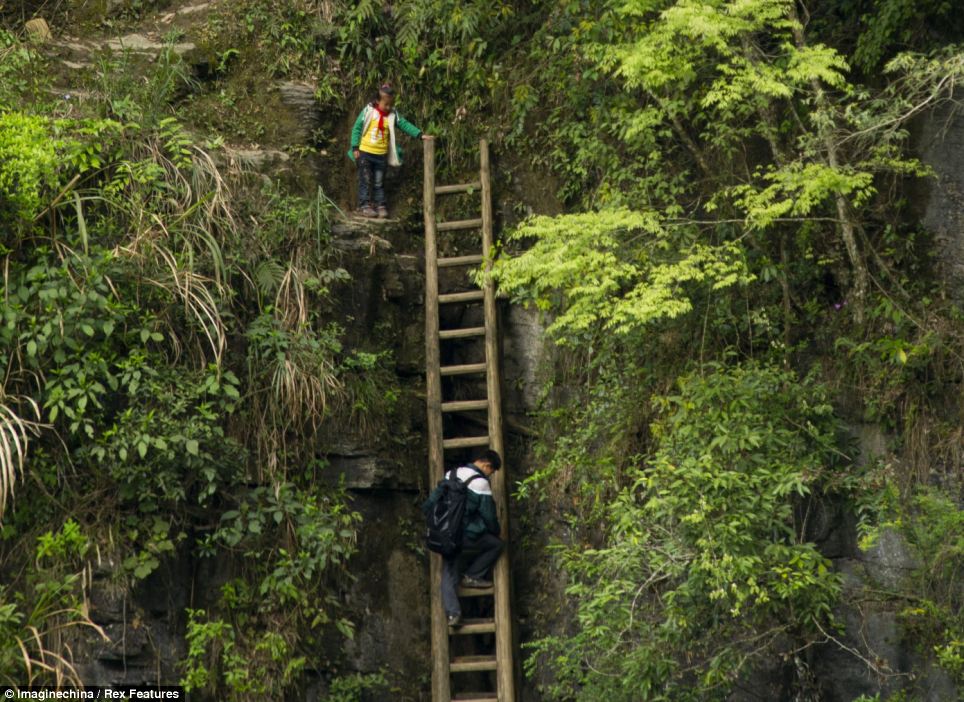
Children climb the ladders to get to school in Hunan province, China

After reading this article I wont complain about getting stuck in traffic on the way to school ever again!

These schoolchildren in southern China are so keen to get to school that they make the perilous journey on narrow wooden ladders every day, with no safety precautions.

Their village in the remote Badagong mountains in Sangzhi county is surrounded by sheer drops on every side, making the school run a daily struggle.

The only way out of Zhang Jiawan village, unless the children have time for a four-hour cross country detour, is via a series of rickety-looking ladders leading down to the valley below.

This little girl balances her three bags leaving her only one hand to scale the mountain to get to school

Staff at the school face a difficult commute to work on the enormous wooden ladders

A schoolgirl holds the ladder for others to come up safely behind her

5-year-old Yu Xinxin, who climbs the ladders to school every day, before she sets off on her long morning journey