Posts Tagged ‘kids’

Things Middle School Students Wish We Knew

December 15, 2014

middle

Courtesy of weareteachers.com via  :


1. I was not trying to get attention by falling off the chair. I am approximately infinity inches bigger than I was yesterday and I just lost track of how to balance. I felt like an idiot so I made falling into a joke. Crying was the other choice. And I’d rather cut off my arm than cry in school.

2. I did that homework. I am almost positive I did it. Getting it from done to folder to backpack to school to you is like seven extra homeworks. That is too many. It’s also possible I forgot to do the homework. I honestly have no idea where my planner is. Or maybe the homework was completely confusing and if I asked for help people might think I am stupid now when that used to be my best subject.

3. That time I called you Mom was the most humiliating moment of my life. It’s one thing in second grade but middle school? Ugh. How does this stuff still happen to me?

4. When you force us to get up—do stuff, act it out, test our ideas—it wakes us up and makes the lesson so much more fun and easy to remember.

5. Sometimes I just can’t focus. I’m buzzy, jumpy, pumped with electricity. Somebody suddenly looks distractingly attractive, across the room, which is fully that other person’s fault, not mine. Or I don’t get what we’re discussing and the pain of not understanding is so excruciating I just have to take a break from paying attention.

6. It feels awesome when you notice something special about me. When you value a skill or interest of mine, you give me a route in to subjects I didn’t think I’d like—and make me feel like I have something worth sharing.

7. What you tell me about myself matters way more than I hope you know. When you tell me I am something—smart, brave, kind, stupid, a trouble-maker, creative, a writer, a mathematician, funny, hard-working—I believe you.

8. I like it when you’re sarcastic but not when you’re harsh. When you say something ironically and I get it, I feel smart and mature. But when you’re mocking in a sharper way, it feels mean and a little scary.

9. Respect me. There are lots of things I already know about myself. Some I want to talk about, A LOT, and it means so much to me when you find time to include me (and it) in class. But lots of other things about me, I’m not ready to discuss, and especially not in class.

10. If you call on me and I am flat-out wrong, please don’t humiliate me. I’m already praying for a hole to open up in the floor and swallow me. It’s hard for me to believe that not knowing isn’t shameful but is instead a good starting point for learning. Help me.

And one bonus extra thing: You are suddenly one of the most important adults in my whole world. How you respond to me affects everything. Please be tough. Please be gentle. Especially when I am neither.


Click on the link to read Watch a Classic Argument in Action (Video)

Click on the link to read 7 Things a Quiet Student Wishes Their Teacher Knew

Click on the link to read Skills That Aren’t Taught But Should Be: #1 People Skills

Click on the link to read Top 10 Most Unusual School Bans

Click on the link to read Rules that Restrict the Teacher and Enslave the Student

Suicide is a Problem Schools Shouldn’t Walk Away From

November 30, 2014

jayden arnold

Since a child spends a majority of his or her waking hours at school, it bothers me that many schools are so reactive when it comes to helping a child at risk. To wait for obvious signs of distress is a policy that flirts with disaster. I have long called for schools to help students who have difficulties making friends or who are undergoing challenges such as radical change, seperation of their parents or those going through a breakup of a friendship or relationship. Instead of waiting for the students to ask for help, is there anything wrong with offering it?

Suicide often occurs when the victim feels that nobody cares or understands. What  better way to show you “get it” than to initiate contact with a student that might need it?

Suicide is not a problem that schools can afford to blame on home issues. It is very much an issue that needs to be tackled through a partnership between school and home:


A SUICIDE prevention policy should be developed in every school in Australia to counter the scourge that affects so many young people, the Black Dog Institute says.

The policy should include plans to execute prevention programs, goals for positive mental health and guidelines for managing suicidal behaviour in schools.

Institute director Professor Helen Christensen said the action plan should be distributed to all school staff.

Teachers and parents also could be trained as “gatekeepers” to improve the identification of suicidal youth by better recognising warning signs and referring students on to further care.

“Gatekeeper training can be delivered universally such as to all school staff or selectively to parents of at risk students,” Prof Christensen said.

Under peer helper programs young people, too, could be equipped with knowledge and skills to help fellow students they believe to be at risk.

Experts believe young people are more likely to confide in one of their peers than in an adult when they are having serious problems.

Prof Christensen has made a series of recommendations on suicide prevention in the specialist publication of the Australian Council for Educational Research, Teacher.

“There is increasing recognition that a coordinated approach to suicide prevention must involve the participation of key community organisations,” she said.

“Among them schools are particularly well placed to deliver interventions that will enhance resilience, improve mental health and reduce risk of suicide.”

Schools at the centre of a mental health crisis among young people report that students are self-harming or threatening to injure themselves at a rate of more than two per week.

Child psychologists also say increasing numbers of children are presenting with mental disorders such as severe anxiety and, in the most extreme cases, have suicided.

Principals campaigning for more counsellors to handle disturbed children in schools report more problems are emerging in younger students — some exhibiting violent and challenging behaviours and a lack of remorse.

Cyber bullying, increasingly linked to incidents of self harm and suicide, now affects an estimated 463,000 a year with around 365,000 of them in the 10-15 age group.

Research by the UNSW’s social policy research centre has found increasing evidence of the lasting effects of cyber-bullying with links to low self-esteem, mental health issues, depression and anxiety.

A number of schools have responded to the Sunday Telegraph’s coverage of the suicide issue affecting young Australians.

Figures show suicide is the leading non-medical cause of death in children aged 10 to 14.

Writing in the newsletter of Rosebank College in Sydney’s inner west, acting assistant principal Paul Hardwick told the school community: “It was with great sadness reading the Sunday papers that the fragility of life hit me.

“Over the last couple of months families, friends and school communities have been left to ponder ‘why?’ and ‘what should I have done differently?’

“The College’s deepest sympathies go out to the families and schools trying to work through the heartache and sadness as they come together to grieve the loss of those so young.

“While adolescent mental health issues are on the rise, we as a community need to be able to arm our children with the tools to seek assistance when they need it and certainly when they are vulnerable.

“Just asking if someone is OK is not always enough.”

Rosebank College republished in its newsletter points of advice given by the headmaster of The King’s School, Parramatta Dr Tim Hawkes, which ran in The Sunday Telegraph.

Southern Cross School at Ballina on the state’s north coast said it, too, was touched by the tragic stories published in The Sunday Telegraph.

The school this week held a Wellbeing Expo “to bring the subject of youth mental health into the public arena and open channels for young people to know where and how to contact the right people” for help.


Click on the link to read Teacher Runs Suicide Note Writing Workshop

Click on the link to read Don’t Wait For Signs a Child is Contemplating Suicide

Click on the link to read Teachers Can’t Afford to Make Light of Suicide

Click on the link to read Schools Have an Even Bigger Responsibility than Educating

What’s in a Name?

November 25, 2014

james


I wonder if kids with the name Michael are more likely to stare out the window and think about their lunch:

It has long been claimed that names can influence your chances of doing well in life and now it seems that monikers can impact on behaviour at school as well.

According to a new study, children named Jacob, Daniel, Amy and Emma are the most likely to display impeccable behaviour while those named Ella, William, Olivia and Joshua are most often to be found on the naughty step.

The findings come from a survey that looked at the names of more than 63,000 school children who logged good behaviour or achievement awards in online sticker books.

Those with the most good behaviour awards were named Jacob and Amy, closely followed by Georgia and Daniel.

By contrast, girls named Ella and Bethany and boys named Joseph and Cameron proved to be the naughtiest.

Other naughty names for boys included William, Jake, Joshua and Jamie while recalcitrant girls were also called Eleanor, Olivia, Laura and Holly.

Well-behaved names included Emma, Grace, Charlotte and Sophie for girls and Thomas, James, Adam and Harry for boys.  

Baby names – and their impact on life chances – have been studied for more than 70 years, with the earliest studies finding that men with unusual first names were more likely to drop out of school.

More recent studies have found more correlation between names and social backgrounds, with the parenting skills of mothers and fathers having a more critical impact on future development.

Gregory Clark, the economist behind The Son Also Rises: Surnames and the History of Social Mobility, found that girls named Eleanor were 100 times more likely to go to Oxford University than girls named Jade.

Although there are proportionally more Jades in the general population than Eleanors, the former was rarely seen at top universities, while the latter was relatively common.

Other common names for Oxford students included Peter, Anna, Elizabeth, Richard and John, while among rarely seen monikers were Stacey, Connor, Bradley, Kayleigh, Shannon and Shane.

The latest round of research into names was commissioned by School Stickers, which creates online stickers for teachers to award to pupils. 

Click on the link to read 10 Ways to Move Forward in Teaching as Well as Life in General

Click on the link to read 5 Ways the System Could Better Recognise Teachers

Click on the link to read Teachers, Lay Down Your Guns

Click on the link to read 4 Ways to Identify a Great Teacher

Gift Ideas for Children that Are Not Toys

November 9, 2014

zoo

A clever and useful list of gift ideas by mother of 6 and blogger Rachel Jones:


18 Non-Toy Gifts for Children

1. Classes. Music, dance, riding, drawing — classes are a great way to encourage children in their interests and let them know that you pay attention to them and what they enjoy.

2. Memberships. Zoo, science museum, children’s museum, YMCA membership, etc. These are particularly great for family gifts! Many young families want to enjoy day outings, but affording them can be a challenge, so give them the gift of a yearly membership.

3. Subscriptions. Kids enjoy getting things in the mail. Why not encourage their reading by getting them a magazine subscription for something they are interested in!

4. Events. Movie tickets, or tickets to a play, concert or sports event are really exciting! Having an event to look forward to makes the rest of life more enjoyable.

5. Activities. Mini golf, bowling, skating rink. These are so much fun! And a big part of the fun is going together. Children love spending time with the adults in their lives; they want to see you enjoying your time as well as enjoying them.

6. Recipe and Ingredients. Kids love cooking with their parents. Baking something special or cooking dinner is an ideal time to spend together and learn life skills. Print out a recipe, purchase all the ingredients and set a date for cooking together.

7. Crafting Date. Our daughter loves making crafts. I do, too; I really do enjoy the creative aspect. But I rarely take time out to do it with her. These crafting dates mean the world to our creative little girl. Keep a basket of craft supplies and get out a book for inspiration. We like Sneaky Art: Crafty Surprises to Hide in Plain Sight, by Marthe Jocelyn.

8. Arts and Crafts supplies. If your craft box is running low, stock up a little on things you need. Add in something fun the kids haven’t used before. A gift of arts and crafts supplies often brings on the imagination, and kids can’t wait to get to work!

9. Coupons. An envelope of coupons that they can “spend” at any time: I’ll do one chore — no questions asked; movie and popcorn night, you pick the movie!; 1:1 game of cards or basketball (whatever the child’s interest is in); sit and read a book with me; stay up 1/2 hour past bedtime.

10. Restaurant Gift Card. Dinner, ice cream, coffee, cupcake — whatever suits their fancy! Give them the freedom of inviting whomever they wish: it may be mom or dad; it may be a grandparent, aunt or even teacher they would like to spend more time with.

11. Dress-Up Clothes. These do need to be limited, but two dresses and a couple play silks can get hours and hours of play!

12. Books. We get a lot of books from the library, but there are some that I just can’t find there, or it takes us longer to read through. We have read through the entire Little House series, Narnia, and are working our way through Shel Silverstein’s books. Be sure to pass the books on when you are done, so they don’t clutter up your home.

13. Clothes. When kids only have a certain amount of clothes, they often enjoy getting clothes. Make it a point to get something that fits their style. That may mean Western clothes, superhero, fancy dresses, etc.

14. Snacks. If your child is a foodie, they will love this! Some homemade granola or cookies made just for them is a special treat!

15. Outdoor Supplies. If you are an outdoorsy family, giving kids their own fishing tackle or gardening equipment can be a big deal. It’s also something that gets left on the shelf in the garage, so you always know right where to find it.

16. Telling Time. Many children these days don’t know how to read analog, or find it takes too long to think about it, so they search for a digital watch. Getting them a cool watch makes them want to be able to tell time on it. Boys, girls, and even teenagers can be excited about this.

17. Games and Puzzles. Games and puzzles are great activities for when kids have to be indoors. It’s a good practice to have individual quiet times during the day, and having a puzzle to sit and work on by themselves helps brain development and problem solving skills. Games teach a lot, too! My kids talk about how they passed geography, just because we played Risk when they were little. Monopoly and Payday have been popular and help cement math skills. Memory games are great for younger children.

18. Calendar. Many children like to know what is going on, what day it is, how many days until ____. These kids are the ones who want to know what the plan is for the day, the order in which things will happen, what time friends are expected over, etc. They struggle with spur-of-the-moment and can be frustrating if you are a spontaneous parent. But celebrate it! These children have many strengths, and make our world run more smoothly. 🙂 Embrace their inner schedule and get them their own calendar. They can write down their own classes, appointments, playdates, etc. And if they ask you, send them to their calendar so they can get used to being in control of their own schedule. You can even schedule “spontaneous days,” so they know that something different will happen that day. Trust me, it will help them enjoy the spontaneous outings!


Click on the link to read When Parents Get Busted!

Click on the link to read The Inconvenient Truth Kids Style

Click on the link to read The Quality Most Parents Want to Teach Their Children

Click on the link to read Are Our Expectations for Children Too High?

Click on the link to read 25 Ways to Approach the Dreaded ‘How was School Today?’ Question

Do We Learn Enough From Children?

November 5, 2014


Sometimes our children show us up as ignorant. In the video above, one simple question is asked: If you could change one thing about your body, what would it be?

Watch the difference between the way children interpret the question to the way the adults do.

It’s society that encourages us to be critical of our own bodies – it is not a natural construction.


Click on the link to read Kids as Young as 7 Diagnosed with Anorexia

Click on the link to read The Destructive Impact of the “Fashion Police” Brigade

Click on the link to read The Plus Sized Barbie Debate Misses the Point

Click on the link to read Study Claims that Being Attractive can give you Better Grades

Click on the link to read The Unique Challenges that Body Image Represents for Females

Watch a Classic Argument in Action (Video)

September 29, 2014

https://www.youtube.com/watch?v=3sKdDyyanGk


One child claims it’s sprinkling another that’s it’s raining. Both refuse to concede. My favourite is the girl in the middle that does her best to stay impartial and act as peacemaker.


Click on the link to read 7 Things a Quiet Student Wishes Their Teacher Knew

Click on the link to read Skills That Aren’t Taught But Should Be: #1 People Skills

Click on the link to read Top 10 Most Unusual School Bans

Click on the link to read Rules that Restrict the Teacher and Enslave the Student

Click on the link to read This is What I Think of the No Hugging Rule at Schools

The Quality Most Parents Want to Teach Their Children

September 21, 2014

quality

A very interesting survey asks, What is the quality most parents want to teach their children?


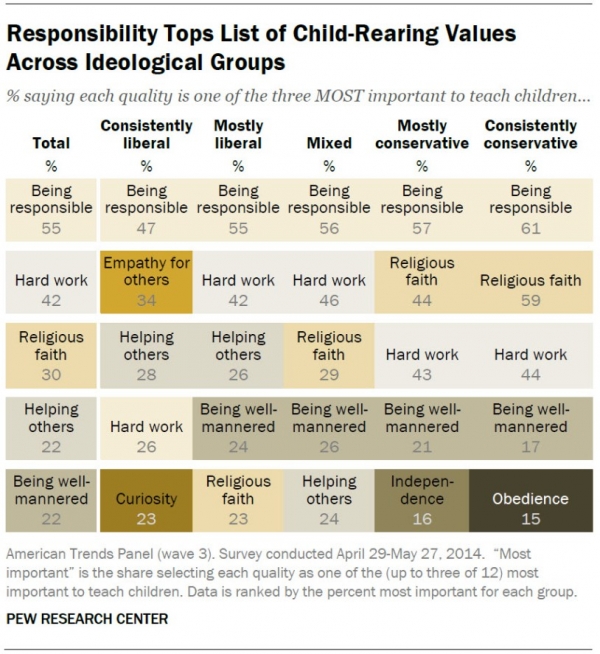
The Pew Research Center study on parenting attitudes sampled more than 3000 adults who were asked to evaluate which of a list of 12 values are the most important they feel children need to learn.

The adults ranked the importance of teaching children the following values from most to least popular: responsibility, hard work, helping others, good manners, independence, creativity, empathy for others, tolerance, persistence, curiosity, obedience and religious faith.

Researchers found that while “being well-mannered” was rated high on the list among all groups, it wasn’t as strong as a desired quality among the most liberal participants. Instead, liberals selected “empathy for others” and “hard work” higher on the list. Pew suggests that children are starting to be taught increasingly different values as political and cultural differences continue to evolve.

Religious faith was found to be one of the most important things parents wanted their children to develop, but it was not rated as important as the other qualities. “Obedience” ranked much higher in the list for consistently conservative parents more than any other quality, following responsibility.

Another difference in the types of qualities parents want to teach their children lies within their level of education. Less than half of college graduates chose religious faith or obedience. The study found that the college graduates selected tolerance, persistence and curiosity more than parents of a lower education. Parents with only high school education valued their children helping others more than those with some college or a college degree.

The study shows that even though political beliefs, race, religion and education vary between American parents, most parents want their children to learn similar qualities.


Click on the link to read Are Our Expectations for Children Too High?

Click on the link to read 25 Ways to Approach the Dreaded ‘How was School Today?’ Question

Click on the link to read Learning to Let Go

Click on the link to read Things Teachers Wish Parents Knew Before the School Year Begins

Click on the link to read The Worst Parent in the World May be an Australian

Click on the link to read 10-Year-Old’s Marriage Advice to His Teacher

11 Valuable Digital Media Tips for Students

September 5, 2014

kidsCourtesy of Justin Boyle at teachthought.com:


1. Use Privacy Settings

Let’s talk Facebook, shall we? Chances are pretty good that your students can be counted among the 1.3 billion monthly active users of the social media giant, and there’s practically no other website that contains such a breadth and depth of personal information.

Encouraging students to put all of their social media accounts, including Facebook, on a short leash might be the most important step toward helping them manage their digital footprint. Look into Facebook’s proprietary privacy tips or get the works from Lifehacker.com with it’s “Always Up-to-Date Guide to Managing Your Facebook Privacy,” then inform students about the steps they can take. Better yet, just pass the links along.

Complete privacy on Twitter is simple — you just choose to protect your tweets under “security and privacy” on the account settings page — but encouraging students to do so might do more harm than good. Some teachers have gotten great results using Twitter in education, and a class full of students with protected tweets might interfere with that.

2. Keep A List Of Accounts

Then delete the ones you no longer use. That myspace page you signed up for? Don’t just forget about it–find it and delete it.

3. Don’t Overshare 

Perhaps the best tip for helping students maintain privacy on Twitter is one that can be applied across the whole spectrum of social networking tools: Don’t overshare. As much of an alien concept as it may be to students these days, the only sure-fire way to avoid digital footprint trouble is for them to keep quiet about anything they wouldn’t want to share with everyone in town.

This includes usernames, aliases, passwords, last names, full-names-as-usernames, pictures, addresses, and other important information.

4. Use A Password Keeper

This is more of a security thing, but the worst kind of footprint is the one you didn’t make that contains all of your sensitive information. It’s too much work to remember 50 different passwords, and every site has their own unique rules. Until someone solves this problem, the best solution is likely a password keeper

5. Google Yourself

You may be surprised what you find.

6. Monitor Linking Accounts

When you link your facebook or twitter account to that new site (whatever site that might be), you may not realize–or care at the moment–what you’re giving it access to. It’s usually safest to use a secondary email address to sign-up for new sites rather than granting this kind of access.

7. Use A Secondary Email

Whether you’re communicating with someone new, or signing up for a new social media platform, it can be useful to have a secondary email address.

8. You Don’t Need 12 Email Addresses

That said, you don’t need 12. Keep it manageable.

9. Sending Is Like Publishing–Forever

Every time you send a message, post, or picture, you’re publishing it the same way CNN does a news story. And the internet never forgets.

10. Understand That Searches Are Social

There’s another side to your digital footprint, too — it’s not always information that you choose to make public. Remember: Privacy controls or no privacy controls, Facebook still records and uses every scrap of information it gets to better determine its users’ marketing demographics.

Google pulls the same trick with search and browsing habits. If a student is logged into their Google account, the service tracks every keyword they search, every Web page they visit and every time they visit Youtube.

There are ways, however, to control the bits of deep data that we leave strewn around. First of all, even though Google is practically an official synonym for “Web search,” it isn’t actually the only game in town. Less profit-motivated search engines like DuckDuckGo.com and Ixquick.com may take a little getting used to, but they do make explicit policy of protecting users’ browsing privacy.

11. Use Digital Tools To Manage Your Footprint

A host of browser extensions and app add-ons can also limit the surreptitious capture of personal information. Disconnect (Disconnect.me), DoNotTrackMe (Abine.com) and Ghostery (Ghostery.com) are examples of cross-platform extensions that block tracking cookies and give users control over site scripts.


Click on the link to read The 10 Best Educational Apps for Children

Click on the link to read The Must Have iPad Apps for the Classroom

Click on the link to read Using Videogames in the Classroom

Click on the link to read Five Great Technology Tools for the English classroom

Click on the link to read 5 Great Spelling Apps for Tablets and Smartphones

Click on the link to read Are Educators Being Conned by the i-Pad?

Learning to Let Go

August 20, 2014


After watching this fabulous clip I wondered if there could be a ceremony for other habits that children are reluctant to give up. The one that causes me some consternation are those students who are obsessed with being the first at line-up.

Some challenges just can’t be solved with a balloon.


Click on the link to read Things Teachers Wish Parents Knew Before the School Year Begins

Click on the link to read The Worst Parent in the World May be an Australian

Click on the link to read 10-Year-Old’s Marriage Advice to His Teacher

Click on the link to read The Science of Parenting

Click on the link to read Why the Call to Fine Parents for Not Reading to Their Children is Utter Stupidity

Click on the link to read Children are Precious!

Click on the link to read Is it Ever OK to Lie to Your Kids?

Up to 1 in 10 US Students Have an Inappropriate Relationship With Their Teacher

August 16, 2014

andrea connersSurely there aren’t as many student/teacher relationships as suggested in this article. If it is anywhere near as bad as that, it is a terrible indictment on our profession:


Critics suggest that as many as one in 10 U.S. public school students — or about 4.5 million children — are involved in some kind of inappropriate teacher-student relationship.

But it’s not easy to identify — accusations involve everything from physical contact to inappropriate comments or looks — and can have a crippling effect not only on those involved but on the student body and their parents and educators.

“It’s devastating to the rest of our students,” said Dan Unger, president of the Northwest Local School District Board of Education. Two of the three teachers from his district have already been convicted and this year imprisoned. The third case is pending.

“When (the other students) think about the accomplishments of the class of 2014, they’ll think about that. This is what they will remember,” Unger said.

It’s become easier in a digital world where smart phones can dominate conversation, for teachers and students to communicate. That’s good when it’s used to discuss school work. But sometimes it can turn criminal.

“The biggest reason this occurs now is social media,” Abbott said.

A text, Facebook post, Instagram or Snapchat message can give teachers and students greater access to each other than ever before. All three of the Northwest Local School educators relied heavily on Snapchat, Facebook and text messages to communicate with the victimized students.

“It seems to be when the conversation goes private like that, the teacher says and does outrageous and outlandish things they’d never say in person,” Abbott said.

Those private contacts allow predatory educators to exploit students, enhancing the control teachers have over their students. Students want to be liked by or get attention from the educator.


Click on the link to read Facebook Exposes Yet Another Bad Teacher

Click on the link to read Why I Won’t Be Celebrating Facebook’s 10th Anniversary

Click on the link to read If You Ever Wondered How Some Kids Become Bullies …

Click on the link to read The Researchers into Cyberbullying Should Review Their Findings

Click on the link to read The Use of Facebook in Cyberbullying Activity

Click on the link to read A Positive Approach to Tackling Cyberbullying