This story isn’t just about a teacher supposedly falling from grace but yet another example of an award that isn’t as useful as it may seem:
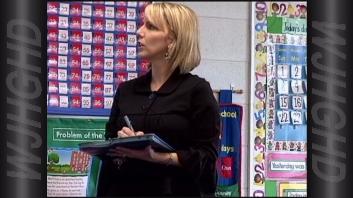
A former Teacher of the Year in Jackson County is facing discipline after being drunk and passed out at school.
Lori Lassmann and the staff of Florida’s Education Practices Commission have worked out a settlement in which Lassmann does not admit any wrongdoing, but she also is not contesting the allegations made against her.
If the EPC accepts the settlement at its meeting next week, Lassmann’s teaching certificate would be suspended for two years, and she would be on probation for two years.
She must also undergo substance abuse counseling and testing.
On October 29, 2013, Lassman was apparently intoxicated in front of her first grade students at Golson Elementary.
When she failed to pick up her students at their physical education class, other teachers went to check on her.
They allegedly found her passed out in a chair, and it took vigorous shaking to wake her up.
Lassmann refused to take a sobriety test, and left the school. She resigned three days later.
1. Your child needs to be aware of others’ inner experiences.
It needs to become second nature to him to think about others and their feelings almost as quickly as he thinks of his own. Many parents validate one child’s perspective, but fail to discuss their own feelings or feelings of another child. Just validating your own child’s feelings does not teach him that there are other people in the world whose feelings matter.
Example of validating your child:
“I see you felt really angry right there when John took your ball.”
“I see you felt really angry right there when John took your ball. He looked angry too. I think he thought you were going to play with him, but then you ended up playing alone.”
2. Discuss your own emotions too.
It does children no good to view a parent as having no weaknesses or vulnerable emotions. If they can empathize with you, they will remember this and it will facilitate self-compassion when they are an adult behaving as you do. Here’s an example of that:
“I’m sorry you got upset when Mommy didn’t play with you. Mommy was feeling anxious because she had a lot of cleaning to do before our friends come over. I will play with you now.”
3. Discuss both siblings’ or friends’ emotions after any conflict, validating and empathizing with both sides. Do not only validate the child whose actions you agree with more.
Example: “You were mad that your sister grabbed your doll, and she was feeling sad that you weren’t paying attention to her. That’s probably why she grabbed it.” You’re not condoning any behavior, but just giving a value-free description of the emotions underlying each child’s actions.
4. Make sure to speak for those who cannot speak, such as pets or babies.
“Why is baby crying? I wonder if he is hungry or tired? What do you think?” And a zero tolerance policy for meanness to those smaller and weaker than yourself. Horton Hears A Who! by Dr. Seuss is a good book to serve as a springboard for a discussion about why it is important to look out for those smaller than yourself.
5. When you interact with others outside the home, discuss their feelings later together.
“I wonder what Grandma was thinking when she waved bye bye to you. I think she was happy she visited with you, but also a little sad you had to go. What do you think?”
You can also do this with characters in books and on TV.
6. Aim for consistency around the issue of meanness and teasing.
Any name-calling or making fun of others should be nipped in the bud right away. Bad names and mean words are unacceptable, even from the smallest child. Don’t laugh or roll your eyes when your 3-year-old calls Daddy a poopy head. This just shows her that bad names are okay and even funny. Instead, say something like, “It hurts Daddy’s feelings when you call him a bad name. That is not nice and it’s not okay.”
You and your partner or any other caregiver should get on the same page about “teasing.” Often, one parent thinks that gentle teasing is okay, and a more sensitive parent or child then ends up getting hurt a lot because the less sensitive family members are “just” teasing them multiple times a day. This is especially a salient issue with Highly Sensitive Children. I recommend that this is discussed openly in a family, e.g. “Mary thinks that you calling her sillyhead isn’t funny, so please don’t say that to her. Joe thinks it’s funny so we can say it to him. Whenever someone says they don’t think teasing is funny, it means we should stop right away.”
7. When children see others who are different from them, e.g. with special needs or birth defects, it is important to discuss that everyone has feelings and wants friends.
Don’t be content with just telling your kids not to talk meanly or make fun of these children. You should go up and say hello and introduce yourselves. Read this wonderful article by a mom of a little boy with a craniofacial disorder for more on this.
8. When you are mean, apologize.
Don’t just feel ashamed and then try to silently make it up to your child or partner later. Own your mean behavior. This is extremely important because you’re modeling taking responsibility for your mean behavior. Children learn from what they see you do much more than from what you tell them to you.
Example: “I’m sorry I grabbed your arm roughly when you pulled the stuff off the shelf in the grocery store. I did it because I was mad. But no matter what I was feeling, grabbing you wasn’t okay.”
If I can add to the list I would recommend having your child watch the entire How to UnMake a Bully series. I was fortunate enough to have some involvement in the installment above.
I have attached an article listing 15 life skills that teachers apparently don’t teach. I certainly cover most of these and I would be surprised if many teachers do as well:
1. Basic financial management
I’m not talking about stocks and portfolios (but, okay, those too), I just mean the very simple, very necessary art of budgeting and making household finance decisions. This is one area that kids could use some expert guidance, considering most parents weren’t taught properly themselves.
2. Understanding credit and student loans
A class on interest rates alone would have saved me from a few mega financial blunders.
3. Relationship counseling
We take classes and a test before getting a driver’s license. We take lord knows how many exams before getting into college. We’re even offered a variety of parenting/birthing/breastfeeding classes before having a baby. And yet I could walk into a courthouse with a simple registration and some makeshift rings and call it a marriage. How can something so complicated and important — something that affects everything from our money to our health to our happiness — have next-to-no training or instructions?
This is another thing that should be learned at home in theory, except many kids have really crappy relationship role models because their parents had crappy role models because THERE’S NO EDUCATION ON MAINTAINING RELATIONSHIPS.
4. Personal communication skills
Children are being born into a world of silent communication (texting, emailing, messengering, etc.), and so their personal communication skills — how to engage and connect with other people — might need a boost. Considering our ability to effectively communicate will affect every single aspect of life, it’s astounding how little attention it’s given in school.
5. The power of negotiation
Unless we had the insight to join a debate team, we probably never learned the art of negotiation — something all adults will need at some point, whether negotiating with a boss, a bank, or a spouse.
6. Emotional awareness/intelligence
We learn plenty about our physical health, but what about our emotional and mental health? What about our inner worlds? Could there be any topic more relevant to students and young adults than understanding and managing their stress, anxiety, and emotions? If mindfulness and emotional awareness was as essential to the public school curriculum as Common Core math strategies, we just might raise a healthier generation of humans.
7. Digital etiquette
‘Tis the time to teach selfie regulation, Internet kindness, and social oversharing. Our kids are inheriting a digital world, and so they’ll need to know how to exist in it.
8. Coding
You know what? Take the cursive out of my kid’s curriculum, whatever. I’d much rather him learn modern skills like coding, computer science, and search engine techniques. If we want our kids to have solid life skills, they’ll need to understand their digital environment. THIS is their life.
According to LifeHack, “Not knowing how to program will soon become synonymous to being illiterate … If you don’t know how to program, you’re merely consuming the whole world around you, which is programmed.” Yet 9 out of 10 schools aren’t teaching coding classes, and computer science doesn’t count toward high school graduation requirements in 25 out of 50 states.
9. Focus
Scientists are now realizing that the newest crop of humans have an unprecedented ability to multitask, probably due to neuroplasticity (our brains ability to adapt and change to the environment). New York magazine reported that kids can “[conduct] 34 conversations simultaneously across six different media, or pay attention to switching between attentional targets in a way that’s been considered impossible.”
But with the give comes the take, and studies show that these kids have less of an attention span than ever before. Perhaps the best thing we can teach these kids is to single-task, and to really listen and focus, rather than succumb to every distraction like a dog in a field of squirrels.
Students are chronically rewarded for succeeding and punished for failing — but what kind of lesson does that send? Some of our most important lessons in life come from the biggest failures.
12. Time management
Learning how to stay organized, on task, and productive is something that virtually every human, in every career, will need.
13. The basics of cooking
No student should be allowed to graduate college without mastering at least one dish beyond microwavable dinners and instant oatmeal.
14. Household repairs and maintenance
I’ve been alive for almost 30 years now, and I have no idea how to fix a leaky pipe or why my car makes that rattling sound.
15. Survival skills/basic first aid
Our kids can take a test and memorize facts, but would they know how to find water if they were stranded? Can they fish? Stop a bleed? Perform CPR? Correctly lift heavy objects? Follow a map sans GPS? I understand that these are skills learned over a lifetime, but shouldn’t we have at least one class on the basics of human survival?
It’s almost as if some teachers are actively looking for a way to lose their job and have their reputation destroyed:
Forty-year-old Teasley Middle School teacher Christine Cantrell was arrested with her husband in Atlanta on Tuesday after allegedly letting minors get high in her home. According to cops, her students ratted her out after their parents tipped off the police.
Phil Price, the commander of the Cherokee County Multi-Agency Narcotics Squad, told the Atlanta Journal-Constitution that “concerned parents provided the first tip of the illegal activity and middle school students later confirmed to investigators the Cantrells’ involvement.” It’s not clear how long this was going on or “how many students were involved.”
Cantrell was charged with possession of marijuana less than one ounce, contributing to the delinquency of a minor, and keeping a disorderly house, which are all misdemeanors. She’s been removed from her classroom by the school pending an investigation.
Price told the Journal-Constitution, “She deals with a lot of people at an impressionable age. Whatever her beliefs are about the use of marijuana, it is still against the law in Georgia.”
Is it just me or does badly cooked, horrible tasting school cafeteria food give the impression that the school doesn’t care all that much about its students?
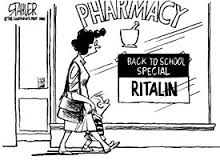
Some doctors seem obssessd with prescribing ADHD pills to youngsters. Are we really to believe that the disorder is as rampant as the prescription numbers lead us to believe?
MORE than a fifth of school psychologists in England know of children under the age of six who have been prescribed ADHD drugs to treat behavioural problems despite it being against health guidelines, a study has found.
HEALTH services are being pressured into offering the mind-altering drugs to preschool children because of a lack of psychologists available to offer intervention first, one of the lead researchers said.
The study, to be published in full next year and carried out by the University College London Institute of Education and the British Psychological Society, raised concerns that diagnosing ADHD was seen as an “easy explanation” for behavioural problems which absolves families and schools of blame. It added that some educational psychologists feared there is “an increasingly prevalent view in society that people who do not fit a particular environment must have something wrong with them”. In its latest advice, independent health advisory body the National Institute for Health and Care Excellence says drug treatment is “not recommended for pre-school children with ADHD”. But 22 per cent of educational psychologists working in primary schools in England told researchers they were aware of children who were already on medication by the time they were seen by a psychologist. Vivian Hill, director of professional educational psychology training at the institute who helped conduct the research, said: “The huge cuts have meant that people really feel under pressure to offer drugs when they can’t offer long-term interventions. “It really is quite a significant threat to our children and young people. It’s a naive gesture to thinking the quick-fix solution is dealing with the problem – it’s just masking it. “Some of children are living in very difficult family situations and the behaviour is a consequence of that. “If you were to unravel the nature of the child’s behavioural problems, 9/10 times you find it is because of significant factors in the child’s life and is really irrespective of any pathological undercurrent.” She added that in many cases children who are treated by psychologists first do not need to progress to medication.
If the allegation in this story is true the actions of the teacher in question should be dealt with swiftly. Teachers who do this type of thing do not deserve a second chance:
A lot of teachers may think this about their pupils but they should never say (or write) it.
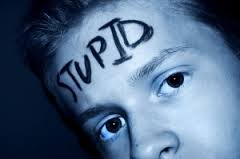
An educator in Tennessee, USA, is in trouble after reportedly writing ‘stupid’ on a student’s forehead because he didn’t like a question he was asked, according to WSMV-TV.
The math teacher even took the trouble to scribe it backwards so it would appear correctly when the pupil looked in the mirror.
‘We’re here to help the children and not to hurt them,’ said Overton County Schools director Matt Eldridge.
He added: ‘One word can break a child. I mean, I’ve got three children. I wouldn’t want it done to mine.’
Ironically the educator could now be considered stupid after receiving an indefinite suspension from Allons Elementary.
Eldridge added: ‘The teacher said, “I was trying to joke with him,” and of course, I said, “that’s not the way you joke with anyone”.’
1. I was not trying to get attention by falling off the chair. I am approximately infinity inches bigger than I was yesterday and I just lost track of how to balance. I felt like an idiot so I made falling into a joke. Crying was the other choice. And I’d rather cut off my arm than cry in school.
2. I did that homework. I am almost positive I did it. Getting it from done to folder to backpack to school to you is like seven extra homeworks. That is too many. It’s also possible I forgot to do the homework. I honestly have no idea where my planner is. Or maybe the homework was completely confusing and if I asked for help people might think I am stupid now when that used to be my best subject.
3. That time I called you Mom was the most humiliating moment of my life. It’s one thing in second grade but middle school? Ugh. How does this stuff still happen to me?
4. When you force us to get up—do stuff, act it out, test our ideas—it wakes us up and makes the lesson so much more fun and easy to remember.
5. Sometimes I just can’t focus. I’m buzzy, jumpy, pumped with electricity. Somebody suddenly looks distractingly attractive, across the room, which is fully that other person’s fault, not mine. Or I don’t get what we’re discussing and the pain of not understanding is so excruciating I just have to take a break from paying attention.
6. It feels awesome when you notice something special about me. When you value a skill or interest of mine, you give me a route in to subjects I didn’t think I’d like—and make me feel like I have something worth sharing.
7. What you tell me about myself matters way more than I hope you know. When you tell me I am something—smart, brave, kind, stupid, a trouble-maker, creative, a writer, a mathematician, funny, hard-working—I believe you.
8. I like it when you’re sarcastic but not when you’re harsh. When you say something ironically and I get it, I feel smart and mature. But when you’re mocking in a sharper way, it feels mean and a little scary.
9. Respect me. There are lots of things I already know about myself. Some I want to talk about, A LOT, and it means so much to me when you find time to include me (and it) in class. But lots of other things about me, I’m not ready to discuss, and especially not in class.
10. If you call on me and I am flat-out wrong, please don’t humiliate me. I’m already praying for a hole to open up in the floor and swallow me. It’s hard for me to believe that not knowing isn’t shameful but is instead a good starting point for learning. Help me.
And one bonus extra thing: You are suddenly one of the most important adults in my whole world. How you respond to me affects everything. Please be tough. Please be gentle. Especially when I am neither.
 is a good book to serve as a springboard for a discussion about why it is important to look out for those smaller than yourself.





 Topical Teaching