Posts Tagged ‘Education’
September 21, 2012

I love stories about remarkable people overcoming adversity:
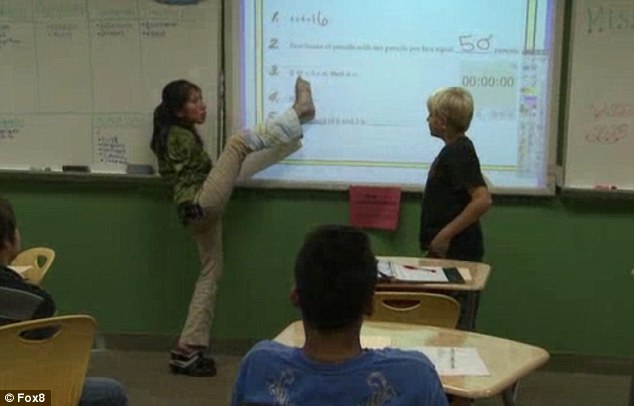
A woman born with no arms is proving to children they can achieve whatever they want to – by teaching them with her feet.
Mary Gannon, who works at a Lakewood, Ohio middle school, writes on the board, types on her computer and hands out worksheets with her toes.
Ms Gannon, who teaches maths and science, grew up in a Mexican orphanage and was adopted by an Ohio family when she was seven.
She joined the school last year as a substitute teacher and now tutors 6th, 7th and 8th graders full-time, driving to work in a car with the number plate: ‘Happy Feet.’
Speaking to Fox 8, she said hopes her determination teaches the children a valuable life lesson.
Tags:Armless, Armless Math Teacher, Armless maths teacher, Education, Inspirational Teachers, Mary Gannon armless maths teacher, Mary Gannon teacher with no arms, Mary Gannon teaches with her feet, math, maths, News, teaches with her toes
Posted in Inspirational Teachers, Maths | Leave a Comment »
September 20, 2012

Playing sexualised games is indefensible, yet the parents of these children disagree:
A police investigation has been launched after a series of disturbing photos emerged showing schoolchildren licking whipped cream from the knee of a Polish priest.
The images – which are apparently part of an ‘initiation ceremony’ at Salesians High School in Lubin, southern Poland – show both male and female 13-year old pupils taking part in the bizarre practice.
Father Marcin Kozyra, who is also the school’s principal, has defended his actions by saying such ceremonies for first year pupils have been an annual event for many years.
In the photos the Catholic priest is shown sitting on a battered armchair, wearing shorts and with some form of stick across his knees.
The pupils are shown kneeling around Father Kozyra as they watch each other lick cream from his bare knee.
Other photos show the students crawling up the stairs in a single file on their hands and knees.
‘This is very disturbing,’ said Marek Michalak, the Polish government’s spokesman on child affairs, reported The Telegraph.
While some people have expressed shock over the pictures, which were posted on the school’s website, the parents of some pupils have come out in support of the priest.
In a letter of defence they claimed that the whipped cream was actually shaving foam and nobody was forced to eat it.
Tags:disturbing photos Polish priest, Education, Father Marcin Kozyra, Father Marcin Kozyra initiation, Father Marcin Kozyra knee, Father Marcin Kozyra shaving cream, Father Marcin Kozyra whipped cream, initiation ceremony' at Salesians High School in Lubin, kneeling around Father Kozyra as they watch each other lick cream, life, Marek Michalak, parents of some pupils have come out in support of the priest., police investigation, Polish priest, religion, schoolchildren licking whipped cream from the knee of a Polish priest., shaving foam, whipped cream from the knee of a Polish priest.
Posted in Child Welfare | 1 Comment »
September 20, 2012

We all know how seriously Facebook takes its age restrictions:
Facebook has an ugly little secret, a number disclosed nowhere in its voluminous filings to become a public company and now only vaguely addressed by corporate officials.
An estimated 5.6 million Facebook clients — about 3.5 percent of its U.S. users — are children who the company says are banned from the site.
Facebook and many other websites bar people under age 13 because the Children’s Online Privacy Protection Act (COPPA) requires websites to give special treatment to children 12 or younger. The law aims to stop marketers prying personal information from children or using their data to advertise to them. Sites must get parental permission before allowing children to enter, and must take steps to protect privacy.
Facebook declines to acknowledge that many of its efforts to block children are not working.
The issue has taken on new relevance as the Federal Trade Commission finalizes rules to further restrict companies and websites that target youths or are geared to young audiences.
Facebook, the world’s leading social media company with 955 million users, has said that the law does not apply to it because it explicitly restricts use of its site to people aged 13 and older.
Click on the link to read Parents and Teachers Should Not Be Facebook Friends
Click on the link to read Introducing the App that will Give Parents Nightmares
Click on the link to read Facebook’s Age Restictions are a Joke
Click on the link to read Facebook and Child Exploitation
Tags:about 3.5 percent of its U.S. users — are children Facebook, Children, Children banned from Facebook, Children's Online Privacy Protection Act, Education, facebook, Facebook age requirement, Facebook age restrictions, Facebook bar people under age 13, Facebook efforts to block children are not working, Federal Trade Commission, kids, Parenting, stop marketers prying personal information from children, using their data to advertise to children
Posted in Social Media | 1 Comment »
September 20, 2012

I hate labels, especially labels given to kids. Too often I have seen a child brandished as a “low ability” student prove everybody wrong. The beauty about mixed ability classrooms is that the group in question isn’t selected based on a label. This allows the students to be appreciated for who they are instead of what they know. This also provides more confident students with the fantastic opportunity of helping their less confident counterparts during whole class and grouped work.
But mixed ability classrooms forces teachers to accommodate for the learning needs of each student and they would therefore have to differentiate the curriculum? Of course we would! That’s our job!
It seems like others do not share my beliefs:
Bright pupils are losing out due to the ‘curse’ of mixed-ability classes, the head of Ofsted warned yesterday.
Sir Michael Wilshaw said thousands were failing to reach their full potential due to poor teaching methods.
Inspectors will now be critical of schools that do not differentiate between high and low achievers.
This could lead to schools falling into the new category of ‘requires improvement’ (which replaces the old ‘satisfactory’ description), or even being labelled ‘inadequate’.
Statistics published following a Parliamentary question show that 55 per cent of lessons in English state secondary schools last year involved children with different academic needs.
Ofsted cannot force schools to adopt setting – grouping pupils according to their academic ability in single subjects – or streaming, where ability groups cover most or all subjects.
However, Sir Michael’s intervention is likely to make headteachers rethink their practice of mixed ability classes for fear of being marked down in future inspections.
Tags:Bright pupils, differentiate between high and low achievers, Education, GCSEs, mixed-ability classes, Ofsted, poor teaching methods, Sir Michael Wilshaw, Special Needs, streaming
Posted in Special Needs | 2 Comments »
September 20, 2012

If duct taping a child’s mouth is the only way you know how to maintain order in the classroom, you may want to find a new profession:
The mother of a Louisiana fourth grader whose mouth was taped shut by a substitute teacher who wanted to stop him from talking in class is seeking to bring criminal charges against the school district and the impatient educator.
“He just told me he didn’t want to go back to school no more, and he didn’t want to be friends with no one in his class, or the school,” Droddy told the station.
Only after school administrators talked to almost 100 students did she learn that a substitute teacher used red duct tape, normally used for arts and crafts projects, to quiet her son.
Click on the link to read Worst Examples of Teacher Discipline
Click on the link to read Why Students Misbehave
Click on the link to read Being a Teacher Makes Me Regret the Way I Treated My Teachers
Click on the link to read Useful Resources to Assist in Behavioural Management
Click on the link to read When Something Doesn’t Work – Try Again Until it Does
Tags:Boy mouth duct taped for talking, Classroom Management, Classroom-Disruptions, D.C. schools chancellor Michelle Rhee has admitted to using tape to quiet a noisy cafeteria, Education, J. Wallace James Elementary School duct tape, Lafayette Parish Schools, Louisiana fourth grader duct tape, Michelle Droddy duct tape, mouth was taped shut by a substitute teacher, normally used for arts and crafts projects, Pat Cooper, red duct tape, Substitute Teacher duct tape, Washington
Posted in Classroom Presentation, Professional Conduct | Leave a Comment »
September 20, 2012

One must be careful how and when teachers reward their students. Chartered Psychologist and teacher, Marc Smith, gives his 5 golden rules for rewarding students:
• Reward schemes based on the accumulation of points that can be exchanged for prizes are costly, unsustainable and ineffective in the long term. Those schools that do choose this kinds of schemes will probably face much bigger problems when the scheme is withdrawn.
• Rewards of any kind given immediately after a task is completed motivate pupils better than those given later (and remember that rewards can be in the form of praise).
• Rewards must be justifiable and based on effort as well as achievement (this will encourage a growth mindset in your students).
• Words can help to ‘nudge’ pupils in the right direction and can have the opposite effect if used negatively.
• Rewards must be fair and not just given to the ‘perfect’ pupils (children have an uncanny sense of what is fair and unfair and they’ll see right through any form of bias).
Click on the link to read Do Kids Need A Classroom Pet (The Four-Legged Variety)?
Click on the link to read Why Spelling is Important
Click on the link to read Tips for Engaging the Struggling Learner
Click on the link to read the Phonics debate.
Tags:Are iPods and Xbox games the right reward for good classroom behaviour?, Education, incentives for good behaviour and hard work, Motivating students, Points system in the classroom, Reward schemes in the classroom, Using ptaise to reward students, Using rewards in the classroom
Posted in Engaging Students | Leave a Comment »
September 19, 2012

Courtesy of doctor-pets.com:
It is a tragic reality that many (most?) children sitting in the classrooms today have not had an opportunity to enjoy and look after a household pet. This is sad because owning a pet brings many benefits to a child – from enjoying the companionship of another living creature (many kids these days don’t have siblings either) to fostering organisation and responsibility.
Some schools have stepped into the breach by replacing the home pet with a classroom pet – most schools opt for a low maintenance species, such as guinea pigs or fish. However this raises a number of questions: Who feeds the pet, cleans the cage, takes it to the Vet? Today’s teachers are busy enough as it is to take on another ‘dependent’ in the classroom.
One solution may be to have dedicated budget and staff time for looking after the pet but most schools are already strapped for money and time. I feel strongly that given the wealth of benefits pets impart to people and especially children, the need for a pet in the classroom should be viewed the same way as a need for textbooks. And pets are more fun, too.
Click on the link to read Strategies for Improving Classroom Interactions
Click on the link to read Why Spelling is Important
Click on the link to read Tips for Engaging the Struggling Learner
Click on the link to read the Phonics debate.
Tags:Animals, Animals and children, Education, Pets, Pets in the Classroom, Psychology, Vet
Posted in Engaging Students | 2 Comments »
September 19, 2012

Shoes belong in boxes, not children:
An Arizona couple is suing their son’s former school district for allegedly throwing him in a tiny, windowless room for bad behavior they say was caused by officials ignoring his severe allergies and feeding him foods packed with sugar.
Leslie and Eric Noyes of Glendale, Ariz., filed a lawsuit in Maricopa County Court last week against Deer Valley Unified School District No. 97 and Desert Sage Elementary School, where their son attended second grade last year.
The complaint, obtained by Courthouse News Service, charges school officials with assault and battery, false imprisonment, gross negligence and intentional infliction of emotional distress on their son.
The couple is seeking compensation for their son’s medical treatment and transportation costs to send him to a school outside his district as as well as general damages.
The use of cool down rooms in the same county whose controversial sheriff Joe Arpaio has forced prison inmates to wear pink underwear isn’t unique to Arizona. School officials across the country have used seclusion rooms, most often for special education students or those diagnosed as autistic. The practice is controversial. In 2004, a 13-year-old Georgia student hanged himself after his parents said he was traumatized by being put in a time-out room.
These “scream rooms” are absolutely abhorrent. They should never have been allowed on a school premises. It disgusts me that we are incorporating torture techniques to deal with classroom behaviour issues.
Tags:Allergies, arpet cleaning chemicals, assault and battery, boy put in a tiny, cool down rooms, Deer Valley Unified School District No. 97, denied permission to go to the bathroom, Desert Sage Elementary School, Education, Eric Noyes, false imprisonment, gross negligence and intentional infliction of emotional distress, ignoring his severe allergies and feeding him foods packed with sugar, Leslie and Eric Noyes of Glendale, Leslie Noyes, Maricopa County Sheriff Joe Arpaio, Parebnting, scream rooms, Seclusion-In-Schools, severe allergies, T.N., time-out room, windowless room for bad behavior
Posted in Professional Conduct | 1 Comment »
September 18, 2012

Amber Dusick uses cartoon illustrations to provide us with a strategy that uses reverse psychology to get kids to eat healthy foods.






Click on the link to read my post on A Long School Day With No Time to Eat
Click on the link to read my post on 6 Strategies for Promoting Healthy Food to Kids.
Click on the link to read 5 Ways to Get Kids Active
Click on the link to read Food Giants Marketing Unhealthy Kids Foods as Healthy
Click on the link to read Good Heavens! It’s the Lunch Box Police!
Tags:Amber Dusick, Cartoon, Diet, Eating, Education, Getting Kids To Eat, getting kids to eat healthy foods, Health, Healthy Food, Humor, Kids And Food, Nutrition, Parenting
Posted in Nutrition | Leave a Comment »
September 17, 2012

Courtesy of edudemic.com. Below is the first 17 suggestions:
- Meet with other classrooms:
One of the most common projects educators utilize Skype for is setting up exchanges with classrooms around the world, usually for cultural exchange purposes or working together on a common assignment. The program’s official site provides some great opportunities to meet up with like-minded teachers and students sharing the same goals.
- Practice a foreign language:
Connect with individual learners or classrooms hailing from a different native tongue can use a Skype collaboration to sharpen grammar and pronunciation skills through conversation.
- Peace One Day:
Far beyond classroom collaborations, the Peace One Day initiative teamed up with Skype itself and educators across the globe to teach kids about the importance of ending violence, war, and other social ills.
- Around the World with 80 Schools:
This challenge asks participating schools to hook up with 80 worldwide and report back what all they’ve learned about other cultures and languages.
- Talk about the weather:
One popular Skype project sees participants from different regions make note of the weather patterns for a specified period of time, with students comparing and contrasting the results.
- Collaborative poetry:
In this assignment, connected classrooms pen poetic pieces together and share them via video conferencing.
- Practice interviews:
The education system frequently receives criticism for its failure to prepare students for the real world, but using Skype to help them run through mock-up interviews with each other, teachers, counselors, or professionals will help grant them an advantage.
- Gaming:
Merge the educational power of gaming with the connectivity of Skype for interactive (maybe even international!) role-playing and other competitive delights that educate and engage in equal measure.
- Hold a contest:
Challenge other classrooms to a competition circling around any subject or skill imaginable, and work out a suitable prize ahead of time.
- Hold a debate:
Similarly, Skype can also be used as a great forum for hosting formal and informal debates to help students with their critical thinking and research skills.
- Make beautiful music together:
Build a band comprised of musicians worldwide, who play and practice together over video — maybe even hold digital performances, too!
- Who are the people in your neighborhood?:
All the press about classrooms meeting with one another tend to veer towards the international, but some schools like to stay local. These two Tampa Bay-area kindergartens met regularly via Skype, sharing their current assignments with new friends only 10 miles away.
- Highlight time differences:
But there is something to be said about global exchanges, too, as it provides some insight into the differences between time zones — great for geography classes!
- Combine with augmented reality:
Both at home and in school, Skype provides a communication tool for collaborative augmented reality projects using the PSP and other devices.
- Mystery call:
Link up to a classroom in another region and have them offer up hints as to their true location, challenging students to guess where in the world their new friends live.
- Each student works a specific job during calls:
Divvy up responsibilities during Skype calls so every student feels engaged with the conversation, not just passive participants watching talks pan out. Assign bloggers, recorders, mappers, and any other tasks relevant to the meeting and project.
- Play Battleship:
The classic board game Battleship offers up lessons in basic X and Y axes; plus it’s also a lot of fun. Compete against other classrooms for an educational good time.
Click here to read the rest.
Click on the link to read Top 10 Educational i-Pad Apps
Click on the link to read Top 10 Math Apps for Children
Click on the link to read The Pros and Cons of iPads in the Classroom
Tags:Classroom Resources, Education, Engaging Students, ICTin the classroom, Parent-Teacher Conferences, podcasting in the classroom, Skype, Skype in the classroom, Teaching digital literacy, technology, Technology in the Classroom
Posted in Technology in the Classroom | 3 Comments »












 Topical Teaching