I am personally not fond of spanking. I don’t think it works and I personally choose to discipline my daughter by other means. I don’t, however, believe in banning parents from exercising their right to spank.
In an experiment that involved surreptitiously watching parents discipline their kids in public places such as restaurants, researchers found that in 23 percent of cases, mom or dad resorted to “negative touch” to get their child to comply.Negative touch can include anything from restraining and spanking to pinching and hitting.
Restraining? How can you blame a parent for restraining their own child? Just the expression “negative touch” is something I consider repulsive.
It is just completely mind-boggling that it is legal for teachers to inflict corporal punishments in many civilised countries, yet to simply restrain your own child during a tantrum draws the disapproval of so-called child experts.
I am vehemently against corporal punishment in all cases. Teachers should never have the right to enforce physical punishment on their students.
But to the those that do, I wonder, how would they feel if their superiors were legally allowed to inflict corporal punishment for their own incompetence?
How would they feel if they were caned for failing to complete their planners on time?
How would they feel if they were caned for overlooking bullying issues in their classroom?
How would they feel if they were caned for failing to cover the curriculum?
Children, for all their weaknesses, are no different to adults. We all make mistakes and we all have our lapses in judgements. Caning a student for not reading aloud is tantamount to a teacher being caned for not responding to a parent email:
A seven-year-old girl student of a private school here was hospitalised after being beaten by her class teacher for not reading her English lesson aloud in class.
The girl’s mother got to know of the incident from the school bus driver when he called her to take her daughter from the vehicle, police said.
The child then told her mother that the teacher had beaten her with a ruler because she did not read aloud in class.
The girl was admitted to a hospital last evening. Police have registered a case against the woman teacher on a complaint from the girl’s father.
He alleged that the principal had not taken any action against the teacher despite parents bringing the incident to her notice and instead asked them to give a written complaint.
We have all cheated on something in our lifetime. I’m not endorsing cheating by any means, but we have all done it.
A child who is found to be cheating should be confronted, but not in front of the class and should definitely not have to put up with unnecessary and unhelpful labels and be subjected to gruesome corporal type punishment:
Unable to bear the trauma of being labeled a ‘cheat’ and unable to bear the taunts of her teachers, an 11-year-old girl jumped to her death from the roof of the five-storied apartment building of in which her school. The incident took place is located in Howrah’s Bijoy Kumar Mukherjee Road on Thursday morning. The incident highlights the poor state of affairs in educational institutions across the state. In spite of a blanket ban on corporal punishment, students are regularly falling victim to high-handedness of teachers. This is, however, the first time in recent years that a child has been driven to suicide by those she is supposed to trust and respect.
The principal of the school and the concerned teacher were detained following a complaint from the girl’s father Shiv Narayan Mishra. He claimed that principal Dilip Kumar Dubey gave his daughter a tongue-lashing, telling her to ‘go to hell’ and remain uneducated for the rest of her life. This may have led the Class-VI girl to suicide. While the school operates from the first floor of the building, the other floors have residential flats which had given the kid access to the roof.
The cane may have disappeared from West Australian public and Catholic schools in 1986 but it has not disappeared completely from the state’s schools.
According to Minister for Education Liz Constable, two independent schools in WA still use the cane.
A spokeswoman for the Department of Education Services said the School Education Act prohibited the use of corporal punishment in public schools – but confirmed the cane was used in some non-government schools.
The spokeswoman said the government regulated the use of canes through the process of school registration.
Mrs Constable said although she did not believe physical punishment was an effective method for controlling student behaviour and did not support its use, parents were able to make their own choice.
“It is a matter of parental choice to send their children to study at schools that include this type of punishment in their discipline policy,” she said.
“The strategies we are implementing now in public schools focus more on positive reinforcement, especially around attendance issues.”
The push to ban corporal punishment has less to do with the rights of parents and more to do with the rights of children.
Teachers that spit on their students should be punished accordingly. It is unprofessional, unhygienic and completely unacceptable behaviour. But there is more to the story of maths teacher David Pecoraro, who was caught on camera spitting at a boy and has since been relegated to administrative duties as a result of his moment of madness.
The video shows clearly a teacher pushed to the edge of sanity. A student trying to attach his used gum on the teachers rear is rightly put in his place by the teacher. Teachers, especially male teachers, are extremely sensitive with the dangers of being accused of inappropriate behaviour. Students that purposely touch a male teacher’s backside are putting that teacher in a very uncomfortable position.
The video also shows the lack of respect he was getting from his other students. As he screams “I want to teach you maths”, we see a student sleeping and others laughing and goading the defiant, foul-mouthed, gum chewing student.
A teacher was secretly filmed on a cell phone struggling with a male student before appearing to spit in the boy’s face.
David Pecoraro, a high school math teacher, is now working in ‘administration’, after the footage was uploaded to YouTube.
Pecoraro, who taught at Beach Channel High School in Queens, New York, has a row with the student for a few minutes before the confrontation turns physical.
Pecoraro is being investigated on allegations of corporal punishment.
The teacher, who has been in the profession for 19 years, can be heard saying in the clip: ‘You can’t make contact with me, that’s illegal.’
He then tries to explain a math problem to the student who is ignoring the lesson and covering his head with a jacket.
At one point, the student, whose identity isn’t revealed, appears to try to hit the teacher.
Pecoraro then tells the teenager: ‘You’re going to go to jail, you don’t touch me… I want to teach you math.’
The altercation is witnessed by a few other students in the class – along with one boy in front of the camera who is asleep with his head on the desk.
The row continues until the teacher appears to spit at the student who then spits back at him.
The grainy film cuts out after Pecoraro can be seen dragging the student out of his seat.
As bad a this teacher’s actions was, the behaviour of the class was absolutely deplorable. This video should be enough to implicate at least two students with some fairly serious breaches of protocol. First there was the student who should be expelled for inappropriate touching and insubordinate behaviour. Then there is the student who filmed the incident. I don’t care how juicy the footage is, any student filming class and uploading the footage on YouTube deserves to be punished.
Instead, I fear that the only person punished was the one who wanted nothing more than the ability to do his job without being touched, mocked or harassed. If those two other students got off without punishment, it reinforces their despicable behaviour, and allows them to continue their bloodsport.
I pity the replacement maths teacher. I fear they are mere fodder for the next potential YouTube hit.
If you ever wanted a reason why teachers should never be given permission to inflict corporal punishment on children, just reflect on this sickening case. An autistic child who threw a ball across the classroom instead of putting it down as instructed, was subjected to a most unorthodox form of punishment. He was put in a duffel bag with the drawstring pulled tight.
The mother of a nine-year-old autistic boy who was placed in a duffel bag with the drawstring pulled tight has called for the teacher responsible to be dismissed and for the practice to be banned.
Baker, who was told her son had been placed in the bag as “therapy” for his autism, in a practice that has been used on other students, said she has had no apology or further communication with the school, despite promises to the contrary.
She said: “You do not put a child in a bag like that for any reason. If I did that to him, I’d be put in jail. We have not heard anything from the superintendent and we have not had an apology.”
What kind of barbaric form of “therapy” is this school handing out? Name me one medical practitioner that suggests time in a duffel bag is the perfect fix for insubordinate behaviour.
And don’t get me started with the schools response (or lack thereof). In these litigious times a school cannot even apologise to rightly disgruntled parents, without the apology seen as a possible green light for a lawsuit.
Even with the apology it seems as though the school hasn’t broken any laws:
Kentucky is one of several states in which no laws exist preventing the use of restraint or seclusion in public schools, according to a document on the Department of Education website.
If we give the teachers the permission to metre out punishments of a physical nature we will see abuse all the time. When teachers (or in this case aides) are capable of this type of ham-fisted reaction, who knows what they will come up with should the parameters widen.
I cannot believe what I just read. Are parents feeling so powerless and so incapable that they feel their childs’ discipline should be in the hands of teachers? Teachers should never be given the ability to impose physical punishment on their students. I don’t believe the punishments would end up being for the betterment of the child, but rather for restoring peace and quiet. An orderly classroom is no reason to cane children.
Nearly half of parents of secondary school children say corporal punishment such as the cane or slipper should be reintroduced, a survey suggests.
In total, 49% of more than 2,000 parents surveyed for the Times Educational Supplement were in favour, compared with 45% who were opposed.
Nearly all surveyed thought teachers should be able to be tougher on pupils.
But one teachers’ union said evidence suggested behaviour has improved since corporal punishment was banned.
The research, carried out by YouGov, showed slightly less support for corporal punishment than a TES survey in 2000 – which found 51% of parents in favour.
And when parents were asked specifically about “smacking/caning children”, support dropped to 40%, with 53% disagreeing.
Teachers must learn to command respect and good behaviour. They must be given the support of the school community to impose rules and regulations and must be consistent in metering out consequences.
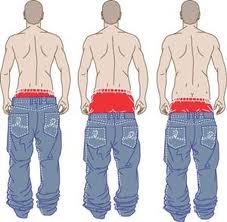
Florida State Senator, Gary Siplin has got his priorities right. Instead of concentrating on education reform he turns his attention to the pressing matter of saggy pants:
In an effort to pass Florida’s new “Pull Your Pants Up” law, State Senator Gary Siplin showed up to Orlando schools on the first day of classes to hand belts to students whose pants sagged.
“We want our kids to believe they’re going to college, and part of that is an attitude, and part of that is being dressed professionally,” Siplin said.
Florida’s public-school revenue per student and spending per $1000 of personal income usually rank in the bottom 25 percent of U.S. states. Average teacher salaries rank near the middle of U.S. states.
Florida public schools have consistently ranked in the bottom 25 percent of many national surveys and average test-score rankings before allowances for race are made.
If Mr. Siplin wants to do something real and meaningful with belts, I suggest he “Ban the Belts” by passing a law that bans corporal punishment in Florida schools. A 2008 paper revealed that Florida had 7,185 students hit in the name of teacher discipline.
I have been aquainted with some brilliant teachers from Florida through writing this blog. They are decicated and committed to providing quality education. They look beyond appearances and fight for the best outcomes for their students. They have far more pressing priorities than baggy pants.
Perhaps Mr. Siplin should forget about lifting pants and instead concentrate on lifting his game.
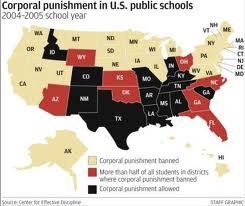
You shouldn’t need a study to tell you that corporal punishment is not a legitimate and ethical means of classroom discipline. Yet, as I write this, 19 American States still allow corporal punishment.
It’s time they stopped!
Hitting misbehaving kids with sticks might result in immediate obedience, but new research suggests it does more damage than good in the long term.
A new study compared kindergarten and Grade 1 students in two West African private schools. In most ways, the kids were similar. They came from the same urban neighbourhood, and their parents were mostly civil servants, professionals and merchants.
The difference was in how their schools doled out discipline. One school beat disobedient kids with sticks, slapped them on the head or pinched them. These punishments were administered for a wide range of offences, from forgetting to bring a pencil to class to disrupting lessons.
The other school favoured non-physical punishment, with teachers issuing time-outs or verbal reprimands for bad behaviour.
Researchers gave students from both schools “executive functioning” tests, measuring their ability to plan, think in the abstract and delay gratification. While test results for the kindergarten kids were similar across the board, the Grade 1 students from the school with corporal punishment performed significantly worse.
The study’s authors, who hail from the University of Toronto, McGill University in Montreal and the University of Minnesota, say the results are consistent with previous research that showed kids will immediately cease bad behaviour after getting physically punished, but they fail to internalize the morals or rules behind the punishment.
What this means, the authors note, is these kids aren’t really learning the difference between right or wrong, and are likely to re-offend.
“This study demonstrates that corporal punishment does not teach children how to behave or improve their learning,” said Victoria Talwar of McGill University.
“In the short term, it may not have any negative effects; but if relied upon over time it does not support children’s problem-solving skills, or their abilities to inhibit inappropriate behaviour or to learn.”
Students should never be physically disciplined under any circumstances. Whilst a majority of teachers care very much for the wellbeing of their students, there are teachers around who are more concerned with quiet compliant classrooms than the needs of their pupils. Giving these teachers the opportunity to use force is asking for trouble.
It’s about time teachers were lawfully allowed to regain control over pupils. Let’s get back to the purpose of being young: becoming a well-rounded adult, not having a good laugh or being “empowered”. Young people have to learn to lose out sometimes, and to follow orders. It is necessary that they learn to live in a world which won’t continue to worship them when they do grow up.
What does “reasonable force” mean anyway? What is reasonable for one teacher may not be reasonable for other sections of society.
The argument that corporal punishment will help students become well-rounded adults is plain wrong. Teachers help their students become well-rounded by understanding, connecting and appreciating their students, by setting a good example and high but fair expectations, imposing fair and consistent consequences, making their lessons engaging, fostering their students’ talents, creativity, critical thinking and independence as well as offering support and guidance.
I bet any teacher wishing to inflict corporal punishment on their students has in fact failed their students. I would encourage them to spend less time worrying about using reasonable force and instead concentrate on their own performance.







 Topical Teaching