Bill Henson, a so-called artist, who makes his living by photographing (among other subjects) minors in the nude, is no expert on child welfare. I find it quite upsetting that a person who has grown to prominence by insisting that photographs of naked minors are somehow artistic, gets the platform to point the finger at the church and sport.
CONTROVERSIAL photographer Bill Henson has pointed to sport and the church as far more likely to harm children than anything involving the arts.
Mr Henson, who sparked outrage by including images of naked minors in a 2008 exhibition, told The Australian that the arts were the last thing likely to actually harm kids.
“We’re talking about the potential for harm,” he said. “If you want to talk about that in relation to real children and real harm, you’d have to start with priests in the church, or sport.
“If you want to talk about actual harm to actual kids, the last place you would start would be the arts.”
Henson has an exhibition opening in Sydney in September but said he had not decided whether it would include nude figures.
“There’s a lot of grassroots common sense out there in Australian society and I think a lot of people began to get a bit sick of it,” he said in reference to the furore over his 2008 exhibition.
I am not in favour of banning Mr. Henson’s work, but I am certainly not a devotee. In my opinion, there is no way to photograph a naked pre-pubecent child without being exploitative and without sexualising the “model”. Sure he might be talented, but talent isn’t an excuse for poor taste.
Mr. Henson should stop looking for easy diversions and grow up!
THEY were meant to inspire young people to engage with sport, but the London Olympic mascots have been branded too creepy for children.
The one-eyed Wenlock and Mandeville – who were apparently born from the “last drops of steel” from the Olympic Stadium – were the product of an 18-month creative process using more than 40 focus groups.
Scores of giant statues of the creatures are about to be unveiled across London as part of a $48.5 million (STG 32m) makeover to drum up enthusiasm in the run-up to the Games.
But the Cyclops-like cartoon characters have faced a barrage of criticism online.
In merchandise reviews for the mascots on Internet shopping site Amazon, buyers have called the creatures “menacing” and “terrifying”.
“Like a nightmare, this evil eyed monster stares straight into your soul looking for the slightest weakness,” reviewer Mr Nicholas Shearer wrote.
A baby bodysuit with a woman’s silhouette printed on the front has parents in Southaven, MS outraged. “Inappropriate” is what several shoppers said when Action News 5 interviewed them outside of Gordman’s, the store selling the onesie.
Wild Child, a brand manufactured by Bon Bebe, sized the outfit for 18-month-old girls. But mom Cathryn McKee told the news station, “I just think that is a little ridiculous that you would put that on your child.” One father who spoke on camera says he wouldn’t let his daughter wear the “bikini” because “it gives people the wrong idea too quickly.”
Clever marketing should see this product be boosted by the negative publicity and sell like hotcake. I think we’ll pass on this one though.
For some reason people feel they have the right to inundate an expectant mother with parenting tips and strategies. Some appreciate the concern and interest whilst others find it invasive and suffocating (especially since a lot of it is contradictory).
Some of my fondest memories and proudest moments in teaching have been related to working with children with extreme behavioural issues. Sure, I could have blamed the home situation of these students, but how is that going to fix the problem? In teaching, one has to expect that they will encounter many students who have violent tendencies and flawed parents.
A growing number of primary school children are too violent and disruptive to be in school, the Government’s behaviour tsar said today.
Charlie Taylor, the former headteacher who advises ministers on discipline, said; “There is a group of children showing very extreme behaviour, very difficult, challenging, violent behaviour – often quite young children. There is an increase in those kind of children.”
They would often resorting to kicking or biting fellow pupils in the classroom, MPs on the Commons select committee for education were told..
He said a school could be “a good school” in terms of the discipline it promoted but still find itself unable to deal with such children
Mr Taylor’s comments follow claims from headteachers’ leaders that children often arrive at primary school — lacking in personal skills and ill-equipped to communicate with their fellow pupils.
They have put the blame on parents who fail to communicate with them – and allow them to remain in front of computer screens or TVs for the most part of the day.
We teachers need to stop blaming others and accept that we have a difficult job to do that requires doing. If we are the only stable presence in a child’s life, so be it. If we invest the time and energy into kids who are difficult and self-destructive, we have a realistic chance to make small but crucial changes to their self-esteem.
People don’t have patience any more. Everything needs to be immediate and instantaneous. I heard someone on the radio last night complain about the 5 seconds of advertising they had to sit through before they could access their YouTube clip.
More than four-in-10 teachers said children failed to read for pleasure at the age of 11, it emerged.
The study – by the publisher Pearson – found that many schools fear children have short attention spans and prefer to spend time online rather than reading a novel.
Teachers also said that books were not seen as “cool” by pupils and raised fears that parents are failing to do enough to promote a love of reading in the home.
Frank Cottrell Boyce, the author, said: “It’s worrying to think that so many young children are not being inspired to pick up a good book and get lost in a story.
“According to Unesco, the biggest single indicator of whether a child is going to thrive at school and in work is whether or not they read for pleasure.”
The poll questioned around 400 secondary school English teachers.
Two-thirds of those questioned said that reading was not seen as “cool” by pupils, according to the study.
Three-quarters said that children’s attention spans were shorter than ever before, while 94 per cent claimed that pupils preferred to be using the internet rather than reading.
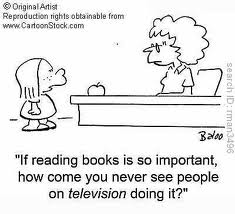
It is my belief that a crucial part of my job is to promote the joys of reading. I take pride in selecting books for my class that will appeal and entertain. I also have a Book Club. This allows my students to see that reading is not necessarily a personal experience but it can be a shared experienced too.
It has been labelled “heartbreaking” and one of the most effective anti-smoking advertisements ever.
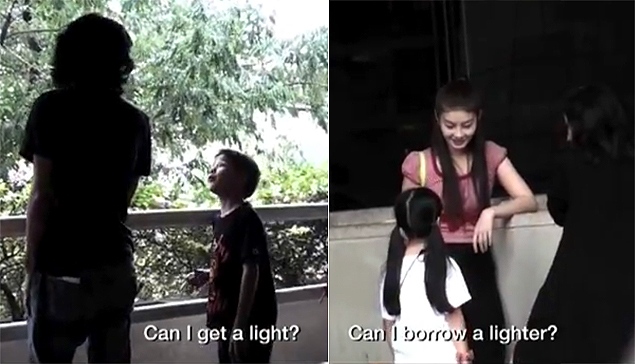
The new public service announcement from Thailand shows two small children approaching adults who are smoking and asking them for a light.
Not one of the adults shown in the ad gives the children what they ask for.
Instead the adults — who have no idea they are being set up — begin giving the children earnest lectures on why smoking is so bad for them.
“If you smoke you die faster,” one man tells a little boy.
“Don’t you want to live and play?”
“When you smoke you suffer from lung cancer, emphysema and strokes,” another says.
The children then reveal their trump card, a brochure they hand the adults which reads: “You worry about me. But why not about yourself?”
The video, produced by the agency Ogilvy Thailand on behalf of the Thai Health Promotion Foundation, was uploaded to YouTube a week ago and has since gone viral, attracting more than 350,000 views.
The foundation has reported a 40 percent increase in the number of calls it has received about how to stop smoking.
I’m sick of reading excuses for why a bus full of middle school children acted in a most deplorable way to their bus monitor. There are no excuses for such vile behavior. I don’t care what age you are, you have a responsibility to be a good citizen and decent person. It sickens me to see a pack bullying situation where a soft target is exposed and then tormented without any resistance whatsoever.
Explanations like this are both unhelpful and insensitive to poor bus monitor, Karen Klein:
When kids reach middle school, bullying becomes more common and more sophisticated, experts says.
“Middle school-age kids are sort of an age group that is notorious for an uptick in the intensity of bullying,” said Dr. Gail Saltz, a psychiatrist in New York and TODAY contributor.
During the middle school years, kids are facing intense peer pressure, the pack mentality is strong and kids feel a growing sense of independence – all while their moral compasses are still developing, she said.
“It’s a time when they’re figuring out who they are by sometimes crossing the line and breaking the rules,” Saltz says. “Their insecurity drives a lot of cliquishness and defining themselves as better by making someone else feel worse.”
Don’t even try to excuse this behaviour in any way based on the age of the perpetrators. This is a culture problem. The parents of these children need to do as much soul-searching as the children themselves.
I am saddened to hear about the families of the students getting death threats. What kind of response is that? What is the sense in dealing with bullying by continuing the chain of bullying? This is isn’t even about a bus full of children. This has even wider implications.
Middle school children worldwide should be put on notice. No more excuses. I don’t care how old you are. It’s time to grow up and treat others with respect!
Technology addiction is one of the most prevalent, yet socially acceptable addictions. It envelopes both children and adults and can ruin marriages, cost jobs and effect sleep.
1. Do you feel preoccupied with the Internet (think about previous online activity or anticipate next online session)? 2. Do you feel the need to use the Internet with increasing amounts of time in order to achieve satisfaction? 3. Have you repeatedly made unsuccessful efforts to control, cut back, or stop Internet use? 4. Do you feel restless, moody, depressed, or irritable when attempting to cut down or stop Internet use? 5. Do you stay online longer than originally intended? 6. Have you jeopardized or risked the loss of significant relationship, job, educational or career opportunity because of the Internet? 7. Have you lied to family members, therapist, or others to conceal the extent of involvement with the Internet? 8. Do you use the Internet as a way of escaping from problems or of relieving a dysphoric mood (e.g., feelings of helplessness, guilt, anxiety, depression)?
Other Symptoms Include:
• Failed attempts to control behavior • Heightened sense of euphoria while involved in computer and Internet activities • Neglecting friends and family • Neglecting sleep to stay online • Being dishonest with others • Feeling guilty, ashamed, anxious, or depressed as a result of online behavior • Physical changes such as weight gain or loss, backaches, headaches, carpal tunnel syndrome • Withdrawing from other pleasurable activities
Television, long seen as a negative influence on children has managed to turn the tide thanks to the recent spate of reality programming:
What do reality television shows The Block, MasterChef and Australia’s Got Talent have in common?
Your child.
According to a TV Tonight report, in 2011, those three shows were the most popular with children under 15.
It seems that feel-good family oriented sitcoms, popular with tweens and teens of the past generation have given way to talent quest shows and experts say that this is not necessarily a bad thing.
Competency based programs showcase hard work and discipline, while graphically depicting the euphoria of success and and the bitter disappointment of failure. In contrast, popular family sitcoms of the 80s and 90s like The Cosby Show or Full House featured safe, insular worlds, in which a happy ending was assured.
Laura Kiln, internationally recognised parenting expert and owner of Laura’s Place, a practice where she offers counselling to families, cautiously endorses reality TV saying some shows expose children to a wide spectrum of issues and offer useful advice without sugar-coating difficult matters.
Kiln notes that a show like The Biggest Loser can help children develop empathy by observing the severe impact of weight problems on contestants’ lives, especially in cases where the children’s own families have no experience of obesity.








 Topical Teaching