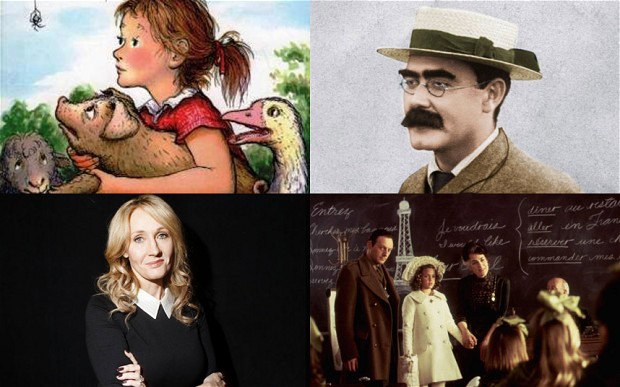
The Telegraph’s Best Children’s Book of All Time

March 6, 2014


books

Some absolute classics among this very well compiled list:

Watership Down

Richard Adams (1972)

The full-scale novel about rabbits finding their promised land has the magic of prophecy, idyllic Hampshire locations and the structure of the Aeneid. Adams enjoys parading his scholarship, and this is a lively introduction to brainy books.

The Hobbit

J R R Tolkien (1937)

Here we meet the characters who will make The Lord of the Rings happen, and on a pre-Peter Jackson scale. If anything, Gollum is even more chilling here, because we see him through the eyes of a hobbit – seldom the calmest of travellers.

The Lion, the Witch and the Wardrobe

C S Lewis (1950)

Welcome to the magical land of Narnia, where the White Witch reigns over a snow-girt land peopled by fawns, talking beavers and people eager to put their trust in four kids from Finchley. The Christian allusions come later, but for now this is pure narrative magic.

Charlotte’s Web

E B White (1952)

The New Yorker writer cherished for his elegance of style gives us an altruistic spider with exquisite manners, and a pig to make her proud. There are intimations of mortality, but a plot of fame and legacy thumbs its nose at the inevitable.

The Little Prince

Antoine de Saint-Exupéry (1943)

The Little Prince falls to Earth to meet the author, who has crashed his plane. His quizzical, wise stories of other planets (most of which are inhabited by solitary monomaniacs) lead to the daftest of all – our own.

Pippi Longstocking

Astrid Lindgren (1945)

It’s quite something to live as an orphan with just a horse and a monkey for companions. The heroine has a chutzpah that makes her sound at her most adult when she’s flouting adult conventions, especially at teatime.

Emil and the Detectives

Erich Kästner (1929)

When Emil is robbed of his mother’s hard-earned savings (that were never likely to stretch far), he has help from a scratch squad of child detectives from Berlin. However much this sounds like the best child’s game ever, the real world is seldom far away.

James and the Giant Peach

Roald Dahl (1961)

One of Dahl’s earliest, best, and most fully developed tales. There is no attempt to make the giant insects or articulate clouds seem natural: this is a world of wonder, more marvellous than Wonka’s, even.

Winnie the Pooh

A A Milne (1926)

Characters begin days by visiting one another, and end up shifting houses, learning to fly or surviving floods.

A Little Princess

Frances Hodgson Burnett (1905)

Sara has a privileged background but is now living as a Cinderella figure; and she plays at being a princess. But her response shows that being a princess is less a social ranking than a state of mind.

The Just So Stories

Rudyard Kipling (1902)

How did the leopard get his spots? How was the alphabet made? Why are elephant’s trunks so long? Kipling is the model of the patient parent in the face of constant questions. And who cares about evolution? This is much more fun.

A Journey to the Centre of the Earth

Jules Verne (1864)

Verne uses all the tricks that make Anthony Horowitz so successful – the action-packed chapters that end at just the right time and the sense of deepening mystery – but also a knack for convincing us that there really might be creatures down there.

The Wind in the Willows

Kenneth Grahame (1908)

The idyllic, stylised account of life on the river, with anxious glimpses beyond it, is a masterclass in character-driven comedy – alongside the arriviste Toad is the petit bourgeois Mole, and Rat, the gentleman of leisure.

The Doll People

Ann M Martin and Laura Godwin (2000)

The dolls in your dolls’ house might look inanimate to you, but you clearly have no idea of what they get up to at night. They’re casing the joint, tracking lost relatives and dodging that cruel fate – PDS (Permanent Doll State).

The Child that Books Built

Francis Spufford (2002)

Although this book isn’t written for children, the more reflective might enjoy it as a guide on how to grow into reading; and it’s a wonderfully eloquent take on how growing up happens unexpectedly.

THE BEST OF THE REST

Read the rest of this entry »

Teacher Called Cops Because Students Planned to Sabotage Class Photograph

March 5, 2014

class photo

It is apparent that teachers are struggling to cope with classroom misbehaviour more now than in any other time. This often brings panic influenced, knee-jerk reactions to help pull students in to line.

The award for the wildest and most needlessly over the top reaction to student misbehaviour goes to this headmistress:

In a bizarre case, a strict headmistress of a UK primary school allegedly called police to thwart a students’ plan to not smile and spoil a school photograph.

Ann Hughes, the headmistress of a school in Anglesey, North Wales, found out some children were planning to “spoil” the picture and telephoned police, a professional conduct hearing was told.

It is alleged that an officer was invited into the village primary school to reprimand the pupils unwilling to pose correctly, The Mirror reported.

Hughes faces a catalogue of complaints including repeatedly calling one student “stupid” and favouring children whose first language was Welsh.

The committee of the General Teaching Council for Wales heard yesterday that she failed to investigate the bullying of two pupils, shouted excessively in the classroom and unnecessarily criticised children’s mistakes.

One pupil watched as Hughes tore his examination paper in front of him when he had spelt his middle name wrong, the hearing was told.

The school was engulfed in crisis in May 2011 when five of the six teachers simultaneously called in sick after earlier threatening industrial action following a vote of no confidence in Hughes.

Staff claimed there was a climate of “fear” at the school before the headmistress was suspended in July 2011 and later dismissed. The case is still continuing.


Click on the link to read Teachers are Better with a Sense of Humour (Photo)

Click on the link to read Would You Want Your Teacher Chair Replaced by a Yoga Ball?

Click on the link to read Worst Examples of Teacher Discipline

Click on the link to read Why Students Misbehave

Click on the link to read Being a Teacher Makes Me Regret the Way I Treated My Teachers

Why Professional Development for Teachers is Often Useless

March 4, 2014


sleep

It is very rare that I come out of a day long or 2 day long professional development seminar feeling more adept at teaching than before attending. I commend Valerie Strauss for her criticisms of professional development, because many teachers feel the way she does, but few are game to admit it:

There has been a strong reaction to my recent post titled  ”A video that shows why teachers are going out of their minds,” which revealed Chicago teachers being led in a professional development session in which they sound like kindergarteners, repeating words in unison. Some commenters on the post defended the practice but most of the comments attacked it, revealing what is well known in the education world: Most professional development (PD) is lousy.

Though professional development for teachers is critical to their development as professionals, a 2013 report on PD by the National School Boards Association’s Center for Public Education noted that most teachers aren’t given the kind of professional development that would actually help them, and it called the most prevalent model of PD nothing short of “abysmal.” A summary of the report said:

Most teachers only experience traditional, workshop-based professional development, even though research shows it is ineffective. Over 90 percent of teachers participate in workshop-style training sessions during a school year (Darling-Hammond et al., 2009). This stands in stark contrast to teachers’ minimal exposure to other forms of professional development (Darling-Hammond et al., 2009). Despite its prevalence, the workshop model’s track record for changing teachers’ practice and student achievement is abysmal. Short, one-shot workshops often don’t change teacher practice and have no effect on student achievement (Yoon et al, 2007; Bush, 1984).

A summary of the report also noted that:

The reason traditional professional development is ineffective is that it doesn’t support teachers during the stage of learning with the steepest learning curve: implementation. In the same way that riding a bike is more difficult than learning about riding a bike, employing a teaching strategy in the classroom is more difficult than learning the strategy itself. In several case studies, even experienced teachers struggled with a new instructional technique in the beginning (Ermeling, 2010; Joyce and Showers, 1982). In fact, studies have shown it takes, on average, 20 separate instances of practice before a teacher has mastered a new skill, with that number increasing along with the complexity of the skill (Joyce and Showers, 2002).

Education Secretary Arne Duncan has gone so far as to say that the $2.5 billion in federal funds spent annually on professional development is largely a waste:

At the federal level, we spend $2.5 billion a year on professional development. As I go out [and] talk to great teachers around the country, when I ask them “how much is that money improving their job or development,” they either laugh or they cry. They are not feeling it. So as we fight for additional resources, we also have to be honest about that $2.5 billion investment, and the additional two or three billion dollars that states and districts are spending, to see what is necessary to really help teachers master their craft and hone their skills. I think the honest answer is that, in most places, we are not even close.


Click on the link to read my post Finally, a Step Forward in Education

Click on the link to read my post Tips For New Teachers from Experienced Teachers

Click on the link to read my post, Do experienced teachers give enough back to the profession?
Click on the link to read, ‘Teachers Trained Very Well to Teach Very Poorly

Click on the link to read my post 25 Characteristics of a Successful Teacher

Never Take the Dream out of the Child

March 3, 2014

ellis cashmore

It doesn’t matter how far fetched a child’s dreams may be, or how much it seems to distract them from their schoolwork, their dreams are vital to their growth and development.

A child’s dream is indicative of where their passions lie, and too many of us suppress our passions in favor of the socially acceptable and mundane. Not every child can become a pop star or gold medalist, but there is nothing wrong with aspiring to be either.

When I was a teenager I wished to be involved with movie making. I didn’t have to be the star or the director, I would have settled being the personal assistant to the editor.

Fast forward to adulthood and I may not be in the movie industry as such, but my desire to make it in movies was particularly helpful and instructive. It made me aware that what I really wanted was to make a difference. Just like the movies I watched as a child made a difference to me, I wanted to find a career that would allow me to inspire others.

That’s why I am completely at odds with the academic that spoke against allowing children to dream big:

Focusing on sporting success is a waste of time because ‘very, very few children’ are going to make it, an academic has said.

Ellis Cashmore, a professor of culture, media and sport at Staffordshire University, says there is little proof that the Olympic Games create any kind of meaningful sporting legacy.

And he believes it is high time parents realised children are more likely to make the finals of shows like The X Factor and Britain’s Got Talent than become sporting heroes of any sort.

‘We shouldn’t be trying to channel all of our energy into this pursuit of excellence in sports when very, very few children are going to succeed at any kind of level at all,’ he said.

‘My answer to parents who tell me their child might become a leading footballer or athlete is that they are putting them at risk of serious injury or closer to the world of performance-enhancing drugs.

‘I ask them: “Are you happy about that?” and they say: “It won’t happen to my child”.

‘To which I reply: “But it goes with the territory”. The cheats are very often those at the top.

Ellis Cashmore says there is little proof that the Olympic Games create any kind of meaningful sporting legacy

‘Do we want to churn out one-dimensional characters who leave no stone unturned in pursuit of excellence?’


Click on the link to read The Snow Day Song that Has Gone Viral (Video)

Click on the link to read Is Tiger Mom a Racist?

Click on the link to read 44 Things Parents Say to their Kids to Get them to Eat

Click on the link to read Should Teachers be Able to Tell People they Are Bad Parents?

Click on the link to read Loving Parents Are Allowed to Take Some Time Out

Hitchens: Dyslexia is NOT a Disease. It is an Excuse For Bad Teachers!

March 2, 2014


dyslexia

While I cannot comment on a report that claims there is no easy definition for dyslexia, I do agree that learning difficulties and ADHD labels have been helpful to poor teachers looking for an excuse.

Mr Hitchens has gone a lot further than I would, but the fact that many teachers rely on labels such as dyslexia to avoid full responsibility for a child’s lack of progress is hard to dispute:

I doubt there has ever been a society so easily fooled by pseudo-science and quackery as ours is. Millions of healthy people take happy pills that  do them obvious harm, and are increasingly correlated with inexplicable suicide and worse.

Legions of healthy children are drugged into numbness because they fidget during  boring lessons, and countless people are persuaded that they or their children suffer from  a supposed disease called ‘dyslexia’, even though there is no evidence at all that it exists.

A few weeks ago I rejoiced at the first major cracks in this great towering dam of lies. Dr Richard Saul brought out his courageous and overdue book, ADHD Does Not Exist.

I also urge everyone to read James Davies’s book Cracked, on the inflated claims of psychiatry since it sold its soul to the pill-makers.

Now comes The Dyslexia Debate, published yesterday, a rigorous study of this alleged ailment by two distinguished academics – Professor Julian  Elliott of Durham University, and Professor Elena Grigorenko of Yale University.

Their book makes several points. There is no clear definition of what ‘dyslexia’ is. There is no objective diagnosis of it. Nobody can agree on how many people suffer from it. The widespread belief that it is linked with high intelligence does not stand up to analysis.

And, as Parliament’s Select Committee on Science and Technology said in 2009: ‘There is no convincing evidence  that if a child with dyslexia is not labelled as dyslexic, but receives full support for his or her reading difficulty, that the child will do any worse than a child who is labelled dyslexic and then receives special help.’

 This is because both are given exactly the same treatment. But as the book’s authors say: ‘Being labelled dyslexic can be perceived as desirable for many reasons.’ These include extra resources and extra time in exams. And then there’s the hope that it will ‘reduce the shame and embarrassment that are often the consequence of literacy difficulties. It may help exculpate the child, parents and teachers from any perceived sense of responsibility’.

I think that last point is the decisive one and the reason for the beetroot-faced fury that greets any critic of ‘dyslexia’ (and will probably greet this book and article). If it’s really a disease, it’s nobody’s fault. But it is somebody’s fault. For the book also describes the furious resistance, among teachers,  to proven methods of teaching children to read. Such methods have been advocated by  experts since Rudolf Flesch wrote his devastating book Why Johnny Can’t Read almost 60 years ago.

There may well be a small number of children who have physical problems that stop them learning to read. The invention of ‘dyslexia’ does nothing to help them. It means they are uselessly lumped in with millions of others who have simply been badly taught.

It also does nothing for  that great majority of poor readers. They are robbed of one of life’s great pleasures and essential skills.

What they need, what we all need, is proper old-fashioned teaching, and who cares if the silly teachers think it is ‘authoritarian’? That’s what teaching is.

Click on the link to read my post on Valuable Tips for Teaching Children With Autism
Click on the link to read my post on Autistic Boy Gives an Inspiring Graduation Speech

Click on the link to read my post on Girl Banned from Museum because Her Wheelchair May Dirty Their Carpet

Click on the link to read my post on Disabled Children: A Missed Opportunity for Us All

Click on the link to read my post on Meet the 14-Year-Old on his Way to Becoming a Nobel Prize Winner (Video)

5 Reasons Why It’s Healthy to Encourage Children to Play

March 1, 2014


play

Child and Adolescent Psychotherapist, Katie Hurley, lists 5 reasons why play is beneficial for children:

1. Stress relief:

Play provides an opportunity for young children to process and work through the negative emotions they encounter throughout the day. Being a kid might seem like all fun and games, and perhaps their “problems” seem insignificant at times, but they do encounter stress along the way. heir problems feel big and overwhelming to them.

Children work through all kinds of emotions when engrossed in unstructured play. They might start out feeling stressed, but once lost in a world of imagination, they gradually let go of their stress and restore a sense of calm.

2. Emotional regulation:

Parents often ask me how to teach their children the art of emotional regulation. Little kids tend to have very big feelings and they often react before they have time to even process the event that triggered the feelings.

Through play, children learn to control their impulses and work through their emotions. They learn to find the triggers and problem-solve potential solutions.

3. Better social interaction skills:

Unstructured group play is the best way to let kids work on social interaction skills. When engrossed in group play, kids have to learn how to cooperate, resolve conflicts, empathize with others, and relate to peers.

4. Promotes creative problem-solving:

You can memorize answers to math questions (and you can even memorize strategies to solve difficult math problems), but you can’t memorize ways to solve real-life problems. What if a puzzle piece goes missing? What if another child is left out of a group? What if the tower just won’t stay up?

Children face a variety of problems each day, and these problems vary by age and stage. They have to learn how to step back and evaluate a situation before giving up or becoming hysterical. They have to learn how to think outside of the box. And that is something they can learn through the power of play.

5. Promotes learning:

The great irony of increasing academic pressure at the expense of unstructured play is that play actually promotes learning. Have you ever watched kids dump out a recycling bin and build something from nothing just because they felt like it? It takes planning, creative thinking, cooperation and resourcefulness to transform a bunch of old cardboard into a monster truck show, you know.

Play is the most natural learning style for children. They learn from play from the very first moment they shove wooden blocks into their mouths and they continue to learn through more advanced play as they grow.

So go ahead and say no to that party this weekend, speak up when the academics become overwhelming and start cutting back on those extracurricular activities. Happier, and less stressful, days are ahead for children. All you have to do is let them play.


Click on the link to read Allowing Children to Stand Out From the Pack

Click on the link to read Hilarious Examples of Kids Telling It As It Is

Click on the link to read Kids Can Operate an iPad but Can’t Tie their Shoelaces

Click on the link to read What is the Difference Between Over-Praising Children and Lying to Them?

Click on the link to read The Skills Kids Can Learn from Traditional Board Games

Primary School Teacher Catches Herself in the Act (Video)

February 27, 2014


I always appreciate it when a school community comes to the defense of a disgraced teacher.

It is important for us to understand that good teachers often make bad mistakes, just like good stockbrokers and company executives do. But bad mistakes in every sphere often leads to a termination of contract, no matter how much that person was regarded or liked.

Here, we have a odd case of a teacher filming herself taunting an autistic child who is stuck in a chair. This would have to be one of the most bizarre ways of getting caught being completely unprofessional:

A PRIMARY school teacher who used her mobile phone to record a 10-year-old boy with Asperger’s syndrome as he struggled to free himself from a chair may be fired.

Nicole McVey, who teaches the fifth grade at Oaktree Elementary School in Goodrich, Michigan, is heard mocking the youngster, asking him, “Wanna be tasered?”

Even the school principal Michael Ellis gets in on the act, telling the child: “It’s not really an emergency in their book,” after Ms McVey states that maintenance is on the way.

According to the New York Daily News, Ms McVey then emailed the incriminating video to school colleagues — presumably thinking they would find it funny — who forwarded it to school administrators.

Mr Ellis has since resigned and there are now calls for Ms McVey to be sacked. But the teacher still has the support of some parents and the incident has divided the local community.

“You hear of bullying by other students and other kids in class … but I have never had a case with teachers and administrators bullying,” the boy’s family lawyer, Patrick Greenfelder, told the New York Daily News.

Mr Greenfelder also revealed the family may take civil action against the school.

Goodrich School Board Superintendent Scott Bogner told ABC 12 that an investigation into the incident was under way.


Click on the link to read An Example of Teacher Sanctioned Torture at its Worst

Click on the link to read What if she were a Man?

Click on the link to read Teacher Allegedly Published the Grades of her Students by Writing on their Foreheads

Click on the link to read You Can’t Foster Tolerance With Racist Teachers

Click on the link to read The Teacher that Defended Hitler and Child Abuse and Advocated Porn


Father Builds his Son the Coolest Desk Ever! (Video)

February 26, 2014


desk


I love it when parents build on the interests and imagination of their children. I wish I could build something like this for my children.


Click on the link to read The Meaning of Being a Father (Video)

Click on the link to read Reflections from a Year as a Stay-at-Home Dad

Click on the link to read Inspirational Dad Competes In Triathlon With Daughter Who Has Cerebral Palsy

Click on the link to read Dad Creates Brilliant Halloween Costume for Wheelchair Bound Son

Click on the link to read Look What This Father Designed for His Son (Photos)

Let’s See if you Can Work Out Why This Teacher was Suspended

February 25, 2014


kelly mascio

A teacher is suspended after she found two 5-year-old students in the bathroom naked claiming that they were “having sex” with one another.

What did the teacher do wrong you may ask.

Did she fail to alert the Principal?

No. She did that straight away.

Well then, what did she get suspended for?

Your guess is as good as mine:

A kindergarten teacher has been suspended from her job after two of her students were found ‘having sex’ while naked in her classroom’s bathroom.

Kelly Mascio, who has been teaching for more than 15 years in Mullica Township, New Jersey, has been suspended with pay since the incident on September 30.

According to a police report, Mascio found the two five-year-olds – a boy and girl – naked in her in-classroom bathroom. They told her they were ‘having sex.’

Mascio immediately reported the incident to Principal Matthew Mazzoni, who in turn advised the Police Department and the state Department of Youth and Family Services.The teacher was immediately suspended, while police investigated the case.


Click on the link to read Why Healthy Eating Laws in Schools Don’t Work

Click on the link to read You Can’t Have Your Lunch and Eat it Too

Click on the link to read How Many Teachers Does it Take to Change a Lightbulb? (Part 1)

Click on the link to read Girl Faces Expulsion for Being a Victim of Bullying

Click on the link to read Cancer Sufferer Claims she was Banned from Daughter’s School Because of her “Smell”

Allowing Children to Stand Out From the Pack

February 24, 2014


cell

Not everyone can be a leader.

In every community there are natural leaders and people more comfortable with following. That doesn’t mean that the followers are blind. Their mission is to find the right person or persons to follow.

And even within the system of leaders and followers, it is vital for all concerned to realise that they all have unique gifts and characteristics which they need to harness, even at the cost of seeming different.

But people don’t like being different. They feel it makes them stand out in a negative way and it reduces their opportunities for gaining respect and acceptance from their peers.

In the classroom this is depicted by the academically gifted student who tones down their effort levels so as not to stand out. Commonly classified as a form of peer pressure, it makes children feel like they need to be seen to have the same tastes in movies, clothes, songs and interests as the pack, just to fit in.

I look at the picture above and I feel sad that doing something different looks odd or uncomfortable. Surely, as teachers, we should be working towards creating a classroom environment where each child is made aware of their unique skills and qualities and is able to express themselves without risk of excommunication.


Click on the link to read Hilarious Examples of Kids Telling It As It Is

Click on the link to read Kids Can Operate an iPad but Can’t Tie their Shoelaces

Click on the link to read What is the Difference Between Over-Praising Children and Lying to Them?

Click on the link to read The Skills Kids Can Learn from Traditional Board Games

Click on the link to read Our Impressionable Children are Desperately Looking for Positive Rolemodels