We all hate being appraised, but it has become a requirement so we might as well adjust to it. I hope this list helps:
Come prepared – Prepare for everything that could happen, from defending criticisms to bringing typed lists and evidence of your achievements.
Look Those Assessing You in the Eye – Project confidence at all times.
Listen – Don’t argue whilst being criticised, it never works. Simply listen, take notes and have your say later. Let them feel “talked out” before you respond.
Have goals – Show that you reflect, are thinking ahead and prove to them that you have ambition and inner drive
Don’t Just Defend – Come in with something you want from them. Something like better condition, pay or responsibility.
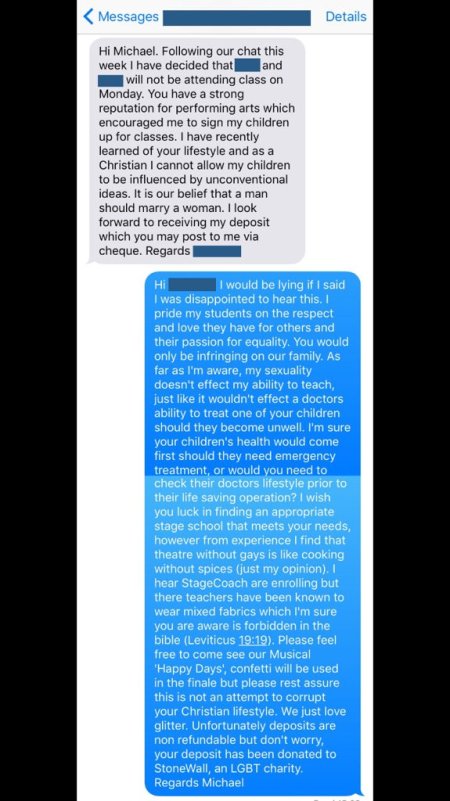
I really loved the first part of the teacher’s response. It is balanced, persuasive and strong. I wasn’t as big a fan of the sarcasm at the end. I don’t blame him for sending up the parent, but I’m afraid he may have undermined the points he so succinctly made early in his text.
Nobody is diminishing the stress and emotional trauma inflicted on many teachers throughout their working day. The bullying, name calling, pushing and disrespect can make a teacher despondent and at times on the edge.
The challenge is to find a way to stay on that edge, without losing it altogether. Because, as the footage below clearly shows, it is not a good look when teachers take the bait and lose all sense of reality and professionalism.
As hard as it is we must find a way to keep our composure and avoid a scene.
As much as we hope that parents will take a lead role in comforting fragile French kids in the aftermath of the Paris tragedy, you can bet much will be left to their school teachers.
Nothing prepares you for the kind of discussions these teachers will be asked to moderate and it’s an unenviable position they have in restoring calmness and clarity to fearful children:
On Jan. 7, 2015, there was suffocating alarm, horror and fear in the wake of the Charlie Hebdo shooting. The next day, wounds still fresh, it was necessary to keep going. It was a difficult day for schoolteachers in France, faced with students and their questions, and at times their anger.
On Monday, Nov. 16, there will be a similar challenge.
HuffPost France asked teachers and school principals about their expectations for the first school week after Friday’s Paris attacks and the messages they hoped to send to the students.
“This Monday, I’ll start my day with a 12th-grade literature class. It’s a class that I’m close to, especially since I already lived through the attacks of last January with them,” said Marie-Sandrine, a high school teacher. “I end my morning with a 10th-grade class that lasts till 12:20 p.m.”
On Sunday, the teacher noticed that discussions were already underway in online teachers’ forums, on social networks and over the phone. “The atmosphere is very different from the day after the attack on Charlie Hebdo,” she said. “In her address, the minister of education thanked us for our professionalism. She has given us resources to tackle the topic in class. From now on, it will be important to talk about a ‘minute of contemplation’ rather than a ‘minute of silence.'”
Marie-Sandrine said that she’s received emails and messages from students and former students, asking if she is safe and well. “They needed to be comforted,” she said.
“On Monday, I’m going to try to welcome their thoughts with an open mind. ‘Do you want to talk about it?’ That’s how I’ll start. I’m not afraid of their hostile reactions because unlike January, I know that nobody can say, ‘They were asking for it.’ I’m more afraid of the state of panic, of fear, or an absence of lightness. Some students who got in contact with me have told me, ‘Miss, I’m scared.'”
“Teenagers aren’t conscious of the fact that they could die. They don’t think about it like adults do. I’ll tell them that death is part of life,” she said. “I’d also like to teach them how to tell the difference between news and rumors. Finally, I’d like to encourage them to think about how we can take care of each other. If all of that is too heavy, we’ll stop, and I’ll have them listen to the song ‘My France’ by Jean Ferrat, and then we’ll go on with class.”
How on earth do you explain the tragedy that took place in Paris to young children?
Below are some tips by experts in the field I used for the Colorado shooting, but they are just as apt in this instance:
Watch for Trauma: “Young children may have difficulties identifying and expressing feelings. Parents should pay attention to the children’s play (for instance, preoccupation with certain aggressive electronic games, drawings, repetitive play that imitates the traumatic event or events). Another sign of trauma is avoidance of reminders.” — Dr. Aurelia Bizamcer, Medical Director, Outpatient Psychiatry at Temple University Hospital
Keep Answers Truthful but Simple: “We’re not holding back, but we’re not giving more because the giving more could have the risk of alarming the child. … As a parent you have an obligation to protect a young child from being overwhelmed.” –Alan Kazdin, Professor of Psychology and Child Psychiatry at Yale University; Director of the Yale Parenting Center.
Reassure Them: “We need to appreciate that kids have different fears. Many will worry about the movies, but others will worry about such events spilling over to other areas, such as the mall, school, the neighborhood. For kids of all ages, it is really important to let them know that these kinds of events are incredibly rare. ” –Dr. Gene Beresin, Director of Child and Adolescent Psychiatry Residency Training, Massachusetts General Hospital and McLean Hospital
Keep Answers Age-Appropriate: “Parents should be sure to pitch the discussion to their kids’ developmental level. For a 6-year-old, it’s completely appropriate to reassure them of their safety, with some emphasis on the fact that this person is no longer at large. For kids over the age of 8, more concrete details are appropriate, along with, perhaps, a general discussion of how to be safe in public — locating exit doors for instance, and getting to safety in the event of any dangerous occurrence.” –Jay Reeve,President and Chief Executive Officer, Apalachee Center
Don’t Make Assumptions: “Don’t project your own feelings, fears and anxiety on kids because you know you don’t really know exactly what your kids are feeling until you talk to them.” –Dr. Jane Taylor, psychiatrist
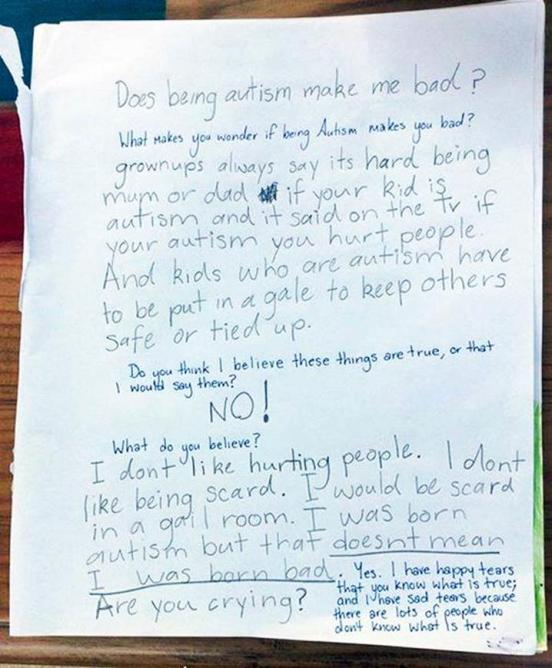
A letter between a Queensland girl, born with autism, and her mother has gone viral just hours after it was shared to Facebook.
The letter, an exchange between seven-year-old Cadence and mother Angela, was written after Cadence – overwhelmed by negative news stories about children with autism – took shelter beneath her schoolteacher’s desk.
A photograph of the letter was then posted to the I am Cadence Facebook page yesterday, where it has since received more than 340 likes and 640 shares.
In the letter Cadence asked her mother whether “being autism” made her “bad”, citing instances of autistic children being retrained in order to “keep others safe”.
She then goes on to declare that, “I was born autism but that doesn’t mean I was born bad”, before asking her mother “Are you crying?”
So let’s get this straight. He makes repeated references to his students’ breasts, rubbed a student’s back, pulled on a student’s ear, refuses to apologise and gets to keep his job!
If these allegations are factual, I wouldn’t want my children in the same post code as this guy let alone classroom!
A middle-school teacher has been disciplined — but not fired — for his unapologetic remarks about his students’ breasts.
Annan Boodram, a seventh- and eighth-grade English teacher at MS 206 in The Bronx, told a student in class, “Your boobs are staring at me,” according to a disciplinary decision filed with the state.
He told another, “Those things are bothering me.”
And a third, “Your ‘friends’ are staring at me.”
Hearing officer Donald Kinsella slapped the 13-year veteran teacher with a $7,500 fine and 10 hours of sensitivity and anti-sex- harassment training after a nine-day administrative trial.
It remains to be seen if the teacher learned his lesson.
“Do you understand that referring to a female student’s breasts as ‘things’ or ‘friends’ is inappropriate?” Boodram was asked in the hearing, Kinsella’s ruling states.
His reply: “No, I did not understand that then, and I really don’t know if it is. I mean, the way I see it, it’s not, but I could be wrong.”
Boodram, who made $85,110 last year, also posted on Facebook last week that the trial was “inherently biased against the teacher.”
“It matters not how fabulous a defense you mount, you never get off scot free,” he wrote.
Kinsella also found that Boodram, 58, inappropriately rubbed a girl’s back, hugged a girl “chest to chest,” and pulled on another’s ears, causing the student pain.
Boodram, a native of Guyana who served six years in the US military before attending City College of New York, admitted during the hearing he made the comments and “expressed regret.” He said students were not adhering to the school’s dress code, and he was trying to get them to cover up.
When one girl wore an open sweater over her shirt, Boodram “stared at her breasts” and “closed her sweater with a paper clip,” says a report by independent schools investigator Richard Condon.
Boodram had received all satisfactory ratings. Principal David Neering was once quoted as praising Boodram: “He does an excellent job of establishing relationships and bonding with the kids. They know that he cares about them.”
But several girls testified that Boodram, despite helping them academically, made them feel uncomfortable, Kinsella’s ruling said.
The Department of Education removed Boodram from the classroom in February 2014 when the complaints surfaced. After Kinsella’s ruling in June, the DOE assigned Boodram to the Absent Teacher Reserve, a pool of substitutes moved from school to school.
An apology doesn’t come close to cutting the mustard!
A high school in southern China has apologised after an intern teacher forced several pupils to walk on their hands as punishment, a local newspaper reports.
A posting made on social media on Friday claimed several teens from Xixiang Middle School in Shenzhen, just over the border from Hong Kong, had been physically punished after they disobeyed instruction from a gym teacher, according to the Southern Metropolis News.
A photo published with the post showed the bloodied hands of one teen, who was said to be enrolled in the school.
Another photo showed a school form carrying a written explanation by several pupils, who admitted they had missed gym class and their parents should not blame the teachers for the punishment they suffered.
The school authority and the education bureau of Baoan district, where the school is located, confirmed a teacher had forced the teens to walk on their hands, according to the News.
The instructor wanted to discipline the pupils and force them to do additional physical training but made a wrong judgment call.
The school said it would pay for the pupils’ medical fees and officials had visited their parents to offer an apology.







 Topical Teaching