Captain Phonics to the Rescue!

July 7, 2011

It’s like the pest that wont go away.  Phonics sneaks up on us all the time, with it’s many proponents insisting it is the missing key in getting literacy levels up to standard.  I doubt that is the case.  In fact, while I think phonics has a minor secondary role to play, if you make phonics the key method for teaching reading, you will almost certainly turn your students off literature.

It seems some British MP’s agree with me:

MPs have criticised government plans to test pupils on their reading ability at the age of six, warning that it will put children off reading for pleasure.

The report criticises the government’s focus on phonics – in which children learn individual sounds and then blend them to read words – as a “mechanical” approach and warns that it will contribute to a decline in literacy.

Fabian Hamilton, who chairs the MPs’ group, said: “If there is a central theme to this, that is, reading must be a pleasure. Of course children need the tools to understand what sounds the symbols make, and what those sounds mean. Phonics is only one way of doing it, there are others.”

The MPs’ report says: “The phonics test is likely to demotivate children rather than ensure that they become eager and fluent readers.”The government is facing a backlash over phonics. Critics, including the United Kingdom Literacy Association, have written to education secretary Michael Gove lobbying him to abandon the test.

The schools minister, Nick Gibb, said: “High-quality evidence from across the world – from Scotland and Australia to the National Reading Panel in the US – shows that the systematic teaching of synthetic phonics is the best way to teach basic reading skills, and especially those aged five to seven.

“It is vital that we focus on the reading skills of children early on in their lives, and give those who are struggling the extra help they need to enable them to go on to enjoy a lifetime’s love of reading rather than a lifelong struggle.”

Surely the greatest contribution a teacher of reading can make is helping to nurture an appreciation and fondness of reading.  Phonics is for most students a giant slog.  Even the expression “systematic teaching of synthetic phonics” is a turnoff.

Phonics has its place, but enjoyment of reading is tantamount.  I want my students to enjoy reading about different people and places, connect with well drawn characters and gain insights. I want them to experinece how reading can trigger emotions, form opinions and nurture their imaginations.

I didn’t become a teacher to turn my students off reading.

Teacher Humiliates Student For Not Doing Her Homework!

July 6, 2011

If proven, this is a horrible case of teaching at its worst.  To strip a student naked and make her clean the toilets all because she didn’t complete her homework is just shocking!  The fact that the parents couldn’t get a proper response when they took the matter up to the relevant authorities just makes matter worse.  Not to mention the allegation that other teachers watched the poor girl and didn’t intervene in any way:

The Gujarat government has ordered an inquiry into the affairs of a minority institution in Ahmedabad where a six-year-old student of class one was reportedly paraded naked in the all-girl school and made to clean toilets. All because she had not completed her home work and the class teacher found her handwriting to be “too bad.”

The class teacher was arrested after the parents lodged a police complaint against her and some of the trustees of the private high school in the minority-dominated area of Shahpur in the heart of the city.

The incident occurred on Friday, but the girl kept quiet and, under threat from the class teacher, did not even inform the incident to her parents till one of her schoolmates spilled the beans on Monday after the girl showed reluctance to go to school.

As the word spread in the neighbourhood, the enraged parents first tried to meet the trustees of the school and, after failing to get a satisfactory answer, lodged a complaint with the Shahpur police.

According to District Education Officer R.H. Patel, though the school was unregistered, the government had taken cognisance of the incident and would go to the root of the problem.

According to the father of the girl, she was stripped naked, made to do sit-ups, paraded in the school naked, was forced to clean the toilets and was locked in there for a few hours.

Though it is an all-girl school, some of the class four staff members are male and her parents felt outraged that she was watched by some male staff when paraded naked in the school. The trustees, however, claimed that only her veil was removed by the teacher.

This, however, is reportedly not the first such incident in the school. Another guardian complained that his daughter was given a similar punishment by the same teacher in March. When he tried to lodge a complaint against her with the trustees, he, in turn, was named in a police compliant lodged by the trustees.

I am appalled by this story.  It gives teachers a bad name.

Another Day, Another Standardised Test

July 5, 2011

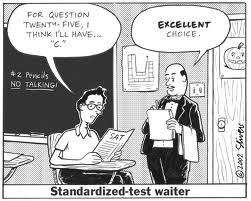
UK teachers are told to add mandatory phonics tests to the ever-expanding list.  Remember when teaching was about engaging the students not test practise?

This time next year, every year 1 pupil in England is likely to encounter a new national test assessing a central aspect of their ability to read.

The children, aged five and six, will be presented with 40 individual words on paper, and asked to sound them out to their teachers or to another adult. Some words will be familiar to most, while others will be made-up or “non” words such as “mip” or “glimp”, designed only to assess the child’s ability to follow the pronunciation rules, such as they exist, of written English.

The results of this test, or “screening check”, will then be collected, given to the child’s parents and also used to produce statistics on national and local performance and to inform Ofsted inspection judgments on schools.

One leading literacy figure has described the new test as potentially “disastrous”, while another told this newspaper it was an “abomination” and likely to be a major waste of taxpayers’ money. A petition with more than 1,000 signatures against it has been collected.

The debate surrounds the principle of teaching phonics, another boring, routine and old-fashioned way of teaching content that could be conveyed in a far more exciting and engaging way.

Beyond this debate, I feel there is another issue at stake.  The rise of obsessive testing inevitably leads to the curriculum being hijacked by test practise as well as pressure needlessly put on Primary aged students.  These students deserve to have their crucial first years of schooling without the stresses they will confront later on down the track.


Kids Are Addicted to the Internet

July 4, 2011

If kids are addicted to internet, Facebook and Twitter, it’s not as if their parents have no options. Reading about how fearful parents are about theeffects of their children’s addictions, I couldn’t help but wonder why they felt so powerless.

A third of all UK parents believe that their children are in danger from the internet and 80 per cent think it is possible to become addicted to social networking sites such as Twitter and Facebook, a new study suggests. It also found that a third of parents even believe that the web can “rewire” a person’s brain.

Internet charity the Nominet Trust, who commissioned the research, say there is no evidence that social networks are harmful in themselves, and that there is no neurological evidence of the web changing brains.

Facebook and Twitter, they suggested, usually in fact reinforce existing friendships, while even playing video games has been show to improve coordination and ‘visual processing skills’.

Parents can take control over their children’s internet access.  Some recommendations include:

  • Capping time on the internet
  • No internet access in their bedrooms
  • Ensuring that they do not have a Facebook page if they are under 13.
  • Imposing strict bedtimes.

If you do not hinder access to the web and have no rules or involvement in how it is used, you have something to worry about.  This addiction is very real and requires a proactive response.

Kids and Obesity: We Have Reached Crisis Point

July 4, 2011

The figures being released about the rate of childhood obesity is quite alarming.  To read that half a million British children have liver disease makes me worry very much about what a difficult state we are in and how far we have to go to reverse this unfortunate trend.

Doctors say obesity levels are now so high that children are commonly suffering signs of disease more commonly associated with alcohol abuse, meaning many will go on to develop cirrhosis, with some requiring liver transplants.

Government estimates say around 500,000 children below the age of 15 are suffering from “non alcoholic liver disease” which is caused by a build-up of fat within liver cells, which stops the organ functioning properly.

The condition increases the risks of heart disease, strokes and type 2 diabetes, and can lead to cirrhosis – scarring of the liver – which is often not detected until it is too late.

Britain’s most senior liver expert said the country was now facing a timebomb, with thousands of lives already at risk, and the numbers of children suffering from the disease projected to “rocket” further in line with rising obesity levels.

Prof Martin Lombard, the Department of Health’s national clinical director for liver disease warned that the disease was rarely detected until it had caused damage.

He said: “Liver disease is a silent killer, which is putting the lives of thousands of our children at risk. We do not want to see the next generation dying young from a condition that can be prevented.

“We know that with childhood obesity on the rise we can expect more children to be at risk of fatty liver disease in the near future.”

Government figures show 30 per cent of children aged between 2 and 15 are now overweight or obese – a figure which is projected to double by 2050.

Prof Lombard said he was concerned that children suffering from fatty liver disease were at particular risk if they started experimenting with alcohol in teenage years. He said even modest amounts of alcohol could worsen the condition.

There is no medical treatment for the disease, but the extent of it can be reduced by weightloss and improvements in diet.

Teachers Are Not Their Students’ Parents

July 3, 2011

A teacher defends kissing, cuddling and touching the behind of a female student by claiming that is the way he treats his own children.  And how did the authorities respond to this pathetic defense of an indefensible action?  They bought it hook, line and sinker.

A TEACHER who kissed and cuddled a schoolgirl defended himself by saying that was how he treated his own children. Jeffrey Cave, who taught at Willows Primary School, in Basildon, also pulled a boy’s hair and then told him that was how “teachers used to handle misbehaving pupils”.

He was found guilty of unacceptable professional conduct and has been reprimanded by the General Teaching Council.

Mr Cave touched a girl pupil on her bottom over her clothing, allowed her to sit on his lap, kissed her head and cuddled her.

Mr Cave admitted in his witness statement kissing her head and cuddling her, but said that was the same way he showed affection to his own children.

He said during police interview he stroked the pupil’s bottom over clothing in a downwards motion to test if her trousers were dry.

The hearing heard Cave. who has had a clean professional history for 26 years. was going through a period of personal stress at the time of the incidents, and his actions were not sexually motivated.

I have no doubt that the soft “reprimand” response came about from his defense.  Their soft ruling sends a very bad message.  The public must be reasuured that teachers can not in any way show affection to students in the same way as parents do.  I am a parent too, but I have no right to treat my students like my children.

My message to all male teachers is to avoid being in a room alone with a student, act with professionalism and integrity at all times and keep your hands to yourself.

They are not your children, they are someone elses.


The Trouble With Professional Development

July 2, 2011

I am so tired of going to long and diabolically boring PD’s that do nothing to advance my skills and leave me deeply frustrated.  I just read a brilliant article about the ineffectiveness of some professional development and how it misses an important opportunity.

The way we provide professional learning experiences and support our nation’s teachers is a running source of debate and, unfortunately, disappointment. Policymakers grumble at the costs. Teachers complain they don’t get what they need while parents and the public wait for our schools to get it right for our students.

…  Another federally funded report found that even after two years of targeting more than 100 7th grade math teachers in 12 districts with professional development, there was no measurable impact on teacher knowledge or student achievement. Even the researchers sounded a bit surprised, noting that the programs did everything the existing research says is effective.

Though I’m not familiar with the specifics of these professional development approaches, I’m not too surprised that they didn’t lead to improved student achievement. It is far too easy for professional development to miss the mark – even if it follows the research.

As the former director of professional development in New York City schools and someone who has devoted most of my professional life to leading teacher professional development, I can tell you that what teachers need to improve their craft is rarely what they receive from professional development.

This is not a slam on professional development per se, though teachers typically do not have enough input in determining what professional development they need, who delivers it and when they get it. And the stakes are about to get higher as states phase in higher common core standards that will ask more of teachers and students.

Much of the professional development teachers are required to attend is attached to textbook adoptions, mandates, or scripted programs that promise results that are rarely delivered.

To read the full article, please follow this link.


Introducing the Candy Diet!

June 30, 2011

Feeling guilty about the amount of candy you allow your children to eat?  Not anymore.  If anything, you aren’t feeding them enough!

Or, at least that’s what the research seems to suggest ….

Indulging a sweet tooth might not be anyone’s idea of a good weight-loss strategy. But in jaw-dropping new research, scientists say they’ve found something even more likely to be associated with unwanted weight gain in children and adolescents than eating candy:

Not eating candy.

For the study, published in Food & Nutrition Research, researchers at Louisiana State University tracked the health of more than 11,000 youngsters between the ages of two and 18 from 1999 to 2004. They found that children who ate sweets were 22 percent less likely to be overweight or obese than kids who shunned sweets. Adolescents? Those who ate candy were 26 percent less likely to be overweight or obese than their non-candy-eating counterparts.

And that wasn’t the only surprising finding. Researchers also found that the blood of candy-eating kids had lower levels of C-reactive protein. That’s a marker of inflammation in the body and a risk factor for cardiovascular disease and other chronic illnesses.

Who funds this research?  Could somebody please do a study that links the watching of televised sport to greater physical health?  I could do with some scientific evidence to persuade my wife that I’m not wasting my time

Maths Lessons Should be “Toughened Up”: Gove

June 30, 2011

Michael Gove might think that rigorous daily and weekly testing in maths is the answer, but my experience tells me that testing doesn’t work for all types of students.  There are some students that lift their game when tested.  Their competitive juices get going, and their drive to get a good grade is palpable.  Then there are students who need to learn in a less pressurised and more r
elaxed setting.  They freeze during formal testing, but progress extremely well when the focus is on the skill or concept rather than the grade.

Michael Gove disagrees:

All primary school children should be given daily maths lessons and weekly tests to stop pupils falling behind those from the Far East, Michael Gove suggested today. 

Mr Gove said schools should also “bear in mind” a system used in Shanghai where pupils have daily maths lessons and regular tests to “make sure that all children are learning the basics”.

What disappoints me as a Primary Maths teacher, is that in the quest for better results the focus becomes testing instead of engagement.  I believe that Maths can be taught in a turgid and lifeless way.  Conversely, it can be taught in an interesting, engaging and creative way.  Whilst constant testing will make students resent the subject, there are ways of teaching maths which can engage and excite students.

The answer to improving our students’ maths skills should not result in them hating the subject.


Our Kids Are the Digital Revolution!

June 29, 2011

It’s a very different childhood to the one we experienced.

SEVEN in 10 Australian households have access to the internet at home, one in five of us want to work less and the most popular physical activity is walking, the latest data on social trends shows.

Four out of every five children aged 5-14 use the internet, making them the digital generation, and 86 per cent of households with children aged under 15 have access to the internet at home, the latest Australian social trends study from the Australian Bureau of Statistics shows.

Eighty five per cent of children used the internet for educational activities, 69 per cent played online games, 47 per cent used the internet to download music and 22 per cent used it for social networking.

Only two out of three households without children had access to the internet at home, the study found.