There is a misnomer that children today eat worse today than than ever before. This is not my experience.
For starters, in my day it was unheard of for children to be drinking water of their own volition. It was always juice or soft drink. Water was for post sport hydration only. Children today happily drink water. My students are forever filling up their drink bottles. In my day drink bottles were for fitting on your bicycles for long rides in the summer time.
I only seldomly ate vegetables on their own. My vegies needed to be cooked, flavoured and magically reinvented before I would eat them. The thought of opening my lunch box and finding a container full of celery sticks was not something I wished to contemplate. Children today are only too happy to snack on carrot sticks and apple pieces. If you put a fruit and vegetable tray in front of 10-years-olds, you’d better have another tray in reserve. They would finish the contents in no time.
The key difference between then and know is exercise. I played on the street with my neighbours after school. My parents didn’t need to supervise. In those days kids were allowed to play outside without it being seen as dangerous or an example of poor parenting.
School cafeteria regulations and lunch policies can be extremely inflexible on our children. Sometimes I look at the example of our generation and wonder if we are not a bunch of hypocrites. Whilst teachers and office workers leave the premises to get a fast food option for lunch, children are left to eat food our generation would of refused to eat.
Whilst our kids are making the progress, many of us continue to indulge. Take this silly article for example:
Could you consume a giant burger comprising three beef patties, six bacon rashers, six slices of cheese and pulled pork in just 10 minutes?
This is exactly what one restaurant in London is challenging its diners to do.
At eight inches high, this gigantic burger is a real contender for the title of the UK’s tallest burger.
Weighing in with a gut-busting 3,000 calories – more than an entire daily intake of calories for a man – the burger is being sold as part of an eating challenge at the at the Red Dog Saloon in Hoxton.
To take part in the challenge, contestants in the Devastator Burge Challenge must eat the entire burger, with accompanying fries and milkshake in under ten minutes.
Those who manage to defeat the burger earn their photo on the wall of fame behind the restaurant’s bar area.
Not surprisingly, the challenge has taken down many of those who dare to take it on – just 5 per cent of people who attempted it have succeeded. Incredibly, one challenger managed to complete the entire meal in just six minutes.
There is no doubt that our children could improve their diet choices and become a lot more active. But considering the role-models we have out there, our kids are doing far better than the media has us believe.
A compilation of behavioural management links by the team at The Guardian:
Positive ways to manage behaviour provides a range of techniques from the training organisation Pivotal Education. These include establishing explicit rules and routines, providing students with clear choices regarding their behaviour and starting each day with a clean sheet.
Further advice on some of the most common behaviour problems is contained in Classroom management strategies. Areas covered include dealing with pupils who are defiant, use abusive language, refuse to work or make silly noises in class. The resource highlights “needs-focused interventions”, such as “chunking” tasks to make them more manageable, taking time over your classroom seating plan and encouraging parental involvement. Strategies to avoid include giving ultimatums or tactically ignoring disruptive pupils.
Coping Strategies for Teachers contains tips on preventing, reducing and managing unacceptable behaviour. Ideas include having a challenge on the board for pupils to complete as they arrive in class, giving responsibility to students for activities such as taking the register, and keeping a behaviour file to record any incidents, meetings or contact with parents.
For newly-qualified teachers, a list of 10 top tips has been created by assistant headteacher and mentor Eugene Spiers. Advice includes remembering to smile and greet your classes, even the groups you dread, being consistent with praise and sanctions and calling a selection of parents with good news every Friday. There is additional advice in the resource 10 top tips for NQTs.
On a lighter note, Five Minutes to a Calmer Classroom provides tips on using meditation in the classroom. It includes details of a simple breathing exercise that can be used to tackle stress and improve concentration.
And for anyone starting the new school year as a supply teacher, there is a list of top tips from primary teacher Colin Cartmell-Browne. Advice includes arriving as early as possible, making a note of the school timetable and discussing with other members of staff whether there are any pupils who will need additional support.
There is a clear campaign from teacher’s unions and academics against phonics. This campaign is heated and vitriolic and makes absolutely no sense to me. Why would an organisation which is entrusted to help children to read, write and spell condemn a method which has a favourable track record? Even if you believed in other approaches (I like to incorporate other approaches too), it makes no logical sense to rant and rave about strategies that others support such as phonics.
Surely, as our students learn in different ways, it is incumbent on us as teachers to teach skills using a variety of different methods:
Nearly nine out of 10 teachers said they practised nonsense words in the run up to the test.
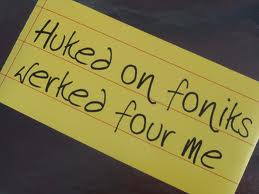
Words like spron, fape and thazz were included in the test designed to check pupils’ abilities to decode using phonics.
And four out of 10 admitted drilling phonics in the week prior to the test.
One Year one teacher said: “Some able readers failed and some non-fluent, less-able readers passed! What does that prove?
“It proves synthetic phonics is only part of a variety of strategies used in learning to read.”
Another teacher said: “I was willing to try it to see if it helped the children and if it helped inform my planning and assessment.
“It was a waste of time and money – (I had to have) a supply teacher to cover me – and had a negative effect on several of the children in my class.”
A Year One teacher said: “Many children made mistakes trying to turn the pseudo words into real words – ‘strom’ became ‘storm’.”
Some 86% of those polled believed the screening check should not be continued.
Perhaps the test needs some improving, but educators can’t be too tough on phonics as a method. After all, many of us can attribute being able to read by phonics.
What is the point of a ten day suspension? What can be achieved by such a useless consequence?
Ten days wont fix the scars of the bullied teen, it wont restore confidence in students, parents or colleagues, it wont provide the teacher with enough time to learn new strategies and it wont deter other teachers from doing the same.
This shocking video shows the moment a Washington middle school teacher allegedly joined bullies in beating a 13-year-old boy to the ground and physically abusing him.
Shot by a fellow student, the disturbing footage begins with the boy being dragged across a classroom floor by his arms and legs, a sock stuffed in his mouth.
One of the bullies can be heard giggling and yelling ‘pull his pants down’ to a chorus of laughter from the others.
Students sit around watching, some visibly entertained, not one of them stepping in to help as the boy cowers on the floor.
But what’s more shocking to the boys devastated mother, Karla Kinney, is that the teacher, John Rosi, stands idly by and is even seen getting stuck in himself.Rosi, an 18-year classroom veteran was suspended from his post for 10 days in an agreement that allowed him to avoid losing his job.
So let’s measure the level of rehabilitation that this meagre punishment has produced:
In a letter to investigators Rosi said he did not consider the incident to be bullying.
‘I can honestly say that at the time I did not believe that any of the children were at risk of harm during their interactions.
‘Nor did I view the incident as anything more than harmless childhood horseplay,’ he wrote.
The real heroes are our family members, the person down the street who works two jobs to feed his family or the lady who works at the bank who greets you because she wants to rather than has to. Our heroes are not necessarily the footballer who wins an MVP or the actor who takes home the Oscar.
Last month “Blade Runner” Oscar Pistorius became a heroic figure to many who watched the Olympic Games. As an amputee, competing in the able body Olympics, many saw his feat as remarkable and looked up to him as a source of inspiration. Some queried that his custom-made blades might give him an unfair advantage over the others, but those arguments were quashed by the outpouring of love and respect from the general community.
To hear Pistorius’ unsportsmanlike rant post-race of the Paralympics 200 meter event just reminds us to look up to heroes that we know, rather than those appointed by spin doctors and television executives looking for a ratings boost:
‘Blade Runner’ Oscar Pistorius suffered a shock defeat at the Paralympics tonight, and immediately claimed that the man who beat him had an unfair advantage.
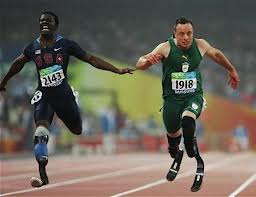
The South African athlete, who became the first double amputee to run at the Olympics less than a month ago, came second behind Brazilian sprinter Alan Oliveira in the T44 200m event.
Pistorius began the final as the big favourite, and the result stunned the 80,000 spectators inside London’s Olympic Stadium into silence.
But the race was surrounded by controversy after Pistorius claimed that he was at a disadvantage because the carbon fibre prosthetic blades he uses to run are shorter than some of his competitors’.He complained that athletes with longer blades are assisted because their stride lengths are greater.Oliveira, one of the athletes who uses longer blades than Pistorius, won the race in 21.45secs.
Pistorius, who had led for most of the race, finished in 21.52secs.
Immediately after the race, Pistorus said the International Paralympic Committee (IPC) did not ‘want to listen’ to his concerns, adding: ‘The guys’ legs are unbelievably long.
Even if he does have a point, this is not the time to raise it. Heroes are not bad sports. The real heroes are all around us. We just don’t seem to notice them.
Paralympic news as it happens
Find the latest coverage of the Paralympics here including live blogs, the day in pictures, videos and comment.
Paralympic sport graphics
One of the main mysteries about the Paralympics is just what is Boccia? Find out what and how using this really useful graphics explaining the format and rules of Boccia and other Paralympic sports including Goalball and Wheelchair Rugby.
Paralympic datablog
Data and charts to explore in class on who is competing in the Paralympics including lots of useful charts and a full list of every athlete competing at the Paralympic Games and the disciplines in which they are taking part.
Paralympics opening ceremony
Last week’s dazzling opening ceremony with fireworks, giant umbrellas and, of course, Stephen Hawkins was in essence an upscaled science lesson – so great stuff to review with your class. Here is a selection of the most spectacular images from a memorable night in east London.
Paralympic opening ceremony media coverage
How the newspapers covered the launch of the London Games. The Daily Express and the Daily Star were the only ones to feature another story as their main headline.
The history of the Paralympics
Fascinating tale of how the Paralympics grew from a sports day for veterans to a global event, from the Guardian archives.
10 Paralympics stars to watch
From China’s blind goalball hero Chen Liangliang to Oscar Pistorius, 10 of the 4,200 competitors to keep a special eye on.
Brick-by-brick Olympics
If you are reviewing the Olympics in class don’t miss the incredible Lego animations reconstructing the best moments of the global sports event in Lego. Here’s a montage of the best bits with links to all the Brick by brick recreations.
Dr Ludwig Guttman – founder of the Paralympic games
A Holocaust Memorial Day resource about Dr Ludwig Guttman, Holocaust survivor and founder of the Paralympic games. The resource is an opportunity to teach students about the link between the Paralympic games and the Holocaust.
Using the Paralympics in class
ICT teacher Chris Leach’s useful blog on bringing real world events to life in class using a range of technology.
Importance of failure
Teacher and psychologist Marc Smith looks at how we embrace failure as a springboard to success.
Meet the Paralympians
Inspiring video of Paralympians including Ellie Simonds and Jon-Allen Butterworth.
ParalympicsGB
The official paralympics site with news and athletes’ case studies
And David Beckham
Sainsbury’s is the official sponsor of the Paralympics and its useful site includes an invitation from David Beckham calling you to play an online game of blind football.
It’s bad enough that doctors are over prescribing medications to young children, to read that they are also prescribing them drugs that are intended for adults makes me extremely angry. How do we allow doctors to prescribe any drug until extensive research has been conducted:
Children are being prescribed unlicensed medicines that could be causing harm, a report has warned.
The Government study is demanding an urgent investigation into the ‘unacceptable’ fact that almost a third of drugs given to sick children are officially approved for only adult use.
It warns of ‘a high number of drug errors’ in which children may be wrongly prescribed too much of a medicine because the doses are meant for adults.
Historically, pharmaceutical companies have not had an obligation to test medicines on youngsters. The law changed in 2007 and new drugs coming to market must now be tested on children before they can be used on them.
But this still means about 30 per cent of drugs prescribed to under-18s – and up to 95 per cent of drugs given to babies in intensive care – have never been tested on children.
It’s one of modern days big tragedies that doctors seem to be in bed with the big pharmaceutical companies.
Newsflash: Prison doesn’t just exist to rehabilitate, it is also there to take the scum off the street. A known paedophile should be locked away for a substantial period of time, regardless of whether or not it will ‘cure’ him of his sickness.
A paedophile who downloaded child porn has been spared jail after a judge said locking him up could be more dangerous to society in the long term.
Jason Fairfax, 35, of Bargoed, south Wales, had amassed a collection of around 2,700 indecent images when police raided his home earlier this year.
The photographs and videos were later graded from one to five – with the higher the category, the more serious the offence.
Cardiff Crown Court heard almost a third of the images were at the higher end of the scale – with 786 level four and 29 level five images.
The details of the photographs were so serious, Judge David Wyn Morgan asked the media not to publish their details.
He said: ‘When the police investigated your computer, they found a staggering number of images that were indecent.
‘There was a very large number of them at the top end of the scale, at level four and five.
‘The natural reaction of any decent human being would be that you should go to prison for as long as possible.
‘But when the revulsion has subsided, the court must consider precisely what that would achieve.
‘You would go into prison as sex offender and still come out as one – just as dangerous if not more so than you are at the moment.
‘And the protection of the public must be of paramount concern to the court.’
Instead what does this animal get?
Judge Morgan decided to make the defendant the subject of a sex offenders treatment programme for three years. He will also have to sign the sex offenders’ register until at least 2017 and undertake 250 hours of unpaid work.
Furthermore, Fairfax is not allowed to have any contact with any children under the age of 16 – either in person, on the telephone or via the internet – without the approval of their parents.
He is also banned from deleting the browsing history on his computer as well as erasing any images from a digital camera or camera phone without permission from the police.
This judgement is absolutely terrifying. We must not put up with it.
It bothers me that society has given up on honesty and is now happy to settle for the occasional deceit:
Most women will forgive their partners for cheating once or even twice, but would dump them if they tried it three times, according to a study.
The research found that more than six in ten women would forgive two relationship ‘errors’ – which include infidelity, excessive flirtatious behaviour or romantic neglect. They would, however, dump their man after three.
A full 53 per cent say they would be likely to give their partner another chance even if they found out they had cheated on them, as long as that cheating was a one-off and didn’t involve a pro-longed affair, according to a poll of 2,000 British men and women for laundry specialists Dr. Beckmann.
An incredible 38 per cent of all current British relationships have endured infidelity of some kind, according to the study.
I believe this study represents a negative worldview which is sure to affect the next generations. We must expect nothing less than honesty and loyalty from each other. Forgiveness is a personal choice, but even so, there must be an expectation of trust in every genuine relationship.
I think it’s highly appropriate for the police to take incidents featuring physical bullying like the one above very seriously:
The argument on a Franklin Township school bus wasn’t particularly unusual. One student had taken a seat that another wanted for himself.
But to Lora Hoagland, what followed was horrifying — a 15-year-old attacking her younger, smaller son for nearly a full minute, the image captured on a cellphone video taken by another student on the bus as it left the parking lot at Franklin Township Middle School East on Wednesday afternoon.
The video, posted to Facebook, was cited by Franklin Township Schools Police in arresting the 15-year-old on preliminary charges of battery with injury and disorderly conduct. It also has left Hoagland with doubts about the safety of her two children, both students in Franklin Township.
She didn’t send either of them to school Friday, likening the scene on the bus to a war zone.