Teaching the Student with Low Self Esteem

October 7, 2012

Courtesy of Dr. Ken Shore:

Praise the student in a specific and genuine way.Students are experts at distinguishing genuine feedback from empty compliments. They learn to dismiss vague words of praise as insincere, and perhaps even phony. Comments that suggest thoughtful appreciation of their work, on the other hand, are meaningful to them. Toward that end, let the student know in specific terms what you like about her work or behavior. If she is progressing slowly, praise her for small steps forward. If you sense that she’s uncomfortable being praised in front of her classmates, tell her in private or in a note.

Show the student tangible evidence of progress. Expressing confidence in a student’s ability is important; pep talks alone might not be enough, however. Help the student appreciate her own improvement by pointing to concrete signs of growth — perhaps by taping an oral reading at the beginning of the year and comparing it to a later performance, by showing her papers from earlier in the year and contrasting them with later papers, or by demonstrating that the math problems she struggled with during the first marking period now come easily to her. You might also have the student place in a box index cards with spelling or reading words she has mastered.

Showcase her accomplishments. You might read one of the student’s compositions to the class, display her artwork on a bulletin board, have her demonstrate how to do a math problem, or, in the case of an ESL student, invite her to speak to the class in her first language. If the student has a particular hobby or interest, suggest that she talk to the class about it. If necessary, have her rehearse her talk in advance.

Help the student feel important in class. You might give the student an important classroom job or find ways in which she can help others. Tell her you are giving her the responsibility because you are confident she can do it well. For example: have the student take care of the class rabbit, deliver lunch money to the office, collect homework, help another student with a computer problem, read aloud the school’s morning announcements, answer the school phone while the secretary is at lunch, or tutor a student in a lower grade.

Engage the student in conversation about her interests. A student can gain self-esteem from involvement in activities she cares about. Find a few minutes every day to talk with her about her favorite hobbies, sports, television programs, or musical groups. If necessary, ask her parents for the information you need as a basis for talking with her. Suggest to the student ways in which she can pursue her interests in greater depth. You might even bring in a book or item from home related to one of her interests.

Help the student deal with adversity. If the student encounters academic difficulties, help her appreciate that failure is a normal part of learning and that everyone experiences disappointment or frustration at some point. You might tell her that Lincoln lost seven elections before being elected president of the United States, or that Babe Ruth struck out 1,330 times during his career. Acknowledge the student’s frustration, and then move on to help her develop strategies for improvement. Express your confidence that –with hard work and your support — she is likely to succeed.

Encourage a sense of belonging. Students with low self-esteem often are isolated from their classmates. You can promote a student’s peer involvement with others by finding ways to integrate her into activities that are take place both in and out of school. You might organize a group activity that includes her. Or ask a couple of friendly and accepting students to spend time with her during recess or lunch. If students pair up for class activities, assign the student a kind and easygoing partner. You also might want to encourage the student’s parents to arrange additional social contacts with classmates, perhaps suggesting potential playmates.

Inform parents of their child’s successes. Teachers are quick to let parents know when their child has a problem. They are not nearly as diligent about notifying parents when their child is successful. Consider sending home a note or calling parents when their child does something noteworthy. Tell the student you are doing it. The gesture might take only a couple of minutes, but it can brighten the student’s day and engender positive responses from the parents to their child.

About Ken Shore

Dr. Kenneth Shore is a psychologist and chair of a child study team for the Hamilton, New Jersey Public Schools. He has written five books, including Special Kids Problem Solver and Elementary Teacher’s Discipline Problem Solver.

Click to read a complete bio.


Click on the link to read Two-Year Olds Forced to Have Fingerprints and Mug Shots Taken

Leave Parents Alone When it Comes to Homework

October 7, 2012


I always tell the parents of my students when they inquire about homework that it is NOT their job to do homework. They already had their lifetime supply of homework when they were a child. Why should they have to revisit primary school homework as an adult?

I am expected to give homework as it is part of my school’s philosophy. Even so, I am very careful that the homework is merely a revision of what I am covering in class. There is nothing new and it’s certainly not a random worksheet designed to keep the students occupied.

I then encourage my students to merely read their homework on the first night (they don’t have to actually begin it), and if there is anything they don’t understand, to circle it and let me know about it the next school day. Explaining the homework is NOT the responsibility of parents, it’s the responsibility of teachers. No parent should ever feel compelled to sit down and figure out their child’s schoolwork.

The home is for quality family time not the stresses and arguments that occur when children rely on their parents to spoon feed them their homework answers.

That is why I found this article particularly grating:

TEACHERS want parents to sign homework contracts so mums and dads acknowledge what is expected of them and their children.

The age-old homework debate about what’s too much and what’s not enough has been thrust back into the spotlight after Federal Parliament set up an inquiry into teaching, including the “influence of family members”.

Queensland Teachers’ Union president Kevin Bates said parents needed to be involved in their children’s after-school learning.

“It’s at the point of enrolment. You sign-up, like a contract (and) it provides expectations … some schools already do it.”

It comes as the Australia Education Union president Angelo Gavrielatos has conceded homework had become a burden for some families who were struggling with modern life.

“There are growing levels of parental anxiety (with homework). Every parent wants their kids to have an edge,” Mr Gavrielatos said.

“I’ve heard it said before that homework is a burden on parents.”

He said some parents claimed their kids got too much and others wanted more. Some parents did homework for their children.

Age-appropriate homework was proven to help children learn. However, schools with students from lower socio-economic backgrounds should get more government funding to help set up systems such as homework centres, he said.

Queensland Education Minister John-Paul Langbroek said he understood how parents had become anxious about helping with their children’s schoolwork.

“It’s our job to make sure we work with them and point out to them that your child doesn’t need to get everything right,” Mr Langbroek said.

He said parents had complained to him, saying, “I’m not a teacher”.

Click on the link to read Parents Urged to do the Job of a Teacher

Click on the link to read This is What You Get for Doing Your Homework

Click on the link to read Experts Call For Homework to Be Abolished

Click on the link to read The Case in Favour of Homework

Who is Going to Stand Up For Bullied Teachers?

October 6, 2012

No student would ever dare spike a teacher’s drink if they felt the likely consequences outweighed the enjoyment factor.

I will gladly stick up for children in most cases, but when it comes to assaults or intimidation against teachers or fellow students I draw the line. Teachers must be supported and treated with respect from top down. Any student found spiking a teacher’s drink (depending on the child’s age) has no place in that classroom … ever!

A North Carolina teacher says her student “spiked her coffee with butt-enhancing pills.”

According to WBTV, 61-year-old Ellen Vick, a teacher at Independence High School in Charlotte, N.C., told police Monday that a student put a “butt-enhancing” drug in her coffee during class.

Investigators say the drug was “GluteBoost,” a supplement that claims to plump up one’s derriere.

As WCNC notes: “One month’s supply with of GluteBoost sells for $50 on the company’s website. The pills [claim to] use “natural supplements that will enhance your butt size.

Police are reportedly still investigating the incident, and there have not been any arrests. The student, however, is said to have been “disciplined according to the district code of conduct,” WBTV reports.

This is not the first time that a student has gotten into hot water for spiking a teacher’s beverage.

According to the Knoxville News Sentinel, three eighth-graders reportedly spiked a teacher’s soft drink with Germ-X hand sanitizer in 2008.

And last May, a high school student in California allegedly “slipped dry erase cleaning fluid and bleach into her teacher’s coffee mug when she wasn’t looking,” NBC News reports.

Click on the link to read 12 Tips for Managing Time in the Classroom

Click on the link to read If Teachers Were Paid More I Wouldn’t Have Become One

Click on the link to read Different Professions, Same Experiences

Click on the link to read Our Pay Isn’t the Problem

12 Tips for Managing Time in the Classroom

October 5, 2012

Courtesy of Susan Fitzell from teachers.net:

1. Keep students on task during activities: Use visual timers during class activities such as think-pair-shares, group work, timed individual assignments, etc. A visual timer is one that enables students to “see” time.

2. Save class time by using efficient note-taking practices: For example, rather than have students spend valuable class time copying notes that the teacher writes on an overhead projector, whiteboard, chalk board or LCD Screen, give students a copy of linear notes as well as a blank graphic organizer based on those notes. Rather than copy notes, students fill in the words of the graphic organizer. This not only saves tremendous class time, it presents the notes in a linear as well as graphic mode and still requires students to pay attention because they have to fill in the missing words.

3. Get students to class on time: Choose a ‘gripping’ novel, or a short educational game (Around the World, Vocabulary Hang Man, etc. One that would only take about five minutes to complete.). Every day, exactly as the bell rings, start reading or playing the game. Students will rush to class to avoid missing the ‘fun’.

4. Use song clips or cell phone ring tones as timers: Sort them by how long they take to play through and use them as auditory timers for the students. Whether it’s a transition or a non-reading activity (Avoid playing music while students are reading.) the music will cue students in to the ‘time’ and keep them hopping.

5. Keep lengthy group work activities on target:  When giving students a good chunk of time to work on a project, for example, twenty minutes; tell students that you will do a ‘check-in’ every 3 min and 22 seconds. (Or some other odd time) Why not five minutes? Because the brain likes novelty and they are more likely to pay attention to something like 3:22.  Then set your visual timer for that amount of time. When the time’s up, stop the action and do a “check-in” with each group.  This should only take a minute or two. Have students whip around the room with a quick report.  This allows you to zero in on the students that are struggling to get started and stay abreast of the students who are barreling ahead and may finish early.

6. Get through your lesson plan with minimal distraction:  Summarize what must be accomplished in a period of time in a bulleted list. Try to keep it to four or five bullets. List the bullets on a flip chart pad or white/chalk board.  Draw check boxes next to each bullet.  As the class completes each bullet, ask a student to check off the completed item.  If the bullets are checked off before the end of the allotted time, students are rewarded with ‘talk time’, an educational game that they love to play, or another incentive. Say, “When we finish these bullets early, we have time to do something fun!”

7. Provide an environment that makes writing more efficient AND saves time: When assigning students a writing assignment, structure 10+ minutes (or more) for students to create a mind map of their ideas. When assigning students a project, structure time during class for students to create a plan. When students start projects with a ‘map’ of where they are going, the quality of their end product not only improves, they work more effectively and efficiently, thus saving time.

8. Give students clear directions so the need for repetition is minimized: Write your directions, assignments, sequences of activities, etc. on the chalk/white board or PowerPoint screen. Have one or two students paraphrase the instructions out loud for the class. Paraphrasing not only allows the teacher to determine how clear the directions are, but it provides the directions once again with a different voice.

9. Say it so all can hear it: If all students could hear what teachers said, or were listening, class activities would move along faster. If possible, use a wireless microphone and a speaker in your classroom.  Teachers who use such a system for ‘one’ student in the class who needs it as an accommodation report that they notice a marked difference in the class; all students hear and respond better. This step saves time because teachers repeat and re-teach less.

10. Allow students to contribute to managing THEIR class: Assign them jobs, or if appropriate, have them come up with a fair system of assigning jobs. Students can not only help with taking attendance, and collecting and passing papers; they can contribute to creating memory devices (mnemonics), songs for learning, vocabulary cartoons, flow charts and graphic organizers. Find out what strengths students bring to the class and use those strengths to differentiate lesson plans and learning materials.

11. Students who take time away from class must give time back: Restitution: When students caused the class to lose time because of poor behavior and disruption, I require them to make it up to the class. Students might have to prepare and present a 20 minute lesson, come after school to tutor another student for 7 minutes, work on the computer to create a crossword puzzle worksheet, etc. They must give back for what they took away.  This is not only an effective deterrent to wasted time; it can be a positive experience for the student and an opportunity for you to build rapport and relationship with the student.

12. Shorten the time it takes to prep: Use internet resources to provide ready made materials for your lesson plans. See my Dozen Internet Tips article from December 2008 for some great time saving tips for using the Internet.


Click on the link to read If Teachers Were Paid More I Wouldn’t Have Become One

Click on the link to read Different Professions, Same Experiences

Click on the link to read Our Pay Isn’t the Problemt

Sometimes Teachers Ought to Keep their Thoughts to Themselves

October 4, 2012

My students often ask me who I vote for and what my politics is. I refuse to answer them. It is not my place to brainwash my students with my political beliefs. I would prefer to help give my students the skills and confidence to think for themselves.

The teacher who allegedly mocked her student for wearing a campaign t-shirt should have kept her politics to herself:

A Philadelphia high school teacher is under investigation after she reportedly ordered a student to take off a t-shirt supporting Mitt Romney’s presidential campaign and compared the shirt to a Ku Klux Klan outfit.

Samantha Pawlucy, 16, chose to wear a pink Republican t-shirt for a uniform-free ‘dress-down’ day at Charles Carroll High School in Port Richmond.

She claims her geometry teacher publicly humiliated her and urged other teachers and students to mock her.

During the incident, Ms. Pawlucy said the teacher told her that Carroll High is a ‘Democratic school’ and wearing a Republican shirt is akin to the teacher, who is black, wearing a KKK shirt.‘I was really embarrassed and shocked,’ Pawlucy told Philly.com.

She decided to wear the shirt after researching both presidential candidates and deciding that she’s a Romney supporter, particularly due to his opposition to partial-birth abortion.

There should be no such thing as a ‘Democratic school’ or a ‘Republican school’ – just a ‘tolerant school’.

Kid’s Cute Note to the Tooth Fairy

October 4, 2012

Talk about driving a hard bargain:


Click on the link to read ‘Love’ as Defined by a 5-Year Old

Portraits of Classrooms From Around the World

October 3, 2012

Courtesy of the brilliant photographer Julian Germain and brainpickings.org:

Brazil, Belo Horizonte, Series 6, Mathematics

Taiwan, Ruei Fang Township, Kindergarten, Art

St. Petersburg, Russia. Year 2, Russian

Tokyo, Japan, Grade 5, Classical Japanese

Lagos, Nigeria. Basic 7 / Junior Secondary Level 1, Mathematics

Qatar, Grade 8, English

Bahrain, Saar, Grade 11, Islamic

Peru, Cusco, Primary Grade 4, Mathematics

More portraits can be found by following the link above.

Click on the link to read Top Ten Funny Excuses For Being Late To School

Click on the link to read 7 Tips for Transforming Your Classroom

Click on the link to read 2 Kids Outsmart 3 Robbers

Click on the link to read the 100 Skills Parents Should Teach Their Children

Kids as Young as 1 Exposed to 4 Hours of Background Television a Day

October 3, 2012


At 4 hours a day we have to rename a television as a ‘babysitter’:

Children and television watching aren’t always a great mix, especially when talking about health consequences. But parents have to worry about more than kids plopped down in front of the TV—now they have to think about how much background TV they’re exposed to.

On average, kids from about age 1 to 8 are exposed to about four hours of background television a day, a recent study in the journal Pediatrics finds. While too much direct television has been linked to obesity and poor cognitive development, less is known about the effects of background TV.

Two studies in 2008 and 2009 in the journal Child Development looked at the fallout of background TV watching. One found an association between background TV exposure and worse quality and quantity of parent-child interactions, and that could influence development. The other found that having TV on in the background disturbed play among young children, which may have an impact on cognitive development.

Click on the link to read ‘Love’ as Defined by a 5-Year Old

220 Pound Teacher Beaten up by 1st Grader

October 3, 2012

Is this man a gold digger or is his experiences emblematic of a culture where kids physically harm teachers with little recourse?:

Prepare for a story that gets stranger the more you read: A first-grade teacher was beaten up by one of his 6-year-old students, humiliating him so much that he sought professional therapy to cope with the incident’s aftermath.

The first-grade teacher, John Webster, was humiliated when 6-year-old Rodrigo Carpio hurt his knee and ankle during a rampage in April. Carpio stands at 4-feet-2-inches and weighs roughly 50 pounds. Webster is a hulking 250-pound former college running back.

“It’s sort of like an angel-devil sort of thing,” said Webster of his violent first-grade student, Carpio. “[Rodrigo] looks like an angel, but then, all of a sudden, that halo turns into horns. It’s been a nightmare. It’s embarrassing. It’s humiliating.”

Webster suffered a fractured ankle and injured knee in an incident that he says also resulted in the kicking and pinching of the school’s principal, a security officer and another teacher. Webster was apparently so shaken by the incident that he consulted with a psychiatrist to cope with the stress, and has now filed a lawsuit against the city over his injuries.

Carpio’s parents have scoffed at Webster’s intent to0 file suit. His father told the NY Post that the lawsuit “is totally absurd. How could my little boy do so much damage? My poor son.”

“My poor son?” Whether the injury is as severe as Webster claims is besides the point. The boy is not the victim in this story. Kicking a teacher is absolutely unacceptable whether it causes a break, a scratch or no pain at all.
Click here to read ’5 Tips for Stressed Teachers’.

Click here to read ‘The Overwhelming Responsibilities of the Modern Teacher’

A Joke at the Expense of Your Own Child

October 2, 2012


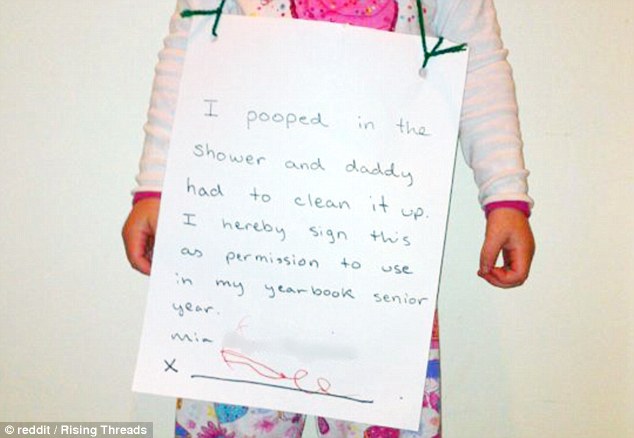
Connecting with other parents is all well and good but I don’t like the idea of having a joke at the expense of your children:

The father who inadvertently ignited a controversy by posting a photograph of his daughter with a sign that said ‘I pooped in the shower’ has spoken out to defend his actions.

The doting father, whose identity MailOnline chose not to reveal in order to protect his child, said that while people have a right to pass judgement on him and his actions, his intentions were merely to connect with other parents and make light of the stinky situations they find themselves in.

He called the people who have attacked him ‘bullies’ and said that he was shocked at the outrage his image received, adding that ‘if people actually have my daughter’s best interest at heart they will leave us alone.

I think the father may be right. Self righteous parents can be ‘bullies’ and I am sure this father was needlessly bullied for his actions.
What I don’t understand is why some parents think poking fun of their children online is a worthwhile pursuit.

Click on the link to read Dad Creates Brilliant Halloween Costume for Wheelchair Bound Son

Click on the link to read Dad’s Letter to 13-Year Old Son after Discovering he had been Downloading from Porn Sites

Click on the link to read Potty Training at a Restaurant Table!

Click on the link to read Mother Shaves Numbers Into Quadruplets Heads So People Can Tell Them Apart

Click on the link to read Parenting Advice that Hits the Mark