Posts Tagged ‘Teaching’

Teachers Who Can’t Engage Should Give Up

July 19, 2011

I am bewildered by the lack of thought and emphasis on engaging lesson content in education.  A few months ago I wrote about the latest trend to hit Australian shores – “Direct Instruction”.  Teachers are given a script and instructed to stick to it at all times.  The script tells them when to pause, what to repeat and what to leave out.  Direct Instruction is being used for teaching maths and spelling in classroom across Australia.  It was designed, in my belief, to ensure that all teachers covered the curriculum regardless of their abilities.

Only trouble is … it is a boring way to teach and a boring way to learn.

Why can’t Maths, English, Science etc. be taught in an interesting and lively manner?  Why does it have to be reduced to a talkfest or an excuse for an endless cycle of worksheets?  If it’s so important to know, why can’t it be taught in a fun way?

Thank goodness for Professor John Hattie:

PROFESSOR John Hattie of Melbourne University drew the wrath of many when he told teachers to ”just shut up”.

In fact, Hattie is supported by a considerable body of research; for instance, North American writers Lorna M. Earl and Andy Hargreaves, who observed lessons no more interesting than watching a haircut in progress. Researchers talk of students drowning in a sea of teacher ”blah”.

The difficulty is that so many people consider themselves experts on schools because they once attended one.

Long-winded accounts of subject matter may have once worked for teachers but young people these days are different from those of the previous century. Their attention spans are shorter, a product, perhaps, of constantly changing multimedia stimuli. They expect – indeed, demand – to be entertained.

Their world is high-tech and their attention is rarely captured by drab or monotonous presentations, which makes engaging in learning one of the chief tasks and difficulties of the modern educator.

The emphasis in schools has changed from teaching to learning and, quite rightly, the critical issue for a teacher is not the quality of their own narrative teaching but rather what their students are learning.

For them to learn effectively, and particularly to master the skills of ongoing learning, of processing apparently limitless information and of developing discernment, they need to be active, not passive, learners.

They need to be ”doers” who can find and process information, rather than just listeners.

Hattie is right: if teachers talk their students into oblivion, the teachers’ knowledge on display might be impressive but what the students gain in terms of content, skills and wisdom will be limited.

Good teachers certainly explain work clearly and test their students’ understanding with strategic questioning. They are masters of content, passionate and excited about their subject, convey a deep interest in their students as people, set high expectations, imbue their students with the confidence to succeed and give students feedback so they know how to improve.

Depending upon their subject, they utilise a wide variety of teaching strategies, working with mind and hand, desk-based and experiential learning, books and screens and also sometimes make their own products.

To read the rest of this brilliantly conceived article, please follow this link.


Calls To Allow Teachers To Use “Reasonable Force” on Students

July 13, 2011

Students should never be physically disciplined under any circumstances.  Whilst a majority of teachers care very much for the wellbeing of their students, there are teachers around who are more concerned with quiet compliant classrooms than the needs of their pupils.  Giving these teachers the opportunity to use force is asking for trouble.

Telegraph journalist, Bertie O’Brien disagrees:

Here’s hoping that the Government’s plans to allow teachers to use “reasonable force” to control disorderly pupils in the classroom is the beginning of a turnaround in our society. The culture of child protectionism – developed in tandem with health and safety and political correctness – is preventing children from entering the professional world as well-developed adults.

It’s about time teachers were lawfully allowed to regain control over pupils. Let’s get back to the purpose of being young: becoming a well-rounded adult, not having a good laugh or being “empowered”. Young people have to learn to lose out sometimes, and to follow orders. It is necessary that they learn to live in a world which won’t continue to worship them when they do grow up.

What does “reasonable force” mean anyway?  What is reasonable for one teacher may not be reasonable for other sections of society.

The argument that corporal punishment will help students become well-rounded adults is plain wrong.  Teachers help their students become well-rounded by understanding, connecting and appreciating their students, by setting a good example and high but fair expectations, imposing fair and consistent consequences, making their lessons engaging, fostering their students’ talents, creativity, critical thinking and independence as well as offering support and guidance.

I bet any teacher wishing to inflict corporal punishment on their students has in fact failed their students.  I would encourage them to spend less time worrying about using reasonable force and instead concentrate on their own performance.

Some Principals Seem to Be Ignorant About Bullying

July 11, 2011

Pricipals are concerned that parents use the “bully” label too quickly, without properly understanding what a “bully” is.  They believe that parents often get “bratty” behaviours mixed up with bullying ones.

BRATTY students are being unfairly branded bullies by parents and teachers who do not know the meaning of the word, according to a Victorian educator.

Peter Hockey, head of Beaconhills College junior school, said the word “bully” was overused and victims of schoolyard nastiness should harden up.

“Rather than just say, ‘Well that person is a bully and that person is a victim’, we need to empower children to stand up and confront these people who are being nasty,” Mr Hockey said.

“I don’t like to say ‘toughen up’, but they need to be taught to argue back or stand up for what they believe is right, explain themselves more fully or use humour or whatever other skills they have.”

Sure, resilience is a valuable skill and one worth advocating, but Mr. Hockey’s approach sounds defeatist to me.  Harassed students shouldn’t need to stand up for themselves, they should have support from teachers and school administrators (including Principals).  Students will naturally “toughen up” when they have the support of others.  When they’re left on their own, they often fail to properly assert themselves.


The veteran educator said the correct definition of a bully was “a person who is habitually cruel to others who are weaker”.

Mr Hockey said he had only encountered a handful of bullies in his 36 years of teaching.

“I have taught many children who have been nasty to others, but these children are not bullies,” Mr Hockey said.

“They are very often simply being nasty because they have been hurt by a situation, or they are being selfish or are responding to an earlier problem.”

He said most “nasty” children could be taught to be nice, while bullies were born bad.

That’s just nonsense Mr. Hockey.  “Born bad”?  Bullies don’t need to be born bad, they just need to harass, torment or seek to undermine others.


“To label a child a bully who has made the mistake of being nasty is wrong,” Mr Hockey said.

“Nasty and naughty behaviour is fixable and we must educate all not to engage in this sort of behaviour.”

Are you saying that “bullies” are not “fixable”?


At the end of the day, these labels are irrelevant.  What really matters is that those students who are negatively affected by others are given the support they need and those that recklessly hurt others get the consequences they deserve.


Education on Climate Change, Not Scare Tactics

July 10, 2011

No matter how strongly teachers may feel on the subject of climate change, there is no place for scare tactics in a Primary classroom.

PRIMARY school children are being terrified by lessons claiming climate change will bring “death, injury and destruction” to the world unless they take action.

On the eve of Prime Minister Julia Gillard’s carbon tax package announcement, psychologists and scientists said the lessons were alarmist, created unneeded anxiety among school children and endangered their mental health.

Climate change as a “Doomsday scenario” is being taught in classrooms across Australia.

Resource material produced by the Gillard government for primary school teachers and students states climate change will cause “devastating disasters”.

Australian National University’s Centre for the Public Awareness of Science director Dr Sue Stocklmayer said climate change had been portrayed as “Doomsday scenarios with no way out”.

The fear campaign must stop.  It is a manipulative and immature tactic by a desperate Government.  Our job as educators is to empower and motivate not scare our students senseless.

I refuse to teach Government resource material that has the potential to frighten my students.

Teachers Are Not Their Students’ Parents

July 3, 2011

A teacher defends kissing, cuddling and touching the behind of a female student by claiming that is the way he treats his own children.  And how did the authorities respond to this pathetic defense of an indefensible action?  They bought it hook, line and sinker.

A TEACHER who kissed and cuddled a schoolgirl defended himself by saying that was how he treated his own children. Jeffrey Cave, who taught at Willows Primary School, in Basildon, also pulled a boy’s hair and then told him that was how “teachers used to handle misbehaving pupils”.

He was found guilty of unacceptable professional conduct and has been reprimanded by the General Teaching Council.

Mr Cave touched a girl pupil on her bottom over her clothing, allowed her to sit on his lap, kissed her head and cuddled her.

Mr Cave admitted in his witness statement kissing her head and cuddling her, but said that was the same way he showed affection to his own children.

He said during police interview he stroked the pupil’s bottom over clothing in a downwards motion to test if her trousers were dry.

The hearing heard Cave. who has had a clean professional history for 26 years. was going through a period of personal stress at the time of the incidents, and his actions were not sexually motivated.

I have no doubt that the soft “reprimand” response came about from his defense.  Their soft ruling sends a very bad message.  The public must be reasuured that teachers can not in any way show affection to students in the same way as parents do.  I am a parent too, but I have no right to treat my students like my children.

My message to all male teachers is to avoid being in a room alone with a student, act with professionalism and integrity at all times and keep your hands to yourself.

They are not your children, they are someone elses.


Maths Lessons Should be “Toughened Up”: Gove

June 30, 2011

Michael Gove might think that rigorous daily and weekly testing in maths is the answer, but my experience tells me that testing doesn’t work for all types of students.  There are some students that lift their game when tested.  Their competitive juices get going, and their drive to get a good grade is palpable.  Then there are students who need to learn in a less pressurised and more r
elaxed setting.  They freeze during formal testing, but progress extremely well when the focus is on the skill or concept rather than the grade.

Michael Gove disagrees:

All primary school children should be given daily maths lessons and weekly tests to stop pupils falling behind those from the Far East, Michael Gove suggested today. 

Mr Gove said schools should also “bear in mind” a system used in Shanghai where pupils have daily maths lessons and regular tests to “make sure that all children are learning the basics”.

What disappoints me as a Primary Maths teacher, is that in the quest for better results the focus becomes testing instead of engagement.  I believe that Maths can be taught in a turgid and lifeless way.  Conversely, it can be taught in an interesting, engaging and creative way.  Whilst constant testing will make students resent the subject, there are ways of teaching maths which can engage and excite students.

The answer to improving our students’ maths skills should not result in them hating the subject.


The Classroom Can Be So Unnatural

June 26, 2011

It mystified me how in the modern era that we live in, we still haven’t properly addressed some fundamental issues effecting the comfort of our students.  The following are three examples:

1.  The Mat – The mat serves a clear purpose.  There are times when the mat is ideal for teaching a new concept or skill or for giving opportunities for students to present their work to the class.  But it must be used in short spurts because it is so uncomfortable.  Sitting in a confined space, without a back rest is not fun at all.  Once, whilst teaching a mat session, I tried it.  I sat on the floor with the kids/ In no time, I’d had enough.  Teachers who use the mat for long, drawn out periods of time should not be frustrated at the child that can’t sit still.  It is to be expected that a naturally restless person will find the challenge just too difficult.

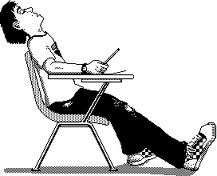
2.  The Chair – Even sitting in a chair for long periods of time is too much to expect.  Why is education often so dormant?  Surely the best forms of teaching allow students to move around.

3.  Lack of Engagement – Currently, there is a strong push to bring back traditional teaching.  This involves lines of handwriting practise, together with pages of maths algorithms followed by reading with comprehension questions.  There are always going to be certain students who will enjoy the safe, predictable, routine side to rote learning.  But on the whole, this methods is nothing short of tedious.  It lacks creativity, energy and critical thinking.  It is unimaginative, noninteractive and downright boring.

I hear teachers complain all the time about how poor attention spans are nowadays.  It makes me wonder whether teachers realise that we are partly to blame.  I can’t concentrate unless I’m engaged  and comfortable in my chair.  I need time to move and stretch and I need to feel as if I am able to express myself.

Why should my students feel any differently?


Too Many Struggling Students Lack Support

June 20, 2011

I read a disturbing article about a young boy who struggles with dyslexia, and the trauma his mother has gone through as his school makes little to no effort to assist him.  It is a difficult article for a teacher to read, but a very important one.  There are too many students that fall between the cracks.  Too many that don’t get the attention and support that they so desperately need.  As teachers, we must fight for the social, emotional and academic wellbeing of all our students, whilst ensuring that they are all, without exception, getting the care and attention they need.

Below is an excerpt of the article.  I truly recommend that you read the whole story,

David is an artistically gifted boy with a photographic memory. The 10-year-old’s dining-room table is full of intricately designed Lego battleships, his art displays such originality that his teacher calls him “the next Picasso”, and he has an extraordinary ability to recall facts from the History Channel documentaries he watches on TV.

“The other day,” his 41-year-old mother Margaret recalled, “we were driving along and he said, ‘mummy, you were born in the year the first man landed on the moon’.”

But there is one big problem with David that overshadows his life. He cannot read. He has been assessed as “severely dyslexic” and “having the reading age of a child aged four years and four months”. His schooling has been a disaster and according to educational psychologist reports seen by the Standard, he has progressed “just one month in five years”.

You might assume that David attends a failing, inner-city school, but you would be wrong. His south London state primary is rated “good” by Ofsted, attended almost exclusively by white British-born pupils, and is located in a street of £3million houses. He is also well behaved.

Yet David, his mother said, has been “catastrophically let down by everyone: by his teachers, by the school and by the council”, all of whom failed to give him the specialised help he needs.

Margaret said: “At school the other kids call him ‘odd’ and ‘weirdo’ and he often comes home crying. He is still reading flashcards and has not progressed beyond words like ‘cat’ and ‘dog’. He has no real friends – how can he? He doesn’t get their jokes or their games. To the other kids, he is a misfit who doesn’t understand anything that’s going on because he can’t read.”

“My son was nine and he still couldn’t read a word,” said Margaret. “What were they waiting for? Why didn’t they do something?” 

Finally the school arranged for David to have some specialist teaching – three hours a week at a nearby literacy centre at a cost to the school of £1,000 a term – as well as 15 hours a week one-on-one with the teacher assistant. For the first time he made a glimmer of progress, improving by “one month in a year”. Margaret says the teacher assistant and the literacy centre are not experts in teaching severely dyslexic children.

There is a growing tendency to allow students to pass the year, regardless of their level of skill or maturity.  The reason for this is quite sensible.  Holding a child back can have strong emotional repercussions.  But because such a system exists, not enough questions are asked of students who are languishing.

I am not suggesting for a second that young David should have been kept down.  I am simply suggesting that since teachers no longer have to explain why a child is ready to be promoted, there is less incentive to put the time and energy into children like David.

It is time that we looked into the issue of students being promoted without the basic skills, and ensure that teachers are made accountable for the progress of their students.  David was allowed to fall into the gaps and starved of the support he needed because there isn’t enough pressure on teachers to reach benchmarks.

The story of David breaks my heart because he is a victim to poor teaching, an inept education system and a misnomer that dyslexia renders one academically incapable.


Is There Anything More Monotonous Than Teaching Handwriting?

June 17, 2011

I am all for teaching handwriting in principle.  Considered a forgotten art by some, I still feel the teaching of handwriting has a place in the modern classroom.  But I do have 2 problems with teaching handwriting:

1.  My writing is neat enough, but hardly the best example of handwriting;

2. I haven’t been able to find a way of teaching handwriting that doesn’t put my students to sleep.

Devotees of handwriting instruction will go to all lengths to promote the skill.  Take this report for example:

New research suggests that we shouldn’t relegate handwriting to the dustbin just yet.

As a piece in the Los Angeles Times reports, “The benefits of gripping and moving a pen or pencil reach beyond communication. Emerging research shows that handwriting increases brain activity, hones fine motor skills, and can predict a child’s academic success in ways that keyboarding can’t.”

In the piece, Karin Harman James, an assistant professor in the department of psychological and brain sciences at Indiana University, explains how neuroimaging has helped researchers discover that “handwriting can change how children learn and their brains develop.”

If handwriting can “change the way children learn and their brains develop”, because it hones fine motor skills, you can say the same about other activities, such as video games.  You wont see reports commissioned on the benefits of video games for the brain.

As i see it, if handwriting is something teachers ought to concentrate on, why are the approaches for teaching it so dry and boring.  Endless lines of copying cursive letters isn’t just monotonous at best, it actually doesn’t change the way my students write.  Sure, they might accurately copy the example in their handwriting book, but in their general writing they revert back to their simple, functional style.  A style that, I’m afraid to admit, mirrors my own.

Is there any method you know of that makes handwriting lessons exciting?  I’ll even settle for less than exciting?  Anything is better than those blasted cursive handwriting books.

Report Writing Can Be So Dispiriting

June 14, 2011

Remember the day when teachers actually got to speak their mind?  When they were able to put an evaluation of a child in writing without fear of a lawsuit?  I’m afraid those days are long gone.

Report writing is as bigger chore now as it has ever been.  Required to complete at least 2 a year, I stay up nights on end in the lead up to my report writing deadline, typing away, without any idea why reports need to be so long and arduous.

The following are 5 frustrating features of a modern-day school report:

1.  It is often written in technical language that makes no sense at all to parents.  This is a ploy by the teacher to use up as much space as possible, make themselves look extra professional and write in such a way that parents have no idea what they are talking about (so they wont have what to complain about).  I feel sorry for parents that genuinely try to read their child’s report, only to be left totally confused by the experience.

2.  The Government is scared that put in the hands of teachers, reports would be too short and wouldn’t include enough detail.  That is why they have directed teachers to write about every detail about the child, down to how neat his/her desk is and how clearly he/she speaks in public.  That means Primary school teachers must write over 1000 characters each in four sections (General Comment, Maths, English and Unit of Inquiry).  Added to that the teachers need to isolate skills yet learnt and pinpoint how they are going to help the students catch up in these areas.  It’s just too long!

3. Similarly, the Government wanted students to be graded according to an insane scale.  The letter grade “B” means the child is a semester ahead, “C” refers to where the child should be, and “D” means the child is a semester behind.  There is “A” and “E”, but teachers are advised not to go there because it makes the school look bad.  In other words, if your student is going well, you give them a “C” – go figure!

4.  The report tell you nothing of real substance!  The threat of lawsuit is too great.  It’s designed to say a lot without saying anything at all!

5.  Teachers are so exhausted from writing these blasted reports that they come to school tired and emotionally drained.  Their planning time has been compromised, so often their lessons are less engaging.

I am as happy with my reports as the constraints lets me be.  I feel as though I’ve written in “plain speak”, demonstrated that I know my students and have shown an understanding of where they are at academically and socially.

But I am so drained!

Why does it have to be like this?