Posts Tagged ‘Teaching’

The Ultimate Bad Teaching Checklist

February 11, 2013


teachin

A brilliant list of habits that define poor teaching courtesy of Cool Cat Teacher Blog:

10- The teacher is always on their cell phone.
I have a new iPhone – today I’m locking it in my desk during class. Sure, I’m usually checking off my list or responding to a question for IT support at my school but my students don’t know that. A cell phone in my hand, whatever I’m doing, says that someone out of the room is more important than the people who are in my room. That is a lie. When I’m teaching, they are the most important thing in the room. Nothing should be between me and them.

9 – The teacher is always on the computer or not paying attention.
Multitasking is a lie. You shouldn’t be Facebooking, Tweeting, emailing, surfing, reading your PLN or anything during class – even during a test. You should be up and around in your classroom helping and TEACHING. They are paying you to teach, not hang out in a virtual teacher’s lounge. Teaching is work. You need to be part of  your class. When you sit down at your desk and disengage with your students, you suck the energy out of your classroom.

I knew a teacher who used to sew on her sewing machine during class. As soon as she started sewing, the class knew they were “free.” You are shocked at sewing but I see teachers doing this now with electronic devices. You are paid to be WITH and engaged with your students not doing something else.

8- The teacher is always losing his/her temper or is predictably dramatic.
I lose my temper 2-3 times a year – last year it was twice. Everyone knows it because it is rare. If you’re losing your temper a lot you need to figure out why and get help. You might be tired or under a  lot of stress, but you are the adult. There is no reason for you to have to raise your voice or constantly lose your temper. It isn’t good for you and it isn’t good for the students. Teachers who are bullies should be ashamed of themselves.

The predictably dramatic could be when you get soooooooo mad you jump on your desk. The kids are shocked the first time and get quiet. But then, they start plotting. You have sealed your doom.

7- The Teacher shares private student information publicly
NEVER call grades out loud – even for the top students. It is embarrassing. Don’t do it. It is a horrible thing when teachers do this. It is also horrible when you berate them in front of the class for ANYTHING. If you want to lose the respect of your class let them see you treat a classmate – even one they don’t like- with disrespect. This isn’t a contest and it isn’t a reality show. Handle private things privately. Period.

6 – The teacher talks without stopping for more than 10 minutes (especially if monotone.)
Do you realize that after 20 minutes they are asleep? Imagine the principal from Ferris Bueller’s day off. This sort of thing will kill the love of learning. Learn to listen for cues and watch for them. When quite a few kids start going to sleep DO SOMETHING. Vary your voice. Have them read. Ask a question. Extended lecture should be viewed as going through the motions of teaching for most students. Sleeping is not an option. I have made an exception when a child is getting over a loss or has something going on in their family but typically this is a no no for me.

5 – The Teacher only teaches with one method
Worksheets are so hard for many children. I have one child who really doesn’t learn a thing from them. When a teacher sticks to only one modality he/she will teach the children who learn through that modality and everyone else will be “bad students.” We can differentiate and we can use multiple modalities. Wanda the One Note Worksheet Wonder will kill the love of learning in a class of students who are auditory learners. Likewise if you only assess learning with tests, you’re missing the point and you’re probably also missing the learning that could happen.

4 – The teacher who only teaches “good” students and lets the “bad” students do their own thing.

Let me tell you something. A “good” student can learn alone in a room with a book and doesn’t need a teacher. A good teacher can make a good student into a great one. But a good teacher also works to reach every child.

I know of a child with a significant LD who is now one of the most successful thoracic surgeons I know. I now an incredibly gifted graphic designers who has some of the leading Fortune 100 companies knocking on her door but was made to feel like an idiot because she couldn’t diagram sentences in middle school. Good teachers work to reach and teach all children. If you only want to work with “good” students then I’m happy that you have such a great teaching environment but the reality of most of our classrooms is that we have some kids who could go either way. I teach only good students because I believe all of my students are great. I get what I believe and expect.

3 – The teacher who teaches the same every year without changing.
I know a math teacher who fought getting a new book because it would mean making out new tests and this person had been using the same tests for over 15 years. Some students don’t get a subject and need some extra help and assessment and others don’t. When I teach binary numbers, some years I can cover it in 2 days and others it takes 7. It depends on the students.

2- The Teacher whose words mean nothing.

Imagine the traffic policeman who just stood by the road, wagging his finger, and yelling at cars for speeding.

“Slow down …. now… now..”
“I said slow down.”

This officer would become a joke because there is no teeth in his actions. Say what you mean and mean what you say. Be consistent. But don’t lie to them. Don’t threaten with no follow through but if you’re threatening a lot, then why? Why should you count? Your word should be enough.

1- Hate your students
Why are you teaching if this is you? When you talk poorly about a student it does get back to your student eventually. I don’t respect teachers who I think have a vendetta against a particular student. I admit I’ve had 3 in my teaching career who were especially hard for me to love. But I had to adjust my own attitude and know that even if that child’s goal was to get me, that I was above it. I am an adult doing an important job and I will behave nobly. No one can take away my nobility but me.


Click here to read my opinion of ‘child centered learning’ vs ‘teacher centered learning’.

Click here to read my opinion on the problem with IT in the classroom.

Click here to read my opinion on the standard of teacher training.

25 Characteristics of a Successful Teacher

February 4, 2013

bed

Courtesy of the great site opencolleges.edu.au:

1. Successful teachers have clear objectives

How do you know if you are driving the right way when you are traveling somewhere new? You use the road signs and a map (although nowadays it might be SIRI or a GPS). In the world of education, your objectives for your students act as road signs to your destination. Your plan is the map. Making a plan does not suggest a lack of creativity in your curriculum but rather, gives creativity a framework in which to flourish.

2. Successful teachers have a sense of purpose

We can’t all be blessed with “epic” workdays all the time. Sometimes, life is just mundane and tedious. Teachers with a sense of purpose that are able to see the big picture can ride above the hard and boring days because their eye is on something further down the road.

3. Successful teachers are able to live without immediate feedback

There is nothing worse than sweating over a lesson plan only to have your students walk out of class without so much as a smile or a, “Great job teach!” It’s hard to give 100% and not see immediate results. Teachers who rely on that instant gratification will get burned out and disillusioned. Learning, relationships, and education are a messy endeavor, much like nurturing a garden. It takes time, and some dirt, to grow.

4. Successful teachers know when to listen to students and when to ignore them

Right on the heels of the above tip is the concept of discernment with student feedback. A teacher who never listens to his/her students will ultimately fail. A teacher who always listens to his/her students will ultimately fail. It is no simple endeavor to know when to listen and adapt, and when to say, “No- we’re going this way because I am the teacher and I see the long term picture.”

5. Successful teachers have a positive attitude

Negative energy zaps creativity and it makes a nice breeding ground for fear of failure. Good teachers have an upbeat mood, a sense of vitality and energy, and see past momentary setbacks to the end goal. Positivity breeds creativity.

6. Successful teachers expect their students to succeed

This concept is similar for parents as well. Students need someone to believe in them. They need a wiser and older person to put stock in their abilities. Set the bar high and then create an environment where it’s okay to fail. This will motivate your students to keep trying until they reach the expectation you’ve set for them.

7. Successful teachers have a sense of humor

Humor and wit make a lasting impression. It reduces stress and frustration, and gives people a chance to look at their circumstances from another point of view. If you interviewed 1000 students about their favorite teacher, I’ll bet 95% of them were hysterical.

8. Successful teachers use praise smartly

Students need encouragement yes, but real encouragement. It does no good to praise their work when you know it is only 50% of what they are capable of. You don’t want to create an environment where there is no praise or recognition; you want to create one where the praise that you offer is valuable BECAUSE you use it judiciously.

9. Successful teachers know how to take risks

There is a wise saying that reads, “Those who go just a little bit too far are the ones who know just how far one can go.” Risk-taking is a part of the successful formula. Your students need to see you try new things in the classroom and they will watch closely how you handle failure in your risk-taking. This is as important as what you are teaching.

10. Successful teachers are consistent

Consistency is not to be confused with “stuck.” Consistency means that you do what you say you will do, you don’t change your rules based on your mood, and your students can rely on you when they are in need. Teachers who are stuck in their outdated methods may boast consistency, when in fact it is cleverly-masked stubbornness.

11. Successful teachers are reflective

In order to avoid becoming the stuck and stubborn teacher, successful educators take time to reflect on their methods, their delivery, and the way they connect with their students. Reflection is necessary to uncover those weaknesses that can be strengthened with a bit of resolve and understanding.

12. Successful teachers seek out a mentor for themselves

Reflective teachers can easily get disheartened if they don’t have someone a bit older and wiser offering support. You are never too old or wise for a mentor. Mentors can be that voice that says, “Yes your reflections are correct,” or “No, you are off because….” and provide you with a different perspective.

13. Successful teachers communicate with parents

Collaboration between parents and teachers is absolutely crucial to a student’s success. Create an open path of communication so parents can come to you with concerns and you can do the same. When a teacher and parents present a united front, there is a lower chance that your student will fall through the cracks.

14. Successful teachers enjoy their work

It is easy to spot a teacher who loves their work. They seem to emanate contagious energy. Even if it on a subject like advanced calculus, the subject comes alive. If you don’t love your work or your subject, it will come through in your teaching. Try to figure out why you feel so unmotivated and uninspired. It might have nothing to do with the subject, but your expectations. Adjust them a bit and you might find your love of teaching come flooding back.

15. Successful teachers adapt to student needs

Classrooms are like an ever-evolving dynamic organism. Depending on the day, the attendance roster, and the phase of the moon, you might have to change up your plans or your schedule to accommodate your students. As they grow and change, your methods might have to as well. If your goal is to promote a curriculum or method, it will feel like a personal insult when you have to modify it. Make connecting with your student your goal and you’ll have no trouble changing it up as time moves on.

16. Successful teachers welcome change in the classroom

This relates to the above tip, but in a slightly different way. Have you ever been so bored with your house or your bedroom, only to rearrange it and have it feel like a new room? Change ignites the brain with excitement and adventure. Change your classroom to keep your students on their toes. Simple changes like rearranging desks and routines can breathe new life in the middle of a long year.

17. Successful teachers take time to explore new tools

With the advance of technology, there are fresh new resources and tools that can add great functionality to your classroom and curriculum. There is no doubt that the students you are teaching (far younger than you) probably already use technologies you haven’t tapped into yet. Don’t be afraid to push for technology in the classroom. It is often an underfunded area but in this current world and climate, your students will be growing up in a world where technology is everywhere. Give them a headstart and use technology in your classroom.

18. Successful teachers give their student’s emotional support

There are days when your students will need your emotional support more than a piece of information. Connecting to your students on an emotional level makes it more likely that they will listen to your counsel and take your advice to heart. Students need mentors as much as they need teachers.

19. Successful teachers are comfortable with the unknown

It’s difficult to teach in an environment where you don’t know the future of your classroom budget, the involvement of your student’s parents, or the outcome of all your hard work. On a more philosophical level, educators who teach the higher grades are tasked with teaching students principles that have a lot of unknowns (i.e. physics). How comfortable are you with not having all the answers? Good teachers are able to function without everything tied up neatly in a bow.

20. Successful teachers are not threatened by parent advocacy

Unfortunately, parents and teachers are sometimes threatened by one another. A teacher who is insecure will see parent advocacy as a threat. While there are plenty of over-involved helicopter parents waiting to point out a teacher’s mistakes, most parents just want what’s best for their child. Successful educators are confident in their abilities and not threatened when parents want to get into the classroom and make their opinions known. Good teachers also know they don’t have to follow what the parent recommends!

21. Successful teachers bring fun into the classroom

Don’t be too serious. Some days, “fun” should be the goal. When students feel and see your humanness, it builds a foundation of trust and respect. Fun and educational aren’t mutually exclusive either. Using humor can make even the most mundane topic more interesting.

22. Successful teachers teach holistically

Learning does not happen in a vacuum. Depression, anxiety, and mental stress have a severe impact on the educational process. It’s crucial that educators (and the educational model) take the whole person into account. You can have the funniest and most innovative lesson on algebra, but if your student has just been told his parents are getting a divorce, you will not reach him.

23. Successful teachers never stop learning

Good teachers find time in their schedule to learn themselves. Not only does it help bolster your knowledge in a certain subject matter, it also puts you in the position of student. This gives you a perspective about the learning process that you can easily forget when you’re always in teaching mode.

24. Successful teachers break out of the box

It may be a self-made box. “Oh I could never do that,” you say to yourself. Perhaps you promised you’d never become the teacher who would let students grade each other (maybe you had a bad experience as a kid). Sometimes the biggest obstacle to growth is us. Have you built a box around your teaching methods? Good teachers know when it’s time to break out of it.

25. Successful teachers are masters of their subject

Good teachers need to know their craft. In addition to the methodology of “teaching”, you need to master your subject area. Learn, learn, and never stop learning. Successful educators stay curious.

Click on the link to read my post, Do experienced teachers give enough back to the profession?

Six Valuable Steps to Making Positive Changes in Your Teaching

January 27, 2013

change

Courtesy of facultyfocus.com:

1. Think about what needs to change before deciding on a change – I regularly lead workshops on campuses across the country and often worry that there are carts being placed before unseen horses. When I’m asked to present, I’m usually counseled that faculty attending will want techniques, new ideas, strategies that work, and pragmatic things they can do in the classroom. But that’s not where the change process should begin. It should start with a question, ‘What am I doing that isn’t promoting learning or very much learning?’ Or, ‘What am I doing that I’ve probably done the same way for too long?’ Once you see the horse, you can better pick out a cart to put behind it.

2. Lay the groundwork for the change – I regularly object to the “just do it” approach to instructional change, as if we all work in a Nike commercial. The motivation is admirable but every instructional situation is unique. Teachers are different, students are different and we don’t all teach the same content in the same kind of courses. Whatever a teacher does must be adapted so that it fits the peculiarities of the given instructional situation. Don’t just do it before having given careful thought to how the change will work with your content, your students, and when you use it.

3. Incorporate change systematically – Beyond adapting the change, teachers need to prepare for its implementation. This means considering when (or if) it fits with the content, what skills it requires and whether students have those skills. If they don’t, how could those skills be developed? It also means valuing the change process by giving it your full and focused attention so as to ensure the new approach has the best possible chance of succeeding.

4. Change a little before changing a lot – Too often faculty have “conversion experiences” about themselves as teachers. They go to a conference or read a book, get convinced that they could be doing so much better and decide to change all sorts of things at once. They envision a whole new course taught by an entirely different teacher. Unfortunately, that much change is often hard on students and equally difficult for teachers to sustain.

5. Determine in advance how you will know whether the change is a success – It’s too bad that assessment has come to carry so much negative baggage, because when it’s about a teacher trying something new and wanting to know if it works, assessment provides much needed of objectivity. If you determine beforehand what success is going to look like, then you are much less likely to be blinded by how much everybody liked it. In this giant review of the change literature I mentioned earlier, only 21% of the articles contained “strong evidence to support claims of success or failure.”

6. Have realistic expectations for success – No matter how innovative, creative and wonderful the new idea may be, it isn’t going to be perfect and it isn’t going to be the best learning experience possible for every student or the pinnacle of your teaching career. Everything we do in class has mixed results; any new approach will work really well for some students, in some classes, on some days. Know that going in, remind yourself regularly, and don’t let it discourage you from continuing to make positive changes.

Click on the link to read 10 Art Related Games for the Classroom

Click on the link to read 5 Rules for Rewarding Students

Click on the link to read Tips for Engaging the Struggling Learner

Click on the link to read the Phonics debate.

The Short Video You MUST Watch!

January 27, 2013


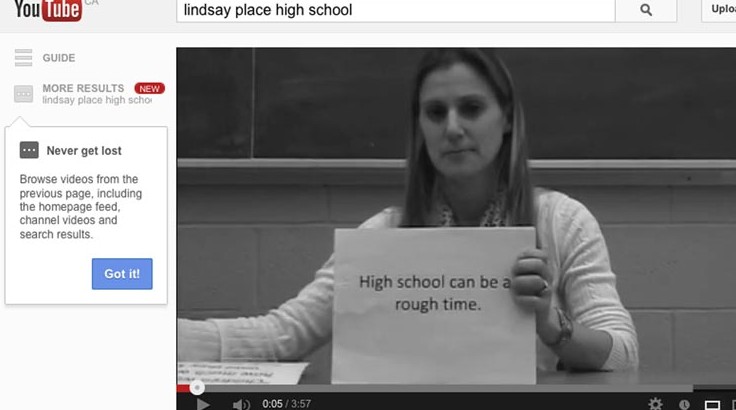
The teacher that had the courage and drive to make this heartfelt and inspirational video must be congratulated. Catherine Hogan, a teacher from Lindsay Place, has captured the very essence of what drives a caring, passionate teacher and her message is bound to alter some misconceptions felt by many students and parents. I was deeply moved and touched by this poignant and heartwarming clip.

Please watch this video and get your friends and family to do the same. Please notify others about its existence on Facebook and other social media devices. Only 12,624 have watched it from YouTube as I write this. This number doesn’t properly do justice to the quality and raw power of the clip.

lindsay

Click on the link to read Dying Teacher on Journey to Find Out if he Made a Difference

Click on the link to read Introducing the World’s Oldest Teacher

Click on the link to read School Shooting Showcases the Heroic Nature of Brilliant Teachers

Click on the link to read Meet the Armless Math Teacher

Click on the link to read The Case of a Teacher Suspended for Showing Integrity

Click on the link to read Teaching is Worth It!

Schools Should Not Be Hiding Important Information From Parents

January 24, 2013

patch

As a teacher, my job is to work with parents for the benefit of the child. That is why I am very uncomfortable with the idea of hiding information from them. The practice of nurses giving out nicotine patches to smoking students without notifying parents constitutes a breach of trust. It is not our place to be giving out nicotine patches or condoms or anything of that sort. That’s chiefly the responsibility of parents. To be doing this without their knowledge and expressed permission goes against the objectives of our role and constitutes a clear breach of trust:

Children as young as 12 are being handed nicotine patches by NHS nurses at school without permission from their parents.

The patches are being distributed by nurses employed by NHS South West Essex who visit schools every fortnight and speak to the children confidentially.

NHS guidelines say children as young as 12 can access nicotine patches from chemists and GPs throughout the country, but it’s up to each primary care trust what services they offer.

Parents at one school in Basildon, Essex voiced concerns that parents weren’t being told about the service.

Danielle Northcott, 39, whose 13-year-old daughter Amaris is a pupil at Basildon with Woodlands School in Takely End, Essex, where patches are distributed, said: “Woodlands is a good school and even though I didn’t know the nicotine patches were available I would rather her have that than a cigarette in her mouth.

“As parents I do think we should have been consulted on it and the school should have been clear about it.

“Some parents will not agree with the meetings between the child and the nurse being confidential and it will divide opinion. The only thing that worries me is that the patches will become a status symbol and children could want them just to look cool in front of their friends.”

Click on the link to read The ‘Meanest Mother’ Isn’t Mean at All (Photo)

Click on the link to read The Most Popular Lies that Parents Tell their Children

Click on the link to read The Innocence of Youth

Click on the link to read Kid’s Cute Note to the Tooth Fairy

Click on the link to read A Joke at the Expense of Your Own Child


Teacher Sues For Making Her Teach Young Children

January 15, 2013

http://www.youtube.com/watch?v=98ArLLxQbDE

I’ve never heard of the condition pedophobia, but I would have thought that teaching doesn’t lend it itself well to somebody who suffers from such a condition:

Retired Ohio teacher Maria Waltherr-Willard is suing her school district, claiming it discriminated against her because of her disability — a debilitating phobia of young children.

Waltherr-Willard, 61, claims in her lawsuit against the Mariemont school district that for 35 years, she taught Spanish and French to high school students in the system. But when she helped fight the district’s decision to cut French class in favor of an online course, officials retaliated by reassigning her to younger students at a middle school in 2009, ignoring her hypertension, specific phobia and general anxiety disorder, Waltherr-Willard says, according to Cincinnati.com.

She claims that district officials were previously sympathetic and aware of her medically diagnosed pedophobia.

While the public and a number of commentators have taken to ridicule the teacher and her lawsuit, Dr. Caleb Adler, associate professor of psychiatry and behavioral neuroscience at the University of Cincinnati, says it’s a serious phobia, as the illness causes Walterr-Willard to experience stress, anxiety, chest pains, vomiting, nightmares and high blood pressure when she’s near young children.

“It’s a tough phobia. You can’t really get away from [children] when you’re outside,” Adler told Cincinnati.com. “When you’re a teacher, it may not be an issue with older students.”

Working with younger children at the middle school “adversely affected [Waltherr-Willard’s] health, due to her disability,” the lawsuit claims, according to ABC News. Although she reportedly helped the younger students succeed in their foreign language endeavors, the move still increased her blood pressure to levels that placed her at risk for a stroke.

When the district denied her request to transfer back to the high school for the 2010-2011 academic year, Waltherr-Willard was forced into early retirement at the age of 59, the suit claims.

A federal judge has dismissed three of Walterr-Willard’s claims in the suit, arguing that the district violated an implied contract to keep her away from young students. The three remaining discrimination claims are awaiting district response, and a tentative trial date is set for February 2014.

Walterr-Willard seeks past and future pay, compensatory damages, punitive damages and attorneys’ fees.

If I was a high school student I would not want to be taught by someone who has a fear of kids. Not only does this lawsuit sound insane but it exposes a system which isn’t able to determine for themselves what type of teacher isn’t appropriate to preside over a classroom


Click on the link to read Alleged Gang Rape in a Classroom and the Teacher ‘Does Nothing’!

Click on the link to read The Most Sickening Abuse I Have Ever Seen a Teacher Commit

Click on the link to read Brawl Between Student and Teacher Goes Viral (Video)

Click on the link to read Teachers Continue to Fail the Common Sense Test

Click on the link to read Useful Resources to Assist in Behavioural Management

Click on the link to read When Something Doesn’t Work – Try Again Until it Does


Dying Teacher on Journey to Find Out if he Made a Difference

December 24, 2012


david

One of the most difficult parts of being a teacher is letting your students go at the end of the year. Often we feel that there was more to be achieved and that if we were given more time, we could have further strengthened the child’s self-esteem and classroom skills. We also wonder if the progress made during under our tutelage will be built on by future teachers. And most of all, when that child looks back at their formative years, will they remember us?

I can understand how important it is for a dying teacher to find out if all the time and devotion spent on teaching his pupils actually made a difference:

David Menasche has stage-four brain cancer and is losing his battle after three operations, chemotherapy and radiation, USA Today reports.

After a recent seizure led to brain swelling and decreased vision, the 40-year-old Miami high school teacher realised he couldn’t keep teaching but didn’t want to sit at home doing nothing.

He posted a message on Facebook in August asking if any former students had a place for him to stay, and within two days students in 50 cities had replied.

He has visited 50 former students in 12 cities so far and says he wants to know whether he has been a good teacher.

“I am at the end of my life,” Mr Menasche said.

“I don’t know how much longer I have left, and I just wanted that sense of satisfaction that the time I did have I used well.”

He said his cancer treatment had caused extensive memory loss and he hoped his students’ stories would also help him remember.

“I don’t remember my childhood at all,” he said.

“In fact, I don’t remember anything prior to roughly 16 or 17 years old.

“And even the things that I was doing as a teacher are somewhat spotty.”

Last week, he slept on the couch of former student and aspiring screenwriter Stephen Palahach.

Mr Palahach said as a teacher Mr Menasche had known all the bands he and his friends listened to and had pushed him to be open-minded about what he read.

“I’ve had great teachers in my life, but he was really present in the moment,” Mr Palahach said.

Mr Menasche taught nearly 3000 students while working as an English teacher for 15 years.

An online fundraising campaign is helping to pay for his trip and he hopes to write a book about interviews with his students.

Click on the link to read Introducing the World’s Oldest Teacher

Click on the link to read School Shooting Showcases the Heroic Nature of Brilliant Teachers

Click on the link to read Meet the Armless Math Teacher

Click on the link to read School Fires Entire Staff!

Click on the link to read The Case of a Teacher Suspended for Showing Integrity

Click on the link to read Teaching is Worth It!

Instead of Teaching a Baby to Read, Teach it to Smile

December 13, 2012

read

What is the rush? So your child reads when he/she is developmentally ready instead of when they’re a baby? So what?

Reading is not the greatest gift you can give a young baby. Love, optimism, hope and friendship are much more important to a baby’s development that the ability to read:

John Wilkey was just four days old when his mother Dana set about teaching him how to read. The fact that newborns can’t focus on anything more than a few inches away — let alone understand words in any form — did not deter her.

Dana, 39, an events organiser who lives in Chelsea, West London, is so passionate in her view that it’s never too early to make your child brilliant, she used to run through a set of ten flashcards with her son twice a day. ‘I would show John words like “milk”, give him my breast, and then show him the baby sign language for milk,’ she says. ‘I did it morning and evening.’

Baby sign language, for those not familiar with modern  parenting, is something ‘Tiger parents’ like Dana are well versed in. It works on the theory that children want to communicate long before they develop speech and can be taught little hand signals to communicate their needs and thoughts.

When he was nine months, Dana says John — her only child — was pointing and using basic baby sign language to show he could recognise up to 20 words and phrases, including ‘I love you’, ‘nose’, ‘ear’ and ‘arms-up’.

From there, Dana says his vocabulary grew at break-neck speed. A video of John at 20 months shows him sitting in his high-chair using a chubby finger to trace underneath the words ‘eyes’, ‘clap’ and ‘book’ from left to right.

Dana, who lived in the U.S. with John’s father before they separated, now lives with her fiance, Philip, in an £3.5 million London townhouse, once owned by a well-known footballer.

She is now one of a growing number of mothers convinced that getting children reading before they are potty-trained will help them get ahead in later life.

Great Collection of Critical Thinking Videos

December 12, 2012

crit

Courtesy of educatorstechnology.com:


1- Critical Thinking Part 1:  A Valuable Argument

2- Critical Thinking Part 2 : Broken Logic

3- Critical Thinking Part 3 : The Man who was Made of Straw


4- Critical Thinking Part 4 : Getting Personal


5- Critical Thinking Part 5 : The Gambler’s Fallacy


6- Critical Thinking Part 6 : A Precautionary Tale


Click on the link to read Kid’s Cute Note to the Tooth Fairy

Click on the link to read ‘Love’ as Defined by a 5-Year Old

Click on the link to read The Innocence of Youth

Click on the link to read Letting Kids Take Risks is Healthy for Them

Click on the link to read Study Reveals Children Aren’t Selfish After All


20 Questions Teachers Should Be Asking Themselves

December 10, 2012

teaching

Courtesy of minds-in-bloom.com:

    1. What are some things you accomplished this year that you are proud of?
    2. What is something you tried in your classroom this year for the first time? How did it go?
    3. What is something you found particularly frustrating this year?
    4. Which student in your class do you think showed the most improvement? Why do you think this student did so well?
    5. What is something you would change about this year if you could?
    6. What is one way that you grew professionally this year?
    7. Who amongst your colleagues was the most helpful to you?
    8. What has caused you the most stress this year?
    9. When was a time this year when you felt joyful and/or inspired about the work that you do?
    10. What do you hope your students remember most about you as a teacher?
    11. In what ways were you helpful to your colleagues this year?
    12. What was the most valuable thing you learned this year?
    13. What was the biggest mistake you made this year? How can you avoid making the same mistake in the future?
    14. What is something you did this year that went better than you thought it would?
    15. What part of the school day is your favorite? Why?
    16. What were your biggest organizational challenges this year?
    17. Who was your most challenging student? Why?
    18. In what ways did you change the lives of your students this year?
    19. Pretend that you get to set your own salary for this past year based on the job that you did. How much do you feel that you earned (the number you come up with should be in no way based on your current salary – rather, come up with a number that truly reflects how you should be compensated for your work this year)?
    20. Knowing what you know now, would you still choose to be a teacher if you could go back in time and make the choice again? If the answer is “no,”  is there a way for you to choose a different path now?

Click on the link to read School Official Allegedly told a Teacher to Train her Breasts to not Make Milk at Work

Click on the link to read 12 Tips for Managing Time in the Classroom

Click on the link to read If Teachers Were Paid More I Wouldn’t Have Become One

Click on the link to read Different Professions, Same Experiences

Click on the link to read Our Pay Isn’t the Problem