Posts Tagged ‘Parenting’

Do We Learn Enough From Children?

November 5, 2014


Sometimes our children show us up as ignorant. In the video above, one simple question is asked: If you could change one thing about your body, what would it be?

Watch the difference between the way children interpret the question to the way the adults do.

It’s society that encourages us to be critical of our own bodies – it is not a natural construction.


Click on the link to read Kids as Young as 7 Diagnosed with Anorexia

Click on the link to read The Destructive Impact of the “Fashion Police” Brigade

Click on the link to read The Plus Sized Barbie Debate Misses the Point

Click on the link to read Study Claims that Being Attractive can give you Better Grades

Click on the link to read The Unique Challenges that Body Image Represents for Females

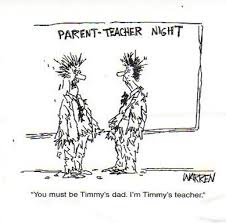
10 Tips for an Effective Parent-Teacher Conference

October 29, 2014

timmyCourtesy of via The Huffington Post:


1. Don’t bring your child with you (unless the teacher requests it): There are times it’s helpful to have a parent/teacher/student meeting, such as when strategizing study skills, organization, or other things where direct communication will facilitate a solution. However, unless you are meeting with that purpose, it doesn’t allow for as much information to be shared between parent and teacher. The dynamic is totally different because when there’s a student in the room, the teacher tends to talk to the student. There may be things I want to say to the parent that I wouldn’t say in front of their child.

2. Ask the teacher how your child is doing socially: A big advantage of attending a school as opposed to home schooling or cyber-school is the social skills that students begin to master only by being forced to interact daily with their peers. For some children, the main stress of school has nothing to do with academics. By middle school, kids aren’t telling you much about their social lives, but their teachers may be able to give you some insight.

3. Come with an open mind: As a parent, I have to remind myself of this often, but my children’s grades and behavior are not a reflection of who I am as a person. They have free will and will make mistakes and decisions that I don’t approve of. It doesn’t make me a bad parent. As a teacher, I remember this too. My goal in working with parents is to be a problem-solver, not a judge. If you are not willing to be open-minded about your child’s challenges, you may walk away from the conference feeling defeated instead of empowered.

4. Bring specific questions or concerns: The toughest opening for a teacher is, “So how’s my kid doing in your class?” Since we only have a few minutes to talk, I’d like to know right away which areas are of concern to you.

5. Share personal information when you can: There are times parents have called to report that a grandparent or a beloved pet recently passed away, there has been a change in home environment for a child, or they are overcoming a serious illness. All of this information helps teachers because students often look or act different in the classroom without explaining what’s bothering them. It’s especially important to tell teachers if your child has been evaluated for learning disabilities or health issues. As a teacher, I have worked as a partner with parents in monitoring kids with food allergies, asthma, and changes in ADHD medication. We are the eyes and ears when you can’t be and can often provide information that will aid you and your child’s health care provider.

6. If your child’s teacher doesn’t provide some positive feedback, please ask for it: The last thing you want is to walk away from a conference feeling sad or hopeless about your child’s school experience. Even kids with the toughest behavioral or academic challenges have redeeming characteristics and good days that we as teachers can point out. If your child is unhappy in school, you may be the emotional dump at home who hears about all the things that went wrong during the day. You didn’t get to witness your children having fun with their friends at lunch or delivering a great presentation to their peers or answering a question that stumped everyone else in the class. We need to focus and build on these little victories together.

7. Tell your teacher what works well at home and what you need help with: You may feel like you’re on your own once your child gets home, but teachers often have tips that may help studying and getting organized at home go more smoothly too. If getting out the door in the morning is an issue, or getting homework done before ten p.m., please ask. Many of your children’s teachers were or are currently raising children. I feel fortunate to have that “insider’s perspective” on how best to work with my children academically and I’m more than happy to share my thoughts because happy, well-prepared students make my workdays pleasant.

8. Take notes: Especially if you are meeting with more than one teacher, you will be hit with a lot of information, too much to process all at once. Taking notes gives you an opportunity to look back on what you learned, possible areas to follow up with the teacher on later, and a chance to see patterns (maybe your child always forgets homework that’s due on Monday, or something else that you may be able to adjust).

9. Tell us what your child loves to do at home: Parents have told me about non-academic skills their children have, unusual hobbies, or passions that lie outside the classroom. When I know these things, I can work to connect them to what I teach, making school more interesting for students and helping them feel like they are essential people in the classroom.

10. Ask your child if he or she thinks there is something you should ask or address: Teachers encourage their students to be advocates for themselves, but there are times kids feel intimidated to talk to a teacher about something. A parent can be the intermediary, at least to get the conversation started.

The Inconvenient Truth Kids Style

October 14, 2014


You spend your life trying to teach your kids the importance of telling the truth and then this happens:


truth

Courtesy of Nickmom


Click on the link to read The Quality Most Parents Want to Teach Their Children

Click on the link to read Are Our Expectations for Children Too High?

Click on the link to read 25 Ways to Approach the Dreaded ‘How was School Today?’ Question

Click on the link to read Learning to Let Go

Click on the link to read Things Teachers Wish Parents Knew Before the School Year Begins

Click on the link to read The Worst Parent in the World May be an Australian

Five-Year-Old Forced to Sign a Suicide Contract by School

October 12, 2014


I know there is a great deal of sensitivity about guys and schools but have US school administrators completely lost their minds? How does a 5-year-old with a mild, natural interest in guns constitute a suicide risk?


One mother is furious after her 5-year-old daughter was reportedly forced to sign a “suicide contract” at school.

The mother, named Rebecca, told Alabama outlet WPMI-TV that the incident occurred after her kindergarten daughter drew a picture that resembled a gun and pointed a crayon at another student and said “pew pew.” Authorities at E.R. Dixon Elementary school made the child sign a contract stating she would not kill herself or harm anyone else.

Rebecca said that while she was in the lobby waiting to pick up her child, “they had my 5-year-old sign a contract about suicide and homicide … There should be a different way to handle this situation. If this is protocol it needs to be looked at again.” Rebecca added that she did not think her daughter knew what the words in the contract even meant.

Mobile County school system superintendent Martha Peek told the Alabama Media Group that staff at the elementary school used the district wide procedure for when “a student indicates they may be considering any actions such as hurting themselves or hurting someone else.” However, she noted that the incident will be evaluated and that the policy “will be reworked.”

“I think if we had stepped back and looked at the situation and that others could have been involved — if the principal had known about it — we could have probably had some additional guidance,” Peek told the outlet.

Peek told The Huffington Post that she has not been in touch with the mother since hearing about the incident, but she intends to meet with her and “reassure mom that everything is fine and her child is going to be well taken care of.”

Recently, schools around the country have taken a tough approach to children who play with fake guns or draw fake guns. A young student was famously suspended in 2013 after chewing a pop tart into the shape of a gun.


Click on the link to read Guess Why this Girl Was Sent Home from Kindergarten

Click on the link to read The Disgraceful Decision to Fire a Teacher for Trying to Break Up a Fight

Click on the link to read One of the Greatest Teacher Pranks Ever Recorded

Click on the link to read Don’t Fire Caring Teachers

Click on the link to read Should Teachers Allow Students to Call Them by Their Christian Names?

Click on the link to read Let’s See if you Can Work Out Why This Teacher was Suspended

Shaming Students is Never the Answer

October 7, 2014

eggbuckland


If you really cared about the welfare of your students you would never shame them, even in order to make a point. If I became aware that a student’s profile picture was inappropriate I would deal with it thoughtfully and discreetly.

Not like this:


A 15-year-old says she was humiliated by a teacher who showed an enlarged picture of her in a bikini to more than 100 other students during a school assembly.

Children at Eggbuckland Community College in Plymouth, Devon, were shown the photograph taken from her Facebook profile to illustrate the pitfalls of posting private images online.

Unknown to the schoolgirl, who has not been named, staff had taken her swimwear photo off the internet.

It was blown up and added to a portfolio of other pictures then shown during a packed school assembly.

The shock tactic at the 1327-pupil specialist arts school left the girl distraught.

Her mother, who has now made an official complaint to Ofsted, said: ‘They took the photo from her Facebook profile – she put it on there last year.

‘They used other photos of kids from the neck up but for some reason they thought it was OK to use a picture of my daughter in her bikini.

‘Why did they have to use an image like that to make their point. Then they pointed her out in the assembly. She was really upset.

The teachers should have shown the students this instead.

What is Your Position on the Homework Debate?

September 28, 2014

hwork

I used to be very much against homework, but have softened my stance insomuch as I believe that homework is preferable to hours watching television or playing on a game console. It is interesting that experts are still divided on this matter:


DESPERATE parents are hiring private tutors to turbo-charge their children’s education because they are unhappy with the amount and quality of homework set by schools.

Education experts are so divided about the merits of homework that growing numbers of families are signing up their children for outside coaching to supplement classwork.

Education insiders have told The Saturday Telegraph that homework policies vary enormously between schools and often between teachers at the same school.

The homework row has been fuelled by a parliamentary inquiry in Victoria that found it had almost no academic benefits for primary school students.

And in France a plan by President Francois Hollande to abolish homework in French schools reignited a long-running debate.

The Australian Tutoring Association said many parents enrolled their children in private coaching to ensure they received “structured support” outside of school.

Chief executive Mohan Dhall said homework was often given to primary school children without explaining why it was set and without an obvious reason and purpose.

“There does not seem to be a sense of order or purpose about school homework — just an ad-hoc program that does not always meet the needs of kids,” Mr Dhall said. “A lot of parents think it is unstructured — additional work for children needs to be meaningful and engage them in higher-order thinking.”

Teachers argue there is no one-size-fits-all policy for homework.

Some experts claim children should spend their time after school playing and letting their brains wind down so they can get a good night’s sleep to absorb the day’s learning.

Newly released data reveals Australian children have the fifth greatest homework load globally, with 15-year-olds receiving about six hours’ a week compared to the OECD average of 4.9 hours.

The research shows private school students do about two hours of homework more than their peers in public schools.

Schools are also facing a groundswell of opposition to homework as doctors advise it is bad for children’s sleep and educators and academics claim it is of little benefit.


Click on the link to read The Adult Version of the Dog that Ate my Homework

Click on the link to read Fourth Graders Quizzed about Infidelity in Homework Assignment

Click on the link to read Young Child Shows Dissatisfaction with his Homework (Photo)

Click on the link to read Why I Changed My Mind About Homework

Click on the link to read Leave Parents Alone When it Comes to Homework

Sometimes It’s Worth Risking a Fight With a Parent

September 27, 2014

cookies

I’m glad the teacher didn’t let this most unreasonable parent have her way:

A crazed feminist told a second grade school teacher that she hopes she gets beaten on a nightly basis by an abusive husband because she refused to hand out vagina shaped cookies to her class. 

The unnamed teacher asked a friend to post details of the bizarre encounter on her Reddit account. 

According to the story, the teacher regularly invites volunteer parents to cook snacks for her class on a Friday when the children have been well behaved. 

The teacher said the woman arrived at the school and handed over a plate full of treats and said: ‘I decided you can use these to teach the kids about the woman’s vagina today.’

According to the teacher: ‘Baffled and completely caught off guard I slowly peel the aluminum foil off the pan to behold a plethora of sugar cookie and frosting vaginas. 

‘Not just any old vagina, but ALL KINDS OF VAGINAS. There were small, puffy, white, brown, shaved, bald, and even a fire crotch with beef curtains. Perplexed I give the parent the most professional look I can muster and quietly reply “I’m sorry, but I can’t give these to my students. This just isn’t appropriate.”

The teacher said the outrage parent started shouting at her in front of the class of seven-year-old children. She said ‘I should be proud of my vagina and ‘I am settling for a women’s role in life’. 

The feminist, according to the story, shouted the word vagina repeatedly before storming out of the classroom. 

Later that afternoon the teacher received several phone calls and emails from parents wondering how their child learned the word ‘vagina’ while at school.  

Then, the crazed mother sent a series of abusive emails to the teacher, wishing domestic violence upon her. 

The Quality Most Parents Want to Teach Their Children

September 21, 2014

quality

A very interesting survey asks, What is the quality most parents want to teach their children?


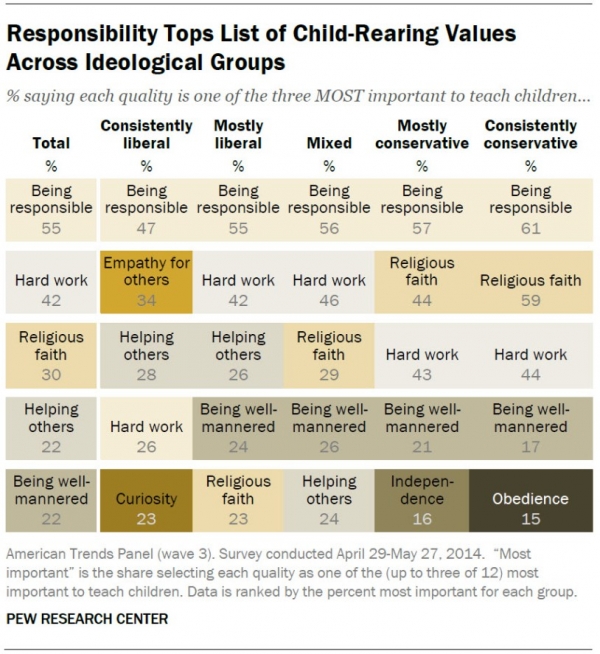
The Pew Research Center study on parenting attitudes sampled more than 3000 adults who were asked to evaluate which of a list of 12 values are the most important they feel children need to learn.

The adults ranked the importance of teaching children the following values from most to least popular: responsibility, hard work, helping others, good manners, independence, creativity, empathy for others, tolerance, persistence, curiosity, obedience and religious faith.

Researchers found that while “being well-mannered” was rated high on the list among all groups, it wasn’t as strong as a desired quality among the most liberal participants. Instead, liberals selected “empathy for others” and “hard work” higher on the list. Pew suggests that children are starting to be taught increasingly different values as political and cultural differences continue to evolve.

Religious faith was found to be one of the most important things parents wanted their children to develop, but it was not rated as important as the other qualities. “Obedience” ranked much higher in the list for consistently conservative parents more than any other quality, following responsibility.

Another difference in the types of qualities parents want to teach their children lies within their level of education. Less than half of college graduates chose religious faith or obedience. The study found that the college graduates selected tolerance, persistence and curiosity more than parents of a lower education. Parents with only high school education valued their children helping others more than those with some college or a college degree.

The study shows that even though political beliefs, race, religion and education vary between American parents, most parents want their children to learn similar qualities.


Click on the link to read Are Our Expectations for Children Too High?

Click on the link to read 25 Ways to Approach the Dreaded ‘How was School Today?’ Question

Click on the link to read Learning to Let Go

Click on the link to read Things Teachers Wish Parents Knew Before the School Year Begins

Click on the link to read The Worst Parent in the World May be an Australian

Click on the link to read 10-Year-Old’s Marriage Advice to His Teacher

We Are Too Soft on Teachers Who Have Sex With Their Students

September 18, 2014


awful

Every day there are new reports of teachers caught engaging in sexual affairs with their students. And these are only the ones the have been caught!

I want a message sent loud and clear to the teaching fraternity that this kind of behaviour is extremely serious and wont be tolerated. I want mandatory minimum sentences for teachers that are found to be engaging in sexual relationships with their students. Even if they are consensual and even if they are no longer considered a minor. It is abhorrent and should be dealt with accordingly.

But it was love!

It was consensual!

It was just an innocent fling!

No excuses! Teachers have a responsibility to act with dignity and common sense.


Click on the link to read Why Teaching and Politics Should not Mix

Click on the link to read Abusing the Privillege of Teaching Children

Click on the link to read Teacher Allegedly Has Cocaine Delivered to School

Click on the link to read Dealing Softly with Bad Teachers Sends the Wrong Message to Students

Click on the link to read Up to 1 in 10 US Students Have an Inappropriate Relationship With Their Teacher

Are Our Expectations for Children Too High?

September 16, 2014

shave


I believe very strongly in setting firm but fair expectations for my students when it comes to behaviour, respect for others and effort. But in doing so, I must be mindful not to overburden them. The last thing I want is for them to drown in unrealistic expectation.

Author and speaker put together a list of unfair expectations parents put on their kids:


1. Always be in a good mood.

Isn’t it upsetting when you come home from a long day of work and your kids are in a bad mood? You worked hard all day to put food in their bellies; the least they can do is not add to your stress. Right?

I’ve felt this way, but the thing I had to realize is that they have bad days too. It might have been that irritating kid at school or a teacher in a bad mood, it could have even been their other parent, but our children experience things throughout their day that will put them in a bad mood, just like us.

We have to cut them some slack at times; they have issues to deal with too. Do you remember how crazy being young felt at times? They’re not always going to be in a good mood, and we have to learn to accept that. Don’t misunderstand me, if your child is ALWAYS in a bad mood, that’s a different story.

2. Be perfect in school.

It’s natural to want your children to study hard and breeze through school like Doogie Howser, MD, but you have to remember that was a TV show! In real life, children learn things differently. It’s our job to guide them, not punish them because they may have a harder time learning.

We’re not perfect at work — at most jobs, it’s not expected. School is our children’s form of “work” until they go out into the world.

3. Never mess up.

It’s frustrating when our children mess up. It could be a dish dropped, door slammed or something bigger, like a car accident. Hey, WE MESS UP TOO! Why do we try to hold our kids to a standard that we can’t maintain ourselves? Mistakes happen, we ALL mess up, that’s life. Don’t hold being human against your children.

4. Be grateful for what I’ve given you.

We give our children so much, and yes, they should be grateful, but being a parent means putting your children’s needs before your own. We can’t just give them the scraps.

That goes for giving of yourself too. Just because you’re in a room with them doesn’t mean you’re spending time with them — especially if you’re glued to the TV. They shouldn’t be grateful for just your presence; they need your attention, too. Give them everything you have, not what you think you can afford to spare.

5. Ignore how we treat each other.

Our children see and pick up more than we think. When we have those “heated” discussions in what we think is private, chances are they know what’s going on.

How you treat each other will affect what kind of people they grow up to be. If you talk down to each other in front of them, if you criticize or belittle each other, you better believe they will too one day.

Our children learn how to treat others from us. Not what we tell them — how we actually treat people. Think twice before you let your emotions take over and cause you to say something that could affect your kids.

6. Don’t try to get away with anything.

I remember trying to get away with so much stuff when I was younger. My mother would yell at me when she caught me. She would tell me daily that she couldn’t wait for me to have children to see what she has to go through.

I use to think, Whatever, Mom… until I had children of my own. Turns out, mom was right. We have to remember what it was like at that age and not make every incident a nuclear explosion.

Yes, some things warrant certain punishments, but others aren’t that big of a deal in the grand scheme of things. Please don’t misinterpret what I’m saying. If it’s a minor issue, letting your kids learn a “life lesson” might be a better approach.

Our youngest son worked hard all summer to buy a laptop for himself. When we moved here to Maui, he ended up dropping it and cracking the screen. We found out a few weeks later, and we were furious.

He lied to us, he hid things from us, he broke an expensive item. We had to take a step back, cool off and remember that this affected him more than us; he bought it with his own money. We talked to him about the lying, but him breaking his own laptop was a life lesson.

7. Always forgive.

You can’t constantly treat your children poorly and expect them to always forgive. They might have a high tolerance for our issues, but there will come a limit.

There are some rough situations. Parents split up, maybe even divorce; there are money issues, stresses of everyday life, and lots of things that are out of your control. But you have to make the best out of every bad situation and not take it out on your children. In those situations, you have to do as much as you can to give them some sense of normalcy.

8. Do what I say, not what I do.

At the end of the day, our children learn more by what we do, not what we say. Actions do speak louder than words in parenting, and you have to lead by example.

When I told my children I was writing this, they informed me that I had a lot more than eight unrealistic expectations. I was irritated, but I’m sure they’re right.

We have to let our kids be kids, not perfect robots. They’re going to mess up — that’s life. Our job is to guide them and be there for them. If a situation requires discipline, then by all means do what needs to be done.

Here is what I challenge you to do: Take a step back first, and don’t let your emotions control the situation. These years are vital in molding the kind of people they will become.