Posts Tagged ‘Parenting’

The Difficulty of Going Back to School for Bullied Students

August 12, 2015


bullying-the-disabled

It’s time to commence with another school year. Spare a thought for the trepidation faced by students harassed for having disabilities.

The following is a great piece on this very issue written by Chester Goad courtesy of The Huffington Post:


Typically going back to school means seeing old friends and making new connections, and while most kids are nervous about going back to school, some kids are actually terrified.

Research suggests that between 150,000-200,000 students are bullied in our schools every day. Many school systems have even added hotlines and “Student Resource Officers” (SRO’s) who can help identify and prevent bullying. Still bullying happens, and statistics show that students with disabilities are more at risk. In fact, anyone who looks different, acts different, or believes something different from whatever is the local cultural norm is a target.

Not only do students with disabilities sometimes look different from non-disabled peers, but students with certain disabilities like dyslexia or dysgraphia also learn differently, and students who learn differently often receive additional resources or extra help which can bring unwanted attention from potential bullies.

Growing up is hard but growing up with a disability brings a different set of challenges. Social stigma, misunderstandings, or lack of awareness affect the learning environment when educators, parents, and other students aren’t paying attention. What does all this mean?

It means families should talk more. It means we must be more intentional in our efforts to address the problem without causing more trouble for the kids who are prone to be bullied, and without arming bullies with information that makes them wise enough to avoid intervention. Yes, it’s that complicated.

In 2013, the increasing number of students with disabilities being bullied prompted the U.S. Department of Education to release a “Dear Colleague Letter” reminding schools of their responsibility to provide a bully-free education, and to implement specific strategies to effectively prevent or stop bullying of all students, but especially those with disabilities.

Parents of students with disabilities or any sort of difference should be vigilant and listen to their kids when they’re discussing school. Pay attention to changes in behavior, especially aggression and meltdowns. If your instinct tells you there may be an issue with bullying, talk with teachers or other adults and ask about changes in behavior or attitude. It’s a challenge for us as parents not to want to handle things completely on our own, but parents should avoid confronting others about bullying until they have all the information, and it’s best to leave the confrontation part to the school. Discuss the issues with teachers or administration. They may be able to give you valuable insight before you talk with the other parents or take your concerns to a different level.

Some adults are inclined to let bullying go assuming that kids will just “work it out,” and some students do work out one-time incidences, but sadly, true bullying involves a pattern of inappropriate behavior and when left alone can worsen circumstances for everyone involved. In some instances, students may truly not understand that their actions are being perceived as bullying. They may simply be seeking attention. However, in other situations they know exactly what they’re doing. Parents should never just “let it go” or trust the situation to work itself out.

Talk to your kids, and listen. Listen to what they’re saying, and to what they’re not saying.

Student suicide rates are on the rise. Quick, proactive communication and education is key, and could save lives.

The best way to prevent students from becoming bullying statistics is to know your students and their disabilities, understand the law, encourage peer intervention (because intervention by peers is considered the most powerful deterrent to bullying), and to foster open positive relationships between parents and schools.

Going back to school is always going to be a little nerve wracking. Kids will always worry about classes, friendships, and keeping up with the latest fads. But they should never have to worry for their safety.


Click on the link to read my post on What This Teacher is Accused of Doing to an Autistic Boy

Click on the link to read my post on School is the Place to Make Better Connections with Our Disabled

Click on the link to read my post on Dreams Come True When People Show they Care

Click on the link to read my post on Hitchens: Dyslexia is NOT a Disease. It is an Excuse For Bad Teachers!

Child Given a Bill for Missing His Friend’s Birthday Party

January 20, 2015

party


Remember when a child’s birthday party was a simple and innocent affair?


Two mothers became embroiled in a bitter Facebook battle over an invoice handed to one of their sons for missing the other’s birthday party.

Tanya Walsh and her partner Derek Nash were appalled when their son Alex, five, arrived home from school with a £15.95 bill for missing his classmate Charlie Lawrence’s big day at a local ski centre.

After refusing to pay, Alex’s parents were threatened that they would be taken to court. 

Since then Miss Walsh and Charlie’s mother Julie Lawrence have become entangled in a war of words. 

‘I messaged Julie on Facebook to say sorry and let’s resolve this amicably. And she said: “The amicable way I believe is for you to pay me the money. And let that be a lesson learnt,’  Miss Walsh, 30, said. 

 
‘The next thing I heard she was taking us to small claims court. My partner went to see her and it ended in an argument. She shouted down the street: “Don’t mess with me”.

‘Every time I spoke to her previously she was always very polite,’ Miss Walsh added. 

All of this is very shocking.’ 

‘Julie could have tried to contact us before issuing the bill. If she had spoken to us we would have considered paying it.

I could totally understand her point. It is not about the money for us and we did not mean to let them down. It is the way she has gone about it.’

But Mrs Lawrence said in a statement: ‘All details were on the party invite. They had every detail needed to contact me.‘ 

Alex’s father however said he had no means of contacting the woman, resorting to trying to find her at the children’s school gates to apologise. 

‘My partner looked out for [Mrs Lawrence] to apologise for Alex not showing up to the party, but didn’t see her.

‘But on January 15 she looked in Alex’s school bag and found a brown envelope. It was an invoice for £15.95 for a child’s party no-show fee.’

Click on the link to read Tip for Getting Your Kids to Open Up About Their School Day

Click on the link to read Study: Smartphones are a Bigger Concern than TV

Click on the link to read What Kids Really Wanted for Christmas (Video)

Click on the link to read Young Girl Pens Angry Letter to Tooth Fairy

Click on the link to read Gift Ideas for Children that Are Not Toys

List of Body Positive Books for Kids

January 13, 2015

body positive

A great list courtesy of thehuffingtonpost.com


  • Flora and the Flamingo and its sequel, Flora and the Penguin, age 4+. These charming, wordless picture books feature a spunky yet graceful little girl. Flora has a pear-shaped body, yet does a ballet pas de deux with a flamingo in the first book and figure skates with a penguin in the second. So many images in books, movies, magazines and ads feature young girls with slim bodies; it’s nice to see an image of a girl with a round tummy who’s athletic, graceful and creative.
  • Brontorina, by James Howe and illustrated by Randy Cecil, age 4+. When a brontosaurus shows up at ballet class, some of the students insist, “You are too big!” But the open-minded ballet teacher decides the problem is that her studio is too small — and moves the class outdoors. It’s a lighthearted lesson about not letting your size or shape prevent you from following your dream.
  • Freckleface Strawberry, age 5+. The main character feels self-conscious about her freckles, especially when other kids make comments and give her a nickname she doesn’t like. The final message isn’t that her freckles are beautiful, but that maybe they don’t matter. More important, people are happier when they accept who they are and what they look like.
  • Firebird, by Misty Copeland, age 5+. A young girl who wants to be a dancer almost gives up before ballet great Misty Copeland inspires and mentors her to reach her full potential in this exuberant picture book that emphasizes hard work and self-discovery.
  • Ivy + Bean, age 6+. Two “opposite” 7-year-old girls become best friends in the first of a wonderful 10-volume series. Bean is a rough-and-tumble tomboy who wears pants and a T-shirt and gets dirty; Ivy wears dresses, thinks a lot and is always reading books. They appreciate each other’s qualities, and the kids in their neighborhood appreciate them for their uniqueness and imagination.
  • Confessions of a So-Called Middle Child and its sequel, Watch Out Hollywood!: More Confessions of a So-Called Middle Child, age 8+. In the first book, Charlie shows she’s comfortable with her out-of-shape body (while trying to make healthy food choices) and confident in her bold sense of style. In the sequel, when she tries out for a TV show, kids tease her about her body, but the TV people admire her for being comfortable with her shape. It’s a refreshing, positive-body-image message to find in a book about middle school.
  • Harry Potter series, age 8+. Hermione is part of the triangle of main characters, and she’s smarter and does better in school than Harry and Ron. Her looks are never a focus, even when the kids become teens, go to dances and start to have crushes. It’s always about who she is as a person and her outstanding abilities.
  • Randi Rhodes Ninja Detective: The Case of the Time-Capsule Bandit, by Octavia Spencer, age 8+. Randi moves to a new town and becomes best friends with two boys who also are outsiders; one is bullied for being hearing impaired but is as passionate about martial arts as Randi is, and the other is lanky, into music and super smart. Together the diverse pals — Randi’s white, and her friends are Latino and African-American — solve a mystery using brains and the occasional Bruce Lee move.
  • Blubber, age 9+. An overweight girl is teased mercilessly by some classmates, and no one stands up for her in this brutally honest look at (pre-Internet-era) bullying among fifth graders. The novel doesn’t spell out moral lessons but teaches kids by portraying repugnant behavior and showing the value of true friendship and courage under peer pressure.
  • Diary of a Wimpy Kid: The Ugly Truth, age 9+. Middle schooler Greg Heffley goes through puberty in this series installment and suffers the indignity of teeth-fixing head gear. He deals with it all through humor and utter cluelessness, as always. He may not become more accepting of himself, but kids reading about his travails understand that everyone goes through this stage and that you can have a good laugh at the embarrassing stuff instead of being quietly embarrassed.
  • Grace, Gold, and Glory: My Leap of Faith, by Gabby Douglas and Michelle Burford, age 10+. This moving memoir shows the Olympic gymnast’s dedication in the face of homelessness, bullying and having a coach tell her she should get a nose job. Gabby stays focused, works hard and accepts herself as she is, even as she strives for greatness.
  • The Girl of Fire and Thorns, age 12+. A plump princess is chosen by God (in a fictional religion) for a special unknown task. She begins the book as intelligent but insecure and afraid and ends it confident and powerful.​ Rising to challenges and having faith in yourself are big lessons here — as is the message that any size girl can be a respected and capable leader.​
  • InReal Life, age 12+. An exciting graphic novel about a teen girl gamer who learns about harsh working conditions in other parts of the world. She’s smart, competent, and compassionate, both in real life and as her online avatar.


Click on the link to read Sometimes You Need to Expect Rudeness

Click on the link to read Do We Learn Enough From Children?

Click on the link to read Kids as Young as 7 Diagnosed with Anorexia

Click on the link to read The Destructive Impact of the “Fashion Police” Brigade

Click on the link to read The Plus Sized Barbie Debate Misses the Point

Tip for Getting Your Kids to Open Up About Their School Day

January 8, 2015

first day

Personally, I try to make the child’s’ school experience pleasurable enough to make them anxious to share their day with their parents. But for the parents who find it hard to get anything substantive from their children in this area, here are some tips courtesy of via parenttoolkit.com:


1. Wait at least a half an hour

Kids are generally drained and strained the moment they walk in door. So wait at least 30 minutes to start talking about school. Give your child a chance to decompress and have a snack, take off the backpack, and just breathe.

2. Don’t turn questions into a third degree

What would make you want to open up and tell her all those details? The same rules apply to kids. Big kid turn offs: pushing, prodding, demanding, coaxing, lecturing and threatening.

3. Look interested

Think of how your best friend asks you about your day. Use her example. Make sure you are relaxed and appear genuinely interested when you speak to your child.

4. Ask questions that require more than yes or no

“Do you have homework?” “Did you give your speech?” are questions that make your kid only have to answer with a yes or no response. So pose questions that require your child to respond with more than just yes, no, nope, sure, nothing, fine.

5. Don’t use the same questions

A big kid turn off is hearing your same old predictable: “How was your day?” query. So be creative. Churn up those questions so your kid knows you are interested!

6. Stop and listen

The nanosecond your child utters ANYTHING related to school, stop  and give your full presence. Catch any little nugget of information and make it seem as though it’s a gold mine. Kids open up more when they think you’re interesting.

7. Stretch conversation with “invitation openers”

If and when your child shares a detail try using the “stretching method.” Don’t push or prod but instead use these type of comments: “Really?” “Uh-huh?” “I don’t believe it!” “Wow!” They’re not threatening and invite a talker to open up.

8. Repeat “talk” portions

Try repeating bits of your child’s conversation: Child: “I played on the swing.” You: “You played on the swing.” The trick is to repeat the tidbit in a matter-of-fact but interested way to get your child to open up and add more.

9. Make your house kid-friendly

Many parents swear they find out more about school from their kids’ friends than from their own child. So invite your child’s friends over. Keep the fridge stocked with food. Set up a basketball court (or whatever you need to keep those kids at your house). And then be friendly (but not intrusive) to the friend. You may find that not only do the friends open up more, but your child will tag onto the friend’s conversation.

10. Get on the school website

Find out what’s going on in your kid’s school world: read the teacher newsletters, click onto the school calendar, read the school activities schedule and menu. You can then ask specific questions about your kid’s day.


Click on the link to read Study: Smartphones are a Bigger Concern than TV

Click on the link to read What Kids Really Wanted for Christmas (Video)

Click on the link to read Young Girl Pens Angry Letter to Tooth Fairy

Click on the link to read Gift Ideas for Children that Are Not Toys

Click on the link to read When Parents Get Busted!

Study: Smartphones are a Bigger Concern than TV

January 7, 2015

smartp

Kids are spending way too much time in front of a screen. In my day the warnings about the dangers of television were very prevalent. Now the smartphone and gaming console seem to have overtaken it on the parental danger list:


Having a smartphone in a child’s bedroom translates to less sleep, more fatigue, and later bedtimes, according to a new study. Researchers at UC Berkeley found that kids who slept in the same room as a cellphone, smartphone or iPod touch — what they call “small screens” — got almost 21 minutes fewer sleep than those who didn’t. They also went to bed, on average, 37 minutes later than those without phones in their rooms. (Those who slept in the same room as a TV, meanwhile, got only 18 minutes fewer sleep; the TVs were also associated with a 31-minute delay in bedtime.)

In the study of more than 2,000 fourth and seventh graders, published Monday, 54 percent said they slept near a smartphone. “Small screens are especially concerning because they are a portal to social media, videos and other distractions, and they emit notifications that can disrupt sleep,” Dr. Jennifer Falbe, a postdoctoral research fellow at UC Berkely and the lead author of the study, tells Yahoo Parenting. “Parents should keep screen media out of bedrooms, limit screen time, and set a curfew of an hour before bedtime.” 

Falbe says her recommendations are based on the overall literature that excessive screen media can be harmful to children’s health. The American Academy of Pediatrics recommends that kids spend no more than one to two hours a day on recreational screen time, which Falbe says is a good rule of thumb. 


Click on the link to read What Kids Really Wanted for Christmas (Video)

Click on the link to read Young Girl Pens Angry Letter to Tooth Fairy

Click on the link to read Gift Ideas for Children that Are Not Toys

Click on the link to read When Parents Get Busted!

Click on the link to read The Inconvenient Truth Kids Style

Tips for Making a Parent-Teacher Relationship Work

January 5, 2015

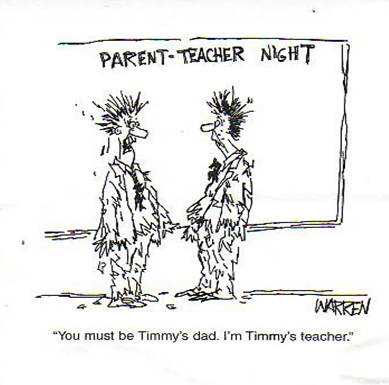
parent-teacher-cartoonThe strength of the parent-teacher relationship is absolutely pivotal to achieving in the classroom. Below are some insightful tips by teacher Toby Sorge:


* Think of what the end goal is. Teachers can tell when the focus is on a specific grade or assessment, whether the communication is by email, phone call or in person. Giving authentic feedback and grading assessments is not an easy task, but remember that the grade that was earned is now in the past.

* Work with the teacher to create a plan. This plan should focus on student engagement and growth. This may take time, so it’s important to trust the process. Maintain open lines of communication, so if you have questions about your role, you can ask and have them answered.

* Trust is one of the core values when it comes to fostering a successful relationship. Trust that the teacher knows what’s best for each student and how to get there.

* Trusting the process of learning is also important. True learning and deep engagement do not happen with one quiz, test or writing assignment. They take time.

* Make sure you work with teachers and not against them. Instead of coming in with an agenda, work on creating a plan with the teacher. The plan should focus on the development, practice and reinforcement of skills.

* Offer suggestions but also take advice. Discussing with teachers ways for students to succeed will help everyone fully understand children and what their capabilities are.


Click on the link to read Sometimes It’s Worth Risking a Fight With a Parent

Click on the link to read 10 Tips for Dealing With Difficult Parents

Click on the link to read 5 Helpful Tips for a Better Parent-Teacher Conference

Click on the link to read The Cafeteria Controversy

Click on the link to read Insensitive ‘Parent Bashers’ Take Aim at Grieving Colorado Parents

8 Methods to Stop Your Child From Being a Bully

December 31, 2014


Courtesy of via huffingtonpost.com:


1. Your child needs to be aware of others’ inner experiences.
It needs to become second nature to him to think about others and their feelings almost as quickly as he thinks of his own. Many parents validate one child’s perspective, but fail to discuss their own feelings or feelings of another child. Just validating your own child’s feelings does not teach him that there are other people in the world whose feelings matter.

Example of validating your child:

“I see you felt really angry right there when John took your ball.”

Example of teaching empathy:

“I see you felt really angry right there when John took your ball. He looked angry too. I think he thought you were going to play with him, but then you ended up playing alone.”

2. Discuss your own emotions too.
It does children no good to view a parent as having no weaknesses or vulnerable emotions. If they can empathize with you, they will remember this and it will facilitate self-compassion when they are an adult behaving as you do. Here’s an example of that:

“I’m sorry you got upset when Mommy didn’t play with you. Mommy was feeling anxious because she had a lot of cleaning to do before our friends come over. I will play with you now.”

3. Discuss both siblings’ or friends’ emotions after any conflict, validating and empathizing with both sides. Do not only validate the child whose actions you agree with more.
Example: “You were mad that your sister grabbed your doll, and she was feeling sad that you weren’t paying attention to her.  That’s probably why she grabbed it.”  You’re not condoning any behavior, but just giving a value-free description of the emotions underlying each child’s actions.

4. Make sure to speak for those who cannot speak, such as pets or babies.  
“Why is baby crying?  I wonder if he is hungry or tired? What do you think?” And a zero tolerance policy for meanness to those smaller and weaker than yourself.  Horton Hears A Who! by Dr. Seuss is a good book to serve as a springboard for a discussion about why it is important to look out for those smaller than yourself.

5. When you interact with others outside the home, discuss their feelings later together.
“I wonder what Grandma was thinking when she waved bye bye to you. I think she was happy she visited with you, but also a little sad you had to go. What do you think?”

You can also do this with characters in books and on TV.

6. Aim for consistency around the issue of meanness and teasing.
Any name-calling or making fun of others should be nipped in the bud right away.  Bad names and mean words are unacceptable, even from the smallest child. Don’t laugh or roll your eyes when your 3-year-old calls Daddy a poopy head. This just shows her that bad names are okay and even funny. Instead, say something like, “It hurts Daddy’s feelings when you call him a bad name. That is not nice and it’s not okay.”

You and your partner or any other caregiver should get on the same page about “teasing.” Often, one parent thinks that gentle teasing is okay, and a more sensitive parent or child then ends up getting hurt a lot because the less sensitive family members are “just” teasing them multiple times a day. This is especially a salient issue with Highly Sensitive Children.  I recommend that this is discussed openly in a family, e.g. “Mary thinks that you calling her sillyhead isn’t funny, so please don’t say that to her. Joe thinks it’s funny so we can say it to him. Whenever someone says they don’t think teasing is funny, it means we should stop right away.”

7. When children see others who are different from them, e.g. with special needs or birth defects, it is important to discuss that everyone has feelings and wants friends.  
Don’t be content with just telling your kids not to talk meanly or make fun of these children. You should go up and say hello and introduce yourselves.  Read this wonderful article by a mom of a little boy with a craniofacial disorder for more on this.

8. When you are mean, apologize.  
Don’t just feel ashamed and then try to silently make it up to your child or partner later. Own your mean behavior. This is extremely important because you’re modeling taking responsibility for your mean behavior. Children learn from what they see you do much more than from what you tell them to you.

Example: “I’m sorry I grabbed your arm roughly when you pulled the stuff off the shelf in the grocery store. I did it because I was mad. But no matter what I was feeling, grabbing you wasn’t okay.”


If I can add to the list I would recommend having your child watch the entire How to UnMake a Bully series. I was fortunate enough to have some involvement in the installment above.


Click on the link to read High School Bullying Victim Gets Even! (Video)

Click on the link to read Police Charges for Teen Bullies is More than Appropriate

Click on the link to read African Children Bullied at School Because of Ebola

Click on the link to read Another Vicious Schoolyard Fight Video Emerges

The Skills They Think We Don’t Teach, But Actually Do

December 30, 2014

skills

I have attached an article listing 15 life skills that teachers apparently don’t teach.  I certainly cover most of these and I would be surprised if many teachers do as well:


1. Basic financial management

I’m not talking about stocks and portfolios (but, okay, those too), I just mean the very simple, very necessary art of budgeting and making household finance decisions. This is one area that kids could use some expert guidance, considering most parents weren’t taught properly themselves.

2. Understanding credit and student loans

A class on interest rates alone would have saved me from a few mega financial blunders.

3. Relationship counseling

We take classes and a test before getting a driver’s license. We take lord knows how many exams before getting into college. We’re even offered a variety of parenting/birthing/breastfeeding classes before having a baby. And yet I could walk into a courthouse with a simple registration and some makeshift rings and call it a marriage. How can something so complicated and important — something that affects everything from our money to our health to our happiness — have next-to-no training or instructions?

This is another thing that should be learned at home in theory, except many kids have really crappy relationship role models because their parents had crappy role models because THERE’S NO EDUCATION ON MAINTAINING RELATIONSHIPS.

4. Personal communication skills

Children are being born into a world of silent communication (texting, emailing, messengering, etc.), and so their personal communication skills — how to engage and connect with other people — might need a boost. Considering our ability to effectively communicate will affect every single aspect of life, it’s astounding how little attention it’s given in school.

5. The power of negotiation

Unless we had the insight to join a debate team, we probably never learned the art of negotiation — something all adults will need at some point, whether negotiating with a boss, a bank, or a spouse.

6. Emotional awareness/intelligence

We learn plenty about our physical health, but what about our emotional and mental health? What about our inner worlds? Could there be any topic more relevant to students and young adults than understanding and managing their stress, anxiety, and emotions? If mindfulness and emotional awareness was as essential to the public school curriculum as Common Core math strategies, we just might raise a healthier generation of humans.

7. Digital etiquette

‘Tis the time to teach selfie regulation, Internet kindness, and social oversharing. Our kids are inheriting a digital world, and so they’ll need to know how to exist in it.

8. Coding

You know what? Take the cursive out of my kid’s curriculum, whatever. I’d much rather him learn modern skills like coding, computer science, and search engine techniques. If we want our kids to have solid life skills, they’ll need to understand their digital environment. THIS is their life.

According to LifeHack, “Not knowing how to program will soon become synonymous to being illiterate … If you don’t know how to program, you’re merely consuming the whole world around you, which is programmed.” Yet 9 out of 10 schools aren’t teaching coding classes, and computer science doesn’t count toward high school graduation requirements in 25 out of 50 states.

9. Focus

Scientists are now realizing that the newest crop of humans have an unprecedented ability to multitask, probably due to neuroplasticity (our brains ability to adapt and change to the environment). New York magazine reported that kids can “[conduct] 34 conversations simultaneously across six different media, or pay attention to switching between attentional targets in a way that’s been considered impossible.”

But with the give comes the take, and studies show that these kids have less of an attention span than ever before. Perhaps the best thing we can teach these kids is to single-task, and to really listen and focus, rather than succumb to every distraction like a dog in a field of squirrels.

10. Identifying our passions

Marc Mason’s “7 Strange Questions That Help You Find Your Life Purpose” should be required reading.

11. The art of failing

Students are chronically rewarded for succeeding and punished for failing — but what kind of lesson does that send? Some of our most important lessons in life come from the biggest failures.

12. Time management

Learning how to stay organized, on task, and productive is something that virtually every human, in every career, will need.

13. The basics of cooking

No student should be allowed to graduate college without mastering at least one dish beyond microwavable dinners and instant oatmeal.

14. Household repairs and maintenance

I’ve been alive for almost 30 years now, and I have no idea how to fix a leaky pipe or why my car makes that rattling sound.

15. Survival skills/basic first aid

Our kids can take a test and memorize facts, but would they know how to find water if they were stranded? Can they fish? Stop a bleed? Perform CPR? Correctly lift heavy objects? Follow a map sans GPS? I understand that these are skills learned over a lifetime, but shouldn’t we have at least one class on the basics of human survival?

Click on the link to read Things Middle School Students Wish We Knew

Click on the link to read Watch a Classic Argument in Action (Video)

Click on the link to read 7 Things a Quiet Student Wishes Their Teacher Knew

Click on the link to read Skills That Aren’t Taught But Should Be: #1 People Skills

Click on the link to read Top 10 Most Unusual School Bans

What Kids Really Wanted for Christmas (Video)

December 29, 2014


This advertisement nails what kids really want from their parents.


Click on the link to read Young Girl Pens Angry Letter to Tooth Fairy

Click on the link to read Gift Ideas for Children that Are Not Toys

Click on the link to read When Parents Get Busted!

Click on the link to read The Inconvenient Truth Kids Style

Click on the link to read The Quality Most Parents Want to Teach Their Children

Click on the link to read Are Our Expectations for Children Too High?

Adults Try Public School Meals (Video)

December 24, 2014


Is it just me or does badly cooked, horrible tasting school cafeteria food give the impression that the school doesn’t care all that much about its students?


Click on the link to read Tips to Get Kids to Eat More Fruit

Click on the link to read 6 Year Old Suspended for 4 Days Because of Cheese in his Lunchbox

Click on the link to read Invaluable Rules for Getting Kids to Heat Healthy Food

Click on the link to read Tips to get Children to Eat Better and Exercise More Often

Click on the link to read 10 Tips for Promoting Kids’ Healthy Eating

Click on the link to read my post on Tips For Parents on Packing a Healthy Lunch Box