Posts Tagged ‘life’

Parent Calls For the End of the Teacher Blame Game

March 2, 2012

Parent Martha Foote has submitted a brilliant piece to the New York Times. In a resounding defense of teachers she called for the end of  teacher data reporting:

“TDRs are a four-letter word!” That was my son’s favorite slogan when the parents and teachers at his school, Public School 321 in Park Slope, held a rally in the fall of 2010 to protest the imminent release of the teacher data reports. We were not alone. Sister rallies were held the same day at Brooklyn’s Public School 24, Public School 29, Middle School 51, Public School 154, and the John Jay Campus Community, and more than 5,000 letters of protest were signed across all five boroughs condemning the public humiliation of teachers as well as the release of what we believed were inaccurate scores. Sadly, though, after months of legal appeals, the teacher data reports were finally made public last week. And what have we learned?

So what do we do now? How do we move forward? To begin, I believe we must stop these attacks on our teachers. It is no way to treat one another (did we learn nothing in kindergarten?), and it is no way to improve education. We must turn away from this punitive blame game and instead work in a collaborative endeavor for the greater good. Look to the models. Look to Finland, where teachers are respected and trusted, and continual professional development is paramount. Look to Montgomery County, Md., where a successful system of teacher evaluation consists of mentoring struggling teachers combined with a panel of teachers and principals to decide if a teacher must be fired. (I only hope that New York State’s new system of teacher evaluation does not preclude the use of such successful strategies.) And stop relying on a score from a single high-stakes test to trump all the other 180 days in the classroom.

As for parents, of course we want our children to have excellent teachers. But as we have learned, these rankings tell us nothing. It is time to rely on our own observations, both direct and indirect, to gauge our children’s learning experiences in the classroom. Look at the types of assignments our children receive, the kinds of books they bring home to read, the quality of feedback they receive on their written work. It is this type of information that will tell us whether our child has a great teacher – and whether we need to be advocating for changes in the classroom.

If only the media and politicians thought the same way.

R.I.P Jan Berestain of Berenstain Bears Fame

February 29, 2012

As a child, I absolutely adored the Berenstain Bears books. I made my parents read them to me over and over again. I particularly loved “The Bike Lesson”, a father’s cautionary tale to his young son on how not to ride a bike. I have since started reading the books to my daughter and on occasion, to my students.

Jan Berenstain, one of the writers of the series of books died at 88:

Jan Berenstain, who with her husband, Stan, wrote and illustrated the Berenstain Bears books that have charmed children and their parents for 50 years, has died. She was 88.

Berenstain, a long-time resident of Solebury in south-eastern Pennsylvania, suffered a severe stroke on Thursday and died on Friday without regaining consciousness, her son Mike Berenstain said.

The gentle tales of Mama Bear, Papa Bear, Brother Bear and Sister Bear were inspired by the Berenstain children, and later their grandchildren. The stories address children’s common concerns and aim to offer guidance on subjects like dentist visits, peer pressure, a new sibling or summer camp.

Thank you Jan for contributing to my love of reading and literature. You have left a legacy that will continue to entertain children. May you rest in peace.

Schools Have to Wake Up to Confidence Issues Amongst Students

February 27, 2012

I’m not a medical expert, so excuse me if I show my ignorance, but I am constantly amazed by what looks like a overdiagnosing of kids. From ADHD to autism, from dyslexia to language disorders, our students are being bombarded with medically based names for sometimes seemingly everyday based problems.

Sometimes these diagnoses prove spot on, and ultimately guide the teacher to better understanding their students. At other times however, I feel the diagnosis seems rushed, lazy and counter productive. Not only do such students receive the stigma of their newfound disability, but they also tend to lose more confidence because of it, rather than letting the revelation give them a new lease on life.

What bothers me is that in making these diagnoses, GP’s, occupational therapists and speech pathologists often see a child’s low confidence levels as a sign of a condition that is impeding their learning. Why can’t a child’s learning challenges be caused plainly and simply by their confidence issues? Why does it always have to be a condition? Why don’t they try to improve a child’s self-esteem before prescribing and labelling?

I can’t tell you how many students I have seen over the years that have been diagnosed with some learning disorder that have responded not to the recommended regime, but to a devoted teacher that spends just as much time trying to raise the child’s self-esteem as they do trying to improve the child’s academic skills.

Sometimes I think we fool ourselves into believing that school life is easy and that all children should be able to cope fairly well. School is tough for children. It can potentially damage a child’s sense of self and can be quite detrimental to their feeling of worth.

I’m not surprised kids are reluctant to go to school. I am surprised however, that our psychologists think that only 1-2% of children fall in that category:

… suffering from school refusal, an anxiety condition that affects 1 to 2 per cent of children.

”A certain degree of anxiety or reluctance to go to school is normal,” psychologist Amanda Dudley says.

”But for some, they experience excessive anxiety and it can result in persistent refusal to go to school.”

Children who experience school refusal often complain of stomach aches, headaches, nausea and other physical symptoms and are often extremely distressed when it is time to go to school.

”It can be all of a sudden that the child refuses to attend; it can be after something upsetting at school or after legitimate absence from school,” she says.

School refusal isn’t a condition. It is a natural response to the challenges that children face at school. It is also a sign that educators are blind to the real needs of their students. By overlooking self-esteem issues and instead concentrating on placing seemingly normal children on an ever-growing spectrum, we are labelling children instead of responding to them. We are diagnosing instead of truly connecting with them.

I accept that there are children with special learning needs who require targeted programs and individual support, but I also believe that there are many children who would be better served if their school helped them to adjust to school life instead of bracket them with a condition or disorder.


The Teacher Bashing Era Must End

February 26, 2012

Teachers have never been more criticised and devalued than they are right now. Whilst you can’t blame all negative incidents on a political and media campaign against teaching standards, I’m sure children pick up on the discontent in the wider community.

To read that three children in the 5th Grade twice attempted to poison their teacher, makes me wonder how children as young as that can rationalise in their own minds that killing their teacher would be a worthwhile solution to their problems:

Three California fifth-graders who confessed to using rat poison in attempts to harm their teacher are being moved to other schools.

The three students at Balderas Elementary School in Fresno admitted lacing the teacher’s coffee and a cupcake with rat poison in two separate incidents, according to the Fresno Teachers Association and published reports.

Miraculously, the teacher never took a sip of the coffee or a bite of the cupcake.

One of the three accused students apparently had a change of heart and knocked the coffee cup out of the teacher’s hand before she could drink from it.

The mid-December incidents came to light two months after they happened because a parent of one of the students bragged that her boy saved a teacher’s life.

No criminal charges have been filed against the two boys and one girl, according to ABC’s Fresno affiliate KFSN. The Fresno Police Department is continuing to investigate, but says there is little or no physical evidence remaining from the December incidents. The Fresno County district attorney’s office will decide whether to press charges against the children.

All three students have been expelled and moved to other schools, according to KFSN. The two boys are being transfered to the Phoenix Academy, which does not sit well with at least one of its teachers.

This story is quite sickening. I wonder if those students involved were in any way incited by a general lack of community respect for the teaching fraternity.

Beating Peer Pressure

February 24, 2012

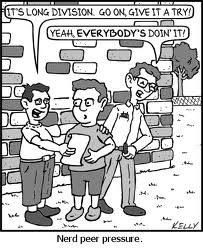
Is a good sense of humour enough to ward off the threat of peer pressure? Child psychologist Kimberley O’Brien, thinks so:

A child psychologist from Sydney’s Quirky Kid Clinic said people should not trivialise peer pressure by saying it happens to everyone.

“We shouldn’t say it’s normal and it’s fine because it’s not,” Kimberley O’Brien said.

Ms O’Brien said parents need to encourage their children to choose friends they are comfortable with.

“It’s important to teach kids to be assertive. If parents model that behaviour and speak up in the community if they feel something is not right then children learn to do the same.”

The Quirky Kid Clinic advises teenagers to make a quick exit if they are feeling uncomfortable in a situation. They teach young people how to use humour to defuse a potentially risky situation.

“They can just laugh and say I’m not into this and leave,” Ms O’Brien said.

“If they are feeling under pressure, we encourage kids to trust their early warning signs and gut feelings and speak up and ask for help.”

Ashley Long and her friends had been drinking alcohol when the helium party trick turned deadly. The inebriating effects of alcohol can make it increasingly difficult to avoid being pushed into risky behaviour.

“[Teenagers] are much more easily influenced if they have been drinking, even physically if they are stumbling or can’t move properly,” Ms O’Brien said.

“They may have lost their phone or friends so it is more difficult to seek help.”


A Teacher Spits on a Student and I Lay Blame on the Student

February 21, 2012

Teachers that spit on their students should be punished accordingly. It is unprofessional, unhygienic and completely unacceptable behaviour. But there is more to the story of maths teacher David Pecoraro, who was caught on camera spitting at a boy and has since been relegated to administrative duties as a result of his moment of madness.

The video shows clearly a teacher pushed to the edge of sanity. A student trying to attach his used gum on the teachers rear is rightly put in his place by the teacher. Teachers, especially male teachers, are extremely sensitive with the dangers of being accused of inappropriate behaviour. Students that purposely touch a male teacher’s backside are putting that teacher in a very uncomfortable position.

The video also shows the lack of respect he was getting from his other students. As he screams “I want to teach you maths”, we see a student sleeping and others laughing and goading the defiant, foul-mouthed, gum chewing student.

A teacher was secretly filmed on a cell phone struggling with a male student before appearing to spit in the boy’s face.

David Pecoraro, a high school math teacher, is now working in ‘administration’, after the footage was uploaded to YouTube.

Pecoraro, who taught at Beach Channel High School in Queens, New York, has a row with the student for a few minutes before the confrontation turns physical.

Pecoraro is being investigated on allegations of corporal punishment.

The teacher, who has been in the profession for 19 years, can be heard saying in the clip: ‘You can’t make contact with me, that’s illegal.’

He then tries to explain a math problem to the student who is ignoring the lesson and covering his head with a jacket.

At one point, the student, whose identity isn’t revealed, appears to try to hit the teacher.

Pecoraro then tells the teenager: ‘You’re going to go to jail, you don’t touch me… I want to teach you math.’

The altercation is witnessed by a few other students in the class – along with one boy in front of the camera who is asleep with his head on the desk.

The row continues until the teacher appears to spit at the student who then spits back at him.

The grainy film cuts out after Pecoraro can be seen dragging the student out of his seat.

As bad a this teacher’s actions was, the behaviour of the class was absolutely deplorable. This video should be enough to implicate at least two students with some fairly serious breaches of protocol. First there was the student who should be expelled for inappropriate touching and insubordinate behaviour. Then there is the student who filmed the incident. I don’t care how juicy the footage is, any student filming class and uploading the footage on YouTube deserves to be punished.

Instead, I fear that the only person punished was the one who wanted nothing more than the ability to do his job without being touched, mocked or harassed. If those two other students got off without punishment, it reinforces their despicable behaviour, and allows them to continue their bloodsport.

I pity the replacement maths teacher. I fear they are mere fodder for the next potential YouTube hit.

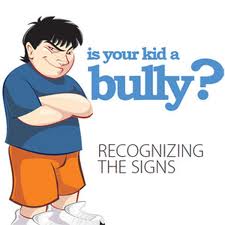
Would You Notice if Your Child Was a Bully?

February 21, 2012

Psychologist Jodie Benveniste thinks parents are so blinded by the belief that their child is perfect that they are startled when confronted with the possibility that their child has been bullying others:

Psychologist Jodie Benveniste says most parents don’t – until they get a call from their child’s school.

“That’s often the first time you hear about it because you’re not there to observe the behaviour,” she says.

Youth worker and school chaplain Nigel Lane says in his experience parents are usually in “total shock” or “total denial” when they learn their child is a bully.

The experts agree there are tell-tale signs parents can look for, including very aggressive behaviour towards siblings, talking aggressively and negatively about other children and coming home with money or items that don’t belong to them.

Lane, who has written several books and is working on another about how to recognise a bully, says most parents eventually accept there is a problem.

 “Generally I say to parents that the first thing they should do is listen. Listen to the accusation, don’t deny and ignore it,” he says.

“Then do exactly the same with your child. Sit down with your son or daughter and just listen. Ask broad questions, such as, ‘School gave me a ring today to tell me something happened at lunch time, what was it?’ rather than saying, ‘You’re a bully’, which could make them defensive.”

Lane says this “gentle” approach is more likely to bring out the truth or a version close to it.

The bullying stigma has become a massive one. It is essential that we don’t label people as bullies haphazardly. What that does is unnecessarily complicate the issue, while it also puts children who are involved in one-off incidents in the same basket as perpetual offenders.

Parents should be open to the fact that their children acts differently at school than they do at home. Schools must realise that such a disparity often comes as a result of the unnatural array of clicks and the deep social segregation that are a common fixture in many schools.

The reason why parents may be surprised to know that their child is bullying isn’t just due to their lack of objectivity, it’s also due to the ‘dog eat dog’ environment rampant in many schools. Kids are presented with an environment that is often vicious, unrelenting and difficult to navigate through.

This of course doesn’t excuse their behaviour. What it does do, is make schools equal partners with the parents in reforming bullying children.

Maths is Taught So Poorly

February 13, 2012

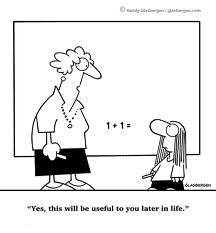
I realise that what I am writing is a gross generalisation, but I believe that maths is generally taught in a very abstract and monotonous way. No wonder the students are not benefitting from maths instruction at the primary level. Traditional maths teaching involves worksheets, a mindless array of algorithms and plenty of other rote styled goodies.

The tragedy of it all is that maths can be taught in a completely different way. I find the basic skills of maths the most refreshing and creatively exciting subject to teach. The fact that maths is a composite of everyday skills means it translates wonderfully to problem solving activities.

The other day, whilst teaching ordering numbers up to 4 digits, I got my 8-year-old students into groups, each given a particular airline to reasearch. The groups had to find the 3 lowest airfares for a return domestic trip between certain dates and times, These prices were then compared and ordered from least expensive to most expensive. Isn’t that the whole point of ordering and comparing numbers?

Whilst engaging in the exercise, the students enjoyed working in groups, competing for a bargain against other groups, learning how to book airline tickets and simply use their imagination by pretending they were actually intending in going on the flight.

Isn’t that more interesting than a worksheet that has numbers on it to order?

This is why I am not at all surprised that British students leave Primary school ‘with the maths ability of 7-year-old’:

An analysis of last year’s SATs results has shown 27,500 11-year-olds are going on to secondary school with the numeracy skills of children four years their junior.

The figures equate to a staggering one in 20 of the total of those leaving primary school. Boys perform worse than girls, with 15,600 behind in their ability.

Separate statistics published two weeks ago also revealed that one in three GCSE pupils fail to get at least a grade C in maths.

The disclosure follows the launch of a Daily Telegraph campaign – Make Britain Count – to highlight the scale of the nation’s mathematical crisis and provide parents with tools to boost their children’s numeracy skills.

It comes amid concerns that schoolchildren are less likely to study maths to a high standard in England, Wales and Northern Ireland than in most other developed nations.

I appeal to Primary teachers to give the text-book a rest and don’t be afraid to try new and exciting ideas to engage your maths students.

The Teacher They Haven’t Sacked, But Should

February 9, 2012

Call me a prude but I am of the opinion that when you sign up to be a teacher you are making a commitment to act with a greater degree of responsibility than most other professions. Whilst it may perfectly alright for a tradesman or receptionist to have a double life as a porn star, a high school teacher should know better and act better.

What makes this story worse is that this teacher was filmed with a former student. I find it unsavoury for teachers to hook up with their former students at the best of times. To make a porn video with them just adds another layer to what is a clear breach of standard teaching protocol.

Or is it?

The graphic video of the teacher and the student, who graduated in 2008, went viral on social media websites after students discovered it.

A preview video shows the couple naked, in sex acts, and with the girl blindfolded.

The ex-student explained yesterday that everyone who knew them understood the couple were in a committed relationship. The couple live together and jointly own a business.

“We’re consenting adults,” she said.

Oberon High School principal Alison Murphy said she took immediate action when she became aware of the video on Tuesday, but said the video did not change her view of the “successful” VCE teacher.

“He is not here today. It’s uncertain when he will return,” she said. “The matter is under investigation.”

She said the teacher was “well regarded”.

Ms Murphy said it would be inappropriate to suspend the teacher until investigations were completed.

Could someone please explain to me why it would be inappropriate to suspend the teacher?

13-Year-Old Girls Given Contraceptive Implants at School Without Consent of Parents

February 8, 2012

There may exist a rule of patient-child confidentiality, but it just doesn’t seem right that such important information would be withheld from the parents. What makes it even tougher to comprehend is that this service is all done at school.

Girls as young as 13 are being given contraceptive implants at school without their parents’ knowledge.

Nurses insert devices into their arms which temporarily prevent pregnancy by releasing hormones into the blood.

Last year 1,700 girls aged 13 and 14 were fitted with implants, while 800 had injections which have the same effect.

The 2010/11 NHS figures also show that 3,200 15-year-old girls were fitted with implants, and 1,700 had injections.

But under strict ‘patient confidentiality’ rules, staff are banned from seeking the permission of parents beforehand – or even informing them afterwards.

Both forms of contraception can bring on unpleasant side-effects including weight gain, depression, acne and irregular periods.

The jabs have also been linked to bone-thinning, although experts say fractures are unlikely if they are used only for a short time.

The implants and injections are being offered to girls in nine secondary schools and three sixth form colleges in Southampton under a scheme run by NHS Solent. The sexual health clinics also offer other forms of contraception, advice and tests for infections.

I think the patient/child confidentiality should have loopholes and shouldn’t include children under the age of 16. As parents, we have the right to be informed and the right to overrule. People might say that this is a very important service against unwanted pregnancies. That may be so. But in my opinion, the best way for 13 year-olds to avoid unwanted pregnancies is to allow the parents to do their job. The best remedy against teenage pregnancy is vigilant parenting.