Posts Tagged ‘Education’

The Use of Video in Education

March 31, 2011

Attached is a wonderful clip of presentation given by Salman Khan.  Salman started making YouTube tutorial clips for his cousins interstate.  Not only did his cousins benefit from the online video tutorials but so did thousands of others across the globe.  He talks about how he quit his high paying job to develop online lessons that were easy to follow, interactive and humorous.  Soon his Khan Academy programs became a hit with teachers, changing the way maths is taught in class and helping to make homework more enjoyable.

Whilst I am not a convert to the style of teaching he is advocating, I find his approach quite fascinating.

What do you think?

Fighting Bullying Through Letter Writing Wont Work

March 30, 2011

After a recent speight of bullying incidents, the New Zealand Government has kicked into gear by …. writing letters to schools!

The letters, to be written by Education Minister Anne Tolley, will demand for schools to become tough on policing and preventing bullying.

What caused the need for such a response (albeit a lame one)?

This month, two teenagers were taken to hospital after schoolyard attacks. On March 8, a 15-year-old girl was punched and kicked as she walked home from Wanganui Girls’ College.

She was hospitalised and said the attack had left her unconscious, bleeding from the ears and with extensive bruising. The assault was filmed.

Also this month, a teenager was hospitalised after being beaten in another schoolyard fight.

The attack on the Lynfield College, Auckland, student was filmed on a cellphone and shared.

Whilst I find bystanders who film acts of bullying instead of intervening extremely upsetting, it seems that video evidence is the only successful device for waking Governments (as well as some schools) up to the realties of their inert response to this very serious issue.  If the Casey “Body Slam” incident had not been filmed, his school would still arguably be hiding from its responsibilities today.

Will writing letters work?  Of course not!

Mr Shearer (Labor MP) said tough action was needed not letter writing.

“John Key(Prime Minister) has a clear pattern of behaviour – he raises hopes high that he is going to fix things, and then comes up with wet solutions that don’t help at all.

Writing to schools about bullying is a good way of saying he is worried about the issue but a useless way of making a difference,” Mr Shearer said.

“If they want to get rid of bullying they will have to take on some tough and complex problems – including getting tougher on intervening with the families of bad kids and with bad parents.

“The Government has to start intervening in the huge gap between haves and have not’s in the education system, instead of making it worse. And the Government has to support anti-violence campaigns in the community instead of cancelling them to pay for high income tax cuts.”

In my opinion, schools that are failing to curb bullying, should be assessed and made to comply with the resulting recommendations.  If they don’t, the Government should strip them of their funding.

A school that doesn’t take a proactive and emphatic stance on bullies and schoolyard bullying, doesn’t deserve a cent of taxpayers money!

Teaching to The Blasted Test!

March 29, 2011


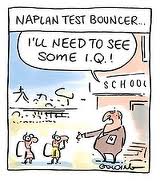
It sickens me to see the Government so smug about the upcoming round of National Testing.  In Australia it’s called the NAPLAN (I refer to it as “NAPALM”), and like other National tests around the world it compares student data against the average.  The Government uses the National tests as an easy way out of doing something constructive about Education.

Before I slam these pathetic tests, in the spirit of goodwill, I will acknowledge some advantages of National Testing:

  • It uses these tests as a vehicle for pressurising schools and teachers to lift their game and secure good results for their students.
  • It forces teachers not strictly following the curriculum to adhere to the syllabus
  • It gives parents some real data to consider, rather than the deliberately vague school reporting, which essentially tells parents nothing.
  • It gives parents an opportunity to become more involved in their child’s education.

Now for the disadvantages:

  • It forces teachers to stop what they are doing, and spend weeks if not months practicing for the test.  Everything gets put on hold while the sample test papers get wheeled out.
  • It fills students as young as 8 years-old with anxiety, pressure and insecurity.
  • It causes schools to “encourage” the parents of special needs students to keep their kids at home during the testing week.  This is to ensure that their child doesn’t affect the school’s results.  It also achieves in further marginalising these children who, in many cases, already feel disconnected from their peers.
  • It puts enormous stress on teachers.  This stress has an effect on their quality of teaching.
  • It turns education into an extreme negative at a time when kids still show an interest in learning.

I am currently teaching Grade 5 for the first time.  I am preparing my students for the rigours of NAPLAN (they sat for them 2 year ago).  It means that my emphasis has had to change.  Instead of teaching in an engaging and creative way, I’ve been forced to teach to the tests.  The result has been a succession of comparatively boring and turgid lessons on strategies for answering multiple choice questions, “debugging” sample tests and revising basic skills.  My students are not enjoying these lessons at all!  I fear that when they sit these tests they will sabotage the process by rushing through it as revenge for what its done to their enjoyment of school.

What makes these tests even worse is that they are testing the children at Grade 5 level even though they have just started Grade 5.  Because of that, my students haven’t covered some of the concepts being tested.  Surely, if they wanted to test a Grade 5 class against the Grade 5 benchmarks they should have done it at the end of the school year, not at the beginning!

When are Governments going to stop being so lazy and start taking on a fresh and innovative approach to learning?  Why must my students be subjected to sample tests and other turgid preparatorylessons, instead of conventional, authentic lessons?

Parents have the right to know how  their child is progressing.  At the same time though, their children deserve the right to have a pressure reduced primary education, where the teachers are able to harness their natural curiosities, instead of burden them with weeks of test prepa
ration!

Newsflash: Teachers Are Bullied Too!

March 28, 2011

I found this letter to the editor which captures the sentiment of many against teachers.  At the moment there is a clear backlash against teachers which is both irrational and highly unfair. Whilst certainly not perfect, most of us do our very best to help our students to thrive emotionally as well as academically, with little financial reward.  This letter is a good example of how a profession that was once respected and appreciated, is by many, no longer admired or highly thought of.

Now, teachers can empathize with bullied kids

The Bakersfield Californian | Saturday, Mar 26 2011 11:04 PM

Last Updated Saturday, Mar 26 2011 11:04 PM

Wow, how funny that the tables have turned and some Bakersfield City School District teachers are now afraid to go to work. Just think how some students were also afraid to go to school.

In the March 23 article “BCSD vows action on student discipline issues,” teachers said that students have “shoved, slapped and cursed” at them.

Isn’t it ironic that students have been feeling this for quite some time and nothing has been done about it? Teachers have left it up to school administrators to handle any unruly students, and all that the administrators have done, in some cases, is suspend both students, which results in the situation never being fixed and the punishment of the victim along with the bully.

So, to those teachers that have found themselves in this situation, I say welcome to the life of those students who are bullied every day while administrators do nothing or very little to correct the situation and also put blame on the victims for defending themselves. Teachers, welcome to the club!

DAVID A. FLORES

Bakersfield

To Mr. Flores, all I can say that he obviously knows nothing about our profession.   Teachers are the most bullied of all professionals.  They are subjected to bullying from a variety of sources; their superiors, parents, colleagues, students and as we see from New York, the Government regulators.

Whilst that does not excuse a lack of awareness of schoolyard bullying on the part of the teacher, it is offensive to get satisfaction when a person or group of people are victim to bullying.

This letter emphasises how important it is for us to restore our great profession to what it once was.  Many of us love our job.  We love contributing to the lives of our students.  We love helping them develop a sense of sense of self and watching them grow both literally and metaphorically.

Mr. Flores, I may be on the other side of the world, but you are welcome in my classroom any time.  You might gain an appreciation for how hard the job is and how important the welfare of our students is to us.

Valuable Advice for Bystanders of School Bullying

March 27, 2011

One of the underreported aspects of the Casey Heynes/Ritchard Gale bullying incident, was the role of the onlookers in inflaming the situation (or at least failing to intervene).  Not enough of the ensuing conversation focussed on the importance of intervening and diffusing a bullying situation.  Many media outlets omitted the fact that the child filming the incident was suspended, and few columnists even bothered to see it as an issue.

Whilst it is easy to blame bystanders of a bullying incident for their inaction, intervening in such a heated situation is quite a difficult assignment.  That’s why I was so thrilled to stumble on a wonderful article by Rosalind Wiseman, which detailes strategies that bystanders can employ:

Recently I’ve taken a hard look at the advice we give to kids who are being bullied and challenged all of us who work on this issue to do better. Now I want to question the common advice we give bystanders. This is critical for two reasons; we rarely admit the complex role bystanders play in bullying and I’ve never seen us publicly acknowledge that often the reason bystanders don’t come forward is because they don’t have confidence in the adults to do what’s right.

Being a bystander:

It’s not like any of us look forward to the opportunity of confronting a bully, as we saw in the recent Dateline special. Ironically, it can often be harder to confront a bully we’re close to than someone we don’t know or don’t like. And no matter how you feel about the bully or the target, it can be easy to stay silent because you don’t want the abuse directed at you.

But here are three inescapable facts:

  • Almost all of us will be in a situation at some point of our lives where we see someone bully someone else.
  • Bystanders often decide to get involved based on their feelings toward the bully and/or the target. If you like the bully then you are more likely to excuse the behavior. If you think the target is annoying, then you’ll more easily believe the target was asking for it. But a bystander’s decision to get involved should be based on the merits of the problem, not on their relationship to the people.
  • In that moment, we will have three choices. 1. Reinforce the abuse of power by supporting the bully; 2. Stay neutral — which looks like you’re either intimidated by the bully yourself or you support their actions; 3. Act in some way that confronts the bully’s abuse of power.

In the face of seeing someone bullied, here are some common reactions:

  • Deny it’s going on.
  • Distract yourself so it looks like you don’t know what’s going on. And if you don’t know then you have no obligation to do stop it.
  • Remove yourself from the situation.
  • Laugh to try to convince yourself that what’s going on isn’t serious.
  • Join in the bullying, because it’s safer to be on the side of the person with the most power.
  • Ignore it in the hope that it will go away.

What do you do if you are a bystander?

Even if you aren’t proud of how you handled the bullying when it occurred, it’s important to recognize how hard it is to know what to do in the moment. But that fact doesn’t mean it’s too late now to speak out. Especially if you are friends with the bully, reaching out to them is actually the ultimate sign of your friendship.

Supporting someone who’s been bullied.

Say, “I’m sorry that happened to you, do you want to tell me about it?”

Don’t tell them what they should have done or what you would have done. Listen and help them think through how to address the problem effectively. And if they ask you to back them up the next time it happens, ask them what that looks like to them. If it means upholding their right to be treated with dignity and not getting revenge on the bully, then do it.

Supporting someone who is being the bully.

In your own words say something like, “This is uncomfortable to talk about but yesterday when you sent that picture of Dave you know that really embarrassed him. And I know I laughed and I know he can be annoying but it’s still wrong. If you do it again I’m not going to back you up.”

Yes the bully is going to push back, make you uncomfortable, try to get you on their side but remember what happened and why you feel like the bully’s actions were wrong.

Why are bystanders so reluctant to come forward?

Let’s move away from the bystanders and focus on the adults. The prevailing explanation of why kids won’t come forward is because there’s a code of silence that forbids them. No one wants to be a snitch. While there’s some truth in that — I think just as powerful a reason for kids’ silence is because the adults haven’t created an environment where kids think reporting will make the problem better instead of worse. Yet, the most common advice we give to bystanders is to is tell an adult. Like it or not, the truth is it’s not good enough to tell kids to tell an adult.

Telling an adult won’t magically solve the problem. What far too many kids know and experience on a daily basis but we deny is that far too many adults are ill-equipped to respond effectively and often only cause the child to give up on adults entirely. Furthermore, the very way a lot of adults treat young people — in a condescending or dominant (i.e. “bullying”) manner — makes it impossible for children to have any confidence in our ability to be effective advocates.

While there are many effective counselors, even the suggestion to “talk to your counselor” may not be realistic. The child may have no idea who the counselor is — let alone a strong enough relationship with them to take this leap of faith. Recent budget cuts have led many school districts to cut back on their counselors or eliminate them completely. And it has always been the case that kids tend to form strong relationships with their teachers and coaches. It’s these people who bystanders will more likely tell what’s going on. Especially for a bystander that could easily think that since the bullying isn’t technically happening to them, reporting to a counselor is too extreme.

That’s why teachers need to know what to do. Instead of, “That person just needs to get a tougher skin”, “It can’t be that bad, can it?” they need to respond with “I’m really sorry this is happening. Thanks for telling me. I know it can be hard to come forward about things like this and I really respect the fact that you did. Let’s think about what we can do about it.”

Let’s be clear: beyond the peer pressure not to snitch and adolescent cynicism, adults matter. If our kids see us treat people with dignity, if we are outspoken about our respect for people who come forward, if we are honest with how scary reporting can be but assure them that we will be with them throughout the process, I guarantee our kids will find the courage to speak out.

Ms. Wiseman can be contacted through her Twitter account on: www.twitter.com/rosalindwiseman

Calls for Scientology School To Be Investigated

March 25, 2011

I am not a big fan of Scientology and based on accounts of children and adults caught under its spell, I am deeply concerned about its growing numbers and influence.  I agree with Independent senator Nick Xenophon, who has pushed for Scientology’s tax-free status to be scrapped.

The latest of many controversies to come out of the Church of Scientology sees one of their schools accused of covering up its allegiance to the Church and allegedly using Government Funds intended for the school to help build a Church of Scientology headquarters.

A Melbourne school linked to the Church of Scientology spends among the lowest per student in Australia despite receiving thousands of dollars in government funding.

Yarralinda School in Mooroolbark has also come under fire for obscuring its affiliation with Scientology, in a flyer that spruiks the school as a ”no homework school”.

My School website reveals Yarralinda School spent $3727 per student in 2009, despite receiving $6171 per student in combined government funding and $4609 per student in fees. //

Victoria’s independent schools spend an average of $15,201 per student, while government schools spend an average $10,178 per student.

However, most of Yarralinda’s income – $7765 per student – was allocated to paying off debts, according to My School.

A former board member at Yarralinda, Paul Schofield, who resigned in 2009, alleged the school’s debt repayments were so high because the school had taken out a mortgage to lend money to the Church of Scientology for its headquarters in Ascot Vale.

”I was livid the school had been left with this debt in order to fund the Scientology building,” he said.

The Australian Education Union called on the federal government to investigate the use of government funding.

”The government is providing recurrent funding for very specific purposes, and it appears this funding is not being used for the purpose of education,” president Angelo Gavrielatos said.

Yarralinda principal Christel Duffy refused to comment on why the school’s spending per student was so low.

I am extremely weary of the Church of Scientology and hope Senator Xenophon is successful in his endeavours.

50 Books Every Child Should Read

March 24, 2011

I stumbled on a wonderful piece by the Independent entitled The 50 Books Every Child Should Read. It was written in response to Michael Gove’s recommendation that children read 50 books a year.  They asked three of Britain’s leading children’s authors and two of their in-house book experts to each pick 10 books, suitable for Year 7 students.”

Below is the list:

Philip Pullman

* Alice’s Adventures in Wonderland and Through the Looking Glass by Lewis Carroll. Indispensable. The great classic beginning of English children’s literature.

* Pinocchio by Carlo Collodi. What effortless invention looks like.

* Emil and the Detectives by Erich Kastner. A great political story: democracy in action.

* Swallows and Amazons by Arthur Ransome. As clear and pure as Mozart.

* Black Hearts in Battersea by Joan Aiken. If Ransome was Mozart, Aiken was Rossini. Unforced effervescence.

* The Owl Service by Alan Garner. Showed how children’s literature could sound dark and troubling chords.

* The Phantom Tollbooth by Norton Juster. Superb wit and vigorous invention.

* Moominsummer Madness by Tove Jansson. Any of the Moomin books would supply the same strange light Nordic magic.

* A Hundred Million Francs by Paul Berna. A particular favourite of mine, as much for Richard Kennedy’s delicate illustrations (in the English edition) as for the story.

* The Castafiore Emerald by Hergé. Three generations of this family have loved Tintin. Perfect timing, perfect narrative tact and command, blissfully funny.

Michael Morpurgo

* The Star of Kazan by Eva Ibbotson.

The heroine is blessed with such wonderful friends who help her through the twists and turns of this incredible journey.

* A Christmas Carol by Charles Dickens. The first few pages were so engaging, Marley’s ghostly face on the knocker of Scrooge’s door still gives me the shivers.

* Just William books by Richmal Crompton. These are a must for every child.

* The Happy Prince by Oscar Wilde. This was the first story, I think, that ever made me cry and it still has the power to make me cry.

* The Elephant’s Child From The Just So Stories by Rudyard Kipling. The story my mother used to read me most often, because I asked for it again and again. I loved the sheer fun of it, the music and the rhythm of the words. It was subversive too. Still my favourite story.

* Treasure Island by R.L. Stevenson This was the first real book I read for myself. I lived this book as I read it.

* The Old Man and the Sea by Ernest Hemingway. A classic tale of man versus nature. I wish I’d written this.

* The Man Who Planted Trees by Jean Giono. A book for children from 8 to 80. I love the humanity of this story and how one man’s efforts can change the future for so many.

* The Singing Tree by Kate Seredy The story of two children who go to find their father who has been listed missing in the trenches of the First World War.

* The Secret Garden by Frances Hodgson-Burnett. I love this story of a girl’s life being changed by nature.

Katy Guest, literary editor for The Independent on Sunday

* Refugee Boy by Benjamin Zephaniah. Story of a young Ethiopian boy, whose parents abandon him in London to save his life.

* Finn Family Moomintroll (and the other Moomin books) by Tove Jansson.

A fantasy series for small children that introduces bigger ones to ideas of adventure, dealing with fear, understanding character and tolerating difference.

* Diary of a Wimpy Kid by Jeff Kinney. It’s rude, it’s funny and it will chime with every 11-year-old who’s ever started a new school.

* I Capture the Castle by Dodie Smith. Written for a teenage audience but fun at any age.

* The Hobbit and The Lord of the Rings by JRR Tolkein. Be warned, these tales of hobbits, elves and Middle Earth are dangerously addictive.

* The Tygrine Cat (and The Tygrine Cat on the Run) by Inbali Iserles. If your parents keep going on at you to read Tarka the Otter, The Sheep-Pig and other animal fantasies, do – they’re great books – also try Iserles’ stories about a cat seeking his destiny.

* Carry On, Jeeves by PG Wodehouse. A grown-up book – but not that grown-up.

* When Hitler Stole Pink Rabbit by Judith Kerr. Judith Kerr’s semi-autobiographical story of a family fleeing the Nazis in 1933.

* Moving Pictures by Terry Pratchett. Elaborate mythological imagery and a background based in real science. If you like this, the Discworld series offers plenty more.

* The Story of Tracy Beaker by Jacqueline Wilson. The pinnacle of the wonderful Jacqueline Wilson’s brilliant and enormous output.

John Walsh, author and Independent columnist

* The Adventures of Sherlock Holmes by Sir Arthur Conan Doyle. Irresistible puzzle-solving tales of the chilly Victorian master-sleuth and his dim medical sidekick.

* The Curious Incident of the Dog in the Night-Time by Mark Haddon. Age-transcending tale, both funny and sad.

* Mistress Masham’s Repose by TH White. Magical story of 10-year-old Maria, living in a derelict stately home, shy, lonely and under threat from both her governess and her rascally guardian.

* Little Women by Louisa May Alcott. Inexplicably evergreen, trend and taste-defying 1868 classic.

* How to be Topp by Geoffrey Willams and Ronald Searle. Side-splitting satire on skool, oiks, teechers, fules, bulies, swots.

* Stormbreaker by Anthony Horowitz. First of the action-packed adventures with 14-year-old Alex Rider.

* Private Peaceful by Michael Morpurgo. “Dulce et Decorum Est” for pre-teens.

* Artemis Fowl by Eoin Colfer. Lively, amoral, wildly imaginative debut (six more followed) about the money-grabbing master-criminal Artemis, 12. The author called it “Die Hard with fairies”.

* The Silver Sword by Ian Serraillier. Inspiring wartime story of the Balicki family in Warsaw.

* Animal Farm by George Orwell. Smart 11-year-olds won’t need any pre-knowledge of Marx, Lenin, Trotsky and 1917 to appreciate this brilliantly-told fable.

Michael Rosen

* Skellig by David Almond. Brings magical realism to working-class North-east England.

* Red Cherry Red by Jackie Kay. A book of poems that reaches deep into our hidden thoughts but also talks in a joyous voice exploring the everyday.

* Talkin Turkeys by Benjamin Zephaniah. A book of poems that demands to be read aloud, performed and thought about.

* Greek myths by Geraldine McCaughrean. Superheroes battle with demons, gods intervene in our pleasures and fears – a bit like the spectres in our minds going through daily life, really – beautifully retold here.

* People Might Hear You by Robin Klein. A profound, suspenseful story about sects, freedom and the rights of all young people – especially girls.

* Noughts and Crosses by Malory Blackman. A book that dared to go where no one thought you could with young audiences because it raises tough stuff to do with race.

* Einstein’s Underpants and How They Saved the World by Anthony McGowan. A crazy adventure set amongst the kids you don’t want to know but who this book makes you really, really care about.

* After the First Death by Robert Cormier. Cormier is never afraid of handling how the personal meets the political all within the framework of a thriller.

* The London Eye Mystery by Siobhan Dowd. A book that allows difference to be part of the plot and not a point in itself.

* Beano Annual. A cornucopia of nutty, bad, silly ideas, tricks, situations and plots.

Top Ten Lists are fun.  What books would you recommend for a Year 7 child?

Facebook Banning Children For Lying About Age

March 23, 2011

Congratulations to Facebook for actively banning kids who are lying about their age. Age requirements are important, because young students are often prone to making bad choices with social media and fail to use the recommended privacy settings:

Social networking giant Facebook is banning 20,000 children every day because they have lied about their age to join the site.

The company admitted it had to do more to stop young people using Facebook, as it revealed about a third of Australia’s population uses the site every day, the Herald Sun reported.

At a parliamentary inquiry into cyber-bullying, other social networking and online companies called for campaigns to highlight the dangers of the internet.

And there have been calls for an overhaul of the Australian school curriculum to include more effective cyber-danger classes.

The chief privacy adviser of Facebook, Mozelle Thompson, said many Australian children under the age of 13 were trying to access the site by lying about their age.

“It’s something that happens on a regular basis,” Mr Thompson said.

Globally, about seven million children who lie about their age are blocked from the site each year.

For those parents/teachers unaware of the problem of cyber-saftey or if you have children or students that don’t use the privacy settings option, I urge you to watch this clip with them.

Casey and Ritchard Gale’s Interviews

March 22, 2011

How sad this story is.  The only good thing to come out of this story, is that it sends a clear message to schools that they need to be more proactive in stamping out bullying of all kinds.  Below is Casey’s A Current Affair interview and Ritchard Gale’s unfortunate lack of remorse in his Channel 7 interview.

I was hoping the backlash would have taught Ritchard a lesson.  I hoped it would make him reflect on his past actions and help to bring changes to his approach and attitude.  It is very disappointing to see that he remain unrepentant for his part in this incident.

I have no doubt that Gale has had it tough.  But he could have come out of this a champion of reform.  It would have been so powerful to hear him admit wrongdoing instead of painting himself as a victim.

Bullied Hero Speaks

March 21, 2011

Last week I wrote a post about Casey Heynes, the Australian boy who was caught on tape defending himself against a bully.  In a graphic show of what seems to be a completely unprovoked attack, the bully is seen striking Casey with a fist to the jaw.  Casey then responds with the now infamous body slam.  I devoted the post to criticising the school’s response to the incident (It turns out that the child that filmed the video did in fact get suspended too).

So big was the news, and so divided was people’s reaction to Casey’s show of self-defense, that A Current Affair got a 1-on-1 interview with Casey:

The schoolboy who’s become an internet sensation after turning the tables on a bully has told how he snapped after years of cruel taunts about his weight.

Casey Heynes, 16, says he has been bullied nearly every day at his school, Chifley College, at St Marys, but could take no more when Year 7 student Ritchard Gale tormented and attacked him last Monday.

“All I was doing was defending myself. I’ve never had so much support,” he said during an interview with A Current Affair.

Casey reveals he’d been targeted by a new group of Year 7 boys who had started picking on him and teasing him about two weeks prior to the fight.

The Year 10 student said he was surrounded by the students when he went to get a school timetable before class.

As Ritchard backed him against the wall and started throwing punches, Casey said he felt scared and worried that others in the group would also start hitting him.

Eventually, he snapped, picking Ritchard up over his shoulder and throwing him to the ground.

The brawl was recorded on the mobile phone of another student who later posted the video online where he has earned “hero” status.

Asked if he was a superhero, he laughed and said: “No I wish I was.”

The video, which was taken off YouTube on Tuesday, has gone viral worldwide spawning dozens of websites and facebook pages congratulating Casey for fighting back.

It also sparked a media storm with St Marys residents claiming television stations were offering up to $1000 for information about the fight.

Yesterday, Ritchard was unrepentant. Asked whether he was sorry for attacking Casey, he bluntly replied: “No.”

The issue has divided the western Sydney community.

“Good on him. I was so happy to see a bully finally getting what he deserved,” one St Marys resident said.

“I don’t condone violence but when kids stage an attack like that and record it to humiliate the victim it’s wrong.”

But another resident Jayne Saunders said: “He could have broken that little kid’s neck.”

He explained that this wasn’t a one-off incident and he has been taunted for 3 years:

Casey said his outburst was a “build-up” of more than three years of being attacked verbally and physically by other students.

“They used to slap me on the back of the head and said I was a fatty and to lose some weight.

“I’ve been duct taped to a pole before as well. They target me because I don’t retaliate.

“I’ve never reacted that way before but everything built up inside me for three years…I just had enough. All I wanted is for it to stop.”

I am very disappointed that the bully is unrepentant. I would have thought that this saga would have taught him the lesson he needed to learn. Whilst I in no way condone violence of any kind, what rational human person can blame Casey for snapping? Yes Ritchard’s injury could have been a lot worse, and there is a concern that there will be copycat incidents because of the hype around this case. But I can’t help but go back to my original argument.

What is a child supposed to do when they are being taped to polls and there doesn’t seem to be anything done to protect them? I am glad that Casey feels more confident as a result of his new-found fame. But perhaps, the real story is not about Casey. Perhaps the real story is about all those kids who continue to be bullied without adequate intervention by their schools.