Posts Tagged ‘Children’

The Tragic Loss of a Student

October 12, 2011

I recently read a very sad blog post written by notswallowedinthesea.

I never imagined this could happen to me… Especially so early on in my teaching career!

But yesterday, first day of Term 4, and in all my excitement, I went back to the school where I teach music part time, excited to see my students and teaching them all the great things I have planned for them – only to be whisked into the staffroom and briefed by social workers on “how to deal with a death in school.” I looked around confused before the assistant principal came up to me and whispered in my ear that one of our prep kids was hit by a truck during the holidays in front of his mum and older sister (who is in Grade 2).

The AP told me the name of the student but it went past my head. I asked for the name again but it didn’t ring a bell. AP tried to describe him: “little blonde one”. There are so many “little blonde ones”. Which one? When I realized I did not recognize the name I sighed in relief, but only for a second. Because then I shuddered at the thought of not knowing the student. How on earth could I NOT know? I kicked myself for not learning the names of all my students soon enough. I felt an overwhelming sense of guilt and couldn’t wait to break away from the staff room to locate the class list and photo so I can put a face to the name of the student. I have 14 music classes and about 20-28 in each class, so yes, I still don’t know the names of all the students! As the social worker was briefing us, I went through the faces of all my prep kids, trying in vain to remember Rex. Rex, the name is very familiar but I couldn’t put a face to it!

When the briefing was over, I spoke to the school counselor who gave me a bit more details about the accident, and pointed to me a picture of Rex. There he was, the little blonde one. Immediately I knew who he was! He was in my Top 5 students in the final class before the holidays! Sweet smiling Rex. Suddenly the memories overwhelmed me and I felt everything from grief to guilt. Grief because I had lost a student through the worst circumstance, and grief because I wished we could have spent more time together – or that I would have remembered him! It pains me that I couldn’t remember him in the first instant! Why didn’t God give us more time together? Why was he taken away so suddenly? Why hadn’t I paid more attention to him? Why couldn’t I remember him?!

It was awful. I wanted to cry but I couldn’t because my first class came in. I tried my best to hide my tears and answered questions about Rex as honest as I could without breaking down. I had never been in such a situation before, and I found it extremely difficult replying to students who have questions such as : “Why did it happen?” and “Where is he now?”

I know for a fact, because of my faith, that God is taking care of him, that things happen for a reason and that God is in control. But I cannot say this to my kids as I am not teaching in a Catholic school and I don’t want to cross any lines or upset any parents. How can I answer questions like these? I ended up avoiding them as much as I could!

The last class yesterday was Rex’s class, and I knew the moment the students came in that they were itching to tell me about Rex, about why he wasn’t in class and why he was never going to come back. But I went straight into my lesson, avoiding any questions, claiming I do not have time and that we had a lot to get through.

I had a lot to get through… a lot of emotions to get through. At lunch time I stumbled across Rex’s music book, I noticed his work for the first time. 2 weeks ago it was just a book belonging to one of the preps, just a book among the statistics, with scribbly drawings and terrible colouring techniques. Now, it is the precious work of a child no longer here on earth, and the horrifying truth that the child has had only 5 years in this world… not enough to learn how to colour in the lines, not enough to learn to write his name properly… not enough! Not enough!

I don’t know if I am angry. I am definitely not bitter. I know these things happen, and tragedies occur throughout the world. Who am I to complain and pound heaven for an answer? But the fact that it happened, TO ME, at this time has made me realize immensely how precious life is, how precious teaching is, and how fragile we human beings are.

While singing with the Preps yesterday I found myself staring into each student’s eyes, trying to take in as much of them as possible, drinking in their personalities and hoping that they will all come back again next week. I do not want anyone else to leave! I do not want any of them to get hurt!

But I cannot save them all… and I did not save Rex. Rex is gone. My class of 21 preps is now down to 20. He was hit by a truck, and died at the scene. Rex, who only 2 weeks ago I had given a piece of chocolate cake for making it into the Top 5 because he sat patiently for his book while others were shouting for it. Little blonde Rex.

I find myself looking towards the right everytime I pass his classroom to go to the staffroom or toilets. I keep looking because I still see his photo in the class wall, on the class door, on his table, his book shelf, his bag shelf, his music book…

I am only in my first year of teaching, and already I have had to deal with a student’s death. I wonder how much more will come? How much more can I take?

I was wondering if you have experienced something similar?  If so, what advice do you have for this teacher to help her get through this emotionally traumatic experience.

Protecting Kids From Living Freely

October 10, 2011

I am an over-protective father and proud of it.  I am hesitant when my daughter takes any risks and hate to see her in discomfort.  Yet, at the same time, I realise that cuts and grazes are part of life and growing up.  You can’t shadow your child in the playground to prevent them from tripping and you can’t ban them from low-risk activities on the off-chance that something might occur.

That is why I am so opposed to the persistent interference by Governments and local councils in banning everyday activities.  It is not their place to decide what toy my child should play with.  They may choose to advise me about the risks and encourage me to supervise my child with graet care, but the constant banning is taking things too far.

It is such a shame that we live in an age where children are being banned from blowing balloons and playing with whistles:

The EU toy safety directive, agreed and implemented by Government, states that balloons must not be blown up by unsupervised children under the age of eight, in case they accidentally swallow them and choke.

Despite having been popular favourites for generations of children, party games including whistles and magnetic fishing games are to be banned because their small parts or chemicals used in making them are decreed to be too risky.

Apparently harmless toys that children have enjoyed for decades are now regarded by EU regulators as posing an unacceptable safety risk.

Whistle blowers, that scroll out into a long coloured paper tongue when sounded – a party favourite at family Christmas meals – are now classed as unsafe for all children under 14.

As well as new rules for balloons and party whistles, the EU legislation will impose restrictions on how noisy toys, including rattles or musical instruments, are allowed to be.

All teddy bears meant for children under the age of three will now have to be fully washable because EU regulators are concerned that dirty cuddly toys could spread disease and infection.

The EU and other Government bodies will continue to come up with irrational and overbearing legislation, but no matter how hard they try they will never be my child’s parent.


Laws That Seek To Protect Our KIds Fail Them

October 9, 2011

The same laws that seek to protect children are being severely undermined by a total lack of common sense.

Australia has a sexual offender registry which was designed to assist the government authorities to keep track of the residence and activities of sex offenders.  You don’t have to be Einstein to realise that being on that list is detrimental to that person’s ability to get a job, loan, sense of freedom and quality of life.

The registry is a vital tool in dealing with pedophiles.  That is why I was astounded to read that children caught ‘sexting’ photos of themselves or friends have been put on this very list:

HUNDREDS of teenagers have been charged over producing or distributing child pornography amid growing concern that “sexting” has reached epidemic levels.

In the past three years, more than 450 child pornography charges have been laid against youths between the ages of 10 and 17, including 113 charges of “making child exploitation material”.

More than 160 charges were laid in 2010 alone – 26 more than in 2008.

Parents and communities continue to grapple with the issue of “sexting”, where sexual images are exchanged via SMS.

Teens who engage in sexting not only risk child pornography charges, but can also be listed alongside serial pedophiles and rapists on sexual offender lists.

Police confirmed that some juvenile offenders appear on Queensland’s sex offender registry.

Child psychologist Michael Carr-Gregg said “a lack of parental supervision” was a key factor.

“They’re ignorant of the law and no one’s ever sat them down and said ‘When you take a picture of yourself and send it, that’s child pornography’,” he said.

Dr Carr-Gregg said a conviction would have a “catastrophic” effect on a teenager’s future.

“If a young person is put on the sex offenders registry, they have to notify police every time they change their hair colour and wouldn’t easily get visas to places overseas, and it’s going to make employment difficult,” he said.

Don’t get me wrong, I am totally against the practice of “sexting”.  I don’t like it one bit.  But these kids are not sex offenders.  One of the reasons children shouldn’t be ‘sexting’ in the first place is to make sure those images don’t get in the hands of a real sex offender.

The application of this law does 2 very serious things.

1.  It paints children wrongly as sex offenders.  This may have dire consequences down the track; and

2. Having ‘phony’ sex offenders on a sex offender registry completely undermines the registry in the first place.  This is a very serious list, dedicated to sick and evil people.  It shouldn’t be undermined by including silly kids who made poor choices.

It is time the Government stepped in and amended the law so common sense can be restored.

Court Ruling Forces Teachers to Act Like Police Officers

October 6, 2011

Why is it that Government and now the courts think it’s appropriate to constantly change our role and responsibilities?  Why can’t we do the job we have been doing for centuries without having to take on new unfamiliar duties?

A 14-Year old was acquitted for holding up a service station and stabbing the attendant because the teacher he confided in reported it rather than caution him.  Apparently, the teacher had a duty to warn the student about his legal rights.  Because the teacher failed to have that discussion, the child got off.

TEACHERS could be forced to warn students as young as 10 about their legal rights before counselling them after a remarkable court decision.

A 14-year-old boy who confessed to his teacher that he robbed a service station and stabbed the attendant with a knife, has been acquitted after the District Court refused to allow the teacher’s statement into evidence because he had not “cautioned” the boy.

It could change the way teachers and students relate to each other, NSW Teachers Federation President Bob Lipscombe said yesterday.

“This is potentially very serious for teachers,” Mr Lipscombe said.

“Teachers are expected to provide advice, assistance and counselling to young people on a daily basis and during the course of that, many things are disclosed to teachers.

“Most are fairly insignificant but often there are matters disclosed that are quite significant and in such cases teachers have never been advised that they can only act on information if they have previously cautioned the student,” Mr Lipscombe said.

The federation was taking urgent legal advice, he said.

“No teacher in the course of their work would caution students in the way this case states,” he said.

“Clearly this teacher did think he was doing the right thing and acting responsibly.”

Last time I checked teachers were neither police officers or lawyers, so why should we be expected to act like them?  Surely this teacher acted responsibly, first for consulting his/her superior and then for reporting the matter.

What do they mean by giving a caution anyway?

“Next time, I recommend you not stab the person.  He may get hurt.”

Yet another ridiculous and insane development for Australian teachers.

What is the Obsession With Talking About Sex To Children?

October 4, 2011

Nearly every day there is some expert quoting some study about how important it is to talk about sex with your children.  Whilst I have no problem with the message, I wonder why it is constantly being regurgitated.

Why is it always, “teach your children about sex”?  What about teaching your children about manners, selflessness, hard work and respect for others?  Why aren’t these messages seen as important as the “birds and the bees”?

Now they’re telling parents they should talk to their 5-year olds about sex.  My child is 6 and she just discovered that the fish you eat is the same as the fish that swim.  Is this really the time to be discussing sex?

CHILDREN have sex for the first time between the ages of 14 and 15 says a new study, which also suggests that parents should talk to them about their sexuality from as early as the age of five.

I think I will shelve plans of having the “sex” talk for the time being.  I’ve got more pressing problems to tend to – like getting my daughter to eat fish again!


Ban on Raising Hands Gets ‘Thumbs Up’ From Me

October 4, 2011

I remember how frustrating it was to have to raise my hand before I could speak in class.  The teacher took what felt like an eternity to pick me.

First I would go for the conventional right arm raised high, complete with perfect posture and enthusiastic eye contact.  But then my arm grew tired.

Plan B was to swap arms, this time using the left, but with the same steely determination to get chosen.  But after a while, my arm would again become tired.

Finally I would go for the two arm job.  My right arm would be raised with my left used as support behind the elbow, propping it up in the hope that I could last until my name would eventually get the call.

And then, after all that, I would remain overlooked and reluctantly gave up the fight and threw in the towel.

And that was just to ask permission to go to the bathroom …

As you may have guessed I’m not a fan of raised hands.  It amazed me at Uni during tutorials how civil a lesson can be when raising hands was replaced by two simple unspoken rules – wait your turn and don’t interject.

That’s why I’m dumbfounded that a simple change like replacing hand raising with the far less strenuous “thumbs-up” motion, could me met with so much criticism:

Pupils at Burlington Junior School in Bridlington, East Yorks, have been asked to adopt the new hand signal to create a more relaxed classroom.

The children – aged eight and nine – have now been told to get the teachers attention by giving a thumbs up while cupping their hand.

But parents at the 360-pupil school have blasted the decision as “daft” after it was introduced at the beginning of this school year and say the clidren look like The Fonz, from the television comedy Happy Days.

Dad-of-three Dave Campleman, 44, who has two children at the school, said: “I thought it was a joke at first. It’s daft. I can’t see the logic in it.

“Fair enough if it was across the board, but I’ve not heard of any other schools doing it.

The driving instructor added: “I think it’s a bit pointless, it’s not benefiting their education – they could focus on other things.

“Kids are used to putting their hands up, it is natural for them. Being told to do something different just confuses them.

“I am just bemused by it. I think they should go back to the old way of putting your hand up in class.”

And teachers at the pupil school have even taken to putting up signs to discourage kids from raising their hand.

In one poster campaign plastered on the walls of classrooms, a thick red cross can be seen through an image of a raised arm to discourage children from using the old method.

Next to it is an image of a pupil doing a thumbs up aimed at helping pupils get to grips with the change.

Another parent, who has a son in the class but didn’t want to be named, said: “It is going to make the class look like they are all imitating the Fonz from Happy Days.

“On a serious note when these kids go up to secondary school next year they could be a laughing stock because all the other children will be putting up their hands.

“I think there should have been more consultation from the school with the parents over this and perhaps a trial first before an outright ban.

“I can’t really see it making the classroom more relaxed – they are young, excitable kids and putting up your thumb instead of your arm isn’t going to change that.”

It’s amazing how a simple change can create such angst.  I think the signs are a light-hearted send up of the stereotypical rigid school rule.  It’s not as if children are going to be punished for accidentally raising their hands.

As for the kids becoming a laughing-stock in High School, one might be surprised to know that children aren’t stupid.  Treat them like mature young adults and you may be in for a pleasant surprise.


Children Find Ways to Outsmart Their Parents

October 3, 2011

The message to parents has been clear: Monitor your child’s Facebook page to ensure that they maintain their page in a safe and responsible way.  But there are parents who think they are doing a meticulous job of supervising their children, only to come undone by a loophole being heavily exploited to ward off protective parents:

Are you a parent who keeps an eye on who posts what on your child’s Facebook account? Perhaps you know their password and sneak a look at their messages from time to time? You may even enjoy the trusted privilege of being a “friend”.

Whatever the situation, social networking sites are a source of anxiety for parents, and now the latest trend will only add to their alarm. Children are staying way ahead of attempts by parents and schools to police their online activity And the latest ruse is a secret, fake-name Facebook account.

“Some kids will have two or even three,” says Dr Barbie Clarke, of the youth research agency Family Kids and Youth, who monitors online trends among schoolchildren in the UK.

“Their habits change and we’re seeing them progress from the obvious lie about their age – allowing them to use Facebook in the first place – to this second or third identity. It’s usually driven by Mum picking up on something from their page and raising it with them. They want privacy and they want a secret world.” She is very relaxed about Facebook use by children, saying she thinks they are generally more sensible and supportive of each other than they get credit for. “A second identity can be used for nastiness, to anonymously bully, but generally it’s about secrecy – like a secret diary, or dialogue they can have away from parents and other family members.”

Many children use school facilities to access their fake accounts. “I have two,” admits Harriet, 14.

I feel sorry for today’s parents.  With new and highly specialised technological advances flooding the market, parents are finding it much harder to adapt than their children.  No matter how hard they try to supervise and protect their children, sometimes it must feel like hitting your head against a brick wall.

Big Tobacco Funding Primary Schools

September 23, 2011

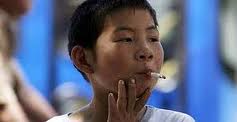
In today’s age, knowing what we know about the risks of smoking, how is it possible that tobacco companies have access to schools?  As important as it is to take into account cultural differences, China has no excuse in allowing tobacco companies to make their pitch to impressionable young children.  The cost of a quality education is not worth it if it comes with lung cancer, heart disease and emphysema.

MORE than 100 primary schools in China are sponsored by tobacco companies in a move described by anti-smoking campaigners as hunting for the next generation of smokers.

The schools often have the names of Chinese cigarette brands, such as Zhongnanhai or Liqun, over their gates and in some cases have promotional slogans in the playground.

”Talent comes from hard work – Tobacco helps you become talented,” says one slogan, in foot-high gilt letters, on the front of the Sichuan Tobacco Hope Primary School.

Tobacco helps you become talented?  No China, tobacco helps you die well and truly before your time!
Unfortunately, the message is successfully getting through to China’s underage demographic:
There are 16 million smokers under the age of 15 in China, 6.3 per cent of the youth population, according to the Chinese government.

For a country that is reknown for its strict regulations, it is mistifying that there is no regulations prohibiting tobacco from parading their brands in schools.

Education vs Self-Expression

September 21, 2011

Last week, my colleague and I taught the most wonderful creative writing lesson.  My colleague wrote the beggining of a sentence on the board  – “As the ball bounced higher and higher …” and we told the students that they had 10 minutes to write a story of their choosing starting with the words on the board.  We told them that we weren’t going to correct spelling, grammar, paragraphing etc.  We just wanted them to have a go and let their imaginations steer them in the right direction.

Everly child bar none wrote frantically.  Those that lack certainty, didn’t.  Those that struggle with composing letters and information reports lapped up the lack of protocols and structure that this activity offered.  Why was this simple lesson such a success?  Because it allowed the students to express themselves.

Curriculums and educational trends have made it harder for teachers to help students find themselves.  It has continued to downplay the importance of The Arts in favour of skills and concepts that many of our children will never use.  The Fibonacci Sequence might be fascinating, but who decides that this is more important than a clay modelling session?  Since when did single-celled organisms have a greater importance in a child’s life than the chance to perform to an audience?

Nowadays the emphasis is on memorising facts, studying for standardised tests and rote learning.  Even when the system purports to be encouraging self-expression it’s often a sham.  The system dictates what literature the students study, how they should think and what they should be feeling.

I remember telling my teacher when I was a student that I was bored by Robinson Crusoe.  You should have seen the look on his face!  He asked me how I could be bored with such a classic.  I told him that I wasn’t interested in reading page after page about details.  I wanted tangible feelings I could connect with.  My teacher was astounded.  He reminded me that Robinson Crusoe was one of the most popular books of all time.  I wanted to reply that Jurassic Park was one of the most popular films of all time, but thought better of it.

There are a multitude of kids who are simply not adjusting to the style of education offered.  So what do we do?  We tell them to smarten up and pull their finger out.  We remind them that if they don’t adjust their potential will be wasted and their career prospects will be hampered.  What if it isn’t the “spoilt” children’s fault they are not thriving at school?  What if it’s actually the narrow-mindedness of the system?

The fact that the writing session was 10 minutes and no longer was key to the success of the lesson.  According to my colleague when they are given more time their work suffers.  It reminded me of a great scene from the film Six Degrees of Separation.  Donald Sutherland recounts how whilst the Grade 1 and Grade 3 teachers at his childs’ school weren’t able to extract great artwork from the students, the Grade 2 teacher was responsible for a classroom of art geniuses.  He confronted the teacher to ask her what her secret is, and she replied that she knows when to take the brushes out of their hands.

The reason why we need to take the pencils out of their hands after only 10 minutes, is that up until that point they haven’t had the time to think beyond their natural instincts.  If we let them continue they would slowly stop writing out of instinct and start writing to please their teacher.  They would consider the structure that teachers have been duty bound to impart to their students (such as containing a problem, resolution and foci).  This very structure leads to boring, formulaic writing.

Our students are crying out for some structure and routine in their lives, but by the same token, they are also crying out for an opportunity to express themselves.  We are all different and sometimes society doesn’t give us the freedom to express it.

It’s time to take the brushes out of our students’ hands and let them show us what they’re really about!

Tips for Parents on Helping Their Children Overcome Obesity

September 19, 2011

It was great to read a list of suggestions by Joanna Dolgoff M.D. with suggestions for parents with obese children.  It was a welcome departure from the “name, shame and threaten” methods being employed by some sections of society on parents who clearly require support.

These suggestions are steeped in common sense and encourage a positive approach:

What Parents Can Do to Help

Be supportive: Overweight children need support, acceptance and encouragement from their parents. Children’s feelings about themselves often are based on their parents’ feelings about them. It is also important to talk to your children about weight, allowing them to share their concerns with you.

Don’t use food as a punishment or reward: Withholding food as a punishment may lead children to worry that they will not get enough food which may result in overeating. When foods, such as sweets, are used as a reward, children may assume that these foods are better or more valuable than other foods. For example, telling children that they will get dessert if they eat all of their vegetables sends the wrong message about vegetables.

Set a good example: Children are good learners and they learn best by example. Set a good example for your kids by eating a variety of foods and being physically active. Involve children in food shopping and preparing. Children may be more willing to eat or try foods that they help prepare.

Teach healthy habits: Teaching healthy eating practices early will help children approach eating with the right attitude: Food should be enjoyed and is necessary for growth, development and essential energy. Guide their choices rather than dictating foods. This will help your children learn how to make healthy food choices. Encourage your child to eat slowly. A child can detect hunger and fullness better when eating slowly.

Cut down on some fats: Reducing fat is a good way to cut calories without depriving your child of nutrients. Simple ways to cut the fat in your family’s diet include eating low-fat or non-fat dairy products, poultry without skin and lean meats, and low-fat or fat-free breads and cereals. However, make sure not to cut out healthy sources of fat such as walnuts, almonds and avocado.

Healthy snacking: You should make snacks as nutritious as possible, without depriving your child of occasional chips or cookies, especially at parties or other social events. Healthy snacks include: applesauce, carrot sticks with hummus, peanut butter on apples, yogurt, dried fruit, fruit juice popsicles, low fat cheese etc.

Increase your physical activity: Regular physical activity, combined with healthy eating habits, is the most efficient and healthful way to control your weight. Some simple ways to increase your family’s physical activity include the following: Plan family activities like walking, dancing, biking or swimming.

For example, schedule a walk with your family after dinner instead of watching TV or playing video games. Overweight children may feel uncomfortable about participating in certain activities so it is important to help your child find physical activities that they enjoy and that aren’t embarrassing or too difficult.

Instead of judging parents with obese children negatively, I feel it is important to encourage, educate and support parents.  Dr. Dologoff’s list is a reminder that the answers lie with positive change and the adcocation of healthier living.