4 Tips for Encoraging Healthy Competition in Kids

August 10, 2014

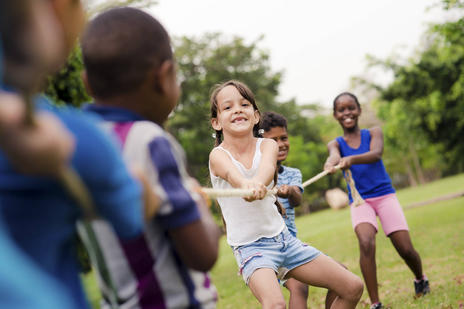
tug

I am much more comfortable avoiding competition in my classroom. I know some see competition as a motivator and others see it as a skill extremely useful for dealing with the competitive realities of the real world. I worry about its effect on classroom unity and friendships. I want my classroom working for and with each other instead of ‘dog eat dog’.

I am very grateful to have stumbled on a useful article that gives 4 ways to encourage healthy competition:


1. Don’t focus on winning

Not everyone can win every competition, whether it be athletic, academic, or just for fun. By focusing on the event itself, rather than the outcome, children can both try to do their best and not be devastated if they lose.

“It’s not all about winning,” Kenneth Barish, a clinical associate professor of psychology at Weill Medical College at Cornell University, told NPR. “It’s also about teamwork. And it’s about effort … becoming a better player.”

David Johnson, professor emeritus of educational psychology at the University of Minnesota, suggested that parents, coaches and teachers not inflate the benefits of winning or coming in first.

“If the stakes are low, the emphasis is placed upon sheer enjoyment of the activity,” Johnson told the Deseret News.

Those who didn’t win the game, score the most points or come in first should still feel like they had an enjoyable experience and got something valuable out of the activity.

2. Let kids learn from failure

Since life will inevitably bring failure at some point, experts recommend letting kids develop coping skills in a low-risk situation.

“Parents see failure as a source of pain for their child instead of an opportunity for him to say, ‘I can deal with this. I’m strong,’ ” says Madeline Levine, Ph.D., author of “The Price of Privilege: How Parental Pressure and Material Advantage Are Creating a Generation of Disconnected and Unhappy Kids,” in a Parent.com article.

While it can be devastating to watch your child suffer, teachers like Jessica Lahey have learned that children perform better when given the chance to fail and accept the consequences.

“Year after year, my ‘best’ students — the ones who are happiest and successful in their lives — are the students who were allowed to fail, held responsible for missteps, and challenged to be the best people they could be in the face of their mistakes,” Lahey wrote in The Atlantic.

3. Don’t make your love conditional on their success

While this may seem like a no-brainer, parents can inadvertently send the wrong message to their kids.

A recent Deseret News article discussed a study by Harvard University that found children and teenagers are three times more likely to agree with the statement, “My parents are prouder if I get good grades in my classes than if I’m a caring community member in class and school.”

“It’s good for kids to value excellence as long as they don’t feel valued only for their excellence,” Sylvia Rimm, director of the Family Achievement Clinic in Cleveland, wrote for the clinic’s website. “Parents’ messages that ‘we like children who win, who are the smartest, and who excel,’ should be changed to ‘we like children who try, who are responsible, and who make positive and sincere efforts.’ ”

Rimm pointed out that highly competitive families can sometimes instill a belief in the child that winning is associated with their self-worth, which can make future failures impossible to handle positively.

4. Have fun and focus on priorities

Parents don’t need to protect their kids from the stress of competition or the failure of losing, but they should make sure that the situation — a soccer game, a spelling bee, a board game or simply getting good grades — is a fun and positive experience.

“When asked whether they would rather be warming the bench on a winning team or playing regularly on a losing team, nearly 90 percent of children chose the latter,” reported the Deseret News, referencing a Michigan State study.

Kids will compete naturally, and want to be the best, but parents can help children understand that competition is not just about winning; it’s about having fun and learning important skills, psychologist David Johnson told the New York Times.

“By taking the emphasis off winning and putting it on mastery,” Johnson said, “the individual and the team — classroom, country, world — will grow in the process.”


Click on the link to read Proof that the Goodness of Our Youth Cannot be Underestimated (Video)

Click on the link to read Teaching Kids to be Competitive Often Leads to Needless Pain

Click on the link to read Two High School Athletes Brawl During Race (Video)

Click on the link to read Tips for Teaching Your Children How to Lose

Click on the link to read Preparing Students for the Real World

Click on the link to read Is Competition in the Classroom a Good Thing?

The Worst First Impression a Teacher Could Ever Make

August 7, 2014

lorie hill

Some people are just not cut out for the job:


IF you think Cameron Diaz’s performance in the 2011 movie Bad Teacher was good, then you must read about Lorie Hill’s first day — or rather morning — at her new school.

Hill, a newly-appointed teacher at Wagoner High School in Wagoner County, Oklahoma, was found in a classroom drunk.

When two of her new colleagues saw her, 49-year-old Hill promptly took off her pants.

“They didn’t know who she was,” Wagoner Police Department Chief Bob Haley told Fox23.

Haley said officers found vodka in Hill’s car parked outside and she admitted she had been drinking.

She was arrested and charged with public intoxication. No charge of driving under the influence could be made due to a lack of evidence proving that she had consumed the alcohol before driving into work, Haley added.

It was the first day back for teachers after a holiday. It was a pupil-free day.

Pupils return to school today. although it is doubtful Hill will.

Wagoner School District declined to comment.


Click on the link to read Teacher Claims he Didn’t Think Sex Abuse Was a Crime

Click on the link to read The Classroom Incident that Isn’t Seen as Child Abuse but Actually Is

Click on the link to read A Cautionary Tale for Frustrated Teachers

Click on the link to read Teacher Sought Dating Advice from Her Fourth Graders

Click on the link to read Teacher Suspended for 10 Days for Grabbing a 6-Year-Old By the Neck (Video)

Bullying from a Teenager’s Perspective

August 6, 2014

bullying

Courtesy of clinical psychologist Barbara Greenberg:


Hello Parents,

Your teens are getting ready to head back to high school and some of them are just beginning as freshmen. All summer long, I have been working with focus groups of teens and they have been talking to me and to each other and have been quite candid about their thoughts about bullying. They have shared their most intimate experiences, their concerns and their very creative ideas about how to deal with bullies.

This is what your kids want you to know about the bullying experience, but might never tell you. You see, they don’t want to upset you, disappoint you, worry you and are even concerned that you might not be interested. They are wrong. I know that but they don’t. Here is what they are not telling you:

1. The majority of your teens report that while they may not have been bullied, they have witnessed a peer being bullied.

2. They have not always been sure how to intervene at these times, but they have ideas.

3. They frequently and in large numbers report that an adult should be told about bullying incidents, but feel that even when they tell adults the adults are NOT likely to intervene effectively. They report that adults look the other way, don’t take bullying seriously enough and even give meaningless consequences to the bully.

4. By and large, the well-spoken and passionate teens feel that the adults are letting them down in this arena. YIKES. I know that no adult in a position to help teens wants to be seen as ineffective and dismissive.

5. Your kids have some very creative ideas about how to handle bullies including:

a. attempting to befriend them in the hope that a bully can become an ally.

b. making the bully laugh so that the bully learns a different style of interacting.

c. letting the bully know the impact that they are having on others. Many teens feel that bullies are clueless about their painful impact on others.

d. asking them about their lives. Many teens feel that bullies are probably hurting. It’s amazing isn’t it that teens feel empathy for bullies?

AND

e. they have even expressed that you raise your kids to have empathy so that they are less likely to act in a socially aggressive and emotionally painful manner. These large groups of male and female teens have been telling me all summer long that they are concerned that some parents may inadvertently be raising bullies.

Your teens would also like you to know that:

1. They see many parents acting as bullying role models for their kids. They worry that you may be encouraging exclusivity, cliquey behavior and even physical aggression. Teens are and always have been watching the adults around them.

2. They think that adults should curtail gossiping because kids mimic them and gossiping is one of the worst and most hurtful forms of social bullying. They are on to something here; aren’t they?

3. They worry that you are bullying your kids in the privacy of your homes and that your kids are going to school upset, frustrated and looking for a place in which to practice what they have learned at home.

AND

4. They are concerned that you might not even have given consideration to the idea that your own kid may be the bully. They think that you should consider this idea and work with your teen to be a kinder and more empathic individual.

I do not want to leave you with the impression that teens all blame the adults in their lives for the bullying behaviors of teens. Many teens reported learning empathic and pro-social behaviors from their parents. Amen to the child-rearing style in those homes. We need more of that. We need parents to realize that you are your teens’ most important role models. I have been saying this for years. Take this important opportunity in your life to teach your kids that their words and behaviors can either soothe and comfort or destroy the hearts and souls of their peers. Do not ever rule out the thought that your own child may be the bully at times and if you suspect this then work with your child to change this behavior.

We all remember own experiences being both the bullies and the bullied. None of us flourished from these experiences. In fact, many of us became emotionally and physically sick during these times. Your kids and I are calling upon you to be aware of your role and power in helping to both raise good kids and to become even more aware of the terrible interactional cycle of bullying that continues to persist in high schools all over.

Good luck.

Own your power.

Help your kids.

XO

Dr. BG


Click on the link to read Girl Gets taped and tied to tree and ‘sexually assaulted’: Where Were the Teachers?

Click on the link to read Start Being Proactive When it Comes to Bullying
Click on the link to read The Real “Mean Girls”

Click on the link to read Anti-Bullying Song Goes Viral

Click on the link to read Some Schools Just Don’t Get it When it Comes to Bullying

Click on the link to read The Bystander Experiment (Video)


The Outrageous Pro-Gun Picture Book for Kids

August 6, 2014

my parents open carry

I’ve seen it all! A picture book aimed at children with the intention of making kids aware of their constitutional right to bear arms.

Can we stop using picture books as a means to pedal propaganda? Can we instead use literature to foster kids’ imagination and understanding of people and their place in society. Keep the propaganda for spam and leaflet drops:


A new “wholesome” picture book by two Michigan-based authors aims to show children the benefits of having parents who openly carry handguns.

The authors of My Parents Open Carry say their goal is to provide “a wholesome children’s book that reflects the views of the majority of the American people, ie that self-defence is a basic natural right and that firearms provide the most efficient means for that defence”.

The book depicts a day in the life of the not-so-subtly named Strong family – Dick, Bea and daughter Brenna.

As the blue-eyed trio leave the house for a fun Saturday out, Dick and Bea “retrieve their handguns from the locked gun safe and check them to make sure they are loaded. They place the handguns in their holster … in plain sight on their hips.”

Going about their weekend chores, the pistol-packing pair bump into various townsfolk who admire their decision to “open carry”, including neighbour Mr Wright.

“I see you are both packin’ as usual, good for you,” he says, cheerily. “You just never know when you might need to protect yourself and loved ones … It’s best to be prepared I always say.”

Brian Jeffs, president of a pressure group called Michigan Open Carry, co-authored the book with Nathan Nephew, a founder of MOC.

On the MOC website, Jeffs sets out the benefits of displaying a large-calibre pistol while shopping and socialising.

“It’s true that open carry has many advantages: a faster draw, a larger calibre handgun and greater round capacity; sure it’s been shown to deter crime, and it is immensely more comfortable to carry in warm weather, but it is much more than that,” he writes. “Open carry brings gun ownership out of the closet. It shows your friends and neighbours, your state and your country that you are not afraid of taking on the responsibility of protecting yourself and the ones you love from evil.”

The MOC website also carries a list of positive comments apparently from sources including James Towle, host of American Trigger Sports Network (“Outstanding, outstanding…every person should buy five copies of this book…”) and Alan Korwin of gunlaws.com (“I love it…boy does this fill a vacuum!”)


vegetables


Click on the link to read Sousa’s Techniques to Build Self-Esteem

Click on the link to read Why I Believe Classrooms Should Be Fitted With Video Cameras

Click on the link to read Are We Doing Enough to Make Our Children Happy?

Click on the link to read  Stop Pretending and Start Acting!

Click on the link to read  Some Principals Seem to Be Ignorant About Bullying

The Perfect Cyber Safety Clip for Parents to Watch With Their Kids

August 3, 2014


I know I have posted this film before, but with the ongoing issues of social media and child safety, I think it is more apt than ever.


Click on the link to read 5 Internet Safety Rules to Share With Your Kids

Click on the link to read Introducing the App that will Give Parents Nightmares

Click on the link to read Teachers Who Rely on Free Speech Shouldn’t be Teachers

Click on the link to read Bullying is Acceptable when it’s Directed to a Teacher

Click on the link to read Punish Bullies and Then Change Your Culture

10 Tips for Dealing With Difficult Parents

August 3, 2014

difficult

Courtesy of teacher.net:


1. Let upset parents know that your goal is to help every child succeed. Look for ways to find common ground. Tell parents that both of you want what’s best for their child and that you want to find ways to work together. When parents are able to look at the big picture and realize that you are on the same side, you can begin to work together to help their child succeed.


2. Be sensitive! No matter how tense a situation becomes, always remember that your student is someone’s precious baby. Open your conversation with parents by acknowledging the child’s strengths before you focus on areas of concern.


3. Good records that document dates, times, notes and decisions about students can be invaluable if problems arise. Keep track of communication you’ve had with parents throughout the school year. Make a set of parent communication folders by labeling file folders with the names of your students. Staple a few blank sheets of paper inside each folder. Use these folders to jot notes with details of important conversations and keep notes from parents organized. Inside each folder, write the date, name of the parent with whom you spoke, and any actions that need to be taken. Make sure to date notes that you receive from parents before you file them in the folders. If you respond to a parent’s note in writing, make a copy of your response and staple it to the parent’s note. After making phone calls to parents to discuss problems, take a few minutes to record any important information that was discussed. Parent Communication Files come in handy if you ever need to document how you’ve involved and informed parents after an incident at school. Keep these important folders inside the front of your desk drawer so they are at your fingertips instantly.


4. Be proactive! Contact parents as soon as you see academic problems or negative behavior patterns develop. You’ll have a better chance to change these patterns if you catch them early. Here are some things to discuss with parents:


  • areas where their child excels
  • if their child is attentive during lessons
  • where their child stands academically
  • specific areas where their child experiences difficulties
  • specific ways they can help their child at home
  • how well their child gets along with classmates
  • how long homework should take to complete
  • allow parents to share their concerns and ask questions
  • if you are unsure what a parent asks about, request specific examples


5. Be prepared to give specific examples to illustrate the points you make. Show parents examples of average and above average work for your grade level. White out the names on papers and use actual samples of students’ work to clearly illustrate typical work for the grade level. The idea isn’t to compare students to one another, it’s to give parents a clear idea of exactly what your expectations are for students in your class.


6. Have you ever been caught off guard by a parent and answered a question in a way that you regret later? If a parent asks you a question that floors you, don’t be put on the spot. It’s fine to let parents know that you need some time to reflect on their question before you respond. Let them know that you’ll get back to them in a day or two. Relax—you’ve just bought yourself time to explore options and perhaps bounce ideas off of a colleague before you respond to the parents.


7. Don’t be afraid to end a meeting with parents who become confrontational. Sometimes, the best thing to do is to provide an opportunity for all parties to cool down and reflect on the issues at hand by bringing the meeting to a close. Set a time and date to meet again. If you feel threatened, ask your principal, vice principal or school counselor attend the next conference.


8. It’s awkward when parents share too much information with you. While it’s helpful to know things that directly impact a student, it can be problematic when parents disclose too much personal information. It’s not your job to be their therapist. Remind parents that during the limited time you have to speak with them, that you need to focus on their child and not on them.


9. Sometimes neighborhood issues spill over into the classroom. Don’t let yourself get dragged into disputes between families of children in your class. Problems escalate quickly if it’s perceived that you’re siding with other parents. When parents begin to share information about neighborhood squabbles, jump right in and tell them that it’s information that you don’t need to hear. Let parents know that you’re receptive to their thoughts and ideas about their child, but you must stay out of personal issues between the families.


10. Watch for parents who hover relentlessly. I had a parent my second year of teaching who expected to volunteer in my classroom all day every day. I welcome parent volunteers, but this was ridiculous! She actually burst into tears when I told her she could only work in my room for an hour or two each week. I let her know that her daughter needed the space to develop social skills and gain independence. Then I told her about all of the other volunteer opportunities available at the school. Before long she was busy helping in the library and active in the PTA.


Click on the link to read 5 Helpful Tips for a Better Parent-Teacher Conference

Click on the link to read The Cafeteria Controversy

Click on the link to read Insensitive ‘Parent Bashers’ Take Aim at Grieving Colorado Parents

Click on the link to read Mother Films Her Kids Fighting and Posts it on Facebook

Click on the link to read It’s Not Spying on Your Children, It’s Called Parenting


Tips for Teaching an Overcrowded Classroom

July 30, 2014

crowd

Courtsey of Rebecca Alber from the fabulous website edutopia.org:

Tip #1: Don’t Give up on Collaborative Grouping

Students need opportunities to check in with each other around their learning, ask questions, guide each other and reflect together. And this is even more crucial with a large class. If a tight classroom space won’t allow for quick triads or quad grouping, use “elbow partners” — two students in close proximity. Do this often. As we know, with large class sizes, quiet students tend to get even less airtime. With less one-on-one time with small groups and individual students, teachers need to keep that large number of kids talking and being listened to!

Tip #2: Accept that Things Take Longer

Know that a learning objective that maybe took 20 minutes with that smaller class in the past, might take twice as long with this larger group. You might also be lamenting over the days when you could whip around the room and spend a few quality moments with each student or group. Or when you could offer immediate and thorough support. Unfortunately, if you did that now with 35 in the room, you’d find yourself out of time before coming close to accomplishing the daily learning objective.

One remedy, especially when it comes to checking for understanding? Strategies like thumbs up/thumbs down, or having students hold 1 to 3 fingers on their chest to let you know how well they understand (3 is, “I’ve got it!) Other quicky formative assessments, such as sentence starters, can help beat that Time Thief in the room. You can also use exit slips to see if they “got it,” asking one strategic question about the day’s learning.

Tip #3: Find New Ways to Know Students

Unfortunately, the larger the class size, the more the relationships with students suffer. Consider creating surveys once or twice a week where students can answer questions on a likert scale and also ask questions of you. Invite students to write you a letter about their learning, their accomplishments, challenges, and interests.

You can also rotate your focus every few days to 5-6 different students. That way, no one will slip through the cracks. Often with large class sizes, the squeaky wheels, so to speak, are the one’s that receive much of the teacher’s time. Make sure you check in regularly with your “proficient” students, and continue to create differentiated assignments for those gifted kids in the room.

Tip #4: Be Okay with Loud and Letting Go

Start saying this mantra immediately, “just because it’s loud doesn’t mean they aren’t learning, just because it’s loud…” Somewhere along road, we began to attribute silence to deep thought and high-level learning. It’s more often just a sign of kids being compliant. So go ahead, take those 37 kids and put them in groups! Give them a challenging task and some supplies. Let it be loud! Roam from group to group and if your door suddenly swings open to visitors from the district… Let them get an eye full of engaged, enthusiastic learners!

As for the letting go, if you are still passing out papers, collecting supplies, stamping homework all on your own — stop. Assign students “jobs” immediately. By giving up these managerial tasks, you will have more time free to check in with a child who has been absent a lot, add a step to an assignment for that advanced student, crack a joke with the quiet, moody teen who avoids others, or pose a strategic inquiry question to the whole class.


Click on the link to read The Most Over-Crowded Classroom in the World (Photo)

Click on the link to read Meet the School Consisting of Only 1 Teacher and 1 Student

Click on the link to read Classroom Free Schools

Click on the link to read Teaching 150 Students in the One Classroom!

Click on the link to read What is the Perfect Class Size?

The Teacher as Superhero

July 29, 2014

super


The Top 10 Teacher Super Powers courtesy of Annie Condron. Love the one about the bladder!


X-Ray Vision

Superman’s X-ray vision has nothing on you. You can see eyes roving onto their neighbor’s test, covert texts, uniform infractions or a dozing student from a mile away.

Super Educational Gadgets

Batman’s known for his gadgets, just like those techie teachers who rock the projectors, interactive whiteboards and all things e-learning to live up to 21st century expectations… and beyond.

Elasti-teacher

Physics can’t explain how you’ve stretched yourself to do everything a crazy classroom requires – from differentiating instruction for every student, finishing mountains of paperwork in a single bound, keeping in touch with parents, researching new teaching tools and techniques, attending innumerable meetings and much more.

Bladders of Steel

Lifting heaving objects might be impressive for some superheroes, but not nearly as impressive as holding it from 8-3 after your large morning coffee (because the caffeine fix isn’t an option).

The Firestarter

You light the spark of learning that is the most important tool for young students. Once you light the fire, you extend those super powers to your students as they learn and grow.

Power of Super Patience

Thought not as glamorous as invisibility or flying, the indestructible patience you show in class is more important and more challenging than lifting an 18-wheeling over your head.

Webs of Knowledge

Take notes, Spidey! Students can’t help but be caught up in the enticing web of knowledge you create with engaging lessons, fun projects and boundless enthusiasm.

The Hammer of Teacher

Keeping discipline and rogue classroom behavior in check is your super skill. Like Thor, you can’t be afraid to bring down the hammer when necessary.

Super Distraction Deflectors

While Wonder Woman used her magic gold bracelets to deflect attacks, you use your super wit and classroom command to deflect distractions and students trying to get you off topic.

The Powerful Protector

You’ve created a safe classroom environment that welcomes students, no matter what they experience outside your doors, to create a force field around them while they learn (and hopefully outside the classroom too).


Click on the link to read I Wish All Principals Could Be Like This

Click on the link to read The 6 Most Inspiring Teachers of 2013

Click on the link to read Brilliant Teacher Alert! (Video)

Click on the link to read Teachers are Better with a Sense of Humour (Photo)

When Teachers Prank Their Students (Video)

July 28, 2014


I just love it when teachers go to the trouble to make their students laugh. Laughter in the classroom, when it isn’t at someone’s expense, adds so much to the environment.

Take the above April Fools Day prank this teacher organised.


Click on the link to read 18 Tips For Getting the Best Out of Your Students

Click on the link to read Michael Michalko’s 7 Principles of Creative Thinking

Click on the link to read Why Many Teachers Don’t Bother Making Their Lessons Interesting

Click on the link to read Why is it Always the Kids’ Fault?

Click on the link to read Student Shot by Teacher Protests His Sacking

Click on the link to read Science Not For the Faint Hearted (Video)