Teaching Body Image at Primary and Secondary Levels

June 21, 2016

barbie-body-image

Courtesy of the Guardian online:

Primary

Start by getting your pupils to think about different representations of bodies on screen with this resource pack from IntoFilm. It includes background information and discussion questions to tackle after watching films such as The Girl With the World in her Hair, The Elephant Man, and Willy Wonka and the Chocolate Factory.

In her brilliant letter to her teenage daughter, Caitlin Moran advises: “Stay at peace with your body. While it’s healthy, never think of it as a problem or a failure. Pat your legs occasionally and thank them for being able to run. Put your hands on your belly and enjoy how soft and warm you are – marvel over the world turning over within.”

Ignite your pupils’ fascination with the inner workings of their bodies with this detailed resource from Teaching Packs. It explains several incredible processes including how blood travels, what bones are made of and how skin responds to touch and pain.

You can also get your pupils to think about the power of their bodies with this investigation from Teachit Primary. It works on the hypothesis “people with long legs jump the furthest” – and introduces the ideas of prediction, fair testing and analysing results. Twinkl also has this dice race activity to get pupils thinking about different kinds of faces. Working in pairs, they have to roll dice and draw the feature linked to each number – the first to get a complete face wins the game.

Your students probably know their bodies will undergo changes as they grow up, but the idea can be unsettling. Get them up to speed with what to expect using this clear worksheet. It shows the changes that puberty brings to both male and female bodies, with a labelling activity to demonstrate their understanding.

Finally, you can teach your pupils the importance of self-belief with this extract from the confidence-building book Being Me and Loving It. The tale follows Noah, who is initially scared to show off his knowledge about space and try new things because he is worried about what other will think of him. The related discussion asks pupils to think about their attitudes towards themselves and how they can stay positive.

Secondary

Should we be worried about cosmetic surgery? Is the fashion industry to blame for anorexia among young people? Is Barbie’s new body a win for feminism? These are some of the questions explored in this collection of articles from The Day. Each topic is examined through a student-friendly news story and a selection of linked activities, plus a glossary of useful vocabulary.

Meanwhile, IntoFilm also offers a look at body image for older students through a series of thought-provoking cinematic outings, including: Milo (about a boy with a rare skin disease); Eating Lunch (about living with an eating disorder); and Girl Model (a documentary about the exploitative machinations of the modelling industry).

It can also be helpful to remind your students that the notion of what constitutes a beautiful body has changed dramatically throughout history. This interesting video looks at how the ideal female body shape has changed over time, from the Greek fashion for rounded curves to the 1990s look of “heroin chic”. It could be useful for sparking discussion and debate among your classes.

And it’s also important that students understand that the images of beauty they are confronted with each day have been digitally manipulated to achieve a certain look. This self-esteem workshop (and associated worksheets) from Sport Relief offers inside information on image manipulation. Follow-up tasks ask students to prepare a role play discussing why they can’t look like the people in the pictures and exploring ways to battle body anxiety.


Click on the link to read Whilst I Try to Teach About Positive Self Image, the Media Seeks to Tear My Students Down

Click on the link to read List of Body Positive Books for Kids

Click on the link to read Sometimes You Need to Expect Rudeness

Click on the link to read Do We Learn Enough From Children?

A Maths Quiz That Manages to be Racist and Sexist

June 14, 2016

mobile-county-racist-math

Racist! Sexist! Vile! Take your pick.

Below are some of the insanely grotesque questions asked of students in an actual math test:


  • Ramon has an AK-47 with a 30-round clip. He usually misses 6 out of every 10 shots and he uses 13 rounds per drive-by shooting. How many drive-by shootings can Ramon attempt before he has to steal enough ammunition and reload?
  • Leroy has 2 ounces of cocaine. If he sells an 8 ball to Antonio for $320 and 2 grams to Juan for $85 per gram, what is the street value of the rest of his hold?
  • Dwayne pimps 3 ho’s. If the price is $85 per trick, how many tricks per day must each ho turn to support Dwayne’s $500 per day crack habit?
  • Tyrone knocked up 4 girls in his gang. There are 20 girls in the gang. What percentage of the girls in the gang has Tyrone knocked up?


The teacher has been put on administrative leave. I hope we never see from him/her again.


Click on the link to read Introducing the 5-Year-Old Math Genius (Video)

Click on the link to read Parents Struggle with Modern Day Math Questions

Click on the link to read Teachers Deserve Blame for Maths Disaster

Click on the link to read Proof that Maths Can be Cool (Video)

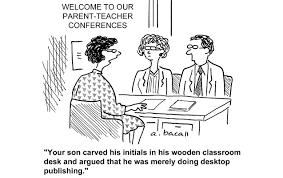
Who Should Lead the Parent-Teacher Conference?

June 1, 2016

parent-teacher

As much as I like the logic of having your students lead the parent teacher conferences, I am grateful taht this doesn’t happen at my school. I prefer meeting with the parents without the child present.

Sometimes vital issues are raised that are not for the child’s ears.

Others such as Monica R. Martinez clearly disagree:


I can still remember the anxiety I felt when my parents went off to school for the traditional biannual parent-teacher conference like it was yesterday. The anxiety I felt was not even rational: I was a good student, I was on the honor role. So why was this so disconcerting? Probably because a set of “authority figures” were discussing and most likely, assessing, my day-to-day behavior, habits and learning strategies. They were sure to talk about what was enhancing or deterring my performance and I knew I would learn all about it later.

I recognize that the purpose of the teacher-led conference is to honor the expertise of the teacher and solidify a relationship between the parent and teacher. This ensures parents can understand and support their children academically. But there is a different, and I believe, better way for parents to learn how to support their students academically – and that is through student-led conferences.

Instead of having students stay home while their parents and teachers talk about them in the third person, have students lead the conference. The student could be prepared for the conference by the teacher through a collaborative review of their previous work and a guided reflection on the connection between their efforts and the quality of their work. The teacher could kick off the conference with an explanation of the process but move to the side or sit across the table with the parents to serve more as a facilitator than the leader. While the specific logistics and dynamics of student-led conferences vary, the basic spirit is the same: This is the student’s moment to take responsibility for their own learning.

Parent-teacher conferences were a good idea in concept but they reflect a tradition that is too centered on adults. Flipping these conferences to be student-led empowers the student and facilitates a partnership between the teacher and parents that is focused on supporting what the student identifies as her strengths and challenges in learning, not what the teacher or parent identifies for the student.


Click on the link to read Tips for Making a Parent-Teacher Relationship Work

Click on the link to read Sometimes It’s Worth Risking a Fight With a Parent

Click on the link to read 10 Tips for Dealing With Difficult Parents

Click on the link to read 5 Helpful Tips for a Better Parent-Teacher Conference

Click on the link to read The Cafeteria Controversy

The Things Our Students Must Know

May 31, 2016

https://www.youtube.com/watch?v=zZy6jRuox-k


There will always be a percentage of students that struggle in various facets of the curriculum. You can’t expect that all your students will be at grade level in Math, Literacy and Science.

What you should expect, however, is that all your students understand and can articulate what a Memorial Day, or in Australia’s case, a Remembrance and Anzac Day commemorates.

It is sad to see so many graduate for school without an understanding or appreciation for those that fought and perished for our country.


Click on the link to read The Education Version of Groundhog Day (Updated)

Click on the link to read Adding Sex Education to the Curriculum Comes at the Expense of Something Else

How to Begin a Successful Lesson

May 30, 2016

https://www.youtube.com/watch?v=GW7tBWxWIPk


They say the reason why students should walk into the classroom in a line is it sets the tone for the lesson. If the class filtered in slowly and in a disorganised fashion, it is likely your lesson will be negatively effected.

The same has to be said of teachers.

The way we enter the classroom is critical to setting the tone of the lesson. If we walk in with presence and energy, we are sending the message that we are eager to share something of value. When we come in looking tired and defeated, we are giving off the impression that we are only fronting up under duress. A teacher under duress shouldn’t be the least surprised when their students feel the same way.

Above is a clip that students secretly made of their teacher. Their Spanish teacher, Señor (Andrew) Ward, has a fun and exciting way of beginning each lesson. Using the Spanish greeting, watch as he opens his lesson with the same words every time – “Buenos días!”

It seems like such a basic thing to do. It’s just welcoming the class at the beginning of the lesson.

But sometimes a happy greeting is all you need.


Click on the link to read Why are So Many Teaching PD’s Dull?

Click on the link to read Teacher Praised after Stripping in Front of Her Students

Click on the link to read Stopping the Doodling Epidemic

Click on the link to read Students Love it When Their Teacher Dares to be Outrageous

What Should Happen to a Teacher Caught Having Sex With a Student

May 23, 2016

Changzhou University

The article below refers to the teacher possibly losing his job for his terrible act. What I want to know, is whether or not he will face prison time for what he did.

If it was up to me, he certainly would.


A shocking video of a teacher having sex with a female student on a classroom desk has gone viral on social media.

The video was apparently filmed by an unidentified person on a mobile phone.

The X-rated video clip shows a male professor having sex with a naked girl who appears to be lying on her back on the desk.

The incident took place at Changzhou University in China’s Jiangsu province.

In the footage, the girl can be seen resting her legs on the man’s shoulder.

According to Live Leak, the professor is currently under investigation for violating the code of conduct.

The footage first appeared on the Chinese social media platform, Weibo and later spread to other platforms as well.


Click on the link to read Teachers Who Make Big Mistakes Should Do Community Service

Click on the link to read It’s Not a Teacher’s Job to Put Limits on Their Students

Click on the link to read How is this Teacher Still in the Classroom?

Click on the link to read You Shouldn’t Get to Apologise to Students You’ve Just Tortured


A Day in the Life of a Substitute Teacher

May 18, 2016

substitute-letter


If teaching can be very hard, substitute teaching can seem impossible at times.

Substitute teachers are often seen as a free opportunity for an unruly class to sabotage. Whilst they would have to be around their classroom teacher all year, a substitute teacher represents an opportunity to make a teacher’s day a living hell. Then this unwitting victim will be never be seen from again. No guilt, no real consequences.

So there is no surprise that this letter above went viral.


Click on the link to read Good Intentions Doesn’t Equate to Good Teaching

Click on the link to read Teachers Have to Maintain Their Self-Control

Click on the link to read Teachers Confess Their Sins

Click on the link to read Sometimes You Don’t Even Realise That You Have Impacted a Student

Saying “No” to Kids is Very Difficult, But Essential (Video)

May 17, 2016


A great clip we can all relate to.


Click on the link to read A Song for Exhausted Mothers

Click on the link to read Girl’s Hilarious Attempt at Getting a Day Off School

Click on the link to read The Love a Child Has for Their Parents Cannot be Properly Measured

Click on the link to read Hilarious School Drop-Off Clip Goes Viral

Just 1% of Children Eat Enough Vegetables

May 11, 2016

Hate-Vegetables

1 percent? Surely not:


Vegies might be brimming with goodness, but less than one per cent of Aussie kids are eating the recommended amount each day.

While children eat, on average, more fruit than adults, they’re having just 1.8 serves of veg a day compared to the recommended 2.5-5.5 serves.

And it doesn’t get much better as we get older, with less than two per cent of men and about four per cent of women meeting the guidelines of five-to-six serves a day.

The findings were based on analysis by the Australian Bureau of Statistics of the 2011-12 National Nutrition and Physical Activity Survey.

The ABS found that overall, most Aussies don’t eat the minimum recommended daily serves from the five major food groups – vegies, fruit, dairy products, lean meats, and grains.

More than one third of our daily intake is now coming from so-called discretionary foods such as sweetened beverages, alcohol, cakes, confectionary and pastries – all of which are high in calories and poor in nutrients.

ABS director of health Louise Gates said that among the five food groups, fruit and grains had the best compliance.

“Less than four per cent of the population consumed enough vegetables and legumes or beans each day,” Ms Gates said as the data was released on Wednesday.

“One-in-10 was meeting the guidelines for dairy products, while one-in-seven consumed the minimum number of serves of lean meats and alternatives per day.”

Health experts say the findings on low vegetable consumption are worrying and probably linked to increased consumption of discretionary foods.

Aloysa Hourigan, senior nutritionist at Nutrition Australia, says the cost of vegetables, particularly in regional and remote areas, is also a factor.

“There could be benefits for having a sugar or fat tax for those discretionary foods to help discourage people from purchasing as many of them and that money could be used to help subsidise other foods,” she told AAP.

Dieticians Association of Australia spokeswoman Kate DiPrima said parents need to be role models for their children by eating more vegetables.

“If the parents don’t eat the recommended amount and aren’t serving them up to their kids, they don’t have any chance,” she said.

Ms DiPrima noted that only 4.5 per cent of kids ate the recommended amount of lean meat and other alternatives including poultry, eggs and tofu, putting them at risk of missing out on protein, iron and zinc.

“The two most commonly rejected foods are vegetables and meat. They’re harder to chew and have stronger flavours,” she said.

She advises parents persist with offering vegetables in all forms – mashed, grated, cooked, roasted, raw – at different times of the day.

“Don’t leave it until dinner at night when they’re tired and can’t chew, they’ll fall off the wagon.”

Just Because Standardized Tests Suck Doesn’t Mean We Have To (Photo)

May 10, 2016

standardized-desks

Today we started our wonderful standardized testing week.

As bad as they are, and they are bad, it gives us the opportunity to inject humor and fun into a potentially stressful week for our students.

Take this novel gesture by a teacher. I’m not sure I’m game to graffiti my classroom desks, but I’m sure the message was greatly appreciated.


Click on the link to read You Can Blame Me for My Students’ Standardized Test Scores

Click on the link to read Teacher Writes Truly Inspirational Letter to Her Students

Click on the link to read Redirect Your Frustrations About Common Core

Click on the link to read Perhaps There Should be a Standardized Test for Teachers