Archive for the ‘Teachers Stress’ Category

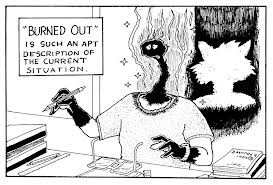
Top 10 Ways of Dealing with Teacher Burnout

June 17, 2013

stress

Courtesy of :

1. Foster Positivity

Instead of focusing on the negative, turn your negative thoughts into positive ones. Every time you think a negative thought reword it in your own mind. Even though this might seem silly, it is the core of internal happiness. No one wants to be around a negative person 24 hours a day. If you are always thinking negative thoughts that’s just what you’re doing to yourself. Therefore, to avoid stress and teacher burnout, you really need to examine the messages you are sending yourself about the job. If every day you are saying, “This job is so hard. There are just too many demands,” then you really are not giving yourself any reason NOT to burn out.

2. Create Realistic To Do Lists

Some people put everything including fixing the kitchen sink on their to-do list each day. There is a point where there are just so many things on a list that there is no way all of them can be accomplished. Therefore, you would be wise to create an overall task list that you need to accomplish and store this someplace where you can check it over each week. Then make yourself a daily to-do list that is reasonable and doable. Try to limit yourself to 3-5 tasks that you can accomplish in one day. Then when you mark them off the list you can feel a sense of accomplishment, and you will have something to celebrate.

3. Accept That There Are Things You Cannot Change

The Prayer of St. Francis is an excellent way to help you accomplish this. Each time something happens beyond your control, you can just ask for the courage to change the things you can, the strength to accept the things you cannot change, and the wisdom to know the difference. While teachers often have a greater degree of control within their own classrooms, real stressors come from the outside. These might be in the form of high stakes testing, educational reforms, or professional development requirements. While teachers cannot change much of what is thrown at them, they can change their own attitudes towards these challenges.

4. Learn to Relax

Many find relaxation through meditation, yoga, or exercise to be the perfect anecdote to a stressful day. When your workday is done, you need to leave the stresses of it and the rest of your life behind, even if only for fifteen minutes. Relaxation and meditation can rejuvenate the body and the spirit. Right now you can begin by just closing your eyes and telling each of your body parts to relax as you sink further into your seat. Then focus on your breathing. If you only did this for five minutes each day, you would see a big difference in your own stress levels.

5. Watch a Funny Movie

Research has proven that laughter often is the best medicine. The natural endorphins that are released while laughing help bring us relief from the stresses of the world. Find something that will really give you a good belly laugh – something that might even make your eyes water from the joy it brings.

6. Try Something New

This might be something you do different during your classes or it could be something in your personal life. Burnout can often be caused by getting caught in a rut. While on the Internet, search for new lessons or materials to help you teach an upcoming topic. Outside of school, find something that you’ve always wanted to try but haven’t done yet. This might be something as simple as enrolling in a cooking class or more ambitious like learning to fly an airplane. You will find that these experiences outside of school will also transform your day-to-day teaching.

7. Leave Your Teaching at School

While this is not always possible, try not to bring home work every night. You might want to consider going into school early so that you can complete your paperwork. Then you will be able to leave as soon as your workday is done. Every person needs that mental break from their work, so use the time in the evening for you and your family.

8. Get Plenty of Sleep

Then number of sleep hours each person needs varies by the study that is being discussed. Yet all the sleep studies that I’ve read make it clear that everyone needs a good night’s sleep to function properly the next day. I know that I personally need at least seven hours to be productive the next day. Figure this number out for yourself and make a date with your bed each night. Your body will thank you! If you are having trouble falling asleep, there are many tools and sleep aids available. Personally, I find having a journal by my bed where I map out the next day’s work and write down any thoughts I might have really helps me fall asleep quickly.

9. Talk to Someone Positive

Sometimes we just need to talk through issues we’re dealing with at school. This can be very helpful when trying to understand difficult situations or when trying to figure out solutions to problems. However, you must be careful who you speak with. There is nothing that can drag someone down faster than a group of disgruntled individuals. If every day you go to the teacher’s lounge and join a couple of teachers complaining about their jobs, you will not be able to fight teacher burnout. My advice to you would be to stay away from those who are disgruntled. Instead, find someone who has a positive outlook on life and talk about teaching with them.

10. Celebrate What It Means to Be a Teacher

Think back to why you became a teacher. You can refer to this top ten list of why teaching is an awesome profession. if it might help. Always remember that teachers are important and valuable to society. Remember and cherish any time that a student gives you a compliment or writes you a teacher appreciation note. One way to celebrate the high points in your teaching career is to create an ‘I Make a Difference Scrapbook‘.

Click on the link to read I Also Had a Student Hold a Toy Gun to my Face

Support Teachers Before they Have a ‘Meltdown’

March 5, 2013

chalk

Teacher meltdowns are often ugly and they are toxic in a school environment. When they occur, inevitably, disciplinary action must be taken to ensure that the offense doesn’t happen again.

Whilst a teacher doesn’t have an excuse when they act unprofessionally, it is vital that more support and greater welfare provisions are available for what is a highly stressful and sometimes quite unforgiving occupation.

The teacher that wrote an intimidating message on the chalkboard of his classroom deserves to be severely punished for his inexcusable actions. However, with 28 years of service, I only wish he would have been able to seek help instead of  feeling the need to vent in such a way:

A northwest Indiana teacher is the subject of a police probe over a threatening message he scrawled on the chalkboard of his classroom.

According to ABC Chicago, the teacher at Edison Junior-Senior High School in Lake Station, Ind., wrote the following message on his chalkboard following after he had a “meltdown” during his sixth-period personal finance class last week:

A.) You are idiots!!!!!!!!B.) The guns are loaded!!!

C.) Care to try me???????

Students took a photo of the message and the image was circulated on social media, prompting school administrators to take action. The teacher was told to leave the school last Friday morning while an investigation into the apparent threat is completed.

Both police and the Lake County prosecutor’s office are working on the matter, according to Fox Chicago, and charges may yet be filed against the teacher.

According to CBS Chicago, the school sent out a district-wide call to students’ parents assuring them that “your student was never in danger” and that “the staff member is currently not in school.”

The teacher, a 28-year veteran of the school, has never been disciplined before, according to ABC.


Click on the link to read I Also Had a Student Hold a Toy Gun to my Face

Click on the link to read Who is Going to Stand Up For Bullied Teachers?

Click on the link to read 12 Tips for Managing Time in the Classroom

Click on the link to read If Teachers Were Paid More I Wouldn’t Have Become One

Click on the link to read Different Professions, Same Experiences

Click on the link to read Our Pay Isn’t the Problem

November 11, 2012

A funny post by a teacher quite sick of the same old questions.

Different Professions, Same Experiences

September 5, 2012


It’s interesting how teachers often complain as if their problems and challenges are completely unique.

Some point out that they take their work home unlike many other professions.

Others talk about the low wages and hostile work environment.

Many talk about the troubles they have from bullying parents.

In truth, there are a myriad of different professions that struggle with similar problems to that of a teacher. They may not be similar occupations on the surface, but they can have almost identical constraints.

I recently had the pleasure of reading Vadim Chelom’s brilliant new book, Vet Bites Dog. Vadim is a veterinarian and fellow blogger who has a keen interest in educational affairs. He used his expertise to design a program for teachers to help instruct children about dog safety practices. In Vet Bites Dog, a book about his experiences working at a not-for-profit animal clinic, Chelom writes the following:

I take another deep breath. 8PM is just around the corner. People often say that being a veterinarian must be hard because our patients can’t talk to us. The truth is, it’s not our patients which make our work a challenge. More often than not it’s the animal on the other end of the lead. Learning to treat pets is easy. Learning to ‘treat’ their owners is what takes years of practice, boundless patience and expert negotiation skills.

Sounds familiar to the plight of a teacher?

I think it’s important to realise that teaching has it’s unique issues and challenges, but essentially all job with deadlines, paperwork, bosses, expectations and key performance indicators are distinctly similar in many ways.

I urge you to grab a copy of Dr. Chelom’s book. It’s hilarious, revealing and brilliantly written. You may, like me, realise you have much more in common with a vet than had previously thought.

Click on the link to read If Teachers Were Paid More I Wouldn’t Have Become One

Our Pay Isn’t the Problem

August 22, 2012

Teachers have more to complain about than their pay. Sure, it would be nice to get paid more, but let’s face it, our nation can’t afford a substantial pay rise and we are not being completely ripped off. No teacher enters into the profession with the intention of making a sizeable income.  We know that we will always be paid less than the ideal amount.  

It is the conditions we face that we should be most concerned about. The obsession with changing curriculums every two years without any apparent reason, the increase in planning paperwork that robs us of time to devote to other aspects of our job and the crazy overregulation which has shifted the focus from quality education to lawsuit damage control.

Rita Panahi is right to point out that a teacher’s pay is no reason to strike:

Why, one wonders, do presumably intelligent people study for four years to enter a profession where they find the pay so unacceptable?

It’s akin to buying a house near an airport then complaining about aircraft noise.

If money is what motivates you then teaching is probably not the job for you.

Higher pay comes with greater scrutiny but teachers have fought hard against attempts to link their wages to their performance.

Under the current system, which the Australian Education Union desperately wants to retain, almost all teachers automatically move up the pay scale every year regardless of their ability, effort or suitability for the job.

This absurdity helps to explain a 2009 survey of teachers which found that nine out of 10 of them don’t believe their school would acknowledge improvements in the quality of their work, while seven out of 10 believed their consistently underperforming colleagues were in no danger of losing their jobs.

Actually, despite the persistent whingeing we’ve grown used to from teachers, they are hardly surviving on the breadline.

A first year teacher can expect to earn around $57,000, which is more than graduate paramedics, accountants and substantially more than nurses. This can rise to more than $90,000 at leading teacher level.

Not bad for a job with enviable hours and holidays of which most of us can only dream.

Click on the link to read If Teachers Were Paid More I Wouldn’t Have Become One
 
Click on the link to read “Better Pay Leads to Better teachers”: Prove it!
 
Click on the link to read The Overwhelming Responsibilies of the Modern Teacher

Why is it so Hard for Burnt-Out Teachers to Retire?

July 27, 2012

The current system of paying off burnt-out teachers with a $50,000 pay ‘bonus’ in order to get them to retire is very troubling. How come we don’t have the same problem with burnt-out nurses, policemen, social workers and veterinarians? They seem to leave when the passion has eroded. Why is it so hard to get our teachers to leave?

UNMOTIVATED, ageing public school teachers look set to be offered another round of $50,000 “burnout bonuses” to quit.

An Australian Taxation Office ruling reveals that the Education Department has applied for and been given permission to provide early retirement packages this financial year under the Teacher Renewal Program.

Under the scheme, 103 experienced teachers accepted the payout last year, freeing up 100 permanent positions for graduates and early career teachers.

A department spokeswoman said the Government had not yet committed to implementing a second round in 2012-13.

“The recent Teacher Renewal Program was highly successful,” the spokeswoman said.

Perhaps a better question is why do our teachers burn out so quickly?

My view is that teachers are burning out alarmingly young. Perhaps then, the bigger issue is addressing the incredible workload and stress levels faced by a modern teacher rather than the urge to have a burnt-out teacher replaced by another teacher destined to commence their own rapid journey into Burnoutsville.

Click on the link to read I’m Drowning in Paperwork: Please Pass the Snorkel

Click on the link to read It isn’t that Hard to Make a “Poor” Teacher a “Good” One

Click on the link to read The Overwhelming Responsibilies of the Modern Teacher

Click on the link to read That’s Right, Blame the Teachers

5 Tips for Stressed Teachers

July 16, 2012

Beth Morrow has provided 5 useful tips for stressed teachers. I particularly agree with number 4:

Take a walk.
Sounds too easy and too good to be true, right? But give walking a try and you may find that with fresh air often comes a fresh perspective. Walking releases endorphins, the body’s natural stress-relieving hormones, which have been proven to increase energy, focus and positive mental processes. In the long run, research shows walking lowers the risk of heart disease and other health-related issues. Best of all, it’s free!

Get Up 15 Minutes Earlier
Or, if you’re a night owl, stay up 15 minutes later. Use this time to plan tomorrow’s activities, read a book, have a cup of tea, meditate, treat yourself to a piece of chocolate and just enjoy the peace that comes with a quiet household. Do NOT use this time to clean house, pay bills, grade assignments or anything which already causes stress during the regular day. You’ll have plenty of time for that once the day kicks into gear.

Seek Out Positive People
Often this is easier said than done. We all have colleagues, family, friends and parents who drag us down, regardless of the issue. You know who they are–they leave you feeling empty, alone, bitter, angry and defeated the instant you see them. Managing stress requires that you limit or eliminate the sources of negative energy around you and focus on the positive. It can be difficult if you discover a longtime friend or teacher next door drags you down, but by limiting your interaction with that person you’ll open up opportunities for interacting with people who inspire, excite and share your enthusiasm for teaching and life.

Just Say No
As teachers, we’re innately programmed to volunteer when others do not. Our guiding mantra–do it for the kids–at times puts more on our plate than we can realistically handle. But being overwhelmed and overscheduled can be detrimental to both you and your students. Make a list of the two or three programs or volunteer opportunities you truly enjoy or believe your students benefit most from and limit your participation to those. Resist the urge to raise your hand when something pops up at staff meetings, even if others claim dire consequences if you don’t help. Be flattered, be pleased your involvement was noticed, then say you’d like someone else to enjoy organizing or participating. If you feel pressured, ask for time to think about it (knowing you’ll just turn them down in private the next day!).

Create Your Own Oasis
The key to making this a successful stress reliever is choose something you love and allow nothing to intrude on that time you’ve created. Maybe Wednesday evenings you can plan dinner at your favorite restaurant. Or go to the newest movie every Saturday afternoon. Money isn’t necessary, however. Lock the bathroom door on Friday nights and treat yourself to a hot bubble bath. Do thirty minutes of yoga every day after school. Lose yourself in your favorite mindless television show. Plan in advance and honor that time no matter what threatens to intrude. After all, if you don’t treat yourself as if you’re worth the time, you can’t expect others to, either.


Click here to read my post, ‘Ten Useful Tips for Improving Classroom Management’.

It isn’t that Hard to Make a “Poor” Teacher a “Good” One

July 12, 2012

There is a theory among educational circles that a struggling teacher can’t improve. This is probably true in today’s climate, but it isn’t a reflection on under-performing teachers, but rather a reflection on the total lack of support given to teachers.

A teacher’s journey begins with a pressurised, yet basically completely useless, teacher training course. This course not only fails to provide teachers with the requisite practical skills but is often taught and run by former teachers who are overjoyed at the prospect of finally being out of the classroom.

Then, if that teacher is lucky enough to score a job at a school with resources, a track record of half-decent behaviour and academic standards (because let’s face it – graduate teachers often go to the toughest schools to teach in), they are left on their own. No mentor, no support system. They are put in an environment where every teacher is in charge of their own classroom and teamwork is often non-existent.

That teacher can always break the unwritten rule and ask for help, but that would be a mistake. A graduate teacher’s first contract is usually a 12-month trial run. That teacher cannot afford to advertise their uncertainty and lack of experience. Teachers are overburdened as it is and many resent having to help an amateur when they have an ever-increasing workload to deal with. Therefore, a graduate teacher that asks for help risks not having their contract extended, thereby risking future employment.

So what do these teachers do? They learn on the job. And that’s where mistakes are made and bad habits are formed.

These bad habits sometimes make them look like “poor” teachers. Many of them are just well intentioned teachers who have never been given the support they needed.

The public are probably very supportive of new regulations that makes it harder for teachers branded “incompetent” from finding a new teaching job. I bid them to see beyond the labels and call on the system to support our teachers rather than replacing them for a newer version of the same thing:

For the first time, schools will be given legal powers to find out whether staff applying for new jobs have previously been subjected to official warnings.

Former employers will be required to disclose any disciplinary action taken against teachers over the last two years to give new schools a more comprehensive picture of their ability.

The regulations – being introduced from this September – come amid fears that too many schools allow weak teachers to leave and find new jobs rather than draw attention to their performance.

In the last decade, just 17 staff in England have been officially struck off for incompetence.

But teachers’ leaders insisted that the regulations would treat teachers “worse than criminals” and force some out of the profession altogether.

Click here to read about how I would solve the problem of the unsupported teacher.

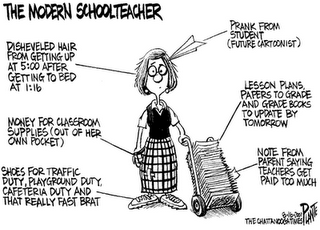
The Overwhelming Responsibilies of the Modern Teacher

March 26, 2012

I just read a brilliant piece by teacher Daniel Cohen.

Whilst I differ from the author of this article in one key area, I believe the article presents a most accurate account of the day-to-day challenges that face working teachers. I don’t agree with the premise that for all the hard work we put in, we receive little in return. Yes, we are underpayed. But what we do get back from our students can not be easily quantified.

Even still, his assessment on the daily rigours and insane paperwork and planning requirements is captured brilliantly in the article.

I BECAME a teacher to help children learn.

I’m now working with at-risk children who do not cope in a mainstream setting.

They have emotional and behavioural issues affecting their ability to perform and succeed within school.

They, like all students, need a strong teaching profession.

I see the role of teachers as both educating students and preparing them for society as adults.

A lot of the focus is on literacy and numeracy.

As a teacher, I believe there are a lot more skills that students need than just reading and writing.

It’s my role to help them develop into adults.

Teaching is the closest thing you can get to being a parent without having children.

Like parents, teachers form relationships with children that are central to a child’s learning and development.

We help them sort out personal problems and friendship issues.

We help with knowledge in an academic sense. But we also help them learn to interact and deal with people and how to get along.

They can’t learn subject content if they can’t work with others.

And they can’t learn to work with other people in isolation. That’s part of a teacher’s role as well as a parent’s.

Day to day, students attend classes between 9am and 3.30pm.

When the students are at school, the teacher’s whole focus is on working with them.

Preparing lessons, correcting work, organising meetings and other duties associated with being part of a workplace all happen outside of class time.

A teacher’s legal and professional responsibility to students does not end when students aren’t around.

A lot of that happens during a teacher’s personal time.

Our tasks – attending staff meetings outside of class, correcting and checking work and so on – cannot be properly completed within normal, paid allocated time.

Because teachers are in a workplace, we have Occupational Health and Safety obligations to fulfil, such as ensuring that the school is safe and correct procedures are followed in classroom safety.

We are required to provide supervision and ensure that the classroom is a safe environment.

Also, we must formally report on any issues involving child welfare.

These are just some of the very serious responsibilities all teachers assume.

Watching students is difficult.

When you have 27 students, ensuring they are all safe and within sight at all times can be quite time-consuming.

The pay situation as it is now makes me feel really undervalued by my employer – the State Government. I’m disappointed and upset that our pay negotiations have not been progressing.

The work we do is essential.

To have the Government stall undervalues our work and undervalues the education that children deserve.

Failing to pay us properly means we’re not given the resources or time we need to do the best for our students – Victoria’s children.

We’re using our own time to do more for the students because we think it’s important. Teachers want what’s best for students.

Without proper pay, my worry is that the profession will suffer and good teachers will leave.

Those who stay may suffer ill-health because they are not given enough time to properly do the job.

We already have a shortage of teachers.

Without proper pay, we will struggle to keep the ones we have or to recruit new ones.

Teachers put in the extra time because they’re doing what’s best for their students.

But without support from their employer, it is increasingly difficult for teachers to keep on doing that important work.

The Government wants more productivity.

That will be achieved by giving teachers the resources they need and by supporting the profession.

Teacher Morale at an All Time Low

March 8, 2012

Should we be the least bit surprised that teachers are generally not getting job satisfaction? Did anyone consider for a moment that the introduction of standardised testing would do little for student achievement and do even less for teacher morale?

Or better yet, an even more compelling question, does anyone even care about the plight of teachers?

As long as Governments keep on peddling their diatribe about how many poor teachers there are in the system and how they are determined to expose them before slowly weeding them out. As long as Educational bureaucrats have someone to blame for low achievement levels, then why should they care?

Sure there are more stakeholders in the educational system than just teachers, and it’s true that teachers aren’t the only ones responsible for disappointing academic figures, But who cares? As long as the public buy the spin about the poor state of the teaching fraternity, it doesn’t really matter that spending on education is mismanaged and misallocated, curriculums are inflexible and politically motivated and the paperwork expectations of teachers are extremely unfair. Why should it matter?

“Those hopeless teachers! All they ever do is complain!”

So, no, I am not surprised the teachers of New York are not enjoying themselves:

More than half of teachers expressed at least some reservation about their jobs, their highest level of dissatisfaction since 1989, the survey found. Also, roughly one in three said they were likely to leave the profession in the next five years, citing concerns over job security, as well as the effects of increased class size and deep cuts to services and programs. Just three years ago, the rate was one in four.

The results, released in the annual MetLife Survey of the American Teacher, expose some of the insecurities fostered by the high-stakes pressure to evaluate teachers at a time of shrinking resources. About 40 percent of the teachers and parents surveyed said they were pessimistic that levels of student achievement would increase in the coming years, despite the focus on test scores as a primary measure of quality of a teacher’s work.

Sandi Jacobs, vice president of the National Council on Teacher Quality, a nonpartisan advocacy group in Washington, said the push for evaluations, punctuated by a national movement to curb the power of unions, had fostered an unsettling cultural shift.

“It’s easy to see why teachers feel put upon, when you consider the rhetoric around the need to measure their effectiveness — just as it’s easy to see why they would internalize it as a perception that teachers are generally ineffective, even if it’s not what the debate is about at all,” Ms. Jacobs said.

More than 75 percent of the teachers surveyed said the schools where they teach had undergone budget cuts last year, and about as many of them said the cuts included layoffs — of teachers and others, like school aides and counselors. Roughly one in three teachers said their schools lost arts, music and foreign language programs. A similar proportion noted that technology and materials used in the schools had not been kept up to date to meet students’ needs.

“The fixation on testing has been a negative turn of events when the things that engage kids in schools are all being cut,” said Randi Weingarten, president of the American Federation of Teachers.

I could argue that unless teachers are given the conditions and freedom to thrive in their workplace the results are not going to come. But solutions have never been an urgent matter for politicians. They are far more interested in scapegoats – and let’s just say, teachers make great scapegoats!