Archive for the ‘Teacher Training’ Category

It is Refreshing When a Teacher Shows His ‘Human’ Side

January 12, 2014

On of the biggest issues I have with the current teacher training courses is the philosophy that teachers need to avoid emotional involvement with their students. To me, avoiding emotional involvement is akin to being emotionally distant. In University we were told not to smile in the first term of the year and we were warned that students are looking to befriend their teacher as a means of reducing their power and exploiting them.

This is of course complete rubbish. Teachers should be encouraged to connect with their students and should always make an effort to be approachable and easy to relate to. I couldn’t bear teaching if it meant I was unable to smile. And I may be naive, but I don’t see my students as schemers, but rather promising young individuals with a lot going for them.

I love the video above, because it reinforces the notion that a teacher can be respected for taking the time to connect with his students. Even if it makes him look a bit silly.

Click on the link to read my post Tips For New Teachers from Experienced Teachers

Click on the link to read my post, Do experienced teachers give enough back to the profession?
Click on the link to read, ‘Teachers Trained Very Well to Teach Very Poorly

Click on the link to read my post 25 Characteristics of a Successful Teacher

Click on the link to read my post 10 Important Tips for New Teachers

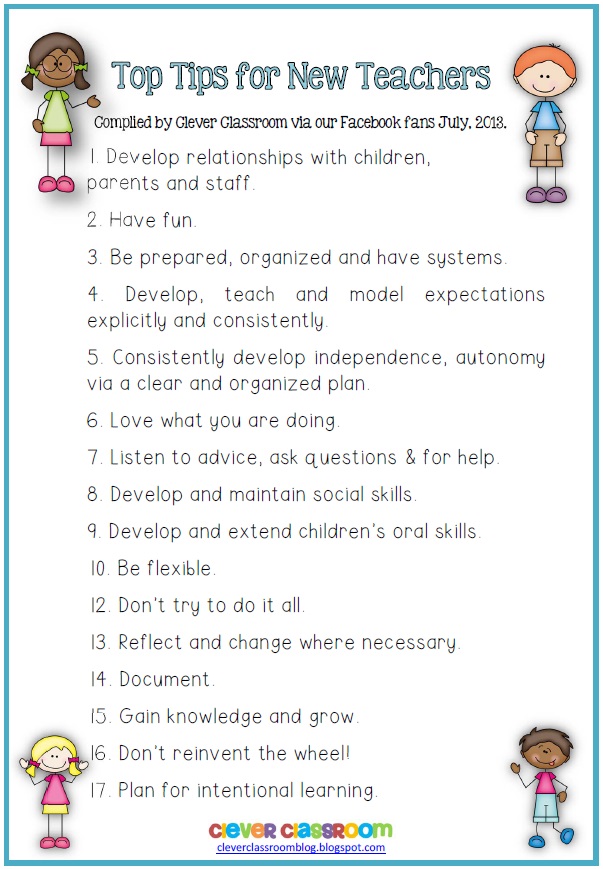
Tips For New Teachers from Experienced Teachers

October 9, 2013


Some brilliant advice courtesy of teachthought.com:


tips

Click on the link to read my post, Do experienced teachers give enough back to the profession?
Click on the link to read, ‘Teachers Trained Very Well to Teach Very Poorly

Click on the link to read my post 25 Characteristics of a Successful Teacher

Click on the link to read my post 10 Important Tips for New Teachers


10 Important Tips for New Teachers

September 2, 2013


new


Courtesy of Alex Quigley at huntingenglish.com:

1. Expectation is everything. Call it a self-fulfilling prophesy or the ‘Pygmalion effect‘ – but it is simple common sense that the expectations a teacher has for their students has a huge impact upon how they will go on to perform. New teachers need to possess an infinite capacity for hope and optimism: despite the challenging students, the bad days at the whiteboard and the energy whittling workload. Such optimism helps us to retain high expectations in the face of such spirit-sapping salvos. Couple high expectations with both determination and perseverance and you have the qualities to survive and thrive in teaching.

2. ‘The Rule’: ‘No speaking when I’m speaking’. If one small ring can rule Middle Earth, then one simple rule can surely spread orderliness in our classrooms. Novice teachers often take for granted that students understand what we mean by the simple act of listening. They don’t. Show them what ‘active listening‘ looks like and feels like. Hold onto this one rule like a wild dog with lock-jaw. They need to listen to you and others – unequivocally. Explain, repeat and reiterate exactly why listening makes for successful learning. Expect it and demand it consistently.

3. Consistency is king. Good teaching is all about consistency. Forget about brass band parades that masquerade as outstanding lessons. Great teachers grind away at challenging learning; they have clear classroom rules and they use them consistently and with unstinting fairness. Students may not like your rules, or the challenge presented by your towering standards, but if you are consistent and relentless they will respect you. Execute your three Rs: relentless and rigorous routines. You can smile before Christmas (a smile is an excellent behaviour management tool) or whenever you like, just be consistent.

4. Focus on feedback. I will spare you the catalog of research, but feedback matters. It works. Formative assessment is the daddy, so ensure your written feedback is top notch (I have written a post with some tips here) and don’t forget how crucial oral feedback can be for developing the knowledge and understanding in every lesson (once more, I have a doc for that! See here).

5. Ask great questions. Sometimes even the best of teachers are distracted by shiny new teaching tools or the latest acronym driven craze to sweep the teaching nation. Effective teaching comes down to what effective teaching has been built upon since Socrates was busy corrupting the youth of Athens – great questions! We want students to hoover up knowledge and understanding and asking great questions lets us know exactly what they know and what they need to know. Probe and prize away at your little cherubs to help them succeed. This post of mine hopefully (my most popular) can give you a few further tips for great questioning – see here.

6. Know thy student. Relationships matter. In most classes many students spend hours with their teacher but they actually spend little time speaking directly to them. We need to develop our knowledge of students so that we can develop our relationships and best help them learn. As stated in tip 5, we need to know what they know and what they need to know. We also need to know the nuances of their character: who they work well with, why they are in a sleepy stupor when they should be slaving away, or what books they enjoy reading. Don’t be frightened of data. It helps. Own the data and don’t let it own you. All this information connects to successful learning. I won’t go into the nuances of differentiation and all that jazz, but that is about knowing your students too. The better we know the students in front of us the better we can help them learn. Simple.

7. Make lists. Make a list of your lists! Being an NQT can be a confusing storm of activity. Any given Monday can be a dizzying barrage of lessons, meetings, data management jobs etc etc etc. So make lists. Identify priorities on those lists (I suggest your lesson planning and marking are high on the priority agenda) and manage them as best you can. Allocate colour codes, timings, deadlines, or whatever helps you to get the job done.

8. Ask lots of questions. The best teachers were never the most assured novices. They were/are humble enough to know they need help and support. They ask lots of great questions. The seek out knowledge and ask politely for help. Don’t worry if your mentor or Subject Leader appear snowed under, it is their professional responsibility to guide you. Not asking questions will likely cause you and them more work and heartache in the long run!

9. Learn to say no. By all means get involved in the social life of the school. Build support networks, make friends and keep what is the crumbling semblance of a personal life, but also learn to say no. Being a new teacher is incredibly hard. Select a school trip perhaps, but don’t book a season ticket for such trips. Read a good book, but don’t look to run the book club. What you are aiming for is that pot of gold at the end of the rainbow – a work/life balance. If you find it please let me know and we can share the patent!

10. Build a memory palace. This a cracking revision strategy for students – see here – but my version is one where you build a palace where you store rooms full of positive fragments from your novice teaching experiences. Those moments to actively remember are that make the crappy days tolerable. The moment diffident David bellows out an inspired answer like a modern day eureka, or when your resident hardened crim’ solves a quadratic equation or unpicks a Hamlet soliloquy. Place the small card at Christmas from the unassuming quiet kid on the mantle-piece of your memory palace. Remember and revisit the good stuff. The fragments we shore against our ruin. They make perseverance possible. They pave the pathway from novice to toughened expert.


I particularly like points 6 and 8.


Click on the link to read my post, Do experienced teachers give enough back to the profession?
 
Click on the link to read, ‘Teachers Trained Very Well to Teach Very Poorly

Click on the link to read my post 25 Characteristics of a Successful Teacher

Women Teachers Lack Confidence in Teaching PE: Lord Coe

July 28, 2013


coe


Was Lord Coe being sexist or merely relating the findings of research? You be the judge:

Lord Coe was plunged into a sexism row last night after saying that most women teachers lack the confidence to take PE lessons in primary schools.

The former London 2012 chairman blamed their failings on training colleges that offer only six to ten hours of sports tuition over two years.

Although he was simply highlighting research carried out by a sports charity, his comments drew an angry backlash.

‘It is entirely unacceptable to be peddling such sexist nonsense,’ said Christine Blower, general secretary of the National Union of Teachers.

‘I’m sure Jessica Ennis and all those other female Olympians would be outraged by such views. To imply that female primary school teachers don’t have as much ability as men to teach sport isn’t right.’

But Lord Coe, the Government’s Olympic legacy ambassador, insisted it was not a question of ability, but one of training.

‘I was shocked by how little they get,’ he said.

‘Eight out of ten teachers in primary schools are women. And this is not remotely pejorative but I think that something like 80 per cent of them said they just did not feel confident taking physical education.

‘I am guessing that there will be a lot of men who will feel the same way.’

Lord Coe has long emphasised the ‘crucial’ need to provide better PE teaching in primary schools.

Click on the link to read my post, Do experienced teachers give enough back to the profession?
Click on the link to read, ‘Teachers Trained Very Well to Teach Very Poorly
Click on the link to read my post 25 Characteristics of a Successful Teacher


School Gun Lessons a Disaster!

March 1, 2013

gun teach

I told you it was a terrible idea, but I wasn’t aware of just how bad it would be:

An employee at a Texas public school was accidentally shot on Wednesday during a district-sponsored handgun safety class, KLTV reports.

According to KLTV, Glenn Geddie was a maintenance worker for the Van Independent School District. The school district voted last month to arm some teachers and other employees in the aftermath of the Sandy Hook Elementary School shooting in Newtown, Conn.

District Superintendent Don Dunn confirmed that the incident occurred. Here’s his full statement, courtesy of KLTV:

At the conclusion of the CHL training on February 27, 2013, one certified person stayed for private instruction with the instructor and had a mechanical malfunction with his weapon. With the assistance of the instructor, the malfunction was addressed, but the gun misfired and the bullet ricocheted coming back to strike the VISD employee in the left leg. The VISD employee was attended to at the scene and transferred to Tyler for further treatment. The injury is not life threatening or disabling. Because of privacy and security issues we cannot make any further statement.

A school board member told The Tyler Morning Telegraph that the shooting would not affect their decision to arm employees on campus.

Many schools have begun to arm teachers in the wake of Sandy Hook. Schools from Texas to Ohio are allowing teachers to bring guns to school, and some states, like South Dakota, have begun to pass legislation to allow guns in schools.


Click on the link to read Living With Adam Lanza

Click on the link to read School Shooting Showcases the Heroic Nature of Brilliant Teachers

Click on the link to read Let’s Make Sure that this School Shooting is the Last

Click on the link to read Get Rid of Your Guns!

Click on the link to read Explaining the Sandy Hook Elementary School Shooting to Children

25 Characteristics of a Successful Teacher

February 4, 2013

bed

Courtesy of the great site opencolleges.edu.au:

1. Successful teachers have clear objectives

How do you know if you are driving the right way when you are traveling somewhere new? You use the road signs and a map (although nowadays it might be SIRI or a GPS). In the world of education, your objectives for your students act as road signs to your destination. Your plan is the map. Making a plan does not suggest a lack of creativity in your curriculum but rather, gives creativity a framework in which to flourish.

2. Successful teachers have a sense of purpose

We can’t all be blessed with “epic” workdays all the time. Sometimes, life is just mundane and tedious. Teachers with a sense of purpose that are able to see the big picture can ride above the hard and boring days because their eye is on something further down the road.

3. Successful teachers are able to live without immediate feedback

There is nothing worse than sweating over a lesson plan only to have your students walk out of class without so much as a smile or a, “Great job teach!” It’s hard to give 100% and not see immediate results. Teachers who rely on that instant gratification will get burned out and disillusioned. Learning, relationships, and education are a messy endeavor, much like nurturing a garden. It takes time, and some dirt, to grow.

4. Successful teachers know when to listen to students and when to ignore them

Right on the heels of the above tip is the concept of discernment with student feedback. A teacher who never listens to his/her students will ultimately fail. A teacher who always listens to his/her students will ultimately fail. It is no simple endeavor to know when to listen and adapt, and when to say, “No- we’re going this way because I am the teacher and I see the long term picture.”

5. Successful teachers have a positive attitude

Negative energy zaps creativity and it makes a nice breeding ground for fear of failure. Good teachers have an upbeat mood, a sense of vitality and energy, and see past momentary setbacks to the end goal. Positivity breeds creativity.

6. Successful teachers expect their students to succeed

This concept is similar for parents as well. Students need someone to believe in them. They need a wiser and older person to put stock in their abilities. Set the bar high and then create an environment where it’s okay to fail. This will motivate your students to keep trying until they reach the expectation you’ve set for them.

7. Successful teachers have a sense of humor

Humor and wit make a lasting impression. It reduces stress and frustration, and gives people a chance to look at their circumstances from another point of view. If you interviewed 1000 students about their favorite teacher, I’ll bet 95% of them were hysterical.

8. Successful teachers use praise smartly

Students need encouragement yes, but real encouragement. It does no good to praise their work when you know it is only 50% of what they are capable of. You don’t want to create an environment where there is no praise or recognition; you want to create one where the praise that you offer is valuable BECAUSE you use it judiciously.

9. Successful teachers know how to take risks

There is a wise saying that reads, “Those who go just a little bit too far are the ones who know just how far one can go.” Risk-taking is a part of the successful formula. Your students need to see you try new things in the classroom and they will watch closely how you handle failure in your risk-taking. This is as important as what you are teaching.

10. Successful teachers are consistent

Consistency is not to be confused with “stuck.” Consistency means that you do what you say you will do, you don’t change your rules based on your mood, and your students can rely on you when they are in need. Teachers who are stuck in their outdated methods may boast consistency, when in fact it is cleverly-masked stubbornness.

11. Successful teachers are reflective

In order to avoid becoming the stuck and stubborn teacher, successful educators take time to reflect on their methods, their delivery, and the way they connect with their students. Reflection is necessary to uncover those weaknesses that can be strengthened with a bit of resolve and understanding.

12. Successful teachers seek out a mentor for themselves

Reflective teachers can easily get disheartened if they don’t have someone a bit older and wiser offering support. You are never too old or wise for a mentor. Mentors can be that voice that says, “Yes your reflections are correct,” or “No, you are off because….” and provide you with a different perspective.

13. Successful teachers communicate with parents

Collaboration between parents and teachers is absolutely crucial to a student’s success. Create an open path of communication so parents can come to you with concerns and you can do the same. When a teacher and parents present a united front, there is a lower chance that your student will fall through the cracks.

14. Successful teachers enjoy their work

It is easy to spot a teacher who loves their work. They seem to emanate contagious energy. Even if it on a subject like advanced calculus, the subject comes alive. If you don’t love your work or your subject, it will come through in your teaching. Try to figure out why you feel so unmotivated and uninspired. It might have nothing to do with the subject, but your expectations. Adjust them a bit and you might find your love of teaching come flooding back.

15. Successful teachers adapt to student needs

Classrooms are like an ever-evolving dynamic organism. Depending on the day, the attendance roster, and the phase of the moon, you might have to change up your plans or your schedule to accommodate your students. As they grow and change, your methods might have to as well. If your goal is to promote a curriculum or method, it will feel like a personal insult when you have to modify it. Make connecting with your student your goal and you’ll have no trouble changing it up as time moves on.

16. Successful teachers welcome change in the classroom

This relates to the above tip, but in a slightly different way. Have you ever been so bored with your house or your bedroom, only to rearrange it and have it feel like a new room? Change ignites the brain with excitement and adventure. Change your classroom to keep your students on their toes. Simple changes like rearranging desks and routines can breathe new life in the middle of a long year.

17. Successful teachers take time to explore new tools

With the advance of technology, there are fresh new resources and tools that can add great functionality to your classroom and curriculum. There is no doubt that the students you are teaching (far younger than you) probably already use technologies you haven’t tapped into yet. Don’t be afraid to push for technology in the classroom. It is often an underfunded area but in this current world and climate, your students will be growing up in a world where technology is everywhere. Give them a headstart and use technology in your classroom.

18. Successful teachers give their student’s emotional support

There are days when your students will need your emotional support more than a piece of information. Connecting to your students on an emotional level makes it more likely that they will listen to your counsel and take your advice to heart. Students need mentors as much as they need teachers.

19. Successful teachers are comfortable with the unknown

It’s difficult to teach in an environment where you don’t know the future of your classroom budget, the involvement of your student’s parents, or the outcome of all your hard work. On a more philosophical level, educators who teach the higher grades are tasked with teaching students principles that have a lot of unknowns (i.e. physics). How comfortable are you with not having all the answers? Good teachers are able to function without everything tied up neatly in a bow.

20. Successful teachers are not threatened by parent advocacy

Unfortunately, parents and teachers are sometimes threatened by one another. A teacher who is insecure will see parent advocacy as a threat. While there are plenty of over-involved helicopter parents waiting to point out a teacher’s mistakes, most parents just want what’s best for their child. Successful educators are confident in their abilities and not threatened when parents want to get into the classroom and make their opinions known. Good teachers also know they don’t have to follow what the parent recommends!

21. Successful teachers bring fun into the classroom

Don’t be too serious. Some days, “fun” should be the goal. When students feel and see your humanness, it builds a foundation of trust and respect. Fun and educational aren’t mutually exclusive either. Using humor can make even the most mundane topic more interesting.

22. Successful teachers teach holistically

Learning does not happen in a vacuum. Depression, anxiety, and mental stress have a severe impact on the educational process. It’s crucial that educators (and the educational model) take the whole person into account. You can have the funniest and most innovative lesson on algebra, but if your student has just been told his parents are getting a divorce, you will not reach him.

23. Successful teachers never stop learning

Good teachers find time in their schedule to learn themselves. Not only does it help bolster your knowledge in a certain subject matter, it also puts you in the position of student. This gives you a perspective about the learning process that you can easily forget when you’re always in teaching mode.

24. Successful teachers break out of the box

It may be a self-made box. “Oh I could never do that,” you say to yourself. Perhaps you promised you’d never become the teacher who would let students grade each other (maybe you had a bad experience as a kid). Sometimes the biggest obstacle to growth is us. Have you built a box around your teaching methods? Good teachers know when it’s time to break out of it.

25. Successful teachers are masters of their subject

Good teachers need to know their craft. In addition to the methodology of “teaching”, you need to master your subject area. Learn, learn, and never stop learning. Successful educators stay curious.

Click on the link to read my post, Do experienced teachers give enough back to the profession?
Where Have These So-Called “Master Teachers” Been All this Time?

July 19, 2012

I am very frustrated by the lack of investment from many of our “best teachers” in helping mentor their less experienced and less confident colleagues.

In a post in May, I raised the question – Do experienced teachers give enough back to the profession? I argued that these experienced teachers could be a vital resource for improving teacher quality.

It seems President Obama agrees:

President Barack Obama on Wednesday proposed a $1 billion program to recruit high-performing math and science teachers to mentor and evaluate their peers and help students excel.

The so-called Master Teacher Corps program calls for recruiting 2,500 such educators at the outset and increasing that to 10,000 over four years, paying them $20,000 stipends on top of their base salaries. Each teacher would be required to serve at least four years.

To help launch the program, the Obama administration has pledged to release $100 million already available to school districts that have made plans to develop and retain effective teachers of science, technology, engineering and math, or STEM.

Education Secretary Arne Duncan said the plan would raise the prestige of the profession and increase teacher retention.

I just wish experienced teachers could offer more voluntarily without having to be bribed to help with costly incentives.

Click on the link to read my post, Do experienced teachers give enough back to the profession?

Teachers Considered “Highly Qualified” After 5 Weeks of Training

July 18, 2012

Of course a student learning to become a teacher has not developed the skills to justifiably call themselves a “highly qualified” teacher. Sadly, with teacher training at such a poor standard, they could be studying for 5 years and it wouldn’t make much difference:

Today a U.S. House appropriations subcommittee will consider legislation that would allow students still learning to be teachers to be considered highly qualified teachers under federal law.

The nonprofit organization Teach for America places college graduates into high needs schools after giving them five weeks of training in a summer institute. The TFA corps members, who are required to give only a two-year commitment to teaching, can continue a master’s degree in education with selected schools while teaching.

Of course it doesn’t make any real sense that a new college graduate with five weeks of ed training or any student teacher should be considered highly qualified — because they aren’t. But federal officials inexplicably partial to Teach for America have bestowed millions of dollars on the organization, and TFA has, not surprisingly, lobbied Congress for this legislation.

The truth is, that 5 weeks of practical observation and teaching is far more beneficial that years of theory and mindless lectures.

Click on the link to read, ‘Teachers Trained Very Well to Teach Very Poorly

Why Our Schools are in Crisis

July 16, 2012

Xavier Symons wrote a compelling examination of our failing education system. He pinpoints three areas where things are going awry:

The first is student-oriented learning. Traditional teaching in which teachers provide a succinct overview of topics is an endangered species. Student orientated, interactive learning has almost completely displaced it.

Certainly, there are benefits: creativity, enthusiasm, research skills. But why not pour a bit of expert knowledge from the well into the bucket? My friends and I loved having a teacher who had just graduated from education school. Student-centred learning for us meant student rule. It was great fun. We just didn’t learn much.

The second problem is the obsession with IT literacy. Students know heaps more than most teachers about IT. X-Box and circumventing internet filters and downloading movies is child’s play for this generation.

IT literacy is like learning to ride a bike: you don’t need school. But essay writing skills? We did need a teacher for that. In the worst cases, students end up pooling ignorance in meandering discussions, and scratching their heads in bewilderment.

As a high school student, I built and produced pictorial essays using film software. Some of my friends made mind maps on smart boards and podcast radio plays. The latest fad is educational games on iPads.

I certainly became IT literate. But it was at the expense of English proficiency and knowledge of history. I had a lot of fun doing a pictorial essay about the Vietnam War – but I I never learned why the French were there in the first place.

While IT literacy is very important in the digital age, the bread and butter of the humanities remains grasping and describing human experience and human history.

The third problem is uniformed teachers. Too many leave uni knowing the bare minimum, and never try to delve deeper. Many of my peers have found that their history teacher knows no more than the textbook. Alarmingly many teachers of English literature don’t actually read. And science teachers may be able to entertain a classroom by emphasising the practical aspects of biology, but students will be seriously underprepared come exams.

I have given my opinion on each of his three points:

Click here to read my opinion of ‘child centered learning’ vs ‘teacher centered learning’.

Click here to read my opinion on the problem with IT in the classroom.

Click here to read my opinion on the standard of teacher training.

It isn’t that Hard to Make a “Poor” Teacher a “Good” One

July 12, 2012

There is a theory among educational circles that a struggling teacher can’t improve. This is probably true in today’s climate, but it isn’t a reflection on under-performing teachers, but rather a reflection on the total lack of support given to teachers.

A teacher’s journey begins with a pressurised, yet basically completely useless, teacher training course. This course not only fails to provide teachers with the requisite practical skills but is often taught and run by former teachers who are overjoyed at the prospect of finally being out of the classroom.

Then, if that teacher is lucky enough to score a job at a school with resources, a track record of half-decent behaviour and academic standards (because let’s face it – graduate teachers often go to the toughest schools to teach in), they are left on their own. No mentor, no support system. They are put in an environment where every teacher is in charge of their own classroom and teamwork is often non-existent.

That teacher can always break the unwritten rule and ask for help, but that would be a mistake. A graduate teacher’s first contract is usually a 12-month trial run. That teacher cannot afford to advertise their uncertainty and lack of experience. Teachers are overburdened as it is and many resent having to help an amateur when they have an ever-increasing workload to deal with. Therefore, a graduate teacher that asks for help risks not having their contract extended, thereby risking future employment.

So what do these teachers do? They learn on the job. And that’s where mistakes are made and bad habits are formed.

These bad habits sometimes make them look like “poor” teachers. Many of them are just well intentioned teachers who have never been given the support they needed.

The public are probably very supportive of new regulations that makes it harder for teachers branded “incompetent” from finding a new teaching job. I bid them to see beyond the labels and call on the system to support our teachers rather than replacing them for a newer version of the same thing:

For the first time, schools will be given legal powers to find out whether staff applying for new jobs have previously been subjected to official warnings.

Former employers will be required to disclose any disciplinary action taken against teachers over the last two years to give new schools a more comprehensive picture of their ability.

The regulations – being introduced from this September – come amid fears that too many schools allow weak teachers to leave and find new jobs rather than draw attention to their performance.

In the last decade, just 17 staff in England have been officially struck off for incompetence.

But teachers’ leaders insisted that the regulations would treat teachers “worse than criminals” and force some out of the profession altogether.

Click here to read about how I would solve the problem of the unsupported teacher.