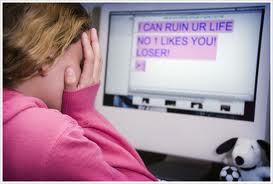
The latest research into cyberbullying claims that boredom is responsible for this immensely damaging practice. Well, I believe the research is completely and utterly wrong.
Boredom is not responsible for a person acting in a harassing manner. Boredom doesn’t compel a person to systematically go about about damaging the reputation and self-esteem of another. No, cyberbullying comes about when the perpetrator either has a low opinion of himself, is angry with their life or is playing up to the wrong people.
Research like this is not helpful because it takes a abhorrent activity and reduces it to something innocent – boredom:
Boredom is behind many incidents of cyberbullying and trolling on social media sites, according to the first major study into the matter.
Linguistics expert Dr Claire Hardaker, of Lancaster University, studied almost 4,000 online cases involving claims of trolling.
She has revealed the methods most regularly used by trolls on sites such as Facebook and Twitter to trigger outrage for their own amusement.
Bosses at one of Britain’s top universities today warned students face being kicked off their course for naming and shaming sexual partners on an ‘offensive’ Facebook page.
Students have been posting details of sexual liaisons and links to the personal profile pages of those involved on the Loughborough Rate Your Sh*g page.
Similar pages have been sprung up at universities across the country, although social networking giant Facebook has said it has removed all of the pages which have been reported.
The pages see students give their peers marks out of ten on a range of factors. The Loughborough page has attracted around 2,500 likes in just a few days.
Furious bosses at high-ranking Loughborough University, Leicestershire, today branded many of the comments ‘personal’ and ‘offensive’.
And they vowed to discipline students who posted on the site, for contravening their policies on acceptable use of IT and harassment.
The institution – known for its sporting prowess – is ranked 12th in the Sunday Times 2013 university league table.
The page encouraged students to send their reviews to an administrator who then posts them anonymously on behalf of the users.
I believe that a compliment can change the world in a profound way. If sincere, a person being complimented is much more likely to compliment others, thus begging a chain of positive expressions of admiration and respect. That’s why I completely endorse the concept explained in the video above and I hope it goes a long way to combating cyberbullying.
For more information about this wonderful initiative:
Schools need to decide what they represent. Are they merely a place for learning or are they also a place where students can feel safe and secure. If the latter is true, schools must do everything in their power to protect their students, regardless of whether the fight is online, offline, on school property or in the local mall.
In reviewing its existing bullying and cyber bullying policies during Monday night’s meeting, administrators and school board members discussed what role the district should play in cyber bullying, particularly when purported bullying takes place out of school.
“I don’t think we need to be the police and the DA’s office for everybody,” board member Louis Polaneczky said. “Have we done enough to exclude things that really aren’t our jurisdiction?”
I can’t believe a psychologist would go on record claiming that the recent attention on cyberbullying is overstated:
Old-style face-to-face bullying is still the way most young people are victimized, even though it’s cyberbullying that seems to get all the headlines, an international bullying expert told psychology professionals Saturday.
Reports of a cyberbullying explosion over the past few years because of increasing use of mobile devices have been greatly exaggerated, says psychologist Dan Olweus of the University of Bergen in Bergen, Norway. He says his latest research, published this spring in the European Journal of Developmental Psychology, finds not many students report being bullied online at all.
“Contradicting these claims, it turns out that cyberbullying, when studied in proper context, is a low-prevalence phenomenon, which has not increased over time and has not created many ‘new’ victims and bullies,” the study finds.
The reason that such attention has been devoted to cyberbullying awareness is three fold:
1. Cyberbullying numbers are growing. Why should we dismiss something until it becomes a problem we are not prepared for?
2. Cyberbullying is, more than likely, the most destructive for of bullying. Unlike face-to-face bullying that happens in schoolyards and parks amongst a finite group of people, cyberbullying penetrates the safest room (the victim’s bedroom) and can be easily disseminated to an audience of thousands.
3. Teachers can deal with school bullying. It is much harder for significant adults to monitor cyberbullying.
Cyberbullying should never be diminished in any way.
The Internet can be a hostile place, and Twitter is no exception. According to a new study, about 15,000 bullying-related tweets are posted every day, meaning more than 100,000 nasty messages taint the digital world each week.
To further understand what happens in the virtual world, researchers from the University of Wisconsin in Madison trained a computer to analyze Twitter messages using an algorithm created to point out important words or symbols that may indicate bullying. In 2011, during the time of this study, 250 million public tweets were being sent daily — a number almost 10 times the population of the state of Texas.
Insulting your students in Facebook may indeed be permitted under freedom of speech, but that doesn’t make it right. Teachers should know better than to make hurtful comments about their students. If they are caught doing so in a public forum such as Facebook they should apologise not scream “free speech“:
On this Independence Day, a controversy over free speech among teachers using Facebook is making headlines after their online discussion referred to a student as possibly being “the evolutionary link between orangutans and humans.”
Now, the state of Florida will investigate the matter.
Bay News 9 obtained a Facebook conversation from mid-May among teachers at G.D. Rogers Garden Elementary School in Bradenton, Fla.
The exchange reportedly began with music teacher Lauren Orban writing: “I’m fairly convinced that one of my students may be the evolutionary link between orangutans and humans.”
The Bradenton Herald says several other instructors then jokingly joined the conversation, with second-grade teacher Emma Disley pressing Orban to share the student’s name, writing, “Please tell me who you are talking about. This made me laugh out loud. Haha.”
Another second-grade teacher, Laura Beth Cross, wrote, “even though I can probably guess, please tell.” When Orban revealed the student’s initials, Cross responded, “Yup! Just who I suspected!”
But the conversation came to a sudden halt when Jauana Johnson, the school registrar, jumped in to write, “What the hell is that suppose to mean?”
What if Ms. Orban’s students had written insulting comments about her on Facebook? Would she have considered that as simply an expression of free speech?
If we do not stamp down on this kind of conduct we may as well give up trying to fight cyberbullying altogether!
Click here to give your opinion on whether or not teachers really need Twitter and Facebook accounts.
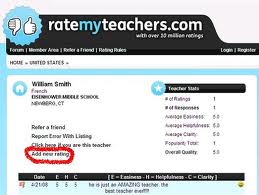
When a child is bullied it is rightly considered unlawful, yet when a teacher is bullied it’s considered free speech. The only thing stopping the vulgar website Rate My Teachers from being banned is the fact that it is an American website which is allowed to operate under the guise of free speech.
The teachers’ union wants the Education Department to shut down a website it says allows students to make defamatory and slanderous comments about their teachers.
The State School Teachers Union council resolved recently to write to the department asking it to close the Rate My Teachers website that some students use to abuse teachers personally and professionally.
“The website has allowed anonymous postings for some years, many of which would be found to be defamatory and slanderous of teachers if tested against legislation,” the resolution said.
The US-based website’s rules state posts will be removed if they contain profanity, name-calling or vulgarity, but recent comments about WA schoolteachers include “She is a whore”, “He is a douche bag” and “Sadistic bitch, she is a horrible teacher”.
Other posts say teachers are “bad” or “completely incompetent”. The website emerged in Australia six years ago, but this is the first time the union has made a formal request for help from the department.
Can you imagine if there was a website called ‘Rate My Students’?
When a nasty Facebook page that invites children to bully others is “flooded” by students of a particular school, isolated punishments is not enough. The most important step in this circumstance is to investigate the school’s culture and ask the following question:
Why, with all the awareness about bullying, are our students engaged in spreading rumours and making sexual taunts?
GEELONG students have flooded a Facebook page built to spread sexual taunts, rumour and nasty gossip.
The page victimising students from years 7 to 12 at Oberon High School features swags of hurtful, bullying comments.
A parent said she became distressed after stumbling across the Facebook page earlier this week.
She said her child had been bullied at the school and she feared others would suffer emotional and social effects similar to her child.
“When I got on to the page and I just felt totally disgusted and really horrible because half of the kids on this page I know and you couldn’t get sweeter kids,” the woman, who asked for her identity to be withheld, said.
“They’re the kids that won’t speak up and say this is wrong so somebody has too.
“These types of things can have serious effects on kids.”
Oberon High School is investigating the page with acting principal Elizabeth Kelly saying the school, which was made aware of it on Tuesday, was in the process of speaking with students.
I am glad that the school has not washed their hands of this incident. They have a lot of work to do.
I was deeply moved by dying teenager Shaun Wilson-Miller’s YouTube video. Filmed as a farewell to all his friends and a request that his father is taken care of, Shaun amazingly, talks positively about his life experiences and how his girlfriend Maddie has made him a very happy person. I commend Shaun for the message, which I feel will strike a chord with adults and children alike.
What I abhor is the vile, disgusting comments that are attached to this heartrending clip. They are crude, demeaning and completely unacceptable! YouTube has a responsibility to ensure that these sorts of comments are taken down and those writing them have their accounts banned! I am appalled that a dying child can be subjected to such bullying.
This YouTube clip presents the very best and worst of what life has to offer. It shows a child that refuses to play the victim, even when faced with the toughest and most dire of situations, and it demonstrates the most disgusting sections of society – those that hide behind false names and keyboards whilst taunting and degrading an innocent person.
Because of those awful people, poor Shaun has had to make another clip refuting their claims.







 Topical Teaching