Posts Tagged ‘Teachers Stress’

School Official Allegedly told a Teacher to Train her Breasts to not Make Milk at Work

November 15, 2012

Some school officials have a love affair with the word “no”. Any time they are asked a question by a teacher the answer is a predictable – “No”.

In the rush to satisfy politicians, donors, board members and parents, looking after teachers and responding to their wants and needs takes a backseat to all other stakeholders.

Teaching is supposed to be a flexible, family friendly career. But it isn’t in the hands of officials and their favourite two letter answer.

One former teacher allegedly found out that the word “no” is not nearly as bad as advice on what she should do with her breasts!

A former California school teacher accuses school officials in a lawsuit of failing to accommodate her breastfeeding schedule.

The Monterey Herald reports that Sarah Ann Lewis Boyle has sued the Carmelo School, where she worked, and the Carmel Unified School District, alleging discrimination and wrongful termination.

The lawsuit was filed on Oct. 30.

Boyle says before returning to work, she told a manager at the school that she would need about 15 minutes every day between 9 a.m. and 11 a.m. to pump her breasts.

Boyle claims the manager told her to train her breast not to make milk then, and the district made no accommodations to allow her to feed her newborn. According to Boyle, she later received a negative evaluation and was urged to resign.

District spokesman Paul Behan said the district does not comment on litigation.

I am glad you don’t comment on litigation. I also hope for your sake your schools don’t comment on breasts and breastfeeding either.


Click on the link to read Who is Going to Stand Up For Bullied Teachers?

Click on the link to read 12 Tips for Managing Time in the Classroom

Click on the link to read If Teachers Were Paid More I Wouldn’t Have Become One

Click on the link to read Different Professions, Same Experiences

Click on the link to read Our Pay Isn’t the Problem


Our Pay Isn’t the Problem

August 22, 2012

Teachers have more to complain about than their pay. Sure, it would be nice to get paid more, but let’s face it, our nation can’t afford a substantial pay rise and we are not being completely ripped off. No teacher enters into the profession with the intention of making a sizeable income.  We know that we will always be paid less than the ideal amount.  

It is the conditions we face that we should be most concerned about. The obsession with changing curriculums every two years without any apparent reason, the increase in planning paperwork that robs us of time to devote to other aspects of our job and the crazy overregulation which has shifted the focus from quality education to lawsuit damage control.

Rita Panahi is right to point out that a teacher’s pay is no reason to strike:

Why, one wonders, do presumably intelligent people study for four years to enter a profession where they find the pay so unacceptable?

It’s akin to buying a house near an airport then complaining about aircraft noise.

If money is what motivates you then teaching is probably not the job for you.

Higher pay comes with greater scrutiny but teachers have fought hard against attempts to link their wages to their performance.

Under the current system, which the Australian Education Union desperately wants to retain, almost all teachers automatically move up the pay scale every year regardless of their ability, effort or suitability for the job.

This absurdity helps to explain a 2009 survey of teachers which found that nine out of 10 of them don’t believe their school would acknowledge improvements in the quality of their work, while seven out of 10 believed their consistently underperforming colleagues were in no danger of losing their jobs.

Actually, despite the persistent whingeing we’ve grown used to from teachers, they are hardly surviving on the breadline.

A first year teacher can expect to earn around $57,000, which is more than graduate paramedics, accountants and substantially more than nurses. This can rise to more than $90,000 at leading teacher level.

Not bad for a job with enviable hours and holidays of which most of us can only dream.

Click on the link to read If Teachers Were Paid More I Wouldn’t Have Become One
 
Click on the link to read “Better Pay Leads to Better teachers”: Prove it!
 
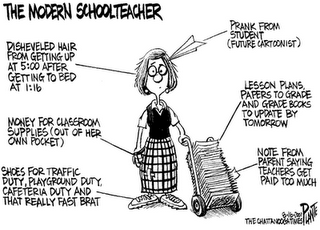
Click on the link to read The Overwhelming Responsibilies of the Modern Teacher

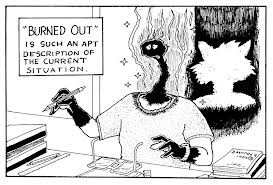
Why is it so Hard for Burnt-Out Teachers to Retire?

July 27, 2012

The current system of paying off burnt-out teachers with a $50,000 pay ‘bonus’ in order to get them to retire is very troubling. How come we don’t have the same problem with burnt-out nurses, policemen, social workers and veterinarians? They seem to leave when the passion has eroded. Why is it so hard to get our teachers to leave?

UNMOTIVATED, ageing public school teachers look set to be offered another round of $50,000 “burnout bonuses” to quit.

An Australian Taxation Office ruling reveals that the Education Department has applied for and been given permission to provide early retirement packages this financial year under the Teacher Renewal Program.

Under the scheme, 103 experienced teachers accepted the payout last year, freeing up 100 permanent positions for graduates and early career teachers.

A department spokeswoman said the Government had not yet committed to implementing a second round in 2012-13.

“The recent Teacher Renewal Program was highly successful,” the spokeswoman said.

Perhaps a better question is why do our teachers burn out so quickly?

My view is that teachers are burning out alarmingly young. Perhaps then, the bigger issue is addressing the incredible workload and stress levels faced by a modern teacher rather than the urge to have a burnt-out teacher replaced by another teacher destined to commence their own rapid journey into Burnoutsville.

Click on the link to read I’m Drowning in Paperwork: Please Pass the Snorkel

Click on the link to read It isn’t that Hard to Make a “Poor” Teacher a “Good” One

Click on the link to read The Overwhelming Responsibilies of the Modern Teacher

Click on the link to read That’s Right, Blame the Teachers

It isn’t that Hard to Make a “Poor” Teacher a “Good” One

July 12, 2012

There is a theory among educational circles that a struggling teacher can’t improve. This is probably true in today’s climate, but it isn’t a reflection on under-performing teachers, but rather a reflection on the total lack of support given to teachers.

A teacher’s journey begins with a pressurised, yet basically completely useless, teacher training course. This course not only fails to provide teachers with the requisite practical skills but is often taught and run by former teachers who are overjoyed at the prospect of finally being out of the classroom.

Then, if that teacher is lucky enough to score a job at a school with resources, a track record of half-decent behaviour and academic standards (because let’s face it – graduate teachers often go to the toughest schools to teach in), they are left on their own. No mentor, no support system. They are put in an environment where every teacher is in charge of their own classroom and teamwork is often non-existent.

That teacher can always break the unwritten rule and ask for help, but that would be a mistake. A graduate teacher’s first contract is usually a 12-month trial run. That teacher cannot afford to advertise their uncertainty and lack of experience. Teachers are overburdened as it is and many resent having to help an amateur when they have an ever-increasing workload to deal with. Therefore, a graduate teacher that asks for help risks not having their contract extended, thereby risking future employment.

So what do these teachers do? They learn on the job. And that’s where mistakes are made and bad habits are formed.

These bad habits sometimes make them look like “poor” teachers. Many of them are just well intentioned teachers who have never been given the support they needed.

The public are probably very supportive of new regulations that makes it harder for teachers branded “incompetent” from finding a new teaching job. I bid them to see beyond the labels and call on the system to support our teachers rather than replacing them for a newer version of the same thing:

For the first time, schools will be given legal powers to find out whether staff applying for new jobs have previously been subjected to official warnings.

Former employers will be required to disclose any disciplinary action taken against teachers over the last two years to give new schools a more comprehensive picture of their ability.

The regulations – being introduced from this September – come amid fears that too many schools allow weak teachers to leave and find new jobs rather than draw attention to their performance.

In the last decade, just 17 staff in England have been officially struck off for incompetence.

But teachers’ leaders insisted that the regulations would treat teachers “worse than criminals” and force some out of the profession altogether.

Click here to read about how I would solve the problem of the unsupported teacher.

The Overwhelming Responsibilies of the Modern Teacher

March 26, 2012

I just read a brilliant piece by teacher Daniel Cohen.

Whilst I differ from the author of this article in one key area, I believe the article presents a most accurate account of the day-to-day challenges that face working teachers. I don’t agree with the premise that for all the hard work we put in, we receive little in return. Yes, we are underpayed. But what we do get back from our students can not be easily quantified.

Even still, his assessment on the daily rigours and insane paperwork and planning requirements is captured brilliantly in the article.

I BECAME a teacher to help children learn.

I’m now working with at-risk children who do not cope in a mainstream setting.

They have emotional and behavioural issues affecting their ability to perform and succeed within school.

They, like all students, need a strong teaching profession.

I see the role of teachers as both educating students and preparing them for society as adults.

A lot of the focus is on literacy and numeracy.

As a teacher, I believe there are a lot more skills that students need than just reading and writing.

It’s my role to help them develop into adults.

Teaching is the closest thing you can get to being a parent without having children.

Like parents, teachers form relationships with children that are central to a child’s learning and development.

We help them sort out personal problems and friendship issues.

We help with knowledge in an academic sense. But we also help them learn to interact and deal with people and how to get along.

They can’t learn subject content if they can’t work with others.

And they can’t learn to work with other people in isolation. That’s part of a teacher’s role as well as a parent’s.

Day to day, students attend classes between 9am and 3.30pm.

When the students are at school, the teacher’s whole focus is on working with them.

Preparing lessons, correcting work, organising meetings and other duties associated with being part of a workplace all happen outside of class time.

A teacher’s legal and professional responsibility to students does not end when students aren’t around.

A lot of that happens during a teacher’s personal time.

Our tasks – attending staff meetings outside of class, correcting and checking work and so on – cannot be properly completed within normal, paid allocated time.

Because teachers are in a workplace, we have Occupational Health and Safety obligations to fulfil, such as ensuring that the school is safe and correct procedures are followed in classroom safety.

We are required to provide supervision and ensure that the classroom is a safe environment.

Also, we must formally report on any issues involving child welfare.

These are just some of the very serious responsibilities all teachers assume.

Watching students is difficult.

When you have 27 students, ensuring they are all safe and within sight at all times can be quite time-consuming.

The pay situation as it is now makes me feel really undervalued by my employer – the State Government. I’m disappointed and upset that our pay negotiations have not been progressing.

The work we do is essential.

To have the Government stall undervalues our work and undervalues the education that children deserve.

Failing to pay us properly means we’re not given the resources or time we need to do the best for our students – Victoria’s children.

We’re using our own time to do more for the students because we think it’s important. Teachers want what’s best for students.

Without proper pay, my worry is that the profession will suffer and good teachers will leave.

Those who stay may suffer ill-health because they are not given enough time to properly do the job.

We already have a shortage of teachers.

Without proper pay, we will struggle to keep the ones we have or to recruit new ones.

Teachers put in the extra time because they’re doing what’s best for their students.

But without support from their employer, it is increasingly difficult for teachers to keep on doing that important work.

The Government wants more productivity.

That will be achieved by giving teachers the resources they need and by supporting the profession.

Teacher Morale at an All Time Low

March 8, 2012

Should we be the least bit surprised that teachers are generally not getting job satisfaction? Did anyone consider for a moment that the introduction of standardised testing would do little for student achievement and do even less for teacher morale?

Or better yet, an even more compelling question, does anyone even care about the plight of teachers?

As long as Governments keep on peddling their diatribe about how many poor teachers there are in the system and how they are determined to expose them before slowly weeding them out. As long as Educational bureaucrats have someone to blame for low achievement levels, then why should they care?

Sure there are more stakeholders in the educational system than just teachers, and it’s true that teachers aren’t the only ones responsible for disappointing academic figures, But who cares? As long as the public buy the spin about the poor state of the teaching fraternity, it doesn’t really matter that spending on education is mismanaged and misallocated, curriculums are inflexible and politically motivated and the paperwork expectations of teachers are extremely unfair. Why should it matter?

“Those hopeless teachers! All they ever do is complain!”

So, no, I am not surprised the teachers of New York are not enjoying themselves:

More than half of teachers expressed at least some reservation about their jobs, their highest level of dissatisfaction since 1989, the survey found. Also, roughly one in three said they were likely to leave the profession in the next five years, citing concerns over job security, as well as the effects of increased class size and deep cuts to services and programs. Just three years ago, the rate was one in four.

The results, released in the annual MetLife Survey of the American Teacher, expose some of the insecurities fostered by the high-stakes pressure to evaluate teachers at a time of shrinking resources. About 40 percent of the teachers and parents surveyed said they were pessimistic that levels of student achievement would increase in the coming years, despite the focus on test scores as a primary measure of quality of a teacher’s work.

Sandi Jacobs, vice president of the National Council on Teacher Quality, a nonpartisan advocacy group in Washington, said the push for evaluations, punctuated by a national movement to curb the power of unions, had fostered an unsettling cultural shift.

“It’s easy to see why teachers feel put upon, when you consider the rhetoric around the need to measure their effectiveness — just as it’s easy to see why they would internalize it as a perception that teachers are generally ineffective, even if it’s not what the debate is about at all,” Ms. Jacobs said.

More than 75 percent of the teachers surveyed said the schools where they teach had undergone budget cuts last year, and about as many of them said the cuts included layoffs — of teachers and others, like school aides and counselors. Roughly one in three teachers said their schools lost arts, music and foreign language programs. A similar proportion noted that technology and materials used in the schools had not been kept up to date to meet students’ needs.

“The fixation on testing has been a negative turn of events when the things that engage kids in schools are all being cut,” said Randi Weingarten, president of the American Federation of Teachers.

I could argue that unless teachers are given the conditions and freedom to thrive in their workplace the results are not going to come. But solutions have never been an urgent matter for politicians. They are far more interested in scapegoats – and let’s just say, teachers make great scapegoats!

Parent Calls For the End of the Teacher Blame Game

March 2, 2012

Parent Martha Foote has submitted a brilliant piece to the New York Times. In a resounding defense of teachers she called for the end of  teacher data reporting:

“TDRs are a four-letter word!” That was my son’s favorite slogan when the parents and teachers at his school, Public School 321 in Park Slope, held a rally in the fall of 2010 to protest the imminent release of the teacher data reports. We were not alone. Sister rallies were held the same day at Brooklyn’s Public School 24, Public School 29, Middle School 51, Public School 154, and the John Jay Campus Community, and more than 5,000 letters of protest were signed across all five boroughs condemning the public humiliation of teachers as well as the release of what we believed were inaccurate scores. Sadly, though, after months of legal appeals, the teacher data reports were finally made public last week. And what have we learned?

So what do we do now? How do we move forward? To begin, I believe we must stop these attacks on our teachers. It is no way to treat one another (did we learn nothing in kindergarten?), and it is no way to improve education. We must turn away from this punitive blame game and instead work in a collaborative endeavor for the greater good. Look to the models. Look to Finland, where teachers are respected and trusted, and continual professional development is paramount. Look to Montgomery County, Md., where a successful system of teacher evaluation consists of mentoring struggling teachers combined with a panel of teachers and principals to decide if a teacher must be fired. (I only hope that New York State’s new system of teacher evaluation does not preclude the use of such successful strategies.) And stop relying on a score from a single high-stakes test to trump all the other 180 days in the classroom.

As for parents, of course we want our children to have excellent teachers. But as we have learned, these rankings tell us nothing. It is time to rely on our own observations, both direct and indirect, to gauge our children’s learning experiences in the classroom. Look at the types of assignments our children receive, the kinds of books they bring home to read, the quality of feedback they receive on their written work. It is this type of information that will tell us whether our child has a great teacher – and whether we need to be advocating for changes in the classroom.

If only the media and politicians thought the same way.

Stricken With Self-Doubt

January 31, 2012

It’s the first day of a new school year tomorrow and I’m suffering from my annual bout of self-doubt. I get very anxious before a school year starts. I worry about whether or not I will succeed at helping my students. I worry about whether my style of teaching will work on a new bunch of kids.

The week leading up to the start of the school year doesn’t help. It’s a week that is set aside for preparing the classroom. This involves displays, fancy name tags and innovative ways to use a small space to enhance learning. The female teachers I work with put a lot of emphasis on the look of their classrooms. Borders are replaced around noticeboards, name tags are put on everything (and I mean everything!) and the fear of death is reserved for the poor laminator who cops the brunt of all this activity.

When it comes to developing fun lessons, I am very comfortable. When it comes to decorating a classroom, I am completely out of my league! I have been getting comments ever since I started about the plainness of my classroom compared to the other teachers. My bosses have pointed out that my classroom looks far less inviting and colourful. This year I put up a beautiful piece of red material to cover my noticeboard, before being told that children don’t learn well in a room of red. Apparently the colour red has a negative effect on concentration and creativity. The comments certainly made me see red!

Then there’s the endless diatribe from those in charge about new responsibilities and expectations that all staff need to adhere to. These usually involve devoting a great deal of extra time. If there is something all teachers have in common, it is the absence of any extra time.

Handover isn’t much fun either. As the previous teacher reads each name from the class list, every child is presented as difficult to teach. There’s behavioural issues, Aspergers, ADHD, ADD, Oppositional disorder, social issues, anger management issues, language disorders etc. What is it with psychologists today? They have turned every personality type into a disorder. Why is every second child on a spectrum? What is this spectrum, and how did it get to be so big? In today’s age, the one kid who can’t manage to get on the spectrum of any modern psychological condition probably ends up feeling left out and abnormal.

All this makes me very uneasy. I get very frightened. I desperately don’t want to let my students down.

101 Ways for Teachers to Cope With Stress

January 24, 2012

101 useful tips from the wonderful blog smartteaching.org. To read the whole list follow this link. Below is just a taste:

Organization Tools

Staying organized will also beat back stress, as you’ll be able to meet deadlines, remember projects and field trips, and have more time for yourself.

  1. Google Calendar: Set up events and schedules for lesson plan submission dates, in-service workshops and more by using Google Calendar.
  2. ubernote: This cute tool lets you dump lists, contact information, event plans, special project ideas, field trip materials and more into several different notepads that keep you organized and on track.
  3. Notesake: This tool is great for teachers who are pursuing a higher degree, going to workshops or earning more credit hours for their certification. You can take notes faster and organize your notes so that you’ll be able to find them once you want to plan a lesson.
  4. eFax: Keep your runs to the teachers’ lounge to a minimum by using eFax, which lets you send out permission reports, progress reports and anything else you need signed over the Internet.
  5. Backpack: This very popular tool lets you “centralize and share information” with other teachers in your department. You can maintain a department calendar, share pages and a to-do list.
  6. Toodledo: Toodledo sends reminders to your mobile phone so you never forget a task.
  7. Project Stat.us: Keep your principal and supervisors updated with new project information or your certification process with this collaboration tool that lets you organize your progress online.
  8. Evernote: Use this beta tool to capture images and websites on your computer or your mobile phone. You can then organize your notes and presentations for class wherever you are.
  9. Tools and Templates: If you don’t have time to design your own certificates, game tools, or work sheets, pull from this list of tools and templates for teachers.
  10. Google for Educators: Here you’ll find some of the best available Google tools and apps just for teachers.

The Boss From Hell

November 2, 2011

For those of you that think your boss is bad:

A BULLYING school head has been banned from the job for life – but can still teach.

Debbie Collinson intimidated and swore at teachers and even gave pupils “Coke and doughnuts” in exchange for information about staff.

She also told teachers to falsely improve attendance records and test scores.

Collinson, head at Harrow Gate Primary School, in Stockton-on-Tees, Co Durham, was found guilty of ­professional misconduct.

Tribunal chairwoman Dr Barbara Hibbert told the Birmingham hearing: “It is simply unacceptable to manage a school in the manner in which she did, whatever the motivation.”

Collinson, who is in her late 40s, is no longer at Harrow Gate. It is it not known if she teaches elsewhere.

If your boss can match or better Ms. Collinson, I’d love it if you could share it.