Posts Tagged ‘Parenting’

Facebook Doesn’t Seem to Care About Kids

June 5, 2012

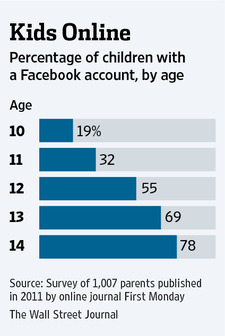
It seems as though Facebook cares more about indoctrinating more young lemmings onto their database than protecting the safety and wellbeing of our children. I have stated before my firm belief that children under 13 do not have the maturity to warrant the privilege of having a Facebook page.

You may argue that many 13 year-olds defy that rule and go and get one anyway. This is unfortunate, and something their parents ought to take an interest in, but at least in this instance there are laws that are being broken. It would be decidedly worse if the age requirement rule was abandoned altogether.

A new proposal to allow children under the age of 13 to have legal access to Facebook is the first step in a concerted effort to rescinding these important regulations:

Facebook Inc. is developing technology that would allow children younger than 13 years old to use the social-networking site under parental supervision, a step that could help the company tap a new pool of users for revenue but also inflame privacy concerns.

Mechanisms being tested include connecting children’s accounts to their parents’ and controls that would allow parents to decide whom their kids can “friend” and what applications they can use, people who have spoken with Facebook executives about the technology said. The under-13 features could enable Facebook and its partners to charge parents for games and other entertainment accessed by their children, the people said.

Facebook currently bans users under 13. But many kids lie about their ages to get accounts, putting the company in an awkward position regarding a federal law that requires sites to obtain verifiable parental consent before collecting personal data from children.

Any attempt to give younger kids access to the site would be extraordinarily sensitive, given regulators’ already heightened concerns about how Facebook protects user privacy. But Facebook, concerned that it faces reputational and regulatory risks from children already using the service despite its rules, believes it has little choice but to look into ways of establishing controls that could formalize their presence on the site, people familiar with the matter said.

Skills Your Child Should Know but Isn’t Taught at School

June 5, 2012

I am not a fan of specialised programs as they tend to clog the school day and leave too few hours for covering the curriculum. Programs such as “Stranger Danger” have been shown in studies to be ineffective and a cause of paranoia and anxiety among students rather than a useful resource for their protection.

An exception to this rule is training children to be safe around pets. As a father of a young girl who is absolutely petrified of dogs of all shapes and sizes, I am concerned that this fear will prevent her from enjoying animals. I am also aware that dog attacks happen on an all too regular basis, with many of these incidents involving children and proving deadly.

Adults may know that running away from an angry or vicious dog is a recipe for disaster, but do children know that? And if they do, do they have the tools to manage such a situation?

The answer to that question is invariably – no!

That’s why I am grateful to prominent veterinarian, author and blogger, Dr. Vadim Chelom, whose passio for this issue prompted him to release a program for teachers to integrate into their literacy/social studies curriculum free of charge. On his blog is a comprehensive lesson by lesson program which will enable teachers to educate their students about how to stay safe around pets.

I have no doubt that this program has the potential to save lives. I certainly encourage parents to share the information with their children and for teachers to find time in a crowded curriculum to at least dedicating a lesson to this very important issue.

What to do When Threatened by an Angry Dog according to Dr. Chelom:

  • Lie down face on the ground.
  • Pull your legs up to your stomach.
  • Bring your hands close to the body to cover your face with your arms and your chest with your elbows.
  • Don’t move and don’t shout.
  • Lie still until the dog is gone.

Most People Think This Woman is Fat

June 3, 2012

This morning’s newspaper asked readers to comment on whether or not they thought this woman was fat. Whilst I don’t think this woman is fat at all, it is the question itself that got me worked up.

It reminded me about how obsessed we are about weight, and how this obsession is going to ensure that our children will spend more time aspiring to fit a certain look rather than to become good people.

Nobody seems to care anymore whether a person is caring, selfless, charitable or kind. These are attributes of losers. Surveys that ask what we would prefer to be, beautiful or kind, favour beautiful every time. The rationale being, that nobody is jealous of a kind person in the way they are of a good-looking one.

How are our children supposed to make sense of this?

It upsets me to see Primary aged children so conscious of their weight. It bothers me no end that 8-year olds know everything there is to know about the perfect body size and shape, but have no insights on the correct protocol for offering ones seat to an elderly person on a crowded train. The thought would never have entered their mind.

Haven’t we learnt our lesson? Did we not realise that an obsession with looks leads nowhere. It doesn’t make one happy. Why are we creating kids that follow our sick ways? Why are we perpetuating the message that there’s nothing wrong with gossiping, fakery and selfishness, but eating ice-cream is a sin?

So, no, I don’t find the woman fat. But guess what? I don’t care whether she is fat or not. I care whether she is a good woman, a kind wife, a loving mother, a loyal friend, a friendly co-worker etc. And ultimately, that’s what I want us all to look for.

There are frumpy, unfit people out there, with pale complexions who have unpopular taste in clothes. Some of these people are also tremendously kind and good-hearted. It would be criminal for us to marginalise these people, as some of them are the real beautiful people!

Praise Your Children and then Watch them Bully

May 30, 2012

A new report dispels the long-held theory that bullies have low self-esteem. This report maintains that bullies often come as a result of being over-praised and over-complimented.

LAVISHING children with praise and constantly pumping up self-esteem is breeding a generation of bullies, groundbreaking research reveals.

Prof Helen McGrath from RMIT, a key player in Australia’s anti-bullying policies, says mums, dads and educators have spent too much time telling kids that “darling, everything you do is wonderful”.

Rather than giving children “trophies for coming seventh, eighth and ninth”, they instead need a good old-fashioned dose of reality – including in their school reports, she said.

“The silliest thing you can tell children is, ‘If you set your mind to it, you can do anything you want’,” Prof McGrath said.

Now the State Government has flagged a comprehensive discussion on teaching methods.

Education Minister Martin Dixon said last night: “What Prof McGrath’s research has shown makes good sense and is worthy of wider debate.

“While parents and teachers want to encourage their children and students to be the best they can be, it is also important that we are genuine. A measure of self-esteem is good, but a large dose of self-respect and respect for others is even better.”

Well-meaning parents and teachers had been unwittingly contributing to the problem for 30 years through the “failed self-esteem movement”, she said.

“Parents love their children and are trying really hard to keep their self-esteem high, not realising … they’ve made the mistake of assuming that means their child can never have any failures, disappointments, sadness,” she said.

“But if we’re getting kids who are increasing in their sense of narcissism, and the need to be entitled and always get positive feedback … that is a fairly dangerous way for our community to go.”

It is fascinating to read of the Government’s clumsy response to this findings. They want teachers to start being “genuine” with the2ir students. Great idea! Now why didn’t I think of that?

It is quite a simple interpretation to think that bullies are just often children with overfed egos. The mistake this report seems to make is that it assumes that children grow to believe the messages that these parents send. The assumption is that these kids grow up thinking they can achieve anything they want (whether they have natural ability or otherwise).

This is not my experience. My experience tells me that such children weigh up the compliments and positivity they get from home with some of the negative talk they get outside, and it confuses them. Children who are constantly told how beautiful they are at home, are then called “ugly” and “fat” in the schoolyard. This mixture of messages makes them feel terrible insecure. Are their parents liars? Are their school friends just being cruel, or do they have a point?

So indeed, I do believe such children have low self-esteem. The realisation that some of the messages being sent from home are not shared by the world outside doesn’t inflate their ego, but rather, confuses them and makes them less trustworthy of others.

The best depiction of a bully (or I should say, “bullies”) comes from Mike Feurstein’s classic movie “How to Unmake a Bully“. Instead of portraying the bully as a person that has no characteristics that other children can related to, Feurstein paints him as a lost child, bullied himself in the past, without a undesratnding of other options and modes for letting off steam.

The beauty about the film is that after watching it, my students gain an appreciation and a unserdtanding not only for the victim but also for the bully himself.


Sexting Reaches our Primary Schools

May 28, 2012

We don’t need another useless educational program preaching to children about the dangers of sexting. They are preachy, don’t work and make children uncomfortable. What we need is a strong approach consisting of two important elements.

1. Clear and unambiguous consequences for those involved in sexting; and

2. Schools need to focus more squarely on setting up an environment that encourages its students to respect themselves. This kind of behaviour comes about from an abject lack of respect for one’s self. Schools should work on their culture and environment to ensure that their students are best placed to make good decisions, not just because they are sensible, but because they have an inbuilt sense of self and a regard for who they are and what they do with their lives.

Without this approach, nothing will properly discourage children from this potentially dangerous practice:

PRIMARY school children are engaging in “sexting” and experts believe parents are at a loss as to what to do about it.

UniSA academic Lesley-Anne Ey says research shows some pre-teens are taking and sending out sexually explicit photographs.

“There’s research saying the phenomenon is out there for children at primary school and I think parents might be a bit uninformed about it,” she said.

“They may think it is a risk when their children are adolescents but it’s unlikely they would think younger children would engage or be aware of that kind of behaviour.”

Ms Ey said educating children about the dangers of “sexting”, either by mobile phone or internet, had reached a point where it must be dealt with before they reached puberty.

“We need to start addressing this at primary school,” she said. “I think it’s too late when you start going into school at Years 8 or 9.”

Child protection expert Professor Freda Briggs said potential young offenders needed to be made more aware of the repercussions.

“Parents and schools need to be making young people aware that this is a criminal offence,” she said. “It’s a huge community issue and most parents don’t know what they can do about it. I think a lot of people have given up.”

Babies Brought into Schools to Teach Kids About Empathy

May 20, 2012

To be able to teach children about empathy one has to get them to understand that the world doesn’t revolve around them. They need to know that everyone has problems, insecurities and sensitivities. Children that struggle to show empathy can get self obsessed and insular.

That’s why I am surprised that some have confused caring for a totally dependant baby, to the understanding that their fellow classmate has problems too. A young baby is simply not threatening. They are cute, fun to play with and a great distraction for any classroom. I don’t understand how caring for a baby has any bearing on a child’s capacity to feel the pain of a classmate:

Babies are set to be brought into primary schools in Cardiff to help improve pupils’ empathy levels and help reduce any bullying and aggression.

The scheme, pioneered in Canada, encourages children to interact in a nurturing manner after observing a parent and baby in the classroom.

Reports suggest children who have taken part are more likely to help others, share, and accept peers as they are.

The programme is being run by the charity Action for Children (AfC).

Around 2,000 school children will take part in Roots of Empathy, as the scheme is known, which will see a local parent and young baby visit their school nine times over the course of a school year.

Debra Ennis, the charity’s children’s services manager, said the project had been running very successfully in Scotland for two years and a Big Lottery Fund grant had enabled them to bring it to Wales.

“We chose Cardiff as we have a really good relationship with the local authority and already run some programmes here.

“The results in Scotland have been amazing. I was a bit sceptical at first – babies going into classrooms – but the turnaround in behaviour in children’s classrooms and drop in anti-social behaviour has been amazing.

I think this program has some value when it comes to fostering maturity and social skills, but I just don’t understand how you can teach empathy for classmates by bringing in babies to the classroom.


Student Sues School for Failing to Get into Preferred Law Course

May 17, 2012

Does anybody want to take personal responsibility for anything anymore? We are become a society of ‘blamers’. Fancy a student in an exclusive Private school suing for a lack of assistance! Those schools give so much more support than Private school. Did it ever occur to her that getting into a course relies on ones own aptitude over anything else? Did it ever occur to her that there were students studying night and day to get into that course? Meanwhile, it is claimed, she was serving suspensions for coming to class late and failing to complete set work tasks.

A former student of one of Australia’s most prestigious private schools is suing the academic institution after she failed to get into the law course of her choice.

Rose Ashton-Weir, 18, claims that the elite Geelong Grammar School, where Britain’s Prince Charles spent two terms as a student in 1966, did not provide her with adequate support, The Age reported Thursday.

As a result, the teenager’s final high school score was insufficiently high enough to gain admittance to law at the University of Sydney, the Victorian Civil and Administrative Tribunal heard Wednesday.

Ashton-Weir is currently pursuing an arts and sciences degree at the University of Sydney.

She had attended Geelong Grammar, 48 miles (77km) south of Victoria’s capital city Melbourne, in 2008 and 2009, but left to continue her high school education in Sydney.

Ashton-Weir told the Geelong Advertiser that the school had failed her.

‘It was incredibly detrimental to my academic skill and development,’ she said.

Ashton-Weir, who was a boarder at the school, reportedly struggled with mathematics, and scored eight out of 68 in one test. Despite this, she was placed in a regular class. The school’s representative, Darren Ferrari, said every effort had been made to help the teen.

Ashton-Weir’s mother, Elizabeth Weir, is also suing Geelong Grammar, The Age reported.

Weir wants AU$39,000 (US$38,740) compensation for rent she paid when they moved to a new home after her daughter relocated from Geelong to Sydney.

Weir also claims that Ashton-Weir’s move resulted in her giving up her cookie business which would have raked in AU$450,000 over a three-year period.

Ferrari told the tribunal that Ashton-Weir had been suspended several times at Geelong Grammer, was absent from classes often and had failed to complete required school work.

I suppose if she wins this case, it would be ironic. Trust a future lawyer to endorse dodgy lawsuits that puts the ‘blame game’ over personal responsibility.

Standardised Testing Meets Spin City

May 15, 2012

A few weeks ago I sought to have an interview with Australia’s Education Minister regarding the upcoming NAPLAN standardised tests. I am still waiting for a reply.

Luckily, I came across his op/ed piece over the weekend, where he tries to allay the fears of the parenting community and make a case for these highly pressured, incredibly unpopular series of tests.

In his piece, he claims that:

Parents and the community should rest assured that the NAPLAN tests are simply a way of measuring how our students and our schools are performing in the three key areas of reading, writing and numeracy. Nothing more, and nothing less.

I assure you Mr. Garrett that parents of 8-years olds subjected to 4 rigorous exams in 3 days understand that these tests represent much more than just a simple way of measuring child progress.

There is nothing in any of the tests that students need to learn above and beyond what is already being taught in the classroom, namely the curriculum.

I am not sure that is true. Whilst my students are expected to write persuasive essays, there is no mention of persuasive writing in the Grade 3 curriculum.

By measuring how our students are performing as they progress through school, we can get a clear national picture, for the first time, of where we need to be directing extra attention and resources.

This is just spin. This implies that these tests exist to help direct the Government in regards to spending and programs. There is no evidence of any Governmental response whether it be financial or a simple change of priorities based on the yearly NAPLAN results. Instead, the outcome of the NAPLAN is designed to expose failing schools, inept teachers and anything and everything that can divert attention from a Government good at measuring performance but poor at performing themselves.

It needs to be made clear to schools and teachers that excessive test practising ahead of NAPLAN is unnecessary. While it helps to be familiar with the structure of the tests, carrying out endless practices should not be encouraged. NAPLAN matters, but it is not the be all and end all.

Unnecessary to whom? If you and your staff were to be tested on the performance of your portfolio wouldn’t you take the time to prepare? When a class gets appraised, so does the teacher. Are we meant to sit back and watch 8-years old kids sit for their first formal exams without preparing them for the kinds of questions and scenarios they are likely to encounter?

Mr. Garett, your opinion piece tries to win over parents, yet it completely deviates from the very issue that parents are most concerned about. Parents do not like seeing their young children exposed to so much pressure. They don’t like to see their children who may currently enjoy learning, subjected to such a negative learning experience.

Today, one of my students was so frightened by the prospect of these exams that he was reluctant to get in the car. We are talking about a child that loves learning.

I have no problem with High School children being tested. But 3rd Graders? Is it really worth it?


The Impact of Social Media on Kids

May 13, 2012

I agree with many of Jim Steyer’s points in regard to the need to educate children about using the personal setting on Facebook, as well as the addiction issues relating to children and social media. I am a big fan of his suggested “erase” button, which would enable children to delete any uploaded information they regretted putting on their pages.

Facebook’s big stock offering on Wall Street must be followed by an intensive debate on Main Street about social media’s powerful impact on children, an expert on the topic says.

Jim Steyer, founder of Common Sense Media, a San Francisco think tank focusing on media and families, said the technology that Facebook represents is having “an enormous impact” on youngsters, families and schools worldwide.

“We need to have a big national, if not global conversation about the pros and cons of that,” Steyer, a father of four who is also a civil rights lawyer and Stanford University professor, told AFP in an interview.

While social media such as Facebook, Google Plus and Twitter offer “extraordinary possibilities” in such areas as education, he said, “there are also real downsides in a social, emotional and cogitative development way.”

Steyer was in Washington to promote his just-published book “Talking Back to Facebook: The Common Sense Guide to Raising Kids in the Digital Age,” which argues for greater parental involvement in their children’s online lives.

“Whether we like it or not, kids are now spending far more time with media and technology than they are with their families or in school,” – as much as eight hours a day on average in the United States alone, he wrote.

Children face the triple peril of what Steyer calls RAP – relationship issues, attention and addiction problems, and privacy issues – as well as cyberbullying, online pornography and, for girls, body image fears.

“There is an arms race for data, and to build things as fast as possible … but that’s not a great strategy when you’re talking about kids,” he said, accusing tech outfits for “not respecting the concept of privacy.”

Earlier this week, a Consumer Reports survey found nearly 13 million US Facebook users – out of 157 million, and 900 million worldwide – do not use, or are not aware of, the site’s privacy controls.

Girls are especially vulnerable, Steyer said, with studies indicating that many body-conscious teens are photoshopping images of themselves so as to look thinner and score more “likes” among their friends.

On a governmental level, Steyer suggested the United States follow Europe’s lead in privacy regulation and introduce an “eraser button” enabling users to wipe off anything they might have posted in the past.

“We need clear and simple rules (around privacy) for the tech companies, too, because right now they’ve dominated the debate and they’ve set the rules themselves,” he said.

But the immediate responsibility, he said, falls on moms and dads.

“It’s part of parenting 2.0 today, so you have to do your homework,” he said.

“You have to actually learn the rules of the road… and then you have to set clear and simple limits for kids, set clear rules of behaviour – and you have to be a role model.

“If you’re constantly addicted to your cellphone or your ‘CrackBerry’ then that’s not sending a very good message to your kids.”

Pushy Parents and those Awful Standardised Tests!

May 13, 2012

So it turns out that some parents are so keen to have their children perform at the NAPLAN tests (Australia’s standardised tests) that they have started preparing them as early as kindergarten age. I couldn’t think of anything more dispiriting for a child. It’s bad enough I have to teach my Grade 3’s based on the questions they are bound to encounter during the tests, what could be worse than being subjected to it, up to 5 years in advance?

PUSHY parents are training kindergarten kids for Naplan – four years before they have to sit the controversial literacy and numeracy tests.

About a million students – in years 3, 5, 7 and 9 – will sit this year’s tests over three days next week.

But the pressure to perform is beginning years early, with some parents forcing their four-year-olds to take grade 3-level tests at home.

Dr Les Michel, from the Senior Students Resource Centre, said pre-school parents had joined the soaring demand for practice Naplan tests.

“This year we’ve even been getting kinder parents,” Dr Michel said.

“We would have had dozens, I’d say.”

Dr Michel said kindergarten parents bought the grade 3-level booklets, costing up to $24.95 each.

“They are really pushing their kids,” he said.

School Education Minister Peter Garrett said Naplan practice for pre-schoolers was “highly alarming”.

“It’s putting more pressure on kids at such a young age that they really don’t need, and it’s usurping the role that teachers in the classroom play, which is completely unnecessary,” he said.

However schools are also increasing the pressure, with “teaching for the test” now beginning as early as grade 1.

“We’re aware of it happening, even though people won’t admit it on the record, and why would they?” Parents Victoria executive officer Gail McHardy said.

“It demonstrates the desperation of some schools – their reputation hangs on it.”

Victorian Independent Education Union secretary Deb James said there was an “increased and unwelcome” focus on the tests in schools.

Australian Education Union state president Mary Bluett said: “Kids sitting down and practising tests is not the way to learn.”

Lucky for these pushy parents, I have some suggested exercises for them to set for their children.


To prepare them for the persuasive writing exam, you could set your child some of the following topics:

1. What is more fun, studying language conventions or playing outside with friends?

2. Is doing practice tests with mum and dad considered quality time?

3. Is learning for fun overrated?


To prepare them for the maths paper, I have the following suggested activities:

1. Count up the blisters that you have accrued from all the writing you’ve done and round the number to the nearest ten.

2. If Johnny went to school from 8:00 a.m until 4:00 p.m. and then spent the next 2 hours completing timed reading comprehension exams, how much time does he have to relax?

3. What percentage of pushy parents ends up rearing appreciative kids?

Good luck parents!