Posts Tagged ‘Literacy’

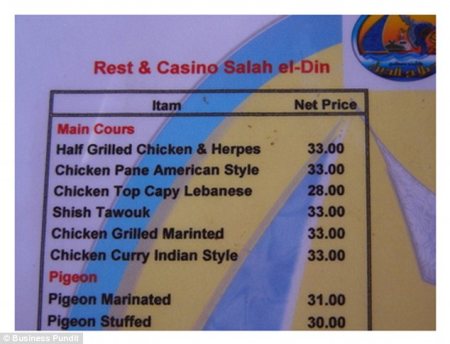
Hilarious Menu Items Lost in Translation

December 25, 2012

lit

Believe it or not, these menus are very real!

Below are 15 hilarious menu items, mostly from East Asian countries, that got lost in translation.

The photos of the funny food items are courtesy of BusinessPundit.com.

Laugh as you scroll down and try not to lose your lunch thinking about them too hard.

spicy
pork
cheese
cof
urine
herpes
crap
saliva
puke

Click on the link to read Who Corrects Our Spelling Mistakes?

Click on the link to read This is What Happens When You Rely on Spell Check

Click on the link to read The 15 Most Commonly Misspelled Words in the English Language

Click on the link to read Who Said Grammar Isn’t Important?

Click on the link to read Why Spelling is Important

Instead of Teaching a Baby to Read, Teach it to Smile

December 13, 2012

read

What is the rush? So your child reads when he/she is developmentally ready instead of when they’re a baby? So what?

Reading is not the greatest gift you can give a young baby. Love, optimism, hope and friendship are much more important to a baby’s development that the ability to read:

John Wilkey was just four days old when his mother Dana set about teaching him how to read. The fact that newborns can’t focus on anything more than a few inches away — let alone understand words in any form — did not deter her.

Dana, 39, an events organiser who lives in Chelsea, West London, is so passionate in her view that it’s never too early to make your child brilliant, she used to run through a set of ten flashcards with her son twice a day. ‘I would show John words like “milk”, give him my breast, and then show him the baby sign language for milk,’ she says. ‘I did it morning and evening.’

Baby sign language, for those not familiar with modern  parenting, is something ‘Tiger parents’ like Dana are well versed in. It works on the theory that children want to communicate long before they develop speech and can be taught little hand signals to communicate their needs and thoughts.

When he was nine months, Dana says John — her only child — was pointing and using basic baby sign language to show he could recognise up to 20 words and phrases, including ‘I love you’, ‘nose’, ‘ear’ and ‘arms-up’.

From there, Dana says his vocabulary grew at break-neck speed. A video of John at 20 months shows him sitting in his high-chair using a chubby finger to trace underneath the words ‘eyes’, ‘clap’ and ‘book’ from left to right.

Dana, who lived in the U.S. with John’s father before they separated, now lives with her fiance, Philip, in an £3.5 million London townhouse, once owned by a well-known footballer.

She is now one of a growing number of mothers convinced that getting children reading before they are potty-trained will help them get ahead in later life.

Teachars Cant Spel

October 21, 2012

It seems like poor spelling doesn’t stop with the students:

TEACHERS are filling lessons, report cards and letters home with errors, including SMS-style spelling, grammatical mistakes and misspelt spelling lists, parents have claimed.

A survey of 480 people about the literacy skills of the nation’s teachers found half thought the quality was poor.

More than 40 per cent had noticed spelling or grammatical errors on letters sent home from school and 35 per cent had seen mistakes in report cards and marked assignments.

Other parents claimed their child’s teachers lacked passion and skill, taught incorrect information and provided misspelt word lists for children to learn from. Some had even noticed teachers using SMS-style spellings, like l8r (later) and coz (because).

The “must do better” grading comes as the federal government reveals current teachers will be given specialist training to make sure future educators get better mentoring.Current and ex-teachers who took the survey were among those who complained about substandard quality, saying it was depressing.

One teacher from a state high school said many graduate teachers lacked a basic understanding of grammar, spelling and punctuation through their own schooling.

“It’s those 20-somethings who just missed out and I’m scared that they’re going to be teaching my kids,” she said.

Click on the link to read Who Corrects Our Spelling Mistakes?

Click on the link to read This is What Happens When You Rely on Spell Check

Click on the link to read The 15 Most Commonly Misspelled Words in the English Language

Click on the link to read Who Said Grammar Isn’t Important?

Click on the link to read Why Spelling is Important

Four-in-10 Children Have Trouble Reading Basic Words

September 27, 2012

This is what happens when you overcrowd the curriculum, stop teaching phonics and word attack strategies and administer mindlessly boring drivel dressed as literature:

Figures published for the first time show that 42 per cent of pupils – almost 250,000 – fail to achieve the expected standard in reading after a year of school.

Data from the Department for Education – based on a new-style test sat this summer – revealed that boys are already slipping far behind girls in terms of their ability to accurately decode a list of 40 words.

White British boys from the poorest backgrounds officially performed worse than any group, other than those from gypsy and traveller families. Just 37 per cent of these children reached the standard expected of their age group.

The disclosure will raise concerns that some groups of children – particularly boys – are being failed in the early years.

It comes just a week after Sats results showed that more than 20,000 boys finished primary school this summer with the reading age of a seven-year-old or worse.

To win this battle we need to promote reading, not just teach it. This can only be done by replacing ‘take-home leveled readers’ with rich, engaging texts. It is essential that our students see the benefits of reading, grow an appreciation for words and word sounds and most of all, come to the conclusion that their teacher is passionate about reading too.


Click on the link to read Who Corrects Our Spelling Mistakes?

Click on the link to read This is What Happens When You Rely on Spell Check

Click on the link to read The 15 Most Commonly Misspelled Words in the English Language

Click on the link to read Who Said Grammar Isn’t Important?

Click on the link to read Why Spelling is Important

Who Corrects Our Spelling Mistakes?

September 14, 2012

Um … I think that should read “public education“.


Click on the link to read This is What Happens When You Rely on Spell Check

Click on the link to read The 15 Most Commonly Misspelled Words in the English Language

Click on the link to read Who Said Grammar Isn’t Important?

Click on the link to read Why Spelling is Important

This is What Happens When You Rely on Spell Check

September 14, 2012


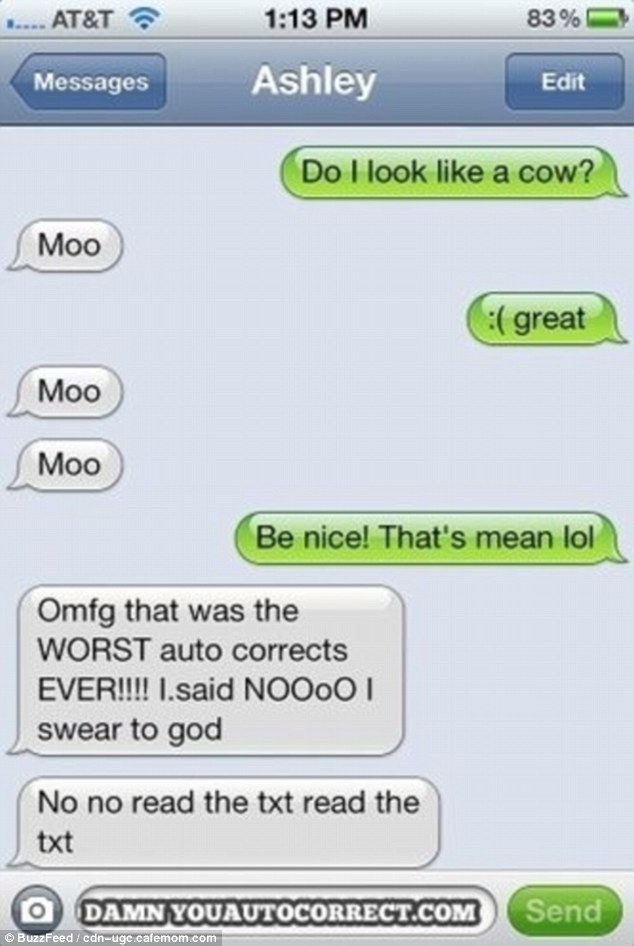
Our children are abandoning spelling skills in favor of a very dubious system known as auto correct:


Click on the link to read The 15 Most Commonly Misspelled Words in the English Language

Click on the link to read Who Said Grammar Isn’t Important?

Click on the link to read Why Spelling is Important

Click on the link to read No Wonder Children Hate School

Click on the link to read the Lenient Punishments for Teachers Who Have Sex With Under-Aged Students

Why are Teachers so Threatened by Phonics?

September 4, 2012

I am on record as saying that I find teaching phonics to be a challenge because it can be so dry and tedious to students. However, I can clearly see the benefits of the method.

There is a clear campaign from teacher’s unions and academics against phonics. This campaign is heated and vitriolic and makes absolutely no sense to me. Why would an organisation which is entrusted to help children to read, write and spell condemn a method which has a favourable track record? Even if you believed in other approaches (I like to incorporate other approaches too), it makes no logical sense to rant and rave about strategies that others support such as phonics.

Surely, as our students learn in different ways, it is incumbent on us as teachers to teach skills using a variety of different methods:

Nearly nine out of 10 teachers said they practised nonsense words in the run up to the test.

Words like spron, fape and thazz were included in the test designed to check pupils’ abilities to decode using phonics.

And four out of 10 admitted drilling phonics in the week prior to the test.

One Year one teacher said: “Some able readers failed and some non-fluent, less-able readers passed! What does that prove?

“It proves synthetic phonics is only part of a variety of strategies used in learning to read.”

Another teacher said: “I was willing to try it to see if it helped the children and if it helped inform my planning and assessment.

“It was a waste of time and money – (I had to have) a supply teacher to cover me – and had a negative effect on several of the children in my class.”

A Year One teacher said: “Many children made mistakes trying to turn the pseudo words into real words – ‘strom’ became ‘storm’.”

Some 86% of those polled believed the screening check should not be continued.

Perhaps the test needs some improving, but educators can’t be too tough on phonics as a method. After all, many of us can attribute being able to read by phonics.

Click on the link to read Who Said Grammar Isn’t Important?

Click on the link to read The Resistance Against Teaching Grammar

Click on the link to read Captain Phonics to the Rescue!

Click on the link to read the Phonics debate.
Why Spelling is Important

August 23, 2012

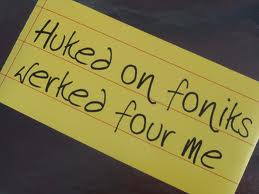
Need I say more?


Click on the link to read Who Said Grammar Isn’t Important?

Click on the link to read The Resistance Against Teaching Grammar

Click on the link to read Captain Phonics to the Rescue!

Click on the link to read the Phonics debate.

Our Authors Don’t Want us Teaching Phonics

July 25, 2012

There is a major phonics debate going around. One side argues that one must learn phonics to be able to read properly, the other suggests that phonics is dry and boring and detracts from the pleasure of reading:

More than 90 of Britain’s best-known children’s authors and illustrators have called on the government to abandon its plans to introduce early-year reading tests, warning that they pose a threat to reading for pleasure in primary schools.

The former children’s laureate Michael Rosen is leading the writers’ charge against a phonics-intensive approach to teaching young children how to read.

A letter to the Guardian signed by 91 names including Meg Rosoff, Philip Ardagh and Alan Gibbons says millions is being spent on “systematic synthetic phonics programmes” even though there is “no evidence that such programmes help children understand what they are reading”.

Rosen told the Guardian: “It does not produce reading for understanding, it produces people who can read phonically.”

Click on the link to read Who Said Grammar Isn’t Important?

Click on the link to read The Resistance Against Teaching Grammar

Click on the link to read Captain Phonics to the Rescue!

Click on the link to read the Phonics debate.

Who Said Grammar Isn’t Important?

July 17, 2012

I found this particular sign very amusing:


Click here to read The 15 Most Commonly Misspelled Words in the English Language