It is disgusting how some sections of society treat overweight kids. As if the stigma of being overweight in a “body beautiful” obsessed world isn’t hard enough. I am sick to death of reading negative ideas when trying to solve childhood obesity. The latest negative idea, which seeks to reward slim kids by giving them extra marks for no other reason than their body mass index readings, not only compromises the fairness of the exam process but makes children already suffering from feeling neglected and judged, feel like dirt.
Pierre Dukan, the nutritionist behind the popular but controversial Dukan diet, has suggested that France tackle child obesity by giving extra exam marks for slimness.
Dukan, who has sold 8 million copies of his diet book worldwide, made the proposal in a 250-page book called ‘An Open Letter to the Future President’, which he sent out on Tuesday to 16 candidates for France’s presidential election.
The plan calls for high school students to be allowed to take a so-called “ideal weight” option in their final year exams, the “baccalaureat”, under which they would earn extra points if they kept a body mass index (BMI) of between 18 and 25.
Those already overweight at the start of the two-year course would score double points if they managed to slim down over a period of two years.
“It’s a fantastic motivator,” Dukan told Reuters.
When we even consider adopting methods like Dukan’s we do a monumental disservice to kids struggling with their weight. These kids are often well-mannered, generous, talented and caring individuals. These are traits we should be focussing on, not weight! You will never see a suggestion that caring, empathetic, selfless and considerate kids get extra marks. These qualities pale into insignificance compared to a person’s weight.
When we employ negative inducements to entice children to lose weight, we not only make it harder for them to succeed but we also make them feel not good enough.
My view (as espoused in my novel) is that whilst I hope our overweight children are successful in losing their excess kilos, either way, let’s not let weight distract us from the qualities and unique characteristics of the person.
Whilst childhood obesity isn’t ideal, ignoring who the child is and concentrating on how much they weigh, is infinitely worse.
Excessive video game use and high rates of video game addiction lead to much anguish from concerned parents. Many parents never saw the addictive pull of video games as an issue when they bought consoles for their kids or allowed them to have a computer in their bedrooms. I read a very interesting piece by writer, Scott Steinberg, on the major issues relating to children and video games.
– Amount of Play Time
– Age Appropriateness
– Health and Obesity
– Addiction
– Safety Concerns
– Violence, Aggression and Misbehavior
The issue of particular interest to me was the video game addiction section. Video game addiction is not a term we hear very often, but I’m afraid it will be widely familiar in the next few years.
Addiction– For some kids, there is a real danger of becoming too involved in playing games, or even in living too much of their lives in the virtual world of the Internet. In rare cases, true symptoms of addiction can develop, and such kids can require direct help from their parents, peers, and professionals to have a healthy, balanced life. While a change of environment and routine can sometimes be enough to break kids out of an addictive mindset, the reality is that it’s hard to prohibit kids from using technology on a regular basis, since it’s such an integral part of daily life. Many experts encourage parents to become more engaged in the addictive activity in an effort to better understand the problem and prospective solutions. They also encourage families to seek out professional help should children exhibit warning signs of addiction. Several of these warning signs, according to the Search Institute, an independent non-profit organization dedicated to creating healthy communities, and other sources, include:
Playing for increasing amounts of time
Lying to family and friends about video game usage
Thinking about gaming during other activities
Using video games to escape from real-life problems or bad feelings, as well as anxiety or depression
Becoming restless or irritable when attempting to stop playing video games
Skipping homework in order to play video games
Doing poorly on a school assignment or test because of time spent playing video games
I urge parents to spot the signs before the addiction gets completely out of hand. It may even be worth reading Mr. Steinberg’s book, “The Modern Parent’s Guide to Kids and Video Games,” which will be free to download at www.ParentsGuideBooks.com in February 2012.
I understand that teachers in a religious school cannot be “seen” to have radically opposed views to the school they are teaching at. For instance, I am not opposed to a religious school requesting their science teachers to subsist from proferring a personal view about creation which isn’t consistent with their religious beliefs.
But as long as a teacher doesn’t broadcast their differing views or lifestyle choices what is the problem? How can a teacher undergoing artificial insemination lose her job because of it in today’s age? Worse still, the reason for her dismissal was that she had done a “grave immoral act.”
There was nothing immaculate about a Catholic school teacher’s conception.
Christa Dias, a former teacher at Holy Family and St. Lawrence Catholic schools in Cincinnati, Ohio, claims she was fired for becoming pregnant using artificial insemination.
Ms Dias was fired in October 2010 when, at five and a half months pregnant, she approached her employer about maternity leave options.
The schools initially fired Ms Dias, 32, for being single and pregnant, Cincinnati.com reports.
When the schools discovered that violated several federal and state anti-discrimination laws, they said she was fired because she became pregnant using artificial insemination.
That, the school said, was in direct violation of her contract.
‘She has a right to her opinion, but she doesn’t have a right to violate her (employment) contract,’ Archdiocese of Cincinnati spokesman Dan Andriacco told the website.
The contract Ms Dias signed called for employees to adhere to Catholic social teachings, including the avowal that having a child without a husband and out of wedlock is a ‘grave immoral’ act.
Many will argue that a contract is a contract and if you break a contract you should suffer the consequences. Well, I think the contract is unconstitutional. It is time to ban religious school from imposing these restrictive and highly inappropriate contracts. Sure, if she had personally advocated artificial insemination to her students, I would understand if the school would react by releasing her from her contract.
But she didn’t flaunt her personal choice. She kept it a secret. Firing her may be legal at the moment, but something should be done to stop religious school from imposing such restrictions in the future.
If you ever wanted a reason why teachers should never be given permission to inflict corporal punishment on children, just reflect on this sickening case. An autistic child who threw a ball across the classroom instead of putting it down as instructed, was subjected to a most unorthodox form of punishment. He was put in a duffel bag with the drawstring pulled tight.
The mother of a nine-year-old autistic boy who was placed in a duffel bag with the drawstring pulled tight has called for the teacher responsible to be dismissed and for the practice to be banned.
Baker, who was told her son had been placed in the bag as “therapy” for his autism, in a practice that has been used on other students, said she has had no apology or further communication with the school, despite promises to the contrary.
She said: “You do not put a child in a bag like that for any reason. If I did that to him, I’d be put in jail. We have not heard anything from the superintendent and we have not had an apology.”
What kind of barbaric form of “therapy” is this school handing out? Name me one medical practitioner that suggests time in a duffel bag is the perfect fix for insubordinate behaviour.
And don’t get me started with the schools response (or lack thereof). In these litigious times a school cannot even apologise to rightly disgruntled parents, without the apology seen as a possible green light for a lawsuit.
Even with the apology it seems as though the school hasn’t broken any laws:
Kentucky is one of several states in which no laws exist preventing the use of restraint or seclusion in public schools, according to a document on the Department of Education website.
If we give the teachers the permission to metre out punishments of a physical nature we will see abuse all the time. When teachers (or in this case aides) are capable of this type of ham-fisted reaction, who knows what they will come up with should the parameters widen.
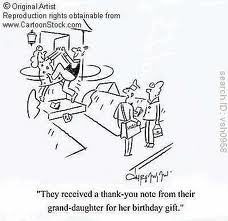
I have noticed that kids these days take things for granted on a far greater scale than when I was a child. It is much harder to please children and equally as hard to get a voluntary “Thank You.”
I imagine that Christmas is when this trend comes to the fore. As children are expecting gifts, there is a visible feeling of entitlement. The occasion mandates a good gift so what is there to be thankful for? If the gift isn’t up to their expectation, they feel that a public show of disappointment is appropriate because the gift bearer should had a better sense of occasion and made a better purchase.
What many young children may not be aware of is the stress involved with buying presents. Parents and family members go to great trouble and expense to buy quality gifts. All the child has to do is rip open the gift wrapping.
I don’t know about you, but I’m still recovering from a fun-filled holiday. I have thoroughly enjoyed the look on my kid’s faces when they saw their presents Christmas morning, all the food, and most importantly, the quality family time.
But now that the presents are finished—and we’re putting our house back together—it’s important to me that my kids appreciate all the kindness and generosity that has been shown to them.
When I was growing up, my mother had a rule about presents: you couldn’t use the gift until you had properly said thank you. Many times, this meant a phone call to say thank you for the present. But as I got older, my mom instilled in me the importance of a thank you note.
I have been trying to instill that same gratitude for gifts in my children. We usually make a phone call or draw a picture, but now my 5-year-old is learning how to properly write a thank you note. In fact, I know the significance is getting through, because after receipt of one gift, my son whispered to me that he needed to write a thank you note because that was exactly what he had been hoping for—my heart melted.
This week, I’m determined to have my boys write notes to their grandparents, family and even Santa, to thank them for the wonderful gifts they received. We’re even going to include some drawings to sweeten the package.
Babies and young toddlers: Take a piece of construction paper and using finger paints, dip your child’s hand in the paint. Then make hand prints on the paper. Then you can write a thank you for the gift on the side. Trust me when I tell you that grandparents love this!
Older toddlers: Have them color a picture, and then take a marker and then write in the thank you.
Preschoolers: Take a piece of handwriting paper, have them draw a picture on the top half and then on the bottom half, pre-write the letter for your child using dotted-line letters that your child can trace and then sign their name.
Elementary school: Give your child a head start by making them a template to follow. Sometimes the hardest part of a thank you note is knowing what to write. Elementary school kids can write the letters, but will feel less intimidated if you help them with the basic framework.
Middle/high school: Give your child a deadline. Tell them they have to have the notes completed by a certain date.
Believe it or not, your child will actually appreciate the present more because he or she took the time to do this. I know I always appreciate when people take the time to say thank you to me as well.
There is a disproportionate number of female primary teachers to males and there always will be. Instead of manipulating the numbers and offering incentives for males to join up, how about we look for teachers based on quality rather than gender? As much as it would be nice to have more men taking up primary teaching, I am not certain it is a position which men have an interest in. Many of my friends would sooner collect the dole than sign up to be a teacher. Whilst I love my job very much, most men don’t understand how why I selected my profession over the myriad of alternatives I had to choose from.
I love the position male teacher, Rocco Marchionda, takes on this issue:
Rocco Marchionda is a bit of an oddity.
At a glance, his kindergarten classroom at Merrill Elementary School in Oshkosh looks like any other song-filled, activity-oriented room of 5- and 6-year olds.
The unusual part is Marchionda himself: He’s a man. Teaching kindergarten.
“Pretty much everyone I’ve ever worked with is female. I can’t imagine what it would be like to teach with another male,” he said.
But that doesn’t seem to bother local educators as long as the teacher does a good job.”At the end of the day, the point is how the teaching is getting done and how the students are learning,” said Marchionda, who has been in the profession 13 years.
Marchionda said he became a kindergarten teacher because “in no other grade have I seen children grow so much.”
While educators want better diversity in their schools, Inda said she doesn’t believe the imbalance is a problem.”The most critical piece in a classroom teacher is not whether they’re male or female. It’s their ability to be a great teacher,”Jean Inda (director of professional education programs) said. “The worst thing we could do is encourage more males to go into elementary education if they’re not comfortable there.”
Some teachers must live under a rock. The only thing worse than calling your students names is calling your students names on Facebook. Any teacher found to be insulting their students on Facebook deserve what is coming to them.
Two teachers have quit after staff allegedly called pupils “thick” on Facebook.
Teacher Stuart Clark sparked the tirade after he declared he was “fed up of bumping into pupils in town”.
Nyanza Roberts replies: “By town, do you mean top end of holderness road? That’s bout as far anyone goes. No wonder everyone is thick..
“Inbreeding must damage brain development.”
Head Debbie Johnson jumps in and says: “You’re really on one today mrs… !! Xx.”
Colleague Jane Johnson posted: “Massive queue of year 5/6 kids in poundland! x”
Parents found out about the conversation by staff at Westcott Primary School in east Hull when copies were attached to fences in the streets surrounding the building.
Mary Wallace, chairwoman of governors at Westcott Primary School in Hull, said the two had “decided to relinquish their posts”.
Hull city council added: “We’re supporting the school and will focus on ensuring children get the best possible standards of education.”
There are thick people in this incident, but they are not the students.
The continued debate between private and public school funding tires me out. I am a big believer of a well-funded (i.e. wisely funded) public school sector as well as a thriving private school sector. There is no reason why parents can’t be given choice and why supporting private schools must come at the expense of quality public education.
This is where the “Moneyball” analogy fits in.
Moneyball is the true story of Oakland A’s GM Billy Beane. Oakland is severly restricted due to the lowest salary constraints in baseball. Winning means beating teams with much better infrastructure and player payment capacities. Billy is presented with the unenviable task of finding a winning team with the miniscule budget offered. Together with a Harvard economics major, a system is devised that uses statistical data to analyse and value players they pick for the team.
Public schools need to take the same approach. Just like the big baseball teams of the time, plenty of money is spent on public schools, but much of it is wasted money. I look at education in a very traditional way. Whilst it is ideal to have the best sporting fields, technologies and building designs, none of these ingredients has been proven to be essential for teaching and learning the curriculum. The school across the road may be able to give each child their own i-Pad, but that shouldn’t explain a marked difference in maths, science or english results. A teacher should be able to deliver on the curriculum with or without such devices.
Whilst many get worked up when Governments subsidise private schools, there is a good reason why they do it.
1. It takes billions off the budget bottom line. This saves Governments money, resulting in reduced taxes and smaller class sizes in public schools.
2. It allows private schools to lower their fees. This is crucial for parents who are by no means wealthy, but are prepared to scrimp and save (and sometimes take on multiple jobs and a second mortgage) to get their children into private schools. These people should be commended. They work long hours, weekends, give up overseas travel and big screen TV’s, just to give their kids the best education possible. Government subsidies allow that to happen.
In Australia, the Government gives $13,000 to every public school per student. Private schools get $5,000. Factor in to the equation that many private schools are not elite schools with truck loads of money and resources (I work in such a private school, where I earn considerably less than a public school teacher), and you realise that the subsidy shouldn’t detract from a thriving public education system.
By constantly drawing attention to private schools, we risk bringing the private school system down to the public level. What we should be doing instead is trying to get the public school system improved to the level where it gives its private school equivalent a run for its money. That way, you have a private school that sets the bar for top quality education and a public school system that is structured to be able to go toe-to-toe with them based on prudent spending, good decision-making and a workforce of supported and fairly paid teachers.
I commend head teacher Andre Sohatski for not only standing up for himself and his reputation, but also for representing the downtrodden teachers and students victimised by scandalous bullying websites proliferating across the web.
Web sites like RateMyTeacher.com allow students to post salacious accusations and damaging insults. These sites, together with sites that allow students to slander other students such as Little Gossip have been allowed to remain unhindered under the guise of freedom of speech.
Until now …
Andre Sohatski, headteacher of Priory School in Dorking, Surrey, took action after being told by his pupils that children were being targeted on the website Little Gossip with homophobic, racist and sexist abuse.
The site contains abusive and explicit messages written by schoolchildren that can be rated “true” or “false” by their peers. It allows them to name their “targets” but the user remains anonymous.
Mr Sohatski called for the site to be shut down and said it could cause “really big problems,” for children.
“I think it’s irresponsible. It is a form of internet bullying. Any kind of comment posted anonymously about somebody is basically unfair and sometimes cruel,” he said.
Police said they would investigate the US-based website, which has previously faced heavy criticism, and said the consequences of online bullying were “worrying”.
I am a big believer in the freedom of speech. I can accept that people have the right to vent about any professional within certain boundaries. When a student slanders another student or a teacher with homophobic, racist, sexist or defamatory insults it is fair to say those boundaries have been well and truly crossed.
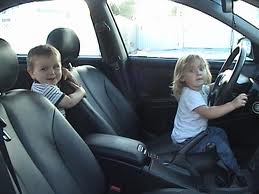
Before you disagree with my proposal let me explain the rationale. At some point people need to know how to drive. We all want capable drivers on our roads, so what better time to teach them the intricacies of driving than when they are young.
KINDERGARTENS will be urged to teach cyber safety to four-year-olds amid fears they could fall prey to online predators and bullies.
The Gillard Government will write to state education heads to encourage the take-up of cyber safety programs that teach children not to be mean online and keep their private information to themselves.
It comes amid revelations Victorian primary school children are “sexting” their friends and posting hate messages about their teachers on social networking sites.
A parliamentary committee report earlier this year recommended the Government consider the feasibility of helping deliver programs in preschools and kindergartens.
The Government yesterday accepted the recommendation in principle, but was waiting for a paper on cyber issues to be released in mid-2012 to give a detailed answer.
In the meantime, it will encourage use of Australian Communication and Media Authority programs, including Cybersmart for Young Kids.
It features a bottlenose dolphin called Hector Protector and his friends teaching young children to keep “special information” private and tell mum or dad if they see anything scary or upsetting online.
It also encourages children to share passwords with their parents and to “be nice” to others.
And parents can download a “safety button” that children can click on to cover up anything upsetting they see online with a friendly picture.
Cyber safety expert Susan McLean said flexible, compulsory education should begin as soon as children switched on a computer, from kindergarten onwards.
“I’ve seen cyber bullying in grade 2. I’ve seen kids buying things on the internet at age seven after their parents have told them not to. That’s commonplace.”
Teaching kids skills too early is like not teaching them at all. I can’t see the value of making young children endure a program that will surely be too advanced for them and doesn’t relate to their present day lives.
Whats next? Teaching four-year olds how to work an electric drill?








 Topical Teaching