Posts Tagged ‘life’

Teacher Left Out in the “Cold”

October 1, 2011

Let’s face it,  most of us respond, “Bless You” to a sneeze simply because it’s a tradition, not because of any religious reasons.

I’ve always wondered why one gets a “Bless You” for a sneeze but nothing for a cough.

I’m sure poor Steve Cuckovich wished his students had a cough rather than cold.  Perhaps none of the circus act to follow would have eventuated:

Teacher Steve Cuckovich docked his students’ scores after they said “bless you” in the middle of class. He says talking of any kind is disruptive and takes time away from class.

Cuckovich teaches health at William C. Wood High School in Vacaville.

Some parents were furious with the teacher, claiming his rule was anti-religious.

Cuckovich apparently listened to the parents. He says he will no longer deduct points from assignments for the disruption, but he added he will continue to control his classroom.

On Thursday, the district made it first comments on the issue. Superintendent John Niederkorn said that Cuckovich thought the students were sneezing in dramatic fashion with the intent of disrupting class.

“It was brought to the District’s attention a few days ago that students were disciplined for being disruptive in class. The teacher believed that students were dramatically sneezing and responding in repetitive fashion “Bless You”. One of the concerns is the social convention of saying “Gesundheit”, “God Bless You”, or “Bless You” after someone sneezes. Of question is whether a series of these repeated remarks by several students constitutes freedom of speech or a classroom disruption and merits student discipline. Vacaville Unified’s Administration is continuing its investigation of this reported classroom disruption. We are reviewing the impact of this disruption and the student grading policy. Certainly a blessing by one individual to another after a sneeze is a welcomed acknowledgement of a social norm. Hopefully it is not abused as a disruption of classroom instructional activities.” Dr. John Niederkorn, Superintendent.

Let’s get this straight.  Students erupted in a chorus of “Bless You” designed to disrupt Mr. Cuckovich class for their own enjoyment.  He responds with a consequence (albeit a harsh one) and the parents, instead of seeking the teacher or Principal for a clarification, go right to the top with their protest.

And instead of taking responsibility for the poor conduct of their children they decide to make this into a religious scandal.

And what does the superintendent do? Does he:

a. Redirect the parents to the teacher or school?

b. Tell the parents not to take this minor issue out of proportion?

c. Defend the teacher in question?

Nope.  None of the above.  I’m afraid he takes the criticisms extremely seriously and conducts a full investigation.

What’s wrong with an investigation?

This whole ugly story shows how powerless and unsupported many teachers are.  Here is a teacher who wants to do his job without disturbance.  That is every teacher’s right.  He isn’t a religious bigot or necessarily a bad teacher.  But where was his defence?  Where was the instruction to consult with the teacher before taking it to the superintendent?

How would the parents like to have such disturbances in their workplace?  How would they like it if I turned up at their desk every 5 minutes screaming “Bless You”?  How would they like it if while they were conducting a meeting I waltzed in screaming “Bless You”?.

I’m sure they wouldn’t like it.  But they wouldn’t be able to stop me.  That would be anti-religious!

It’s Time That Teachers Get Trained Properly

September 28, 2011

It’s just bewildering how unprepared our system seems to be in dealing with students who turn up to school without basic language skill.

When a person fronts up to a doctor with an ailment that came about from unhealthy eating habits and reckless behaviour, the doctor doesn’t throw his/her hands up in the air and tell them that they can’t properly help them because of their inability to look after themselves.

When a plumber gets called to a house to inspect a toilet that has been clogged due to the owners stupidity and laziness the plumber doesn’t refuse to take the job citing that they can’t fix a problem that wouldn’t have existed had the owner stuck to flushing toilet paper only.

There are professionals that are prepared to take on all kinds of cases regardless of the negligence or challenges involved.  And then there’s teachers …

Traditionally, teachers seem to crumble when presented with students who haven’t acquired basic skills at home.  I am glad to hear that our wonderful profession is taking more positive steps in dealing with this problem:

In socially deprived areas more than 50% of children begin school without the ability to speak in long sentences, which experts say can lead to problems in later life. Schools across England are taking part in a day without pens to tackle this speech deficit.

It took the whole class of five and six-year-olds six attempts to reassemble these jumbled words into a coherent sentence: “Past the walked we shops.”

Partly it was the noise in the classroom which made listening difficult.

Partly it was the distracting presence of a man from the BBC with a microphone.

But mostly it was unfamiliarity with the basic rules of English, their first language, which made the exercise so long winded.

The children, from Baguley Hall Primary School in Wythenshawe, south Manchester, are bright and normal children.

But they have had few opportunities to develop conversation skills.

It is a poor area with high unemployment and a large proportion of children living in lone parent households.

 Family discussions do not happen very often.
Of course I am making a generalisation  (and I am not comparing a child with a clogged toilet!). There are plenty of teachers fully equipped at dealing with this issue.  But there are too many that aren’t.
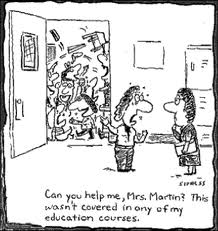
For me this has little to do with effective teaching and more to do with effective teacher training.  Teachers are not fully prepared for the child that doesn’t know how to carry a conversation because practical skills aren’t properly covered in a Teaching degree.
Whilst it would be nice for parents to ensure their children turn up to school with basic language skills this just can’t be relied upon.  Teachers need to be prepared for all types of scenarios.
Unfortunately, they are not prepared at all!

Expert Criticises Lack of Action on Bullying

September 28, 2011

Leading expert on bullying, Professor Debra Pepler of York University condemns Canada for failing to manage its rampant bullying problem.  Professor Pepler’s criticisms are valid not just for Canada, but for all countries.  You would think that since we have a greater understanding of the issue and Governments have pumped mega dollars in fighting the problem  that we would have seen some results.  Unfortunately, this is not the case:

Canada is not doing a good job of addressing bullying so it remains a major problem, says one of the country’s leading experts on the issue.

“Here we are, a country that has an international reputation of being so nice and dealing with issues of diversity, inclusion and equity, and yet at the level of children, we really aren’t doing a good job,” said Professor Debra Pepler of York University, who is also a scientist at the Hospital for Sick Children.

“We are not keeping them safe; we are not providing them with the necessary supports to learn how to live in healthy relationships,” added Pepler, a founder of PREVNet (Promoting Relationships and Eliminating Violence Network), a national network of researchers.

With the recent news of an 11-year-old Pickering boy who killed himself earlier this month — with bullying one of the many factors involved — many now wonder what more can be done.

The parents of Mitchell Wilson say their son, who suffered from muscular dystrophy, began a downward spiral of depression and anxiety following a November 2010 mugging and subsequent bullying by older students at Westcreek Public School.

It’s time schools spent less energy trying to protect themselves from lawsuits and invest more into improving its culture and ramping up the consequences for bullying infringements.   Inept policies and programs may be enough to avoid legal suits but it has never come close to dealing with the problem.

Success in curbing bullying is every bit as important as academic achievement.  Ultimately, both go hand in hand.  You are unlikely to get a child to perform at their potential when they are being victimised and tormented.


Turning a Blind-Eye to Terrible Teachers

September 28, 2011

One seldom reads an article about an inspirational teacher, because such things are not considered newsworthy.  You do, however, read about the incompetent teachers who abuse the trust bestowed on them.  Today I read of one such teacher.  A teacher so destructive and irresponsible, one wonders why it took so long to get rid of her:

Roslyn Holloway, who taught at the Lord Silkin Trust Secondary School in Telford, Shrops, threatened to use the bizarre ritual to drown the unnamed student if he didn’t stop misbehaving in class.

In a series of other incidents, the special educational needs teacher tore the hair out of a pupil’s skull after he did not stop talking in class while she also engaged in sexual-based conversation with another.

A General Teaching Council panel was told that she struck another different boy on the forehead with the heel of her hand in the school corridor, referred to him as an “idiot” in front of his classmates and threatened to bang his head on the table.

She was formally cautioned by police for battery, for the hair pulling incident involving one of her students in November 2009, but failed to notify her employers, which breached her employment conditions, even though they were aware of caution.

The assult left the student with a red mark and a lump on his head.

Holloway, who taught students aged 13 at the school from September 2003 until her suspension in January last year, also racially abused other pupils by calling them “black boy”, “Pepsi Max” and “ginge” during class.

I am sympathetic to some of the teachers condemned by the media.  I understand that teaching can be very difficult and I am aware that it is hard to keep ones emotions in check when chaos in the classroom ensues.

But I have no sympathy for this woman if the allegations against her are indeed true.  What I do have, is a very important question:

Why did it take so long for a teacher who transgressed in so many blatant ways to be deregistered?

It is unbelievable how meek the initial response was:

After the parents of two children complained that they had been left “distressed”, she was counselled by her bosses to change her methods, which she failed to heed.

So when you get a spokesperson saying the officials place “the safety, health and welfare of its students first”, I don’t believe them for one second.

As far as I’m concerned, this story isn’t merely about a volatile and unprofessional teacher, it’s about a system that takes too long to respond to serious incidents.  The “blind eye” approach might work in the general workplace, but we are talking about young children here!

More needs to be done to detect such teachers before the damage is insurmountable.


Primary Schools Forced To Give Sex Education

September 27, 2011

I don’t object to Sex Education lessons in Primary Schools, but I do object unreservedly to schools continually being forced to undertake programs.  Schools should be able to decide for themselves what extra programs they wish to take on.

Some primary schools are being forced by local authorities to teach sex education to their pupils, a report has claimed.

The research, published on Monday, raises concerns over the “considerable level of inconsistency” across the country. Many local authorities are incorrectly informing primary schools in their area they will not be eligible for the ‘Healthy School’ status if they did not teach sex education, it suggested.

Every week a new program is being established for schools throughout the world.  If it’s not Sex-Ed it’s suicide prevention, bullying, cyber bullying, cyber safety, hygiene, traffic safety, Stranger Danger etc.  Whilst all these initiatives have good intentions and are worthy causes (with perhaps the exception of Stranger Danger), it causes a great strain on teachers already struggling with time constraints.  The more programs undertaken by schools the harder it is to cover the curriculum.

At some point in time we will have no choice but defer some of the responsibility of sex-ed on the parents of our students.  After all, educating ones child about sex is a perfectly reasonable thing to expect from a parent.

Students Are Not Allowed Opinions Anymore

September 26, 2011

As a teacher, it isn’t uncommon to confront opinionated students.  Of course, many of their opinions I don’t personally agree with (some of which are a reflection of their immaturity).  That being the case, I still feel that it is much healthier for a child to have too many opinions that to have none at all.  As our job description includes nurturing each childs’ critical thinking skills, you would have thought that the canvassing of opinions is vital to a functioning classroom.

But you would be wrong.  More than ever before, the powers that be have been stifling debate, silencing contrasting views and imposing a mantra of political correctness.  Take the case of Dakota Ary:

The mother of a Fort Worth student said she unhappy her son was given in-school suspension for making a comment in class about homosexuality and Christianity.

During a discussion in his German class at Western hills High School on Tuesday, freshman Dakota Ary said he commented to a friend that his religious beliefs say homosexuality is wrong.

“I said, ‘I’m Christian and, to me, being homosexual is wrong,'” Ary said. “And then he (the teacher) got mad, wrote me an infraction and sent me to the office.”

It is my view that you don’t change a person’s viewpoint by silencing or suspending them.  Whether I agree or disagree with my students is immaterial, they are still entitled to share their views with the class.  Usually views materialise from only considering one side of the argument.  A healthy classroom discussion often features a range of insights and perspectives.  This healthy discussion often leads kids to change or alter their views and accept differences of opinions.

Unfortunately, in the age of political correctness opinions are becoming a thing of the past.

The Case in Favour of Homework

September 24, 2011

I used to be philosophically opposed to homework in all forms.  That was, until I witnessed how my students used their after-school time.  It was then, that I realised that ten to fifteen minutes a night would constitute the only meaningful activity some of these students would take part in on a given night.

I am still hardly a proponent of homework, but I do share some of the opinions of author and teacher, Katharine Birbalsingh:

The radio presenter Alan Jones doesn’t believe in homework because children should have time to play outside and learn skills that only time after school with your family can teach. Normally, I would agree. But do children today have these types of experiences after school?

Families are so busy working that when children come home, they often sit in front of the TV for hours or play computer games. Children spend hours every day networking on Facebook. Exhausted parents do not realise just how dangerous these modern technological tools can be.

Technology can open a world of excitement to children. Yet it can also glorify gangster lifestyles through MTV, and encourage the use of bad language and ”text speak” in social networking.

An hour of homework a night distracts children from such activities and enables them to practise what they were taught at school. Excellent learning requires constant revisiting, and homework is the perfect tool to reinforce facts and skills. Teachers often find that children forget what they learnt the day before. At high school, you may not see your history or geography teacher for a few days until the next lesson. Without any homework in between to bridge the gap, often teachers take two steps forward, then one step back in the following lesson.

It is the school’s responsibility to inform parents that homework has been set – easily done through a diary system. The school should also ensure the homework set is of quality and not some assignment that can essentially be downloaded from the internet. Equally, it is the parents’ responsibility to ensure homework gets done.

I object to her call for an hour of homework per day, but I do currently favour 10-15 minutes of revision work, to consolidate on skills and concepts currently being covered in class.
Anthony Purcell from the brilliant blog Educationally Minded employs a similar strategy for homework inspired by his will to see his students gain some confidence from working independently:
Well, I have taught math in the past. My thoughts on homework was that if students had homework, they didn’t get finished in class. I never assigned homework. Homework was there if they didn’t get finished in class, but most times students did.

Now that I teach Science, it’s the same way. A lot of what we do is in class, hands-on activities. Homework are the questions they didn’t get to because they were goofing off or not focused in class.

In my opinion, teachers who teach the entire period and allow no work time are not good teachers. Students need to know they are being successful and have confidence. They can’t have a teacher telling them they are correct when they are at home.

This topic remains a very contentious one.  I look forward to reading your opinions on this much discussed issue.

Big Tobacco Funding Primary Schools

September 23, 2011

In today’s age, knowing what we know about the risks of smoking, how is it possible that tobacco companies have access to schools?  As important as it is to take into account cultural differences, China has no excuse in allowing tobacco companies to make their pitch to impressionable young children.  The cost of a quality education is not worth it if it comes with lung cancer, heart disease and emphysema.

MORE than 100 primary schools in China are sponsored by tobacco companies in a move described by anti-smoking campaigners as hunting for the next generation of smokers.

The schools often have the names of Chinese cigarette brands, such as Zhongnanhai or Liqun, over their gates and in some cases have promotional slogans in the playground.

”Talent comes from hard work – Tobacco helps you become talented,” says one slogan, in foot-high gilt letters, on the front of the Sichuan Tobacco Hope Primary School.

Tobacco helps you become talented?  No China, tobacco helps you die well and truly before your time!
Unfortunately, the message is successfully getting through to China’s underage demographic:
There are 16 million smokers under the age of 15 in China, 6.3 per cent of the youth population, according to the Chinese government.

For a country that is reknown for its strict regulations, it is mistifying that there is no regulations prohibiting tobacco from parading their brands in schools.

Not Enough is Done To Curb Bullying in Schools

September 23, 2011

Parents are right when they express a lack of confidence in the way bullying behaviour is being handled by schools.  Schools just don’t seem to find dealing with the problem anywhere as near a priority as performing in standardised tests.  Schools nowadays use simplistic and inept anti-bullying policies to point out to parents that they are proactive on the issue.  In truth, all anti-bullying policies really does is protect a school from lawsuits.  If policies worked the problem would’t be getting worse.  But it is.

Detective Tim Toth, head of the youth services division of the City of Tonawanda Police Department is absolutely right:

“It’s great to tell the parents we have a bullying program in place, but until they take it serious and until the kids know there are consequences with what they do, the program is no good,” said Toth, who has also spent several years working at the high school as a resource officer.

I however disagree with Toth’s conclusions on cyberbullying:

“We don’t have the legal authority to intervene in a situation which exists between one child’s computer and another child’s computer when they are not being supervised when they are off school grounds,” noted Crawford. “But that doesn’t mean we don’t care…and it doesn’t mean we don’t make efforts to intervene when we can. But we need people, when we do attempt to intervene, to respond to us.”

That is a very poor response to an increasingly massive problem.  Schools MUST intervene when it comes to cyberbullying.  They MUST take more than a passing interest.  Schools, police, parents and the wider school community must join forces to curb cyberbullying.  It must be seen as a wider communal problem rather than something each and every stakeholder hides from.

Schools have got to ramp up their responses.  Programs, procedures and policies is not enough.  They will not work and never have.  Appealing to kids to improve their communications wont work either.

Bullying hurts and sometimes kills.  Surely schools have got that by now …


Private School Teachers Are Not Necessarily Better Teachers

September 21, 2011

Whilst I like the idea of experienced and outstanding teachers helping to mentor student teachers, I am very bewildered by a proposal to have private school teachers mentor public school teachers.

Who thought of this crazy plan?

It is such a simplistic generalisation that private school teachers are superior to their public counterparts.  So what if private school kids get better academic results.  We all know that the credit doesn’t solely fall on the classroom teachers.  Private school students are given higher expectations by their parents and often have tutors to help them when they are behind.

That is why it was refreshing to read an article by lecturer, James Williams:

The results that private schools achieve may be impressive – but results are one thing, raising aspirations in a cohort of disaffected youths, when your experience is of children with Cath Kidston pencil cases who holiday in the Bahamas is quite another.

The problem with such debates is that they miss an important point.

Not all teachers, regardless of how they have been trained, can teach in all schools.

The reality of teacher training is that there is no ‘one method’ of training that instantly produces excellent teachers who can turn their hand to any school, any challenge and any system.

An important skill for those who are teacher trainers, like me, is recognising your trainee’s strengths and weaknesses and guiding them to teach in the right school for them.

It is very good to hear that teacher training is under the microscope.  For too long the problems to do with teacher training was swept under the carpet.  Teachers spend years of their lives slaving away for a degree that ultimately does precious little for preparing them for the realities of the classroom.

I like the idea of a mentor system, I just don’t like this one.