Posts Tagged ‘Education’

Too Many Tests, Not Enough Teaching

March 30, 2012

The rise of standardised testing has replaced authentic teaching and learning with a saturation of practise and formal testing:

SATURATION testing is seriously undermining the quality of primary school education and should be stopped immediately, parents and educators claimed yesterday.

Thousands of kids are subjected to trial exams every week in the lead up to the compulsory Naplan tests, as well as exams for opportunity classes or selective high schools, and coaching by private tutors.

But while Naplan, which forms the basis of performance ratings on the My School website, focuses on literacy and numeracy, experts claim they are being “taught to the test” at the expense of other areas such as arts, physical education and music.

With the barrage of testing beginning in kindergarten, education consultant and public schools principals’ forum official Brian Chudleigh said the system was “out of control” and skewing education in the wrong direction. A former senior principal who is the education expert for The Daily Telegraph’s People’s Plan, Mr Chudleigh said the testing regime was contributing to a “massive dysfunction” in the state’s education system.

“We have become a system that is manic about measurement – the main problem is that it is so convenient for the politicians,” he said. “They want to reduce things to the value of a percentile or a number, and that has an impact on education.

“If a kid can’t be measured they don’t want to know about it.

“It reduces the value of anything that you can’t measure and the curriculum becomes focused on the measurable stuff,” Mr Chudleigh said.

“So the development of the whole child – including socialisation, emotional welfare, physical fitness and cultural factors – are relegated in importance.

“Many schools are having two or three lessons every week practising Naplan-style tests and that takes valuable teaching time away from other subjects. A lot of the best stuff we do with kids, particularly in primary school, is not measurable.

“It’s out of control. But our universities are littered with these kids who don’t do as well there as the generally all-round educated students.”

Federation of Parents and Citizens’ Associations spokeswoman Rachael Sowden said being taught to the test was “not what parents want”.

“They do not want to know that their child scored three marks more than the kid down the street,” she said. “Parents are as concerned about the whole child and how they are going in creative arts, physical education and music as much as in literacy and numeracy.

“Parents do want to know where their child is up to at school and they do that best by having a conversation with the teacher.”

I hate having to prepare 8 year-olds who have never sat for a formal test before for the rigours of the 3 day marathon that is NAPLAN. It’s just not fair! They are too young!

One of the Most Overrated Skills in the Classroom

March 28, 2012

Whilst I can obviously see the value of teaching spelling skills, I don’t think it is anywhere near as important as schools make out.

The emphasis that spelling gets when it comes to teaching allotments, testing and reporting is astounding. Surely there are more vital skills such as maths, writing and reading that can profit from taking some of the ‘treasured’ spelling time.

Many skills now have specialised spelling programs complete with up to 5 weekly periods per class from the Second Grade upwards. Talk about overkill! My daughter recently brought home a form requesting our written consent to take her out of her classes in order to strengthen her spelling skills. What makes this request even more bizarre is that she is only in the first grade! I can understand taking her out for maths or English, but spelling?

What upsets me most about the obsession with children and spelling is what it does to our students. Our children know whether they are good spellers or not. They have been tested countless times and their work is often given a ‘dose of red’ where every misspelled word corrected. What then tends to happen, is that students become self-conscious about their spelling capabilities and try to avoid the dreaded red ink corrections. Instead of using the most appropriate word for their written work, they choose words they know how to spell. This has a severe negative impact on the quality of their writing.

I am a big fan of minimising the emphasis of spelling. I want my students to write freely, to choose words that best fits their work and have a fearless approach to spelling difficult words. To me, a free and unhampered piece of writing replete with spelling errors far outweighs a dreary, disjointed piece of work with correct spelling.

I’m not against the teaching of spelling and I certainly believe that spelling rules and the understanding of morphographs have a place in the classroom. I just don’t think these skills are anywhere near as important as many would have you believe.

Teachers Concerned About Violent Video Games

March 28, 2012

Whenever teachers dispense parenting advice, the outcome is almost never a positive one. As much as I agree that children who are exposed to violent movies and video games are worse for it, I think it is essential that teachers spend less time judging parents and more time concentrating on the curriculum.

Still, in a perfect world, parents should reflect on some of the criticisms conveyed by teachers:

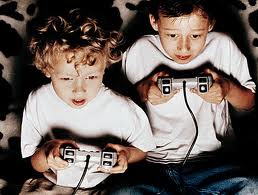
School pupils are being allowed to stay up until the early hours of the morning playing games that are inappropriate for their age, said Mary Bousted, general secretary of the Association of Teachers and Lecturers.

She said many parents were failing to adhere to age-restrictions on the most violent games, raising concerns that children are growing up desensitised to aggression and bloodshed.

It was also claimed that over-exposure to screen-based entertainment was robbing children of valuable time interacting with friends or playing outdoors – harming their education and long term development.

It follows repeated concerns from psychologists that watching violent films and playing games such as Grand Theft Auto, Mortal Kombat and Modern Warfare makes youngsters more prone to violence.

Speaking yesterday, Dr Bousted said: “I think what we are talking about, first of all, is the amount of time children spend locked in their room. The fact that children spend hours locked in their rooms playing computer games, which means they’re not interacting, they’re not playing and not taking exercise.”

Some of these games were “very violent”, she said, and risk having a major effect on “tender young minds of children and young people.”

Dr Bousted said that many teachers fear parents are ignoring age restrictions on computer games, which often ban their sale to children aged below 18.

“The watershed tends to work quite well, but with online TV and video children and young people are probably watching inappropriate content over a range of media,” she said.

It would be great to share criticisms with parents without fear of reprisal. But, in my experience, the importance of having parents on side means that these criticisms can interfere with a healthy parent/teacher partnership.

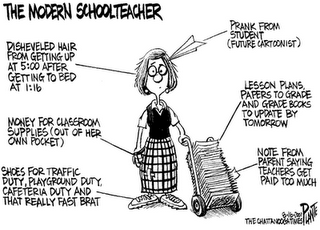
The Overwhelming Responsibilies of the Modern Teacher

March 26, 2012

I just read a brilliant piece by teacher Daniel Cohen.

Whilst I differ from the author of this article in one key area, I believe the article presents a most accurate account of the day-to-day challenges that face working teachers. I don’t agree with the premise that for all the hard work we put in, we receive little in return. Yes, we are underpayed. But what we do get back from our students can not be easily quantified.

Even still, his assessment on the daily rigours and insane paperwork and planning requirements is captured brilliantly in the article.

I BECAME a teacher to help children learn.

I’m now working with at-risk children who do not cope in a mainstream setting.

They have emotional and behavioural issues affecting their ability to perform and succeed within school.

They, like all students, need a strong teaching profession.

I see the role of teachers as both educating students and preparing them for society as adults.

A lot of the focus is on literacy and numeracy.

As a teacher, I believe there are a lot more skills that students need than just reading and writing.

It’s my role to help them develop into adults.

Teaching is the closest thing you can get to being a parent without having children.

Like parents, teachers form relationships with children that are central to a child’s learning and development.

We help them sort out personal problems and friendship issues.

We help with knowledge in an academic sense. But we also help them learn to interact and deal with people and how to get along.

They can’t learn subject content if they can’t work with others.

And they can’t learn to work with other people in isolation. That’s part of a teacher’s role as well as a parent’s.

Day to day, students attend classes between 9am and 3.30pm.

When the students are at school, the teacher’s whole focus is on working with them.

Preparing lessons, correcting work, organising meetings and other duties associated with being part of a workplace all happen outside of class time.

A teacher’s legal and professional responsibility to students does not end when students aren’t around.

A lot of that happens during a teacher’s personal time.

Our tasks – attending staff meetings outside of class, correcting and checking work and so on – cannot be properly completed within normal, paid allocated time.

Because teachers are in a workplace, we have Occupational Health and Safety obligations to fulfil, such as ensuring that the school is safe and correct procedures are followed in classroom safety.

We are required to provide supervision and ensure that the classroom is a safe environment.

Also, we must formally report on any issues involving child welfare.

These are just some of the very serious responsibilities all teachers assume.

Watching students is difficult.

When you have 27 students, ensuring they are all safe and within sight at all times can be quite time-consuming.

The pay situation as it is now makes me feel really undervalued by my employer – the State Government. I’m disappointed and upset that our pay negotiations have not been progressing.

The work we do is essential.

To have the Government stall undervalues our work and undervalues the education that children deserve.

Failing to pay us properly means we’re not given the resources or time we need to do the best for our students – Victoria’s children.

We’re using our own time to do more for the students because we think it’s important. Teachers want what’s best for students.

Without proper pay, my worry is that the profession will suffer and good teachers will leave.

Those who stay may suffer ill-health because they are not given enough time to properly do the job.

We already have a shortage of teachers.

Without proper pay, we will struggle to keep the ones we have or to recruit new ones.

Teachers put in the extra time because they’re doing what’s best for their students.

But without support from their employer, it is increasingly difficult for teachers to keep on doing that important work.

The Government wants more productivity.

That will be achieved by giving teachers the resources they need and by supporting the profession.

3rd Graders Perform Sex Act in the Classroom Without Being Noticed

March 25, 2012

Whilst I can’t understand why a teacher wouldn’t have spotted their students performing oral sex in the classroom, I don’t think that the teacher’s role in this story is the critical one. What I want to know is how on earth do 8 year olds end up behaving like that in the first place?

An unnamed teacher at Tallulah Elementary School in Tallulah, Louisiana has been fired from her job as a teacher for not noticing two third graders engaged in oral sex underneath a table, according to the local News Star.

District Superintendent Lisa Wilmore made it clear to the paper that the teacher was fired because the incident occurred on her watch.

Wilmore said, according to the News-Star,

“The principal felt that she was not monitoring the classroom adequately. The principal made a decision, and I supported the principal. We have to make sure we have people in these classrooms who are monitoring our students.”

The district of Tallulah has been dealing with several problems this year.  Recently another teacher was placed on leave for a substance abuse problem.

The School District also announced that while the two children are going through counseling they are not going to be disciplined or have their studies hurt.

Both teacher dismissals were part of what Wilmore is calling her program of “Changing the culture” in the school district.

It doesn’t matter how many teachers that school fires, they won’t come close to changing the culture of the school without investigating the behaviour of their students. What are these children exposed to at home? Are these kids exposed to pornographic material? Did they now what they were doing? What are their parents’ role in this incident?
It is not enough to focus on the teacher. Yes, the teacher could have prevented it from happening by being more alert. Yes, teachers who don’t notice major incidents under their watch have some serious questions to answer. But that should never prevent the school from investigating the reasons behind the incident and find out what caused their students to act that way.
Sacking teachers in the name of an improved school culture is useless when third grade children feel the need to engage in sex acts and seemingly nothing is done about it.

The Fine Line Between a “Fragile” Teacher and a Dangerous One

March 25, 2012

Sometimes it is absolutely vital to call a spade a spade. There is no good reason to protect the honour or devise a defence for a teacher that incites her class to stand for a minute silence for a known terrorist. It doesn’t matter how troubled this teacher may have been, there was no excuse for this incredibly irresponsible act:

A French teacher was suspended on Friday for allegedly urging her class to observe a minute’s silence for serial killer Mohamed Merah, the day after he was shot dead by police.

Education Minister Luc Chatel had called for the teacher to be suspended after her class reported she called Merah a “victim” and said his links to Al-Qaeda were invented by the media and “Sarko”, referring to President Nicolas Sarkozy.

“An immediate suspension has been decided along with a ban on entering the school,” the local education authority’s Florence Robine told journalists, adding that the suspension did not imply any guilt.

She “clearly said that Mohamed Merah was a victim, that the link with Al-Qaeda had been invented by the media and ‘Sarko’,” said the letter, a copy of which was published by the Paris Normandie newspaper.

“This is not the political act of an extremist but the act of a colleague who has health concerns, who is fragile and who is receiving psychological treatment,” the local head of the SGEN-CFDT union, Pascal Bossuyt, told AFP.

“She said something unfortunate in a particular context and she immediately regretted what she said,” he added.

Police shot Merah dead on Thursday at his flat in southwest France where he was holed up after going on a jihadist-inspired killing spree. His victims included three young Jewish children and three paratroopers.

It is a shame that “fragile” teachers with “health concerns” are often allowed to practice until they do something inappropriate. This was more than the act of a teacher requiring “psychological treatment.”

This was the act of a teacher who is completely unfit for teaching.

Teaching Fractions: The Musical

March 22, 2012

As it is very difficult to convey the skills of fractions,  I am keen to see how a new programme that helps students learn fractions to music actually works. Fractions is often the skill that teachers dread to cover. I have heard of teachers that have demanded to teach lower grades just to avoid it.

That is why I am sure that this programme will generate plenty of interest:

For tapping out a beat may help children learn difficult fraction concepts, according to new findings due to be published in the journal Educational Studies in Mathematics.

An innovative curriculum uses rhythm to teach fractions at a California school where students in a music-based programme scored significantly higher on math tests than their peers who received regular instruction.

“Academic Music” is a hands-on curriculum that uses music notation, clapping, drumming and chanting to introduce third-grade students to fractions.

The programme, co-designed by San Francisco State University researchers, addresses one of the most difficult – and important – topics in the elementary mathematics curriculum.

“If students don’t understand fractions early on, they often struggle with algebra and mathematical reasoning later in their schooling,” said Susan Courey, assistant professor of special education at San Francisco State University.

“We have designed a method that uses gestures and symbols to help children understand parts of a whole and learn the academic language of math.”

It will be interesting to see if this programme becomes a success.

There is Still Some Love for the Forgotten Class Whiteboard

March 22, 2012

I’ve inherited a class that does not have a whiteboard. Well actually it does, but it is covered up by a Smart Board. It seems that my school was so excited to install brand new Smart Boards (interactive whiteboards) that they set it up directly on the existing board. They were so keen to set up the Smart Boards it didn’t even occur to them to take down the whiteboards first!

As much as I love my Smart Board, I find it much easier to write and present maths problems on a traditional whiteboard.

So I got my school to order one for me. Last December ….

And it only arrived today!

Meanwhile, my Smart Board died two weeks ago. The projector just decided it couldn’t facilitate any longer (I hope it didn’t have anything to do with my ghastly interactive whiteboard handwriting). A teacher without a whiteboard is like a carpenter without a drill. It is a huge challenge to teach without a board. A challenge that has proved frustrating and in a sense, quite revealing.

It has taught me that no matter how incredible modern technology has become. No matter how much education has been transformed because of touch screens, blogs, the internet, YouTube, Wikipedia etc. Nothing can replace the simple whiteboard!

101 Ways to Misdiagnose ADHD

March 20, 2012

I am not sure if ADHD exists or not. Since I am not a doctor or medical professional, I will decide to err on the side of caution and give ADHD the benefit of the doubt. But whether or not it exists doesn’t seem to be the pressing issue. The issue seems more to do with the poor children misdiagnosed with ADHD in what seems to be a completely haphazard fashion:

A STUDY of almost a million Canadian children has found those born in December, the last month of the school year intake, are more likely to be diagnosed with ADHD and medicated for it than those born in January.

Relative immaturity may result in the inappropriate diagnosis of ADHD, the University of British Columbia researchers suggest.

They raise “concerns about the potential harms of overdiagnosis and overprescribing” for the condition. Children given medication for ADHD may suffer adverse effects on sleep, appetite and growth and face increased risk of cardiovascular events, the paper says.

Inappropriate diagnosis may lead teachers and parents to treat the child differently and change self-perceptions.

The study in this month’s Canadian Medical Association Journal, found boys born in December were 30 per cent more likely to receive a diagnosis of ADHD than boys born in January and 41 per cent more likely to be given medication for ADHD.

The medical fraternity has let themselves down with ADHD. It seems from this untrained eye that too many kids are being diagnosed with this condition and therefore, too many kids are needlessly medicated. What this does is bunch real sufferers of ADHD with kids who have come down with a bout of, for example, immaturity.

If Teachers Were Paid More I Wouldn’t Have Become One

March 20, 2012

Another year, another impending strike. I know I am a lone voice on this  one, but I find the notion of teachers striking very distasteful and selfish. The job of a teacher is to support and nurture their students. When a teacher decides not to front up to work, they are robbing children of a day of school.

I have never met a teacher that went into the caper for the money. It is a well-known fact that teachers don’t get paid vast sums of money. Partly, this is due to tradition and partly it is due to the fact that Governments simply cannot afford to offer large pay increases across the board.

Am I suggesting that teachers should not be paid more? Absolutely not. I think I work hard enough to justify an increase of salary (currently 3% less than a public school teacher). There is enough wasted money spent on education, I think it would be quite appropriate for some of that misspent money to be allocated to teachers.

What I don’t agree with is the argument that teachers should be given a marked increase. If that was to happen before I started my teacher training, I never would have become a teacher. A large wage increase would have led to a greater popularity in teacher enrolments. The flow on from this would have been that to get into a teaching course, the tertiary rank (based on Year 12 results) would have been much harder. I simply would not have had the grades to get a place.

Some would see that as a positive. Teachers should, according to many, posses outstanding academic credentials. After all, the smarter the teacher, the better the teacher, right?

Not necessarily. I was a late bloomer. I struggled throughout school. My teachers found me very frustrating. No matter how much I applied myself, simply passing was a huge challenge for me. And yet, it is this struggle that has made me become a decent teacher. It has provided me with patience and it allows me to understand the struggles of students with learning difficulties and confidence issues. I try to be the very teacher I felt I needed, but never had.

Whilst I believe that teachers do a wonderful job and they deserve to be paid accordingly, I would like to reach that point without strikes and without Education Unions (they shouldn’t be allowed to be called the Education Union – they aren’t representing what is best for education). I would like potential teachers to join this wonderful profession more for the passion and dedication they have for the job than the money.

I expect that I will be critcised roundly for my stance. I look forward to reading your take on this.