
Posts Tagged ‘Education’

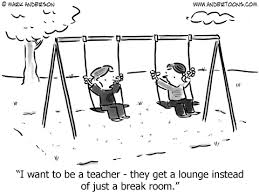
Is There a More Undervalued Career than Teaching?

June 30, 2014

lounge


Teaching is not necessarily as difficult as some make out, but it surely is under appreciated:


The survey, by the Organisation for Economic Co-operation and Development, found only 39 per cent of Australian teachers surveyed believed society valued the profession.

The Teaching and Learning International Survey was conducted last year and included 2059 Australian lower secondary school teachers and 116 principals. They were among 106,000 teachers from more than 30 countries and economies who responded to the survey.

However, Keysborough College principal Heather Lindsay said it was little surprise that many teachers surveyed felt society did not value their work. ”It’s easy for others to have a misunderstanding of what’s involved in teaching,” she said. ”Teaching is a very complex job.”

Ms Lindsay said many of her teachers spent at least one or two hours correcting work after school and half a day on the weekends was often given over to work. ”Teachers work through their holidays. They work long hours,” she said.

The report showed that 62 per cent of Australian teachers believed that the appraisal and feedback process was ”primarily an administrative exercise”, which had a detrimental effect on job satisfaction. Nearly half of the Australian teachers surveyed reported that appraisals had little or no impact on teachers in the classroom.


Click on the link to read Tribute to the Fallen Teachers

Click on the link to read  You Can’t Expect Your Students to be Flexible If You Aren’t

Click on the link to read How Many Teachers Does it Take to Change a Light Bulb? (Part 1)

Click on the link to read The Classroom Shouldn’t be a War Zone for Our Teachers

Click on the link to read Remember When Teachers Were Shown Respect? (Video)


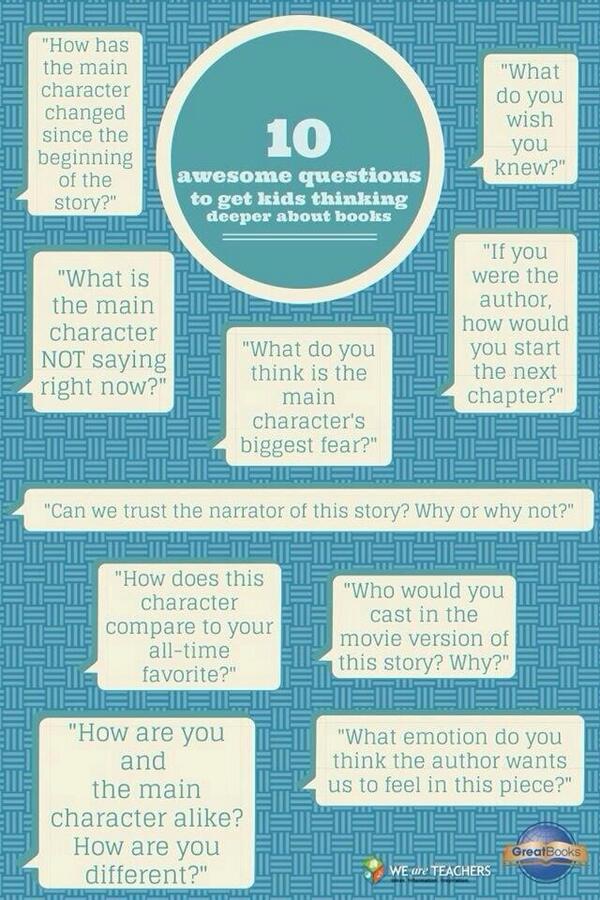
10 Questions to Get Kids Thinking Deeper About their Books.

June 25, 2014


A very worthwhile list:

questions


Click on the link to read 24 Books to Get Your Children Reading

Click on the link to read 17 Children’s Books You Still Love as an Adult

Click on the link to read The Telegraph’s Best Children’s Book of All Time

Click on the link to read The New York Public Library’s 100 Most Requested Children’s Books

Click on the link to read Stunning Photographs of the Most Beautiful Libraries in the World

Click on the link to read The Call to Stop Kids From Reading Books they Actually Enjoy

Smartphones and Tablets Blamed for Stunting Our Kids’ Speech

June 23, 2014


tablet

I find it ironic that some of the best speech pathologists use smartphone and tablet apps as a central plank of their clinical treatment. It seems that these devises are also blamed for creating the problem in the first place.

My view is that the best way to enhance a child’s vocabulary is to speak to them regularly. Unfortunately, many parents don’t have the same time with their kids that previous generations have had. The modern working family often relies on child care, which is not always the best place for kids to get regular conversations.

MORE children are starting school with serious speech problems because parents relying on smartphones and iPads as “babysitting” tools are allowing excessive use, education leaders have warned.

Up to one in eight children in some preschool and Reception classes need speech therapy because they have been starved of conversation and not read to enough at home.

School leaders want more access to speech pathologists to tackle growing numbers of students struggling to make basic phonetic sounds.

Some parents are resorting to private therapy even before their children begin kindergarten.

SA Primary Principals Association president Pam Kent said digital devices were “a fantastic tool” but “they should not be a babysitting device”.

“It’s not that we’re sledging parents but all these (electronic) activities need to be monitored in moderation. They are quite addictive and children can become quite obsessive about them,” she said.

I would like to see teachers modify their expectation of preschool language standards and instead of farming under performing children to speech pathologists, show a greater preparedness to fast track them from within the classroom.

Let’s just assume that children have less than ideal skills in areas such as speech and build a curriculum that meets these challenges rather than sticks up the white flag and reaches for the nearest specialist.


Click on the link to read A Preschooler’s Most Memorable Graduation Speech (Video)

Click on the link to read Is “Bubble Wrapping” Your Child Really Worthwhile?

Click on the link to read The Ease in Which Our Children Can be Brainwashed (Video)

Click on the link to read Teaching Young Children the 3Rs Could be Damaging: Psychologist

Click on the link to read 7 Ways To Teach Kids Self-Awareness

Click on the link to read Kids Explain the Meaning of Happiness

24 Books to Get Your Children Reading

June 19, 2014


reading and children

Courtesy of Huffington Post blogger Devon Corneal:


  • Ninja Red Riding Hood by Corey Rosen Schwartz
    First it was the Three Little Pigs, now Red Riding Hood is studying martial arts! Thank goodness, because how else can she be expected to fend off the Big Bad Wolf? If you liked The Three Ninja Pigs, you’re going to love this new take on an old classic. Get ready — KIYA!
  • Counting has never been so much fun. Detailed pen and ink illustrations splashed with color will keep young readers engaged as they try to spot the adventurous dragon.
  • Troll Swap by Leigh Hodgkinson
    Tabitha Lumpit is loud and messy and doesn’t fit in with her very neat and polite human family. Timothy Limpet is quiet and tidy and doesn’t think he belongs with his scary, mucky troll family. So they do what any two kids would do — they swap places. While it’s fun at first, Tabitha and Timothy soon discover what we all know: there’s no place like home.
  • Little Pear Tree by Jenny Bowers
    Sometimes I recommend books just because they’re beautiful and visually interesting and feel good in my hands. This is one of those times. Little Pear Tree is a gorgeous, eye-catching explosion of color that invites little hands to explore the seasons with an array of images and words tucked behind cleverly designed flaps. Young readers will enjoy searching for the next hidden gem and grown-ups will want to do it right along with them.


  • It’s good to know things about our presidents. Important things. Like whether or not a particular president got himself stuck in a bathtub. These are the sort of facts I wonder about when I’m sitting by the pool drinking lemonade. Maybe you do, too.

(more…)

Teacher Claims he Didn’t Think Sex Abuse Was a Crime

June 18, 2014

marist brothers

I am just too disgusted to even comment:


The former superior of Lismore’s Marist Brothers community and deputy principal Trinity Catholic College the told the child abuse royal commission on Tuesday (June 17) he did not associate child sexual abuse with crime in the ’80s.

The commission is looking at how the Marist Brothers handled accusations against two men later jailed for multiple child sex abuse offences – brothers John Chute and Gregory Sutton.

Brother Anthony Hunt, who led the community to which multiple child abuser Gregory Sutton was attached, said he thought Sutton’s behavior was ‘innocent’.

Br Hunt admitted he had not reported Sutton to authorities despite repeated indications that his behaviour with children at a primary school was ‘inappropriate’.

He said he thought inappropriate behaviour was ‘excessive expressions of affection’ and had not heard the word pedophile.

Commissioner Justice Jennifer Coate asked him, ‘When you give that answer that, as the deputy principal of that Catholic college in the mid to late 80s in this nation, (were you saying) you did not understand that the sexual assault of children was a crime?’

Br Hunt: ‘I would have to say that’s correct at the time’.


Click on the link to read The Classroom Incident that Isn’t Seen as Child Abuse but Actually Is

Click on the link to read A Cautionary Tale for Frustrated Teachers

Click on the link to read Teacher Sought Dating Advice from Her Fourth Graders

Click on the link to read Teacher Suspended for 10 Days for Grabbing a 6-Year-Old By the Neck (Video)

Click on the link to read Middle School Teacher Gives Student a Lap Dance
Why the Call to Fine Parents for Not Reading to Their Children is Utter Stupidity

June 17, 2014


sir michael wilshaw

Every parent should be reading to their kids. We all know that. Even those parents that don’t do it know they should. But should we be fining parents that don’t?

Of course we shouldn’t!

There are two very important points to make on this insane proposal.

1. If we as teachers are any chance of helping our students reach their potential we must work with, not against, their parents. We must be offering support to them whilst also regularly communicating and encouraging them. The best outcomes take place when teachers don’t judge the habits of parents but actively work to help refocus and empower them.

2. Teachers need to stop whinging and making excuses. Our students come to us from all kind of environments and family backgrounds. In any given class a teacher must expect that some students will be well adjusted and well trained whilst others may have issues and complicated home lives. This is the norm, and it is about time we embraced it. It’s part of what makes our job challenging, yet also potentially exciting.  It is because of this reality that teachers should never assume that their set homework will come back complete or that for example, a single mother with multiple kids will have the time to read with all her children on a regular basis. But you know what? That’s OK. We teachers are well equipped to overcome any such deficiency and help that child make up from any lost ground. Whinging and excuse making only serve to prevent the teacher from being accountable for the job they are doing with their struggling students.

“Don’t blame me for Tommy’s lack of progress. His parents don’t read to him!”

That’s why the insane idea of fining parents for not reading to their children is potentially quite destructive. It encourages bad vibes between crucial stakeholders and let’s the very focus, the children, suffer whilst the teacher and parents fight it out:


Parents who do not read to their children should be fined, the chief inspector of schools suggested yesterday. 

Sir Michael Wilshaw also called for headteachers to have the power to punish parents who miss school events or allow their child’s homework to go undone. 

The head of Ofsted railed against ‘bad parents’ who were not supporting their children’s education. 

Sir Michael, 67, accused white working class families of no longer regarding doing well at school as the way to improve their family’s future. 

Instead, pupils from migrant families were outperforming white British counterparts in the classroom because many held a deep cultural belief in the value of education, he claimed. 

Talking about his own days running a school, Sir Michael told The Times: ‘I was absolutely clear with parents; if they weren’t doing a good job, I would tell them so. 

‘It’s up to headteachers to say quite clearly, “You’re a poor parent”. 

‘If parents didn’t come into school, didn’t come to parents’ evening, didn’t read with their children, didn’t ensure they did their homework, I would tell them they were bad parents. 

‘Headteachers should have the power to fine them. It’s sending the message that you are responsible for your children no matter how poor you are.’

Click on the link to read Children are Precious!

Click on the link to read Is it Ever OK to Lie to Your Kids?

Click on the link to read 9 Characteristics of a Great Teacher According to Parents

Click on the link to read 9 Secrets for Raising Happy Children

Click on the link to read Brilliant Prank Photos Show Parenting at its Worst

Click on the link to read Little Girl’s Delightful “Brake Up” Note


Guess What This Map Represents

June 12, 2014


shoot

This map which looks like a bad case of chicken pox unfortunately represents the 74 school shootings in the U.S since Newtown:


After the shooting at Sandy Hook Elementary School in Newtown, Connecticut, in December 2012, President Obama promised “meaningful action to prevent more tragedies like this.” His gun reform push, focused on a background check measure that had overwhelming public support, failed in the Senate last year, and Congress hasn’t passed any other gun legislation.

At least 74 school shootings happened during those 18 months, according to a tally by Everytown for Gun Safety, a group fighting to pass gun control laws. That’s more than one each week school was in session, with the longest gap between shootings spanning last summer’s break, from mid-June to mid-August.

The most recent shooting happened Tuesday morning at a high school east of Portland, Oregon. The gunman and a student are reported dead.


Click on the link to read Is There a Greater Tragedy than a School Tragedy?

Click on the link to read Advice for Talking With Your Kids About the Boston Marathon Attack

Click on the link to read 6 Messages For Children After a Tragedy

Click on the link to read A Teacher’s Guide to Talking to Students About the Newtown School Shooting

Click on the link to read Explaining the Sandy Hook Elementary School Shooting to Children

Click on the link to read Helping Kids Cope in the Aftermath of Sandy

Why Principals Overlook Young Teachers

June 11, 2014


train

I can say with great certainty that the standard of teacher training in this country is lamentable. In my view it is the single biggest factor when it comes to our slipping academic standards. Teachers coming from years of university training are just not ready for the rigors of teaching.

It isn’t surprising that Principals have noticed this. That is why new teachers often find it extremely difficult to get their first job. They are constantly overlooked, regardless of their grades, passion, determination and communication skills. They aren’t overlooked for who they are, but rather where they have come from.

But where the Principals get it all wrong is that they place the blame on the quality of the teachers graduating rather than the quality of the training program. This is a cheap shot and is extremely unfair to the exuberant and idealistic teacher graduates served so poorly by training courses steeped in the theoretical and starved of the practical:


TEACHERS should face one-year internships before they get jobs, to stop underperformers permanently entering classrooms, principals will tell the Federal Government.

Australian Secondary Principals Association executive director Rob Nairn said school heads wanted to see a better selection process for teacher education and year-long internships — longer than current teacher practical places — could be a way of doing it.

“At the moment, we have some teachers who are underperforming,” he said.

“We have got to get better at selecting teachers for teacher training.

“We then have to get better at supporting those teachers and developing those teachers so that every teacher is a good teacher.”

Mr Nairn said the principals association would be suggesting the changes to the Federal Government’s Teacher Education Ministerial Advisory Group.


Click on the link to read my post The Bizarre Call to Train Teachers Specifically for Left-Handed Students

Click on the link to read my post Why Professional Development for Teachers is Often Useless

Click on the link to read my post Finally, a Step Forward in Education

Click on the link to read my post Tips For New Teachers from Experienced Teachers

Click on the link to read my post, Do experienced teachers give enough back to the profession?


The Classroom Incident that Isn’t Seen as Child Abuse but Actually Is

June 10, 2014


sticky

I’m sick of reading multiple stories every year about teachers who react to talkative students by taping up their mouths.

Whilst this is almost invariably dismissed as a passive act where the teacher is demonstrating an important lesson in a unorthodox manner, there is absolutely nothing passive about it. Actually, it is a very violent act! Taping up mouths is the stuff of kidnappers and bank robbers. There is nothing instructive or lighthearted about it.

I would go so far as to say that is akin to getting slapped on the face, but actually it is worse. Firstly, a slap on the face is over in a second whilst a child with their mouth taped shut usually has to wear it for a while. And secondly, nobody laughs when a child gets smacked, but chances are, the taping of a child’s mouth is likely to get at least mild snickers from some students. It amounts to c0mplete and utter humiliation.

And finally I would like my fellow colleagues to realise that a “loudmouth” should never be treated like a child out of control. Talkative children are not behavioral concerns, they are simply a reflection of how well developed and engaging your lesson is. Good teachers don’t crucify students that talk, they see it less as rebellion and more as feedback.

So when school governors choose to call an act of child abuse and an immediate sackable offense as just ‘misguided’ and allow that teacher to go on without any penalty at all, we must draw attention not only to the teacher but to those that can’t see the harm and humiliation involved in forcibly taping a poor child’s mouth shut.


A classroom ‘chatterbox’ had her mouth taped shut by a teacher to keep her quiet.

Elise Smith, 11, was made to sit with Sellotape over her lips for 15 minutes as a punishment for talking too much.

School governors criticised the teacher’s actions as ‘misguided’ – but no further disciplinary action was taken.

The teacher has since apologised to Elise and her parents but they want him removed from the school.

Angry father Marc Smith said: ‘The children were all talking in class and were told to be quiet, but my daughter kept on talking.

‘The teacher should just have sent her out. My daughter told me when I got home and the next morning I went to the school. I was fuming.’

At the time of the incident, former headteacher Mike McCandless received written statements from the teacher and other pupils at William Allitt School in Swadlincote, Derbyshire, which was recently placed in special measures following an Ofsted inspection report.

Mr Smith said he was dismayed that the teacher in question was never suspended.

He added: ‘The teacher apologised but he has not been punished enough, in my opinion, because he is still working at that school. I would not personally want him there.’

Jean Mead, chairman of governors, said: ‘This was a misguided action rather than a malicious one.

‘The teacher immediately regretted his actions and apologised.

‘We worked alongside the local authority to carry out a thorough investigation and appropriate action was taken.’


Click on the link to read Teacher Headbutts a Student and is Given Permission to Resume Teaching

Click on the link to read A Cautionary Tale for Frustrated Teachers

Click on the link to read Teacher Sought Dating Advice from Her Fourth Graders

Click on the link to read Teacher Suspended for 10 Days for Grabbing a 6-Year-Old By the Neck (Video)

Click on the link to read Middle School Teacher Gives Student a Lap Dance
 

School Distributes Condoms to 6th Graders

June 7, 2014


condoms

I was under the impression that 6th graders were just at the age of puberty. It saddens me that pre-teens are thought to be in need of such drastic measures. Surely there is an alternate way to get kids as young as that to make smart decisions:


An Oregon school district plans to offer condoms to students starting in sixth grade as part of an updated sex education policy aimed at decreasing teen pregnancy, sparking debate over whether 11-year-olds are too young for such a program.

The plan by the rural Gervais School District comes after a 2013 survey by nursing students found that 7 percent of district high school girls had experienced pregnancy and 42 percent of students reported “never” or “sometimes” using protection.

“Over the past few decades, teen pregnancy in our community has remained somewhat constant, but higher than the board felt comfortable with,” Superintendent Rick Hensel said in a blog post dated Monday.

The district school board approved the sex education policy earlier this month for sixth through 12th graders in the tiny town north of Salem, and Hensel said administrators would hash out details this summer to be implemented in the fall.

The board decided to include middle school students because the middle and high schools are close in proximity and run by the same administration – and because middle school girls are getting pregnant too.

“Every few years, a middle school student either becomes pregnant or is associated with a pregnancy,” he said. “The board felt that the curriculum should reach the students of the middle school.”

But some question whether sixth graders, who are typically 11 or 12 years old, need condoms.

“I have to say that sixth grade to me seems incredibly young,” said Amita Vyas, assistant Professor and Director of the Maternal and Child Health Program at George Washington University. “We really don’t see high rates of sexual activity when we are looking at 13 and under.”

But she said educating young students and keeping them engaged with teachers and parents is a useful way to decrease teen pregnancy.


Click on the link to read Should High Schools Install Condom Vending Machines?

Click on the link to read Teaching Union Wants Porn on the National Curriculum

Click on the link to read Adding Sex Education to the Curriculum Comes at the Expense of Something Else

Click on the link to read 3rd Graders Perform Sex Act in the Classroom Without Being Noticed