Occupational Health and Safety have gone mad! They have decided to take control of school monkey bar wrung by monkey bar wrung. They have hatched a plan so conniving and out of control, that Principals have reached out for their white flags in despair (only to find out that white flags are a violation of OH&S, because someone might get poked in the eye by the stick).
Below are 5 nonsensical examples quoted in today’s paper of health and safety gone mad:
1. Teachers are expected to put on masks, surgical gloves and gown to apply Band-Aids to students!
2. Schools must have 5 different types of first-aid kits. These kits must be regularly monitored.
3. Staff must undergo regular hearing tests and the results are recorded on their files.
4. Schools must identify all sources of ultra-violet light radiation.
5. Students are banned from bringing their own liquid paper or sunscreen to school.
And don’t get me started with these new boring playground designs, custom-made so that children wont even get a scratch. They are dull and absolutely unfair to children who instinctively want to climb and swing at recess. No one wants to see a child hurt themselves, but get over it – it happens!
If we provide an environment without risk, we are essentially providing an environment without reward. Schools will flourish when the best interests of kids, teachers and parents are paramount and the fear of lawsuits isn’t a stumbling block for a vibrant and fun-filled educational experience.
There will be many supporters of the concept of online classrooms. People will see it as cheap, engaging and an opportunity for children who haven’t been able to acclimatise to the classroom to find a workable alternative.
But do we really want our children living through their computers? Is real human interaction being permanently dismantled in favour of communication via the computer screen?
In a radical rethinking of what it means to go to school, states and districts nationwide are launching online public schools that let students from kindergarten to 12th grade take some—or all—of their classes from their bedrooms, living rooms and kitchens. Other states and districts are bringing students into brick-and-mortar schools for instruction that is largely computer-based and self-directed.
In just the past few months, Virginia has authorized 13 new online schools. Florida began requiring all public-high-school students to take at least one class online, partly to prepare them for college cybercourses. Idaho soon will require two. In Georgia, a new app lets high-school students take full course loads on their iPhones and BlackBerrys. Thirty states now let students take all of their courses online.
Nationwide, an estimated 250,000 students are enrolled in full-time virtual schools, up 40% in the last three years, according to Evergreen Education Group, a consulting firm that works with online schools. More than two million pupils take at least one class online, according to the International Association for K-12 Online Learning, a trade group.
It’s all part of a burst of experimentation in public education, fueled in part by mounting budgetary pressures, by parental dissatisfaction with their kids’ schools and by the failure of even top-performing students to keep up with their peers in other industrialized countries. In the nation’s largest cities, half of all high-school students will never graduate.
Advocates say that online schooling can save states money, offer curricula customized to each student and give parents more choice in education.
In my opinion, some of the biggest advantages of the conventional school system is that it provides children with the exposure to help, guidance, leadership opportunities, social interactions and a taste of the challenges that they will meet in the real world.
None of these advantages are addressed by a i-Pad.
We are currently living in the age of “the hamstrung teacher’. Never has it been so hard for teachers to gain control, receive respect and maintain some semblance of authority.
Blogs and staff rooms are replete with dispirited and powerless teachers struggling with unruly and defiant students. It wasn’t long ago that teachers were able to meter out tough and effective consequences for bad behaviour. Unfortunately, it is so much harder now than it ever was to find the right penalty for inappropriate and insubordinate behaviour.
Why not send them to the Principal?
The Principal used to be an imposing figure. – someone you didn’t want to meet, even to get a certificate or compliment. Students used to avoid the Principal like a plague. Principal’s used to concern themselves with discipline issues and take charge when students overstepped the mark. But nowadays a visit to the Principal’s office is not all that dissimilar to a trip to the fun park. A Principal’s job now is to keep parents and students happy and leave the real disciplining to the teachers.
“Next time try not calling the teacher those names.”
What about suspending them?
Nine hundred students are suspended every day in England. In Australia it is 100 per day. Being suspended used to be a humiliation. It would involve notifying the students’ parents, who would be none too happy to receive the phone call. Now suspensions presents just another opportunity to get back to the Playstation or X-Box. Parents often reassure their kids and allow them to go home and vegetate. Hardly a real punishment!
What about taking away their recess?
Don’t tell the civil libertarians about this mode of punishment! According to law, students can only be kept in for some of recess, not the entire playtime. And anyway, why should the teacher be punished? Teachers rely on their lunch breaks to recharge and re-energize. Monitoring detention just isn’t fair.
What about ringing the parents?
Parents used to be on the side of the teacher. When a teacher called a parent, that parent would take stock of what the teacher was saying and become partners in helping manage the problem. Nowadays, parents are likely to become defensive, make excuses and become unwitting enablers for their children’s poor behaviour.
Please note, that I am not tainting all parents. On the contrary, the parents I work with have been incredibly open and supportive. I am merely pointing out that trends are changing and punishments that used to make students squirm and think twice before acting, are now no longer a deterrent.
It is also important to note that most teachers are not trigger happy when it comes to punishments. We don’t like punishing students. We try to command respect rather than demand it. But there are times when all semblance of control is lost and students are purposely trying to sabotage the class and undermine their teacher.
In those cases, the teacher is often left to raise their arms skyward and ponder what it is they can do to remedy the situation.
A recent study into bullying may have fond that online bullying isn’t as prevalent as regular bullying, but it is still early days.
A new study entitled Teens, Kindness and Cruelty on Social Networks confirms much of what we already know about cyberbullying. Most kids aren’t bullied and most kids don’t bully either online or off.
In fact, the study–conducted by the Pew Internet & American Life Project for the Family Online Safety Institute and Cable in the Classroom–concluded that “[m]ost American teens who use social media say that in their experience, people their age are mostly kind to one another on social network sites.” Nearly seven in ten (69 percent) of teens said that peers are mostly kind while 20 percent said peers are mostly unkind with 11 percent saying, “it depends.”
Fifteen percent of teens say they have been the “target of online meanness.” When you include in-person encounters, 19 percent say they’ve been “bullied” in the past year.
These numbers track very closely with previous scientific surveys on bullying and cyberbullying. The largest source of bullying (12 percent) was in person, followed by text messaging (9 percent). Eight percent said they had been bullied via email, a social networking site or instant messaging and 7 percent were bullied via voice calls on the phone. Girls are more likely to have experienced what we typically call “cyberbullying,” while boys and girls are roughly equal when it comes to in person bullying.
Online bullying may be less prevalent but it is arguably more damaging. It is generally accepted that since online bullying invades the victim’s home (traditionally a place of comfort and safety), it has a much more powerful effect. Another reason that online bullying is potentially more oppressive is that there can be many more bystanders and participants online. Facebook bullying can be shared between hundreds rather than just handful of kids in the schoolyard.
And let’s not kid ourselves. Bullies don’t discriminate between mediums. A bully doesn’t throw their weight around in person and then become an angel online. Bullying is bullying, no matter what the medium. The experts are telling us online bullying is not the major form of bullying that some believe it to be.
It is the responsibility of parents and teachers to protect children and educate them on the dangers that exist in the ‘real world’. However, in attempting to prepare children for incidents and scenarios that are unlikely to happen we have seemingly created a fear and paranoia that has proven quite destructive to the same children we are trying to protect.
A surge in reports of men acting suspiciously near schoolchildren has triggered urgent talks between schools and police, who fear the ‘‘stranger danger’’ message has gone into overdrive.
Police say heightened fears of children being stalked on Gold Coast streets are unfounded, and the increase in reports is the result of people jumping at shadows after a rash of incorrect media stories.
Regional Crime Coordinator Dave Hutchinson says some incidents are made up, and others are cases of children taking fright for no good reason.
I am a bit concerened at how scared and anxious our children are becoming, and teachers are slightly to blame. Besides stranger danger and other programes that inhabit fear in students, many teachers in Australia have been scaring children with doom and gloom predictions about global warming. No matter what your position is on this issue, it is important that teachers instruct, educate and empower children, instead of frighten or demoralise them.
There is a huge difference between helping students become perceptive, instinctive and responsible and helping them to become fearful and paranoid.
At the end of the day, the importance of the message is lost when it inspires an irrational and overpowering fear.
I was hoping that since there hasn’t been a great deal of coverage about childhood eating disorders recently, that the numbers suffering this serious disease had dwindled.
Doctors at the Westmead Children’s Hospital in NSW have told the ABC that child admissions for eating disorders, particularly anorexia, have tripled in the past decade.
Children as young as eight are being admitted, some of whose lives are at risk.
Like other articles on childhood anorexia, fingers are pointed to the media when it comes to metering out the blame:
The head of the hospital’s adolescent medicine department, Susan Towns, suspects the media is to blame.
“Media portrayal can affect the development of body image in young people and this can happen at a stage and an age where children and adolescents aren’t able to conceptualise things in a complex and abstract way and they can take these messages in a very concrete way,” she said.
Whilst I don’t like blaming the media for everything. I couldn’t help but reflect on the damning study conducted in Fiji, where they found that within three years of introducing television cases of eating disorders among children rose significantly.
The Harvard Medical School visited Fiji to evaluate the effect of the introduction of television on body satisfaction and disordered eating in adolescent girls.
In 1995, television arrived and within three years the percentage of girls demonstrating body dissatisfaction rose from 12.7 per cent to 29.2 per cent.
Dieting among teenagers who watched TV increased dramatically to two in every three girls and the rate of self-induced vomiting leapt from zero to 11.3 per cent.
Just when you thought that respect for girls and women was on the marked improve comes yet another reminder that things are not what they seem:
During the 2010-11 school year, 48 percent of students in grades 7-12 experienced some form of sexual harassment in person or electronically via texting, email and social media, according to a major national survey being released Monday by the American Association of University Women.
The harassers often thought they were being funny, but the consequences for their targets can be wrenching, according to the survey. Nearly a third of the victims said the harassment made them feel sick to their stomach, affected their study habits or fueled reluctance to go to school at all.
The survey, conducted in May and June, asked 1,002 girls and 963 boys from public and private schools nationwide whether they had experienced any of various forms of sexual harassment. These included having someone make unwelcome sexual comments about them, being called gay or lesbian in a negative way, being touched in an unwelcome sexual way, being shown sexual pictures they didn’t want to see, and being the subject of unwelcome sexual rumors.
The survey quoted one ninth-grade girl as saying she was called a whore “because I have many friends that are boys.” A 12th-grade boy said schoolmates circulated an image showing his face attached to an animal having sex.
In all, 56 percent of the girls and 40 percent of the boys said they had experienced at least one incident of sexual harassment during the school year.
After being harassed, half of the targeted students did nothing about it. Of the rest, some talked to parents or friends, but only 9 percent reported the incident to a teacher, guidance counselor or other adult at school, according to the survey.
In my view there are two main reasons for this disturbing set of figures:
1. Schools have become hamstrung when it comes to access to appropriate and effective consequences for infringements such as bullying and harassment. Call the parents? No big deal. They gave up long ago. Suspensions? Nowadays you get a suspension for talking out of turn. Suspensions have lost their impact because they are metered out out too readily. In the end, no punishment given seems to come close to matching the crime.
2. Schools have been notorious at turning a blind eye to incidents. I am not talking about all schools, yet in truth, plenty goes under this category. Teachers have been taught not to get emotionally involved with their students. The result being, an emotional distance which inhibits the teachers capacity to pick up on these things, Teachers must have enough of a connection with their students (within the obvious professional parameters of course), as to notice when things are not right with their them. They are intrusted to look after their students and must do so by being proactive. Kids are told from an early age not to dob on a classmate. If teachers wait around for things to get reported to them, they will miss the opportunity to intervene and change a potentially abusive situation.
We must expect schools to be proactive with harassment. They must be able to use tough and uncompromising punishments and show enough of an interest in students as to detect a problem before it gets completely out of hand.
You know you’ve messed up completely when the father of the child you’ve named your legislation after publicly denounces it.
The legislation, called “Matt’s Safe School Law,” was named after Matt Epling, an honor-roll student who killed himself at the age of 14 in 2002 after being assaulted by anti-gay bullies at his school.
The draft law, which passed the state Senate with 26 Republican votes against 11 Democratic votes and now advances to the lower house, includes language inserted before the vote that says the bill “does not prohibit a statement of a sincerely held belief or moral conviction” of a student or school worker.
Activists say that the provision gives bullies license to prey on other students — especially those who are gay, lesbian or transgender — and, at least as important, gives bystanders who should be trying to stop bullying an excuse not to intervene.
The real story here is not the amendment which undermines the whole essence of the legislation, but it is the value of the legislation to begin with. The essence of this legislation is to “push each school district in the state to write their own anti-bullying policy.” Australian schools have been mandated for some time to have their own anti-bullying policies. These policies are wonderful at preventing schools from being targets of litigation. They can simply point to their vague and fickle policy and ward off most lawsuits. But when it comes to its ability to prevent bullying behaviours it has been completely useless.
Bullying legislation has never and will never have a marked impact on bullies and bullying behaviour.
In the name of Matt Epling and all others who have been subjected to malicious bouts of bullying, stop pretending to do something and actually devise something that actually works!
I read a very interesting article about Wikipedia and its newfound legitimacy in education.
Below are some excerpts from the article:
The Toronto District School Board, for instance, lists Wikipedia as a primary source in a research guide it hands out to students, while Wikipedia will expand its college program to a high school in Virginia next year.
Reliable is not a word that traditionally has been associated with Wikipedia, but that’s changing.
The change began in 2005 when the prestigious science journal Nature compared Wikipedia to Encyclopaedia Britannica and found Wikipedia to be almost as accurate as Britannica, a finding that set off a war of words between the two institutions.
The evidence mounted this year, when Brigham Young University in Utah found that Wikipedia was a reliable place to learn about U.S. politicians. The school’s study found few inaccuracies in the biographical and voting details of gubernatorial candidates.
And, in September this year, a study published in the Journal of Oncology Practice found that cancer information on Wikipedia was as accurate as information on peer-reviewed, patient-oriented websites.
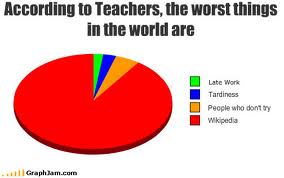
As a teacher, my issue isn’t so much with the accuracy of Wikipedia so much as the laziness it inspires. I want my students to research using a number of different mediums and publications. Wikipedia tends to be a ‘one-stop shop’ for students looking for information on the run.
I am really happy to read that Wikipedia have improved their reputation. I only wish students would extend their repertoire a bit in the name of authentic research skills.
There is a huge difference between hugging someone because they are your friend and sexual harassment. It is not hard to distinguish one from the other.
Friends hugging innocently in the playground in no way prevents schools from punishing children for sexual harassment.
A 14-year-old Florida student who hugged his friend was suspended as a result of his middle school’s zero-tolerance no-hugging policy.
Nick Martinez said he gave a quick hug to his best friend, a female student, between classes, WKMG-TV reported.
The public display of affection was spotted by the principal of Palm Bay’s Southwest Middle School, which is 120km south-east of Orlando. While the principal told WKMG-TV he believed the hug was innocent, he brought the two students to the school’s dean, who penalised them with in-school suspensions.
According to the Southwest Middle School’s student handbook, students can receive a one-day out-of-school suspension for kissing, while students caught hugging or hand-holding are penalised with a dean’s detention or suspension.
The school’s strict policy stipulates that there is no difference between an unwanted hug, or sexual harassment, and a hug between friends, WKMG-TV reported.
What measures like this do, is transform schools which are already unnatural places for children and make them even more dreary and dictatorial. The irony is, that while bullying continues to be a major problem, you would have though that acts of friendship would be encouraged, not outlawed.
What’s next – banning students from complimenting each other?
It’s about time we started matching school bans on children by imposing bans on schools. I would love to ban schools from implementing rules inspired by political correctness gone wrong!





 Topical Teaching