Posts Tagged ‘Boys’

Shops Should Stop Selling “Sexy” Clothes for Children

August 14, 2012

Target and other stores may try and avoid responsibility for stocking some very inappropriate children’s garments but they must accept their fair share of blame. Yes it’s true that in the end it is the parent that makes the decision to buy these clothes, but that doesn’t mean that these stores should get away with putting profits over integrity.

I commend parents that boycott shops for making this greedy choice:

AUSSIE parents have criticised Target Australia for selling “hooker-style” clothes to young girls.

The last 16 hours have seen a flurry of comments posted on the department store’s Facebook page from parents baulking about the department stores’ fashion range for this age group.

It all started after Port Macquarie mum, and primary school teacher Ana Amini posted that she was not prepared to shop at Target again because it was selling clothes that made young girls “look like tramps”.

“You have lost me as a customer when buying apparel for my daughter as I don’t want her thinking shorts up her backside are the norm or fashionable,” Ms Amini posted.

Unfortunately, Ms Amini’s original post has mysteriously disappeared from the Facebook page. It was replaced last night with a response from Target Australia, inviting all their customers to provide feedback on its childrenswear range.

“We know there is a huge diversity of opinion when it comes to children’s clothing which is why we believe in taking great care in ensuring that our range is both age appropriate and something that your kids will love.”

Click on the link to read Television and Body Image

Click on the link to read Our Children Must be Taught About Society’s Lie

Click on the link to read Most People Think This Woman is Fat

Should Boys be able to Play in All-Girls Teams?

June 20, 2012

Whilst I am sympathetic to the 13 year-old boy that wishes to play netball, I don’t think it’s appropriate for a teenage boy to play in an all-girls team. Not only will boys ruin the enjoyment that girls have for the sport but girls are entitled to raise concerns about the body contact that exists within the game.

MEMBERS of a junior netball club have slammed a VCAT decision to allow a 185-centimetre tall, 13-year-old boy interim permission to play in an all-girls’ competition.

Despite Netball Victoria discouraging teams from speaking out, the coach, parents and players from one of the boy’s rival teams, St Therese’s of Essendon, say it would be a disaster if VCAT made the ruling permanent that boys can play in the 15 and under matches.

They fear it would smash girls’ confidence on court, and spell an end to girls having the choice to play in a team of their own gender. St Therese’s head coach Dianne McCormack wrote to The Age saying it was not a personal comment on the boy, who plays for Banyule in the Parkville Netball association’s 15 and under C Grade.

A St Therese’s C-Grade player, Ally, 12, has written to the sports minister and Netball Victoria saying that when she played against the boy in the 13 and under competition, ”no one wanted to play a strong defence because it meant you had to put your body up against his”.Ally said when she got older she might want to play mixed, ”but now I just want to play against other girls”. ”Most boys I know are already bigger and stronger than me.

”Please stick up for me and all girls who play in girls’ competitions. I don’t think it’s fair for any boy to take away my right and any girl’s right to play in an all-girls’ competition.”


Maths is Taught So Poorly

February 13, 2012

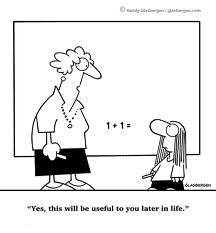
I realise that what I am writing is a gross generalisation, but I believe that maths is generally taught in a very abstract and monotonous way. No wonder the students are not benefitting from maths instruction at the primary level. Traditional maths teaching involves worksheets, a mindless array of algorithms and plenty of other rote styled goodies.

The tragedy of it all is that maths can be taught in a completely different way. I find the basic skills of maths the most refreshing and creatively exciting subject to teach. The fact that maths is a composite of everyday skills means it translates wonderfully to problem solving activities.

The other day, whilst teaching ordering numbers up to 4 digits, I got my 8-year-old students into groups, each given a particular airline to reasearch. The groups had to find the 3 lowest airfares for a return domestic trip between certain dates and times, These prices were then compared and ordered from least expensive to most expensive. Isn’t that the whole point of ordering and comparing numbers?

Whilst engaging in the exercise, the students enjoyed working in groups, competing for a bargain against other groups, learning how to book airline tickets and simply use their imagination by pretending they were actually intending in going on the flight.

Isn’t that more interesting than a worksheet that has numbers on it to order?

This is why I am not at all surprised that British students leave Primary school ‘with the maths ability of 7-year-old’:

An analysis of last year’s SATs results has shown 27,500 11-year-olds are going on to secondary school with the numeracy skills of children four years their junior.

The figures equate to a staggering one in 20 of the total of those leaving primary school. Boys perform worse than girls, with 15,600 behind in their ability.

Separate statistics published two weeks ago also revealed that one in three GCSE pupils fail to get at least a grade C in maths.

The disclosure follows the launch of a Daily Telegraph campaign – Make Britain Count – to highlight the scale of the nation’s mathematical crisis and provide parents with tools to boost their children’s numeracy skills.

It comes amid concerns that schoolchildren are less likely to study maths to a high standard in England, Wales and Northern Ireland than in most other developed nations.

I appeal to Primary teachers to give the text-book a rest and don’t be afraid to try new and exciting ideas to engage your maths students.

The Unique Challange of Teaching Boys

January 31, 2012

There is no doubt in my mind that teaching boys is a more difficult proposition than teaching girls. It is also clear to me that boys have suffered from a traditional classroom setup which has proven far less successful in engaging them than it has for girls.

Currently in Australia, local television station ABC1 is showing a brilliant series entitled, Gareth Malone’s Extraordinary School For Boys. Gareth is a choir master and isn’t qualified to teach, but takes on an 8 week trial with a group of underperforming boys in an attempt to improve their literacy skills.

Mr. Malone draws on his three rules for teaching boys:

1. Make the work feel like play.

2. Have a real sense of competition

3. Have a real sense of risk.

I have just finished watching the first episode and fell in love with his unique and creative style. I also enjoyed watching his colleagues putting down his methods, clearly a byproduct of feeling threatened by this novice.

Below is episode 1 in its entirety. All episodes are available on YouTube.

4 Million Children in the UK Don’t Own a Single Book

December 5, 2011

If we continue to sit there passively watching whilst reading and literature dies a slow death, we will be all the worse for it. To read that books are extinct from up to 4 million British homes is quite distressing.

Almost 4 million UK children do not own a book, research suggests.

The latest report by the National Literacy Trust discloses that one in three does not have a book of their own.

The number has increased from seven years ago, the last time the poll was conducted, when it stood at one in 10 youngsters, meaning the number of children without books has tripled.

The latest survey, which was based on a survey of 18,000 children aged between eight and 16, shows that boys are more likely to be without books than girls.

Why parents buy the latest phone for their young children before something they really do need like a library of books is something I’ll never understand.

Study: Clever Children More Likely to End Up On Drugs

November 15, 2011

There have been a lot of studies recently where the findings were so obvious you wondered how they managed to get a research grant for it in the first place.But every so often you stumble upon a study where the findings were not as you might have predicted.

A recent study that found that clever children are more likely to use drugs surprised me greatly:

Intelligent girls and boys are much more likely than average to take illegal drugs like cocaine, cannabis and ecstasy when they grow up, a study has found.

Scientists think they do so in part as a “coping strategy” to avoid bullying from their peers, and partially because they find life boring.

The effect is more pronounced in girls than boys, with those exhibiting high IQs as children more than twice as likely to have tried cocaine or cannabis by the age of 30, as those of lower intelligence.

The effect in boys with high IQs is also marked, with them being around 50 per cent more likely to have done so by that age as their less intelligent former classmates.

A team at Cardiff University analysed data from almost 8,000 people born in one week in April 1970, who were enrolled at birth in the ongoing British Cohort Study, which follows participants through life. All these children had their IQs tested between the age of five and 10.

Drug use, as reported by the participants themselves, was then recorded at 16 and 30 years of age.

At 16, 7.0 per cent of boys and 6.3 per cent of girls had used cannabis. This minority had “statistically significant higher mean childhood IQ scores” than non-users, according to the authors of the report, published in the Journal of Epidemiology and Community Health.

The authors noted: “Across most drugs (except amphetamine in men), men and women who reported using in the past 12 months had a significantly higher childhood IQ score than those who reported no use.”

They concluded: “High childhood IQ may increase the risk of substance abuse in early adulthood.”

Well that explains it – no wonder why I’ve never taken drugs!

Online Bullying Has Yet to Reach It’s Peak

November 10, 2011

A recent study into bullying may have fond that online bullying isn’t as prevalent as regular bullying, but it is still early days.

A new study entitled Teens, Kindness and Cruelty on Social Networks confirms much of what we already know about cyberbullying. Most kids aren’t bullied and most kids don’t bully either online or off.

In fact, the study–conducted by the Pew Internet & American Life Project for the Family Online Safety Institute and Cable in the Classroom–concluded that “[m]ost American teens who use social media say that in their experience, people their age are mostly kind to one another on social network sites.” Nearly seven in ten (69 percent) of teens said that peers are mostly kind while 20 percent said peers are mostly unkind with 11 percent saying, “it depends.”

Fifteen percent of teens say they have been the “target of online meanness.” When you include in-person encounters, 19 percent say they’ve been “bullied” in the past year.

These numbers track very closely with previous scientific surveys on bullying and cyberbullying. The largest source of bullying (12 percent) was in person, followed by text messaging (9 percent). Eight percent said they had been bullied via email, a social networking site or instant messaging and 7 percent were bullied via voice calls on the phone. Girls are more likely to have experienced what we typically call “cyberbullying,” while boys and girls are roughly equal when it comes to in person bullying.

Online bullying may be less prevalent but it is arguably more damaging. It is generally accepted that since online bullying invades the victim’s home (traditionally a place of comfort and safety), it has a much more powerful effect. Another reason that online bullying is potentially more oppressive is that there can be many more bystanders and participants online. Facebook bullying can be shared between hundreds rather than just handful of kids in the schoolyard.

And let’s not kid ourselves. Bullies don’t discriminate between mediums. A bully doesn’t throw their weight around in person and then become an angel online.  Bullying is bullying, no matter what the medium.  The experts are telling us online bullying is not the major form of bullying that some believe it to be.

That may be true, but it’s early days …

Do Girls Perform Better in Single-Sex Classrooms?

October 17, 2011

I am glad that I teach both boys and girls in my Grade 5 classroom.  I find it more challenging and the social dynamic can be quite fascinating.  However, for a while now, there has been a groundswell of support for single-sex classrooms.  People believe that they are more beneficial for students.

GIRLS can be “marginalised” and often take a back seat to boys in co-educational classrooms, the head of one of WA’s most elite all-girl schools says.

Methodist Ladies’ College principal Rebecca Cody has reignited the single-sex school debate, saying the “female voice is more likely to be marginalised” in mixed-sex classrooms.

Her comments come amid calls for the state’s public students to be given the choice of single-sex education.

All WA public schools are co-ed.

Writing for the next edition of Whichschool? Magazine Ms Cody said there were many “positive academic, attitudinal and social effects of a single-sex education.

“For example, higher levels of engagement, improved achievement and behaviour are just a few of the notable outcomes.

“Similarly, in this context girls are more likely to excel in non-traditional disciplines such as science, technology and mathematics and without the presence of boys feel more empowered to take responsible risks, for example in outdoor education.

“In a mixed-classroom environment, the female voice is more likely to be marginalised as girls tend to take a back seat, allowing boys to speak up. A girls’ school allows students to relax and interact more readily.”

It has not been my experienced that the boys marginalise the girls in a mixed-classroom.  I do however think it is vital for teachers of such schools to do their utmost to ensure that the social dynamic in their classroom is healthy and that all students have the opportunity to express themselves as individuals.

Lack of Male Teachers Not Responsible for Boys in Gangs

September 3, 2011

I think the experts have it all wrong when it comes to the lack of male teachers in Primary schools.  Sure, the male teachers currently working in the primary/elementary system are generally doing a great job, especially in teaching boys, but there are legitimate reasons why male teachers are not lining up to teach.

It was great to read a blog post by writer and educator Katharine Birbalsingh, who dispels the far-fetched assumptions made about the lack of male primary teachers :

Only 12.4 per cent of the primary school workforce is male. 27 per cent of primary schools in Britain are staffed entirely by women. And in secondary schools, only 37.5 per cent of teachers are male. In an age where some fathers have so little to do with their children, these statistics are seen to be scandalous. Clearly this must explain why some of our boys end up in gangs, why boys underachieve at GCSE in comparison to girls – a gap that widened to record level this year – and why chaos reins in our classrooms. Or does it?

Ms. Birbalsingh goes on to conclude that whilst male teachers have a positive effect on male students, the real issue is the fathers of these students.

Sure, having more men in our schools would be a good thing. And absent fathers is a bad thing. But no teacher can really ever replace a missing father. And that’s where the problem for our boys lies on the whole. What we need are families. Indeed, not too long ago, when ordinary families were more the norm, when fathers were present, male teachers hardly existed, and our boys were doing just fine. So are the schools really to blame for the underachievement of our boys? I would think not. I would think the onus is on our broken families.

My view is that the obsession for male teachers is unhealthy.  Men just don’t seem to be interested in taking up teaching.  My former classmates just assume that I fell into teaching and that my grades must have been so poor that I didn’t have much of an option.  Whilst this couldn’t be further from the truth, it does tell us a bit about the average man’s attitude to teaching – there is no interest in the profession whatsoever.  Especially teaching children under the age of 13.

And I ask you, who would you rather have teaching your son, a diligent, professional and passionate female teacher or a male teacher who reluctantly signed up because the Government were offering cash incentives too good to refuse?

I love teaching at the Primary level and wouldn’t swap my job for any other.  I know other male teachers who feel the same way.  But the reality is, men just don’t want to teach.  We can’t expect them to do something they just don’t want to do.

My school doesn’t even have a male toilets.  The male staff members of our school are forced to use the disabled toilets when they need to go.  As sad as that sounds, it’s hard to justify building a toilet in the current climate.

Boys and Reading: The Constant Struggle

May 18, 2011

The results of a recent survey found that boys don’t enjoy reading and fail to get past 100 pages of a classroom text.  Should we be surprised?  Boys have been disconnected from reading for years, and the question has to be asked – what have we done about it.

The findings are an indictment on how inflexible we are at altering the way we teach:

Many secondary school boys do not have the stamina to read beyond the 100th page of a book, research suggests.

Teachers also revealed that classics of English literature, such as those by Jane Austen, are putting boys off reading.

Some 70% of the 500 teachers surveyed for publishers Pearson said boys had switched off by the 100 page mark.

This is leading many teachers to ditch longer novels in favour of shorter books, it adds.

Teachers were asked to identify points where boys would switch off in class when novels were being read.

A quarter said that the interest cut-off point happened within the first few pages of a book.

A further 22% said interest waned within the first 50 pages, while a further quarter identified the 100 page mark.

Nearly a third of the teachers questioned said boys were put off before the book had even been opened, if they saw it had more than 200 pages.

According to the research, Shakespeare plays including The Tempest, Macbeth and A Midsummer’s Night Dream were particularly unpopular, as was Steinbeck’s 1930s classic, Of Mice and Men.

The reluctance to read could partly explain the achievement gap between boys and girls.

Last year 85% of 11-year-old girls reached the expected level in English for their age compared to 76% of boys. In reading, the gender gap was even more stark at 79% for girls and 64% for boys.

According to children’s organisation Unesco, the biggest single indicator of a child’s future success at school is whether they read for pleasure.

The research is timed to coincide with the launch of a new series of books called Heroes aimed at secondary school pupils which aims to switch boys back on to reading and get them past the crucial 100-page mark.

Best-selling author Frank Cottrell Boyce, consultant editor on the series, said: “Pleasure can’t be taught. Pleasure can only be shared.”

He added that boys should be started on shorter books.

Jonathan Douglas, director of the National Literacy Trust, said its research showed that boys lag behind girls not just in literacy skills, but in the amount they read and in the extent to which they enjoy reading.

“This gets worse as children get older. This is a vital issue and one the National Literacy Trust is working hard to address. More needs to be done to engage boys’ and building on their own interests.”

He added that publishers had a crucial role to play in this.

On the subject of publishers, an author who recently read my yet to be published manuscript, commented that had I made my main character a girl instead of a boy, I would have an easier time convincing publishers to publish the book.  She said that since boys don’t read, a girl would have been a more appropriate choice. The comment shocked me.  At no stage did I ever envisage the book to be strictly a book for boys.  I always thought it would be of universal appeal.  But apparently publishing companies don’t see it that way.

Shakespeare and Steinbeck are wonderful, but were never intended to be ones first foray into literature.  Is it so wrong to choose something of lesser literary acclaim for something more contemporary?  The sad reality is, teachers tend not to gravitate to Steinbeck and Shakespeare for their own leisure reading and don’t have strong connection to the texts the curriculum requires them to teach.  For a teacher to effectively inspire their students to love reading, they must love reading.  For students to read beyond page 100, the teacher needs to do more than set reading homework – they need to show the class how enjoyable and meaningful the book is to them.

When I read my manuscript to kids, I am overwhelmed by how much they enjoy the characters and situations.  I love how they connect with the main character and his issues and are able to relate to what he is going through.  Somebody once asked whether the kids enjoy it, not so much for the quality of the writing, but because the author, who has such a deep connection to the material, reads it out with such enthusiasm and joy.

Maybe so.  But isn’t that the key?  For boys to enjoy reading, they must see that their teacher enjoying it too.  If that means dispense with the classics and let the teacher decide what texts to introduce to the classroom – so be it.