Why Reading to Your Kids Isn’t as Easy as It Sounds

March 15, 2015


I love reading to my children when the book I’m reading is somewhat interesting. When the book is boring and repetitive, however, I am tempted to do what Liam Neeson does in the video above.


Click on the link to read Can You Ever Praise a Child Too Much?

Click on the link to read This Mother Clearly Doesn’t Need a Helicopter License

Click on the link to read The Best Film Nominees Performed by Kids

Click on the link to read Child Given a Bill for Missing His Friend’s Birthday Party

School is the Place to Make Better Connections with Our Disabled

March 12, 2015


I know it’s a shameful plug of a product but this ad is quite wonderful. It shows us up for not investing enough time to communicate and fully connect with people who have disabilities.


Click on the link to read my post on Dreams Come True When People Show they Care

Click on the link to read my post on Hitchens: Dyslexia is NOT a Disease. It is an Excuse For Bad Teachers!

Click on the link to read my post on Valuable Tips for Teaching Children With Autism
Click on the link to read my post on Autistic Boy Gives an Inspiring Graduation Speech

Click on the link to read my post on Girl Banned from Museum because Her Wheelchair May Dirty Their Carpet

The Gender Gap in Our Schools

March 11, 2015

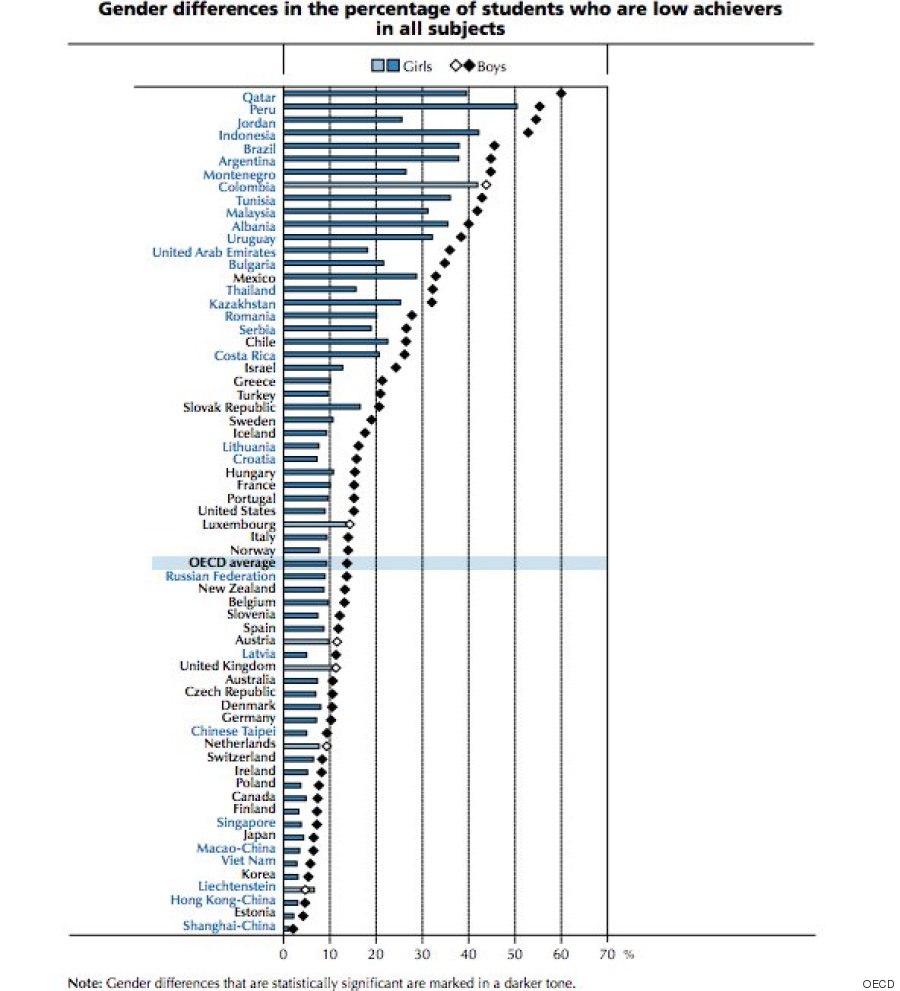
gender-difference-school

This might sound old fashioned but I’m not overly worried about a gender difference in our schools as I feel that boys and girls are, and will always be, slightly different. I don’t consider it concerning, for example, that girls outrank boys at school.

What I do feel however, is that there are general challenges in education that if dealt with properly, should see girls and boys progress far more rapidly:

All around the world, teenage girls are more likely than boys to reach a basic level of proficiency in math, science and reading. However, among the world’s highest achieving students, girls continue to lag behind boys in math, according to a report released Thursday by the Organisation for Economic Co-operation and Development.

The comprehensive, 176-page report looks at gender differences in student performance across 64 countries and economies. The OECD distributes the Programme for International Student Assessment (PISA), an exam taken by 15-year-olds around the world, every three years, and used results from the 2012 test as a lens into the issue of gender equality in education.

Overall, the report highlights the increasing gap between male and female academic achievement — and shows that young women are often performing better than their male peers. Girls are now going to school longer than boys and significantly outperform boys in reading. Across countries examined in the report, boys are more likely to post low scores in math, reading and science.

Compared to girls, boys are more likely to say they think school is a waste of time, show up late to class and generally be less ambitious with their education and career expectations. They also spend less time doing homework and reading for pleasure, and more time playing video games or engaging with technology.

Evidence suggests that even though boys underperform in school as teenagers, they tend to gain necessary literacy skills by adulthood. Previous surveys from the OECD show that men are just as proficient as women in literacy by adulthood.

Yet top-performing girls continue to lag behind top-performing boys in math and science — which is related to the underrepresentation of women in science, technology, engineering and math jobs. The results are especially bleak in math. In science, top-performing boys outscore top-performing girls on average, but there are a number of countries where girls post overall higher scores than boys in this area. But in math, boys significantly outperform girls, on average, in 38 countries and economies. In just a few places, such as Shanghai and Singapore, girls perform as well as their male classmates.


Click on the link to read Our Education System Betrays Boys

Click on the link to read  Are Kindergarten Teachers Biased Against Boys?

Click on the link to read Should We Include Feminism in the Curriculum?

Click on the link to read Arguments For and Against Single-Sex Education

Can You Ever Praise a Child Too Much?

March 10, 2015

over-praising-children


Yesterday we discussed the best approach for praising children. Well, new research indicates that over praising children can lead them to become narcissistic.

But can you really over praise a child?

My belief is that narcissistic children come about from praise that isn’t genuine and isn’t based on real effort, achievement or skill. In other words, it isn’t praising that makes children become narcissistic, but rather it is lying.


Overvaluing and overpraising children can contribute to the development of narcissism, researchers have found.

A study, published today in the Proceedings of the National Academy of Science , answers a long-standing question of whether narcissistic traits develop as a result of too much or too little parental attention.

Narcissism is named after the proud, vain hunter Narcissus, a figure in Greek mythology who fell so in love with his own reflection in a still pool of water that he eventually drowned in it.

Lead researcher and post-doctoral researcher Eddie Brummelman says he became fascinated with narcissism in children and wanted to explore how it emerged.

“It’s children who feel they are better than others, but they also demand constant attention and admiration from others,” says Brummelman, from the University of Amsterdam.

“In essence, they are very vulnerable, says Brummelman.

“For instance, when they are criticised or feel humiliated, they tend to become aggressive.”

There have been two competing theories about the parental influence on narcissistic traits; one suggests that narcissism evolves as a defence mechanism to cope with a lack of parental warmth and affection, while the other posits that it’s actually the result of too much praise.

“Social learning theory suggests that the narcissism develops when parents believe their children are more important than others, more special than others, more entitled than others,” Brummelman says.

The study enrolled 565 Dutch children aged 7-11 years and at least one parent, telling them that it was a study of self-image and how parents raise their children.

The children were given questionnaires designed to measure their self-esteem, and to evaluate how much affection they experienced from their parents, while the parents completed questionnaires designed to pick up on overvaluation but also to assess how affectionate parents were towards their children.

“The questionnaire has items like, ‘my child is more special than others’, ‘my child is a great example for others to follow’,” Brummelman says.

Researchers then asked parents to evaluate how smart they thought their child was, and compared it to the child’s actual IQ, but also tested how much parents valued their child’s knowledge levels.

“We gave them a long list of many different topics to choose from that the children should be familiar with when they are eight years old, and we included some topics that do not exist,” Brummelman says,

“You see that these overvaluing parents, they claim the children have knowledge of all kinds of different topics, including these non-existent ones.”

They found that there was a significant relationship between parental overvaluation and narcissistic traits in their children, but Brummelman stresses that it was a relatively small association.

“It’s good for parents to know that they don’t run the risk of creating a narcissist overnight,” he says.

“It’s a very modest association, but it does show that over time, overvaluation can make an important contribution to the development of narcissism, but … it’s not the only cause.”

Like other personality traits, narcissism is moderately heritable and partly rooted in early emerging temperamental traits, so some children may be more likely than others to become narcissistic when they are overvalued, say the researchers.


Click on the link to read This Mother Clearly Doesn’t Need a Helicopter License

Click on the link to read The Best Film Nominees Performed by Kids

Click on the link to read Child Given a Bill for Missing His Friend’s Birthday Party

Click on the link to read Tip for Getting Your Kids to Open Up About Their School Day
How to Praise Students Properly

March 9, 2015


Praising students for no real reason is certainly counterproductive and not praising them at all is utterly demotivating. That’s why it is important to choose the right time and wording when praising your students. You want the compliment to serve as proper recognition for their achievements but also a motivator for future growth.

I love the clip above. It suggests that we focus more on effort and less on intelligence. I couldn’t agree more.


Click on the link to read Tips for Teachers of ESL Students

Click on the link to read Look What This Teacher Did To His Students’ Doodles

Click on the link to read 5 Ways to Change the Face of Education

Click on the link to read Some Teachers Never Change … Literally!

Feminist Icons in Children’s and Teen Books

March 8, 2015

Film Review The Hunger Games Mockingjay Part 1


A list compiled by Sarah Alderson courtesy of theguardian.com:


  1. Pirate Girl (Pirate Girl by Cornelia Funke)

Our eponymous Pirate Girl, Molly, sets off alone in her boat to visit her grandmother and is set upon by a fierce pirate captain who takes her prisoner and makes her slave away for him, cooking and cleaning. But Molly refuses to be cowed and instead uses her wits to summon her mother – the fiercest pirate of the lot – to rescue her. Together with her mum, Molly turns the tables on her captors and heads off alone once more to visit grandma. Female characters for the under-fives don’t come more brave or bold than this.

2. Matilda (Matilda by Roald Dahl)

My daughter Alula says about Matilda: “She’s really powerful. She refuses to be bullied or watch others being bullied. She shows that being intelligent and reading books, and being kind, is more important than being pretty.” And that says it all really.


3. Luna Lovegood (Harry Potter series by JK Rowling)

Oft overlooked, Luna Lovegood stands out among the pantheon of great female characters Rowling offers us in the Potter series. Yes, Hermione is the classic choice but Luna too is smart, brave and loyal, and more than that, she refuses to bow to bullying or pressure to change. She is who she is – quirky and strange – and is unapologetic about it. She embraces her weirdness, remains compassionate to those who bully her and is unfazed by critics. We love Luna!

4. Malala (I am Malala and the young readers’ edition Malala: The Girl Who Stood Up For Education and changed the World by Malala Yousafzai and Patricia McCormick)

At just 17 years old, human rights activist Malala Yousafzai won the Nobel Peace Prize in 2014 for her work in advocating for girls’ education. Shot by the Taliban for speaking up on the right of girls to attend school, she has since started a fund to empower girls to reach their full potential. Her story is incredibly inspiring.

5. Katniss Everdeen (The Hunger Games by Suzanne Collins)

Yes, Katniss is strong, brave and can wield a bow and arrow like nobody else. She also becomes the poster child for equality for all, but it isn’t this alone that makes her a feminist, I would argue that the way she forges relationships with others, particularly women and girls, in defiance of a patriarchal society, is why she ultimately triumphs in the arena and what makes her such a special character in the YA world.

6. Celie (The Color Purple by Alice Walker)

Alice Walker’s famous novel tells the story of Celie, a poor black woman in 1900s America. Starting off as a victim of abuse Celie finally learns, through the support, example and sisterhood of other black women, to speak up for herself, and ultimately finds the courage to make her own choices.

7. Tavi Gevinson (Rookie Yearbook edited by Tavi Gevinson)

At just 18 years old, Tavi Gevinson is hailed as one of her generation’s leading voices. The website she founded and edits, Rookie, tackles subjects from break-ups to politics, with all the content (art and writing) contributed by teenagers as well as influential thinkers, musicians and creatives. The yearbooks (there are three) contain curated highlights from the website.

8. Chimamanda Ngozi Adichie (We Should All Be Feminists by Chimanada Ngozi Adichie)

Chimamanda Ngozi Adichie, the author of the award winning novel Half a Yellow Sun (another recommended teen reading), writes a funny and accessible book (based on her TEDx talk) about what it means to be a feminist today, and entreats everyone to consider the profound ways that inequality affects us all.

9. Melinda Sordino (Speak by Laurie Halse Anderson)

Teenage Melinda is finally set free from her traumatic burden of silence by choosing to speak up against her rapist and by fighting back against the cultural and societal pressure imposed on her to keep quiet about the attack. In doing so she becomes a symbol of courage and power to all victims of abuse.

10. Lena Dunham (Not That Kind of Girl by Lena Dunham)

This is the book I wish I had read as a teenager. Musing on issues including body image, sex, mental health, friendship, career and sexuality with her trademark honesty and wit, Lena Dunham admits she’s a ‘girl who is keen on having it all’ and then humbly offers her own nuggets of wisdom and experience to help others do the same.


Suicide Leaves So Many Questions Unanswered

March 3, 2015

jillian-jacobcon-suicide

Students find their beloved teacher hanging in the classroom. Why did the teacher commit suicide? Why did she choose the classroom to do it? Was it connected with the demands of the job or was it just by chance that she decided to end it all at school?

Suicide is such a tragedy. If only, we could see the signs more clearly, and get the school community to rally around vulnerable students and school staff so this kind of incident is avoided:


A US high school teacher who hanged herself in her classroom has been found by shocked teenagers.

Students and another teacher found Jillian Jacobson, 31, at El Dorado High School in Placentia, California at around 8.40am on Monday morning, The Orange County Register reports.

“Paramedics performed life saving measures, however after several minutes the victim was declared deceased at the scene,” a Placentia Yorba Linda Unified School District spokesman said in a statement.

“The initial investigation indicates the cause of death to be suicide.”

Ms Jacobson had arrived at the school early and locked herself in the classroom. Students in her first class of the day found her body after they had another teacher open the locked door.

Classes were cancelled at 11am.

The 31-year-old was a photography teacher who had been employed at El Dorado High School for eight years and was reportedly popular with students.

Students and friends of the teacher have posted tributes on Twitter.

“Thank you so much Mrs. Jacobson for teaching me how to take amazing photos, and also for being a great friend,” one student wrote.

Ms Jacobson did not leave a note and what drove her to kill herself is unclear.

Crisis counsellors attended the school and have been meeting with the students who found Ms Jacobson’s body and other teachers, school officials said.

The Truth About Those Internet Safety Myths

March 2, 2015

internet-safety

A great article Caroline Knorr on postcrescent.com:


Myth: Social media turns kids into cyberbullies.

Truth: There are many reasons why a kid might cyberbully, and social media is just a convenient way to do the dirty work.

The reality is that kids who engage in this behavior typically have something else going on that compels them to act out. They might be in crisis — at home, at school or otherwise socially. They may also be bullying in person or they may have an underdeveloped sense of empathy. Awareness of a cyberbully’s circumstances — though not excusing the behavior — can help parents and educators recognize the warning signs and potentially intervene before it goes too far.

Myth: Teaching kids not to talk to strangers is the best way to keep them safe online.

Truth: Teaching kids to recognize predatory behavior will help them avoid unwelcome advances.

In today’s world, where kids as young as 8 are interacting with people online, they need to know the boundary between appropriate and inappropriate conversation. So go beyond “stranger danger” and teach them what kinds of questions are not OK. (For example, not OK: “Are you a boy or a girl?”; “Where do you live?”; “What are you wearing?”; “Do you want to have a private conversation?”). Also, teach kids to not go looking for thrills online. Risky online relationships more frequently evolve in chat rooms when teens willingly seek out or engage in sexual conversation.

Myth: Kids act worse online.

Truth: Most kids say that their peers are nice to each other online.

Newsflash: Most kids want to have fun, hang out and socialize normally online — and in fact, according to the Pew Research Internet Project, that’s what the majority is doing. Check out these comforting stats:

» 65 percent of social media-using teens say they personally have had an experience on a social-networking site that made them feel good about themselves.

» 58 percent say they felt closer to another person because of an experience on a social-networking site.

» 80 percent of teens who’ve witnessed mean and cruel behavior on a social-networking site have come to the defense of a targeted friend.

And how about the kids who’ve fought cyberbullying and used the Internet for a social cause? More and more, kids are harnessing the power of the online world — and busting up a few myths along the way.

Myth: It’s dangerous to post pictures of your kids online.

Truth: If you use privacy settings, limit your audience and don’t ID your kids, it’s pretty safe.

There are two kinds of parents: those who love posting pics of their kids and those who think it’s asking for trouble. Although it’s true that posting anything online invites some risks, there are ways to limit them if you’re smart about how you do it.

Use privacy settings. Make sure your privacy settings are set so only the closest people in your network can view your posts.

Limit your audience. Only share posts with close family and friends. Or use photo-sharing sites such as Picasa and Flickr that require a log-in to see pics.

Don’t rush your kids into social media. Obey the rules about keeping kids under 13 off social media. Once your kids have an online profile, they can be tagged in photos, which magnifies their online presence. If you’re going to upload photos of them, don’t identify them and don’t tag them — that way the photo can’t be traced back to them.

Myth: Parental controls are the best way to monitor my kids’ online activities.

Truth: Focusing on only one Internet safety method lulls you into a false sense of security.

To keep your kids safe online — and to raise them to be responsible, respectful digital citizens — it takes more than installing parental controls. For starters, parental controls can be defeated by determined kids. They also often catch too much in their filters, rendering any Internet search useless, and they set up a “parent vs. kid” dynamic that could backfire.

By all means, use parental controls to help prevent exposure to age-inappropriate material and to manage time limits. But don’t think they get you off the hook. Continue to discuss responsible, respectful online behavior, set rules and consequences for misbehavior and train your kid to manage his or her own usage.

Looking for more information and advice about keeping kids safe online? Go to http://www.commonsense.org/privacy-and-internet-safety.

Going to the Internet

Q: What’s the right age for my child to start going online?

A: The age they begin is entirely up to you. Lots of kids start playing around online during the preschool years, but many parents wait until kids are in elementary school to get them started. Whatever you choose, these guidelines will give you and your kid a good beginning:

» Sit with little kids — at least at first — so you can explain what they see.

» Find age-appropriate sites with high learning potential.

» Put a time limit on your sessions (instill the idea of balance early).

» Avoid just-before-bed computer time. It can be stimulating and interrupt sleep.


Click on the link to read Shaming Students is Never the Answer

Click on the link to read The Perfect Cyber Safety Clip for Parents to Watch With Their Kids
Click on the link to read 5 Internet Safety Rules to Share With Your Kids

Click on the link to read Introducing the App that will Give Parents Nightmares

Teacher Busted for Lying Thanks to Her Facebook Updates

March 1, 2015


In my teens I adored the movie, “Ferris Bueller’s Day Off”. My parents never let me take a day off school, and I was both envious of Ferris for cutting school and in awe of his ability to make fools out of Principals and senior administrators. Perhaps the teacher that ‘pulled a sickie’ in order to go on holiday, also had a soft spot for Bueller’s penchant for taking risks. What she didn’t have, was his smarts:


Some teachers never learn.

Brooklyn guidance counselor Mindy Robinson lied about having dental work so she could celebrate her birthday on a tropical beach. Then she boasted about the ruse on Facebook — even though many New York teachers have gotten busted the same way.

Robinson, who worked at IS 171 Abraham Lincoln in East New York, posted on Facebook a dispatch from her vacation in Turks and Caicos islands several days before the city schools’ spring recess in March 2013.

“So tell me how did u get off of work?” a Facebook “friend” asked.

“I had a small procedure that had to be done do [sic] I told the crazy one that the doctor was going to be out of town and could only do it this week.”

“Be careful,” the friend warned, “because two years ago people got caught doing things like that.”

“Too late but thanks for the info,” Robinson replied.

Robinson refused to speak with investigators and agreed to retire last July 1.


Click on the link to read Up to 1 in 10 US Students Have an Inappropriate Relationship With Their Teacher

Click on the link to read Facebook Exposes Yet Another Bad Teacher

Click on the link to read Why I Won’t Be Celebrating Facebook’s 10th Anniversary

Click on the link to read If You Ever Wondered How Some Kids Become Bullies …

Click on the link to read The Researchers into Cyberbullying Should Review Their Findings

Tips for Teachers of ESL Students

February 26, 2015

teaching-esl


I have found it quite a challenge teaching fluent 5th graders whilst also catering for a child with minimal spoken English who has spent less than 6 months in the country. These tips by Robyn Shulman, M.Ed. are quite useful:


1. Cultural Awareness

All teachers should take a moment to self-reflect about their own understandings and questions in regard to cultural differences. Take the time to learn about different cultures, gestures, and traditions and celebrate these differences with all of the students in the classroom. Encourage all students to share their culture with classmates.

2. Empathize

Try to imagine how overwhelming it must feel to leave your home country and family members while trying to assimilate, learn, and socialize in a foreign language. Be aware that ESL students will be in culture shock and feel highly alienated for some time. Garner patience and understand that it will take time for ESL students to talk, as a silent period is highly expected. Smile and show support to your best ability.

3. Provide A Comfort Zone

Assess where the ESL student’s abilities are in relation to basic survival skills and needs. Assign a friendly and welcoming buddy to assist with common school locations, requirements, and routines. If possible, keep an extra eye out during busy transition times to assure the student gets to the correct location. If possible, find someone in the school, another classmate, parent or volunteer that may speak the student’s language. Connecting the student with someone who speaks his/her native language will provide a great deal of comfort.

4. Spotlight Respect For All Cultures

Reaffirm the message about being supportive of one another, kind, understanding and patient. Encourage everyone to openly talk about his or her personal culture, traditions, and languages. Have parties celebrating the different cultures in the class, sharing music, historical family photos, dances, games, food and traditions. Hold discussions about the history of America, immigration, and the value of diversity and differences. Encourage students to share their own stories of immigration, passed down from generation to generation.

5. Community

If parents and/or guardians do not speak English, request an interpreter if possible for all school communication, including parties, conferences and special events. Invite parents to all school community functions to encourage and foster a sense of belonging. If possible, introduce other students and/or families who speak the same language as the ESL student. Sharing cultural commonalities will provide strong bonds for students, parents, and teachers.

6. Assess Student Informally

Assess ESL students on an informal basis when they first arrive to class, and ongoing during the school year. It is imperative to primarily check for understanding in regard to basic and social needs. Pay attention from the sideline to see if they know numbers, letters, and/or short English phrases. Continuously check for comprehension and growth informally, make notes, and never be afraid to raise the bar and challenge a bit.

7. Don’t Discourage Native Language Use

With all good intentions, this is a common mistake teachers can make. ESL students who have a stronger foundation of their native language will have a shorter route to acquiring English. Don’t discourage native language use, as this will result in negative feelings about the student’s language, culture, and may cause delay in English language acquisition. Provide free time for the ESL student to read and write in their native language.

8. Use Manipulatives, Visuals, Games, Music and Hands-On Activities in the Classroom

According to William Glaser, we learn 80% of what we experience, and 95% of what we teach others. ESL students do exceptionally well when this theory is followed. Involve them in projects that will encourage them to talk as much as possible with their classmates. Some ideas for projects are the following: cooking (following easy directions), art (drawing, painting, sculpture), musical activities (music provides an amazing platform for learning), and acting (for example, charades).

9. Provide Various Opportunities For Talking and Consider Seat Placement

It is very important to consider seat placement in the classroom for the ESL student. All too often, ESL students are seated in the back of the classroom, which leads to a great lack of contribution, listening, and participation. Try and seat the ESL student close to the front, especially with other students who are inviting and enjoy conversation. Provide the most opportunities as possible for talking and listening to others in the class via group work. You will be surprised how much shorter the silent period will end.

10. Communicate with the ESL teacher

Maintain communication with the ESL teacher as much as possible. The sooner both teachers are working together, the quicker the student will learn English. Be open to the ESL teacher’s suggestions, let him/her share in the modification of classwork, and invite the ESL teacher into your classroom. If there is a concern, a question, or if you simply need some advice, don’t be afraid to ask for help. Build this open communication bridge together, as both teachers are there to support and help the ESL student succeed.


Click on the link to read Look What This Teacher Did To His Students’ Doodles

Click on the link to read 5 Ways to Change the Face of Education

Click on the link to read Some Teachers Never Change … Literally!

Click on the link to read The Ultimate Bad Teaching Checklist