5 Tips for Frustrated Teachers

June 6, 2012


If you are finding your job quite challenging lately and you are at a loss to work out how to restore order in the classroom, I hope these tips will prove useful:

1. You Have Nothing to be Ashamed of: Even the best of teachers often struggle to keep control of a classroom. You should not feel deflated if your current crop of children are making your life difficult and testing your patience. This is nothing unusual. Make sure you keep a positive front. Children do not tend to feel empathy for a defeated teacher. On the flip side, they have respect for a teacher that can overcome difficult moments and stay positive, enthusiastic and show a willingness to intoduce new ideas to make things work.

2. What you Teach is not as Important as who you Teach: As much as it can frustrate when you have a lot to cover and so little time to cover it, it is important to note that the most important aspect of your job is to look after the wellbeing of your students. It is perfectly alright to interrupt a maths class for a discussion on bullying or respect. It is also important to realise that whilst Timmy may frustrate you and come to class with a poor attitude, the best thing you can do for him is to plant a seed of positivity. He may leave your class without the skills you have taught, but at least you have let him know that you believe in him and are there for him regardless.

3. If They are not Listening, Perhaps you Should Stop Talking: Teachers often complain about the lack of concentration among their students. This is commonplace, but not always entirely the students’ fault. Teachers often talk too much. From laboured mat sessions to interminable board work, teachers have got to realise that the more they talk, the more the students program themselves to daydream. Teachers have got to spend less time talking to the class and more time going from individual to individual. This is less threatening, more effective and better for charting individual progress. Other ideas include: Group work, games and interactive programs.

4. Stop Threatening: Detentions, suspensions and other punishments are important tools in a teachers toolbox, but boy they can get overused! A teacher’s attitude sets the tone for the classroom. If the “go-to” response is always to threaten and punish, the classroom will be a negative place. If the teacher instead put a privilege on the board (such as extra computer time) and during the class add under the privellege according to behaviour, attitude and work ethic, it sets a very different mood. Instead of feeling watched and judged, the students feel empowered to earn the teacher’s respect and motivated to win the reward.

5. Small Changes Make a Big Difference: When you are in a rut, the desperate part of you wants to change the world in a day. This is impossible. A better approach would be to isolate a goal or two such as; working on an orderly line-up, getting the students to raise hands before asking questions or getting the students to reflect on how they treat each other. These goals may seem insufficient in the grader scheme of an uncontrolled classroom but I assure you small goals can make big changes to the classroom dynamic.

I hope these tips are of use. We all struggle at times to teach effectively. You are not alone!

Facebook Doesn’t Seem to Care About Kids

June 5, 2012

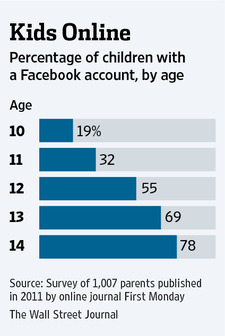
It seems as though Facebook cares more about indoctrinating more young lemmings onto their database than protecting the safety and wellbeing of our children. I have stated before my firm belief that children under 13 do not have the maturity to warrant the privilege of having a Facebook page.

You may argue that many 13 year-olds defy that rule and go and get one anyway. This is unfortunate, and something their parents ought to take an interest in, but at least in this instance there are laws that are being broken. It would be decidedly worse if the age requirement rule was abandoned altogether.

A new proposal to allow children under the age of 13 to have legal access to Facebook is the first step in a concerted effort to rescinding these important regulations:

Facebook Inc. is developing technology that would allow children younger than 13 years old to use the social-networking site under parental supervision, a step that could help the company tap a new pool of users for revenue but also inflame privacy concerns.

Mechanisms being tested include connecting children’s accounts to their parents’ and controls that would allow parents to decide whom their kids can “friend” and what applications they can use, people who have spoken with Facebook executives about the technology said. The under-13 features could enable Facebook and its partners to charge parents for games and other entertainment accessed by their children, the people said.

Facebook currently bans users under 13. But many kids lie about their ages to get accounts, putting the company in an awkward position regarding a federal law that requires sites to obtain verifiable parental consent before collecting personal data from children.

Any attempt to give younger kids access to the site would be extraordinarily sensitive, given regulators’ already heightened concerns about how Facebook protects user privacy. But Facebook, concerned that it faces reputational and regulatory risks from children already using the service despite its rules, believes it has little choice but to look into ways of establishing controls that could formalize their presence on the site, people familiar with the matter said.

Skills Your Child Should Know but Isn’t Taught at School

June 5, 2012

I am not a fan of specialised programs as they tend to clog the school day and leave too few hours for covering the curriculum. Programs such as “Stranger Danger” have been shown in studies to be ineffective and a cause of paranoia and anxiety among students rather than a useful resource for their protection.

An exception to this rule is training children to be safe around pets. As a father of a young girl who is absolutely petrified of dogs of all shapes and sizes, I am concerned that this fear will prevent her from enjoying animals. I am also aware that dog attacks happen on an all too regular basis, with many of these incidents involving children and proving deadly.

Adults may know that running away from an angry or vicious dog is a recipe for disaster, but do children know that? And if they do, do they have the tools to manage such a situation?

The answer to that question is invariably – no!

That’s why I am grateful to prominent veterinarian, author and blogger, Dr. Vadim Chelom, whose passio for this issue prompted him to release a program for teachers to integrate into their literacy/social studies curriculum free of charge. On his blog is a comprehensive lesson by lesson program which will enable teachers to educate their students about how to stay safe around pets.

I have no doubt that this program has the potential to save lives. I certainly encourage parents to share the information with their children and for teachers to find time in a crowded curriculum to at least dedicating a lesson to this very important issue.

What to do When Threatened by an Angry Dog according to Dr. Chelom:

  • Lie down face on the ground.
  • Pull your legs up to your stomach.
  • Bring your hands close to the body to cover your face with your arms and your chest with your elbows.
  • Don’t move and don’t shout.
  • Lie still until the dog is gone.

Most People Think This Woman is Fat

June 3, 2012

This morning’s newspaper asked readers to comment on whether or not they thought this woman was fat. Whilst I don’t think this woman is fat at all, it is the question itself that got me worked up.

It reminded me about how obsessed we are about weight, and how this obsession is going to ensure that our children will spend more time aspiring to fit a certain look rather than to become good people.

Nobody seems to care anymore whether a person is caring, selfless, charitable or kind. These are attributes of losers. Surveys that ask what we would prefer to be, beautiful or kind, favour beautiful every time. The rationale being, that nobody is jealous of a kind person in the way they are of a good-looking one.

How are our children supposed to make sense of this?

It upsets me to see Primary aged children so conscious of their weight. It bothers me no end that 8-year olds know everything there is to know about the perfect body size and shape, but have no insights on the correct protocol for offering ones seat to an elderly person on a crowded train. The thought would never have entered their mind.

Haven’t we learnt our lesson? Did we not realise that an obsession with looks leads nowhere. It doesn’t make one happy. Why are we creating kids that follow our sick ways? Why are we perpetuating the message that there’s nothing wrong with gossiping, fakery and selfishness, but eating ice-cream is a sin?

So, no, I don’t find the woman fat. But guess what? I don’t care whether she is fat or not. I care whether she is a good woman, a kind wife, a loving mother, a loyal friend, a friendly co-worker etc. And ultimately, that’s what I want us all to look for.

There are frumpy, unfit people out there, with pale complexions who have unpopular taste in clothes. Some of these people are also tremendously kind and good-hearted. It would be criminal for us to marginalise these people, as some of them are the real beautiful people!

The Classroom isn’t the Best Place to Rectreate Famous Movie Moments

June 2, 2012


Finding a humourous way to let an unruly student know that they have overstepped the mark can be quite effective. It lets them know that you are disappointed in them without a loss of anger or creating a big scene.

However, when attempting to use humour in this way, please follow the following rules:

1. Never humiliate the student;

2. Never humiliate the student; and

3. Never, ever, humiliate the student!

Public humiliation is a huge demotivator, and it really hurts the same child you are supposed to be nurturing.

When a teacher decided to communicate displeasure in a student by reprising a scene from the hit movie Bridesmaids, the teacher didn’t just manage to break all three rules, but also managed to add violence into the mix:

THE family of a California high school student has failed to see the funny side of a teacher imitating a scene from the hit comedy “Bridesmaids” and allegedly trying to slap some sense into the girl.

Dionne Evans, a ninth grade student at Malibu High School, alleges that when she forgot to bring her homework to class on May 22 she was called to the front of the room and the unnamed teacher asked, “Did you see Bridesmaids?”

The teacher then allegedly slapped the girl’s face up to six times, TMZ reported.

It is believed the teacher was referring to a scene in the 2011 movie where one woman literally tries to slap some sense into another.

Evans’ family have filed a complaint with the Los Angeles County Sheriff’s Department. A spokesperson for the sheriff’s Special Victims Unit confirmed to the Santa Monica Daily Press that they are investigating the incident.

The teacher has since written an apology to Evans but her family have hired an attorney and are reportedly considering a civil lawsuit against the Santa Monica-Malibu Unified School District.

“My client has not been back to the class, she’s been doing her school work in the library,” attorney Donald Karpel told the Daily Press.

“She has been humiliated and devastated. She will be seeking counseling. It has been horrible.”

Bridesmaids, starring Kristen Wiig and Annie Mumolo, centered on a series of misfortunes suffered by Wiig’s character after she is asked to serve as maid of honor for her best friend.

Some suggestions for other movies best left out of the classroom:

1. Fight Club

2. Bad Teacher

3. Kill Bill


Students Set-Up Their Teacher and Destroy Her Career

May 31, 2012

Just because young Julie Warning was framed for having a relationship with a student doesn’t in any way excuse her behaviour. It was extremely mean-spirited and heartless for Eric Arty and his friends to collect bets on who would successfully be the first to kiss her, but regardless, a great deal more is expected of teachers than to be involved personally with a student.

Over the course of the next few days there will be a lot written about Julie Warning, yet, possibly not enough criticism levelled at Eric Arty and his friends. Their role in this saga should not go unpunished. Their bet was quite shocking and should not be tolerated by the school hierarchy. They should be expelled for their little gambling venture.

Expelled? But they were just being kids?

They were exhibiting behaviour which was quite misogynistic, terribly destructive to a young woman’s reputation and career and downright immoral.

Keeping them at the school will not only give the school a bad name, but will turn these pranksters into heroes and celebrities among the student body. This is not an acceptable outcome.

A high school teacher filmed in a passionate embrace with a pupil fell victim to a $500 bet between five friends about who could kiss her first, it emerged today.

Eric Arty, 18, beat his friends to the jackpot after the student and four friends put in $100 for a race to romance their global studies teacher Julie Warning, 26.

Andrew Cabrera, a junior at Manhattan Theater Lab HS, where Warning worked until Tuesday, told the New York Post: ‘It was a bet with a group of his friends. They gave him the $500 [pot].’

Speaking about Arty’s seduction, he said: ‘He would go after class and basically try to seduce her.

‘I don’t know if she knew [about the bet]. They were all trying to get with her.

‘One of his [Arty’s] friends flirted with her more than anyone — I thought he would be the one, but Eric came out of nowhere and got her.’

The affair was revealed yesterday by The New York Post — which ran a front-page picture of the pair kissing on Friday at Bleecker Playground in Greenwich Village and published the video online.

The case has been turned over to the Department of Education Special Commissioner of Investigations and Warning was reassigned.

However, school officials said Warning did not report to her new job yesterday and could not be reached for comment.

Schools Chancellor Dennis Walcott said: ‘It’s my understanding that she did not show up to her reassignment center.

‘So we’ll do more investigating on why she hasn’t shown up.’

Praise Your Children and then Watch them Bully

May 30, 2012

A new report dispels the long-held theory that bullies have low self-esteem. This report maintains that bullies often come as a result of being over-praised and over-complimented.

LAVISHING children with praise and constantly pumping up self-esteem is breeding a generation of bullies, groundbreaking research reveals.

Prof Helen McGrath from RMIT, a key player in Australia’s anti-bullying policies, says mums, dads and educators have spent too much time telling kids that “darling, everything you do is wonderful”.

Rather than giving children “trophies for coming seventh, eighth and ninth”, they instead need a good old-fashioned dose of reality – including in their school reports, she said.

“The silliest thing you can tell children is, ‘If you set your mind to it, you can do anything you want’,” Prof McGrath said.

Now the State Government has flagged a comprehensive discussion on teaching methods.

Education Minister Martin Dixon said last night: “What Prof McGrath’s research has shown makes good sense and is worthy of wider debate.

“While parents and teachers want to encourage their children and students to be the best they can be, it is also important that we are genuine. A measure of self-esteem is good, but a large dose of self-respect and respect for others is even better.”

Well-meaning parents and teachers had been unwittingly contributing to the problem for 30 years through the “failed self-esteem movement”, she said.

“Parents love their children and are trying really hard to keep their self-esteem high, not realising … they’ve made the mistake of assuming that means their child can never have any failures, disappointments, sadness,” she said.

“But if we’re getting kids who are increasing in their sense of narcissism, and the need to be entitled and always get positive feedback … that is a fairly dangerous way for our community to go.”

It is fascinating to read of the Government’s clumsy response to this findings. They want teachers to start being “genuine” with the2ir students. Great idea! Now why didn’t I think of that?

It is quite a simple interpretation to think that bullies are just often children with overfed egos. The mistake this report seems to make is that it assumes that children grow to believe the messages that these parents send. The assumption is that these kids grow up thinking they can achieve anything they want (whether they have natural ability or otherwise).

This is not my experience. My experience tells me that such children weigh up the compliments and positivity they get from home with some of the negative talk they get outside, and it confuses them. Children who are constantly told how beautiful they are at home, are then called “ugly” and “fat” in the schoolyard. This mixture of messages makes them feel terrible insecure. Are their parents liars? Are their school friends just being cruel, or do they have a point?

So indeed, I do believe such children have low self-esteem. The realisation that some of the messages being sent from home are not shared by the world outside doesn’t inflate their ego, but rather, confuses them and makes them less trustworthy of others.

The best depiction of a bully (or I should say, “bullies”) comes from Mike Feurstein’s classic movie “How to Unmake a Bully“. Instead of portraying the bully as a person that has no characteristics that other children can related to, Feurstein paints him as a lost child, bullied himself in the past, without a undesratnding of other options and modes for letting off steam.

The beauty about the film is that after watching it, my students gain an appreciation and a unserdtanding not only for the victim but also for the bully himself.


It is Never Alright to Put Down Your Students!

May 29, 2012


There is simply no excuse for denigrating your students. Whether they are unruly or not is completely irrelevant. It doesn’t matter how much they fidget, answer back, disturb or waste time, there is no place for a teacher to put down his/her students.

Teachers found breaking that rule repeatedly (or at least more than once), should be forced to tender their resignations. No school or classroom of students deserves such a teacher. Teachers have to wake up to the fact that if they choose to teach children, that’s exactly what they are going to be faced with – a room full of children. Children misbehave. That is reality.

If teachers can’t handle the constant disturbances and the rudeness, they have options:

1, Seek the support of their Principal, colleagues or even the parents of the unruly children.

2. Change their style of teaching (because whatever they are doing quite clearly isn’t working).

3. Find a different job.

I fear it may be too late for Mr. Griffin to take option one or two, and for good reason:

A primary school teacher branded his pupils ‘pests, idiots, clowns and buffoons’ a disciplinary panel heard yesterday.

Roger Griffin, 66, denied that the terms were derogatory and insisted that he had used ‘apt and appropriate language’ to describe the eight and nine-year-old pupils who he also labelled ‘miscreants’.

The now-retired teacher also stands accused of playing piano in the school hall for an entire day after he was not asked to come to work during an Ofsted inspection at Beechview School in High Wycombe, Buckinghamshire.

A panel heard that Mr Griffin’s behaviour at the school was called in to question by acting assistant head Beatriz Melero, who had been called in as a trouble-shooter to boost the ailing primary’s fortunes after the previous headteacher was absent on a long-term basis.

She told the hearing that Mr Griffin – who worked at the school for nine years – had been ‘unduly punitive’ when he put three children in detention and listed the reason as ‘fidgeting’.

Representing himself at a Teaching Agency conduct hearing held in Coventry, West Midlands, Mr Griffin told a disciplinary panel that his conduct had been ‘appropriate’.

Presenting Officer Melinka Berridge said he had penned a letter to the school after complaints were made about his language towards children.

It read: ‘Persistent miscreants who act like delinquents can expect to be treated as such.

‘If they don’t like being called idiots, fools, clowns, buffoons or any similar epithet, there is a very simple solution: don’t act like one.’

Mr Griffin later told the hearing he had only used the terms in reference to ‘the small minority who are disturbing the learning opportunities of everybody else.’

Mr Griffin said one allegation against him, that he shouted at a young boy and called him an ‘idiot’, omitted to mention that the boy had been ‘cavorting’ around his classroom for some time before he reprimanded him.

He said: ‘How do you describe that sort of behaviour without using that sort of language? There is no other way, is there?’

Mr Griffin faces two charges of serious misconduct towards staff and pupils between December 2007 and May 2008.

He is also accused of disregarding directions given to him by acting head Miss Melero, and for failing to follow the National Curriculum in his music lessons.

But Mr Griffin said it was ‘total rubbish’ that his lessons did not adhere to the National Curriculum but he was ‘very pleased’ to admit that he had not used Qualifications and Curriculums Authority (QCA) work schemes when planning lessons because they contained a mistake.

He said: ‘I made it quite clear that I never will follow the QCA schemes of work as they contain an error and I will not teach an error.

He went on to claim that work schemes he devised himself were superior to those created by the national body.

‘My scheme of work is much better than the QCA scheme of work,’ he said. ‘My work supports the National Curriculum to levels that by itself the National Curriculum can’t reach.’

Sexting Reaches our Primary Schools

May 28, 2012

We don’t need another useless educational program preaching to children about the dangers of sexting. They are preachy, don’t work and make children uncomfortable. What we need is a strong approach consisting of two important elements.

1. Clear and unambiguous consequences for those involved in sexting; and

2. Schools need to focus more squarely on setting up an environment that encourages its students to respect themselves. This kind of behaviour comes about from an abject lack of respect for one’s self. Schools should work on their culture and environment to ensure that their students are best placed to make good decisions, not just because they are sensible, but because they have an inbuilt sense of self and a regard for who they are and what they do with their lives.

Without this approach, nothing will properly discourage children from this potentially dangerous practice:

PRIMARY school children are engaging in “sexting” and experts believe parents are at a loss as to what to do about it.

UniSA academic Lesley-Anne Ey says research shows some pre-teens are taking and sending out sexually explicit photographs.

“There’s research saying the phenomenon is out there for children at primary school and I think parents might be a bit uninformed about it,” she said.

“They may think it is a risk when their children are adolescents but it’s unlikely they would think younger children would engage or be aware of that kind of behaviour.”

Ms Ey said educating children about the dangers of “sexting”, either by mobile phone or internet, had reached a point where it must be dealt with before they reached puberty.

“We need to start addressing this at primary school,” she said. “I think it’s too late when you start going into school at Years 8 or 9.”

Child protection expert Professor Freda Briggs said potential young offenders needed to be made more aware of the repercussions.

“Parents and schools need to be making young people aware that this is a criminal offence,” she said. “It’s a huge community issue and most parents don’t know what they can do about it. I think a lot of people have given up.”

When Parents Bully Teachers Everyone Loses Out

May 25, 2012

One can’t expect children to stop bullying in the playground when their own parents are guilty of bullying of the worst kind.

Take this awful case where a parent took out his frustraction at his child’s assistant principal by setting up a fake profile of him on a pornographic website:

A disgruntled Higley parent who wanted to get back at his son’s assistant principal has been convicted of two felonies after starting a fake profile on a pornographic website under the assistant principal’s name.

Robert Dale Esparza Jr., 34, was upset that his then 13-year-old son had his iPod confiscated at Gateway Pointe Elementary School last year, and blamed Assistant Principal Frank Hendricsen.

Hendricsen, who is now the school’s interim principal in the Higley Unified School District, denied taking the iPod, which was never found, said Dennis Ogorchock, a detective with the Maricopa County Sheriff’s Office Computer Crimes Unit, who investigated the case.

According to Ogorchock, Esparza retaliated for the lost iPod by starting a fake profile on a pornographic website under Hendricsen’s name in May 2011. The profile used photos from the school website, including pictures of Hendricsen’s wife.

Esparza posted lewd body photos supposedly of Hendricsen and attached more than 20 pornographic videos to the profile, including sex videos of principals spanking school girls.

Esparza also chatted on the site under Hendricsen’s name, and started an e-mail address under Hendricsen’s name. Esparza’s goal was to be active on the site so when someone searched online for Hendricsen’s name, the porn site would come up, Ogorchock said.