Archive for the ‘Child Development’ Category

10 Gift Ideas for Children that Have Nothing to do With a Screen

December 8, 2013

For the children who could do with a little less screen time courtesy of The Huffington Post:

1. For The Homebody
modern dollhouse
Kids can get lost for hours of imaginary play with this beautiful modern doll house. If they want a house of their own, there’s this pop up castle. And if they prefer to build their own domain, you can never go wrong with Magnatiles.

2. For The Traveler
travel kit
Forgo the screens on your holiday road trip and set your kid up up with a crafty travel kit.

3. For The Free Spirit
starter kite
When your kids ask for more screen time tell them to “go fly a kite” — literally. They’ll get some fresh air, learn how to catch wind, and get to control something other than a mouse. Here’s a good starter kite and this one’s a good pick for older kids.

4. For The Writer
tiny printsCool stationery will inspire kids to write — and mail — actual thank you notes. We love this and this.

5. For The Playground Lover
jump rope
Introduce your kids to old-fashioned school-yard games with this double dutch jump rope or these old-school marbles.

6. For The Gamer
bananagrams
If your child complains that board games are boring — by which they mean they’re not as exciting as electronic games — give them some fast-paced ones like Bananagrams or Mancala .

7. For The Athlete
glow in dark frisbee
Tossing a frisbee with your kid can be a relaxing way to spend time together while also getting some fresh air. Try this glow in the dark one for night time fun.

8. For The Scientist
mineral science kit
This super-cool Mineral/Crystal/Fossil Set will get kids excited about non-computer science. And for older kids, this awesome kit will teach about them all about fiber optics and light technology.

9. For The Foodie
chocolate boutique
Mini-foodies will appreciate this Golden chocolate coin maker or this treat making kit. Unlike the cake decorating apps many kids are obsessed with, they can actually taste these sweet treats.

10. For The Artist
calligraphy set
For artsy types, this calligraphy set will allow them to practice writing text, instead of sending texts. And you can’t go wrong with this fabulous art kit. They can decorate the case themselves using the many colorful supplies inside.

Teaching Kids the Importance of Hard Work

November 18, 2013


http://www.youtube.com/watch?v=jSGTZHDJa4Q


Watch how this father makes his young children literally scale the wall for a piece of candy. I bet those chocolate bars never tasted so good!


Click on the link to read Young Love Elementary School Style

Click on the link to read What Age Should Children Start School At?

Click on the link to read Fun Facts about Children

Click on the link to read Teaching Children to be Honest Yet Respectful

Click on the link to read The Children of Today Show a Lack of Respect For Authority

Click on the link to read Is There Anything Better than an Inspirational Child? (Video)

Young Love Elementary School Style

November 6, 2013

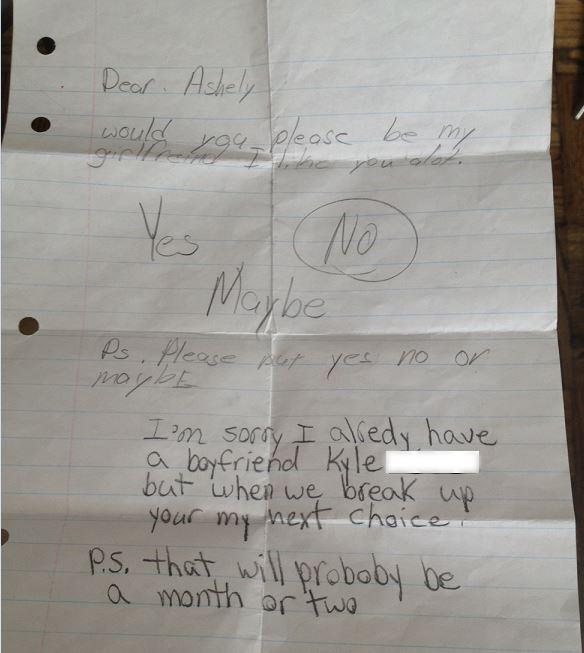
Below is a very cute note capturing the innocence of Elementary school.

note

Click on the link to read What Age Should Children Start School At?

Click on the link to read Fun Facts about Children

Click on the link to read Teaching Children to be Honest Yet Respectful

Click on the link to read The Children of Today Show a Lack of Respect For Authority

Click on the link to read Is There Anything Better than an Inspirational Child? (Video)

What Age Should Children Start School At?

September 12, 2013


bell


Prolonging the commencement of school by 2 years is a nonsense. There is nothing wrong with the current system when it comes to the school age requirement. However, there is a great deal wrong with the system when it comes to helping support children through the transition and developing an environment which is just as determined to boost a child’s sense of self as it is their grade average. Better they work on reinvigorating the current system instead of changing it radically:

Children should not start primary school until they are six or seven-years-old, according to a coalition of education experts who warn of the damaging pressure to perform in class at a young age.

A letter written by 130 teachers, academics and authors said the UK should follow the Scandinavian model and put off formal lessons for two years.

Under the UK’s current system, children start full-time schooling at the age of four or five.

Experts say this is causing ‘profound damage’ in a generation which is not encouraged to learn through play.

But the call was last night dismissed by as ‘misguided’ by a spokesman for the Education Secretary Michael Gove.

Children in the UK are obliged by law to be in school aged five, which the lobby group said is creating a ‘too much, too soon’ culture.

The warning singled out recent government proposals which mean five year olds could be formally tested from the beginning of their schooling.

Under the current system, children are first assessed at the age of seven. But under Deputy Prime Minister Nick Clegg’s proposals, a ‘baseline’ test could be introduced in the first year of primary school.

The group of experts warned that monitoring a pupil’s progress from such a young age promotes stress and fear around learning.


Click on the link to read Fun Facts about Children

Click on the link to read Teaching Children to be Honest Yet Respectful

Click on the link to read The Children of Today Show a Lack of Respect For Authority

Click on the link to read Is There Anything Better than an Inspirational Child? (Video)

Fun Facts about Children

August 15, 2013


cat

Courtesy of 10-facts-about.com:

Fact 1:
The average age children begin to use a microwave is seven.

Fact 2:
A 3-year old Boy’s voice is louder than 200 adults in a crowded restaurant.

Fact 3:
Fathers tend to determine the height of their child, mothers their weight.

Fact 4:
On average, a 4-year-old child asks 437 questions a day.

Fact 5:
Watching television can act as a natural painkiller for children.

Fact 6:
In ancient Greece, children of wealthy families were dipped in olive oil at birth to keep them hairless throughout their lives.

Fact 7:
The great pharaoh Ramses II who fathered over 160 children.

Fact 8:
Children’s kneecaps only start to turn bony at 3 years of age, until that they are made of cartilage.

Fact 9:
Both boys and girls in 1600s England and New England wore dresses until they were about seven years old.

Fact 10:
Children under the age of six are at the greatest risk for crushing or burning injuries of the hand.

Click on the link to read Teaching Perfectionists

I Bet this Guy Used to Lose his Notebooks

August 12, 2013


http://www.youtube.com/watch?v=NRa4FYc98LY


My students are notorious for losing their jumpers, hats, pencils and notebooks. Sometimes I wonder what they will be like when they grow up. I hope they don’t end up losing their wedding ring in a river:

The jubilant moment a relieved groom found his wedding ring after he lost it in a river has been captured on camera.

Richard Ford’s cherished platinum band slipped off his finger while he was paddleboarding with a group of friends along the River Tame, in Tamworth, Staffordshire, on July 14.

The 30-year-old, from Tamworth, who got married last August to primary school teacher Jen, also 30, only discovered the ring was missing when he had travelled half-a-mile down the river.

Richard and his friends then spent 24 hours scouring the bottom of the river bed to try and find it.

Richard, a joiner, explained said: ‘We were on the river when I realised it was missing. I was devastated – I’m not into jewellery, but it is so special to me, it felt like I had lost part of my soul.


ring1

Who Needs the Right Answer When You Can Think Like a Child

July 11, 2013


The clip above demonstrates more than just cuteness. It captures children who are not yet interested in wealth, answer with creativity and insight and are not afraid of being wrong. You ask those same questions to teenagers and you will possibly find cynicism and insecurity on show.

Cuteness has a short shelf life but confidence is of eternal significance. We must help our young maintain their confidence and creativity long after their ‘cute’ period is behind them.

Click on the link to read Teaching Perfectionists
Click on the link to read Teaching Children to be Honest Yet Respectful
Click on the link to read The Children of Today Show a Lack of Respect For Authority
Click on the link to read Our Real Heroes are Not Celebrities or Athletes

Girls’ School Fights Perfectionism by Rigging Tests

June 25, 2013

test

I believe that perfectionism can be quite debilitating because it deprives its subject the ability to take pleasure from their achievements. However, the way to counter perfectionism isn’t by preventing children from getting a perfect score on a test, it’s by making them feel good about who they are and comfortable that their best is more important than their score:

Girls at a leading private school are being made to sit tests in which it is impossible to score 100 per cent, so they understand it is acceptable not to be ‘little Miss Perfect’.

Oxford High School for Girls has designed the online maths tests to show pupils it is ‘fine not to get everything right’.

In the exam, for pupils aged 11, the questions will get harder and harder until the girl reaches the top of her ability. She will then be given questions she cannot answer.

The test could be rolled out to other schools if it is successful at the £12,000-a-year day school where 92 per cent of students scored A* or A at GCSE last year.

Chief executive of the Girls’ Day School Trust Helen Fraser told The Sunday Times the idea would help girls understand that ‘being perfect is the enemy of learning’.

Education expert Professor Alan Smithers, of the University of Buckingham, said the tests should be extended to boys as well. 

He told the Daily Telegraph: ‘Tough tests for both boys and girls to really challenge them are a good idea, and it is good to have questions that only very few – or perhaps none – can answer.

‘The tougher the question, the more children are likely to develop to meet them, and a by–product of that may be that children learn that you can’t succeed in everything and if you fail, the rational thing to do is ask why.’

How does creating a new perfect, as this system forces perfectionists to do, actually change their way of thinking? Surely the key is not to con them into an error but to help them gain satisfaction from their hard work.

Click on the link to read Lego Blamed for Harming Children’s Development

Did I Read Right? TV Good for Schoolwork?

June 23, 2013


tv

I can’t see how excessive TV watching could possibly improve a child’s schoolwork. It certainly doesn’t do anything for the quality of my report writing:

Parents have for years rationed the amount of television their children can watch in the belief that too much will scramble their offspring’s brains.

Now a study suggests the opposite is true – that children who are glued to the screen for hours a day can significantly outperform classmates who watch considerably less.

It also found that other family rules imposed by parents hoping to boost their children’s academic prowess, such as insisting on regular bed or meal times, make only a relatively small difference.

While TV has been consistently blamed for diminishing children’s brain power, University of London academics found those who watched three or more hours a day were three months ahead of those who watched less than an hour a day.

The report’s lead author Dr Alice Sullivan, senior academic at the university’s Institute of Education, admitted the results, particularly those regarding television, were ‘contrary to expectations’.

She added that the educational value of children’s television had been ‘underestimated’. ‘It may also help expose some children to a broader vocabulary than they get at home,’ Dr Sullivan said.

Their findings were part of an  analysis that set out to examine claims made by politicians, including David Cameron, and others that parenting skills were more important than social background in determining how well children do at school and in later life.

Lego Blamed for Harming Children’s Development

June 13, 2013

lego

I’ve heard it all! Lego, an invention which has been an incredible educational and creative mainstay of children’s lives, is being blamed for the very thing it excels in – aiding child development:

THE faces on Lego toys are getting angrier- and it may be harming children’s development, researchers warn.

The number of happy faces on Legos is decreasing, and more angry faces are taking their place, research by Christopher Barneck of New Zealand’s University of Canterbury’s has found.

Dr Barneck studied all the 6000 figures offered by the iconic Danish toy company, including Harry Potter and pirate-themed toys, and says they are increasingly angry and based on conflict – with potentially harmful effects on children’s play and development.

Lego started introducing a greater range of faces in the 1990s, but “happiness and anger seem to be the most frequent emotional expressions,” he found.

“We cannot help but wonder how the move from only positive faces to an increasing number of negative faces impacts on how children play.”

Legos are also increasingly based on conflicts, “often a good force is struggling with a bad one,” he found.

“Designers of toy faces should take great care to design the expressions and to test their effect since toys play an important role in the development of children,” says Dr Bartneck, who is acting head of the university’s Human Interface Technology Lab, which studies how design and technology impact users.

Click on the link to read Teaching Children to be Honest Yet Respectful
Click on the link to read The Children of Today Show a Lack of Respect For Authority
Click on the link to read Is There Anything Better than an Inspirational Child? (Video)Click on the link to read Instead of Teaching a Baby to Read, Teach it to Smile